Page 262 of 317
CONT INUED
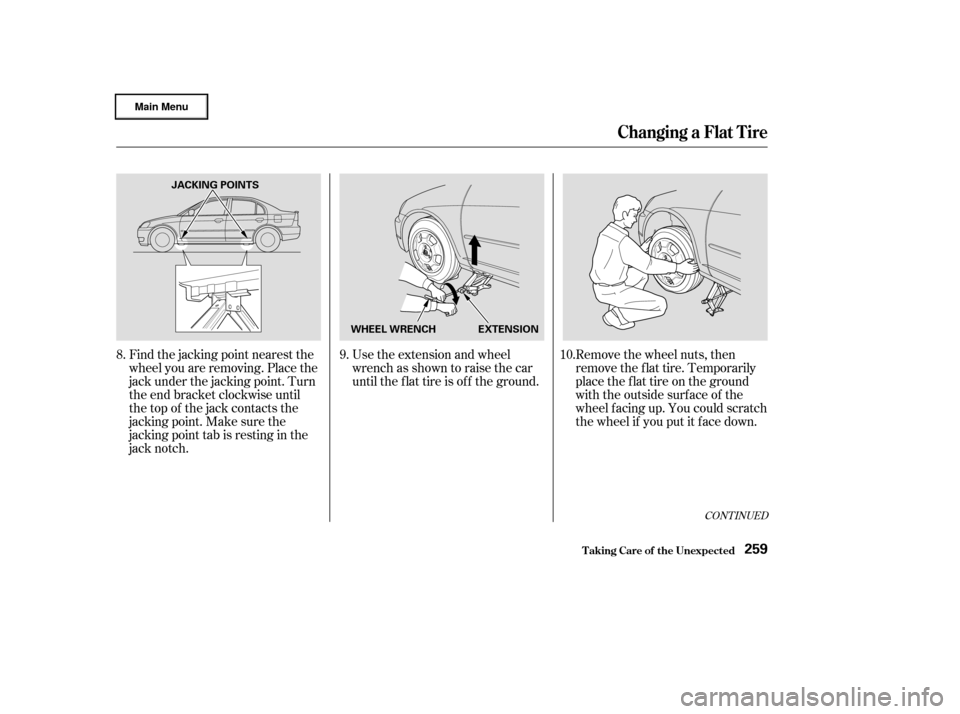
Use the extension and wheel
wrench as shown to raise the car
until the f lat tire is of f the ground.
Find the jacking point nearest the
wheel you are removing. Place the
jack under the jacking point. Turn
the end bracket clockwise until
the top of the jack contacts the
jacking point. Make sure the
jacking point tab is resting in the
jack notch. Remove the wheel nuts, then
remove the f lat tire. Temporarily
place the f lat tire on the ground
with the outside surface of the
wheel f acing up. You could scratch
the wheel if you put it f ace down.
9.
8. 10.
Changing a Flat T ire
T aking Care of t he Unexpect ed259
JACKING POINTS
WHEEL WRENCH EXTENSION
Page 265 of 317
Store the jack in the trunk with the
end bracket on the lef t side. Turn
the jack’s end bracket to lock it in
place. Store the tool kit.Lower the trunk f loor and trunk
floor mat, then close the trunk lid. Store the center cap in the trunk.
Make sure it does not get scratch-
ed or damaged.
18.
19.
20.
Changing a Flat T ire
T aking Care of t he Unexpect ed262
Loose items can fly around the
interior in a crash and could
seriously injure the occupants.
Store the wheel, jack, and tools
securely before driving.
Page 266 of 317

Diagnosing why your engine won’t
start f alls into two areas, depending
on what you hear when you turn the
key to START (III):When you turn the ignition switch to
START (III), you do not hear the
normal noise of the engine trying to
start. You may hear a clicking sound
or series of clicks, or nothing at all.
Check these things:
You hear nothing, or almost
nothing. The engine’s starter
motor does not operate at all, or
operates very slowly.
You can hear the starter motor
operating normally, or the starter
motor sounds like it is spinning
f aster than normal, but the engine
does not start up and run. Check the transmission interlock.
If you have a manual transmission,
the clutch pedal must be pushed
all the way to the f loor or the
starter will not operate. With an
automatic transmission, it must be
in Park or Neutral.
Turn the ignition switch to ON (II).
Turn on the headlights and check
their brightness. If the headlights
are very dim or don’t light at all,
the battery is discharged. See
on page . Turn the ignition switch to START
(III). If the headlights do not dim,
check the condition of the f uses. If
the f uses are OK, there is proba-
bly something wrong with the
electrical circuit f or the ignition
switch or starter motor. You will
need a qualif ied technician to
determine the problem. (See
on page .)
If the headlights dim noticeably or
go out when you try to start the
engine, either the battery is dis-
charged or the connections are
corroded. Check the condition of
the battery and terminal connec-
tions (see page ). You can
then try jump starting the car from
a booster battery (see page ).
265 282
216 265
CONT INUED
Nothing Happens or the Starter
Motor Operates Very Slowly
Jump Starting Emergency T owing
If Your Engine Won’t Start
T aking Care of t he Unexpect ed263
Page 273 of 317

Using gloves or a large heavy
cloth, turn the radiator cap
counterclockwise, without pushing
down, to the f irst stop. This
releases any remaining pressure in
the cooling system. After the
pressure releases, push down on
the cap and turn it until it comes
off.
Start the engine and set the
temperature control dial to
maximum. Add coolant to the
radiator up to the base of the f iller
neck. If you do not have the
proper coolant mixture available,
you can add plain water.
Remember to have the cooling
system drained and ref illed with
the proper mixture as soon as you
can.Put the radiator cap back on
tightly. Run the engine and watch
the temperature gauge. If it goes
back to the red mark, the engine
needs repair. (See
on page .)
If the temperature stays normal,
check the coolant level in the
radiator reserve tank. If it has
gone down, add coolant to the
MAX mark. Put the cap back on
tightly.
9.
10. 11.
12.
282
T aking Care of t he Unexpect ed
If Your Engine Overheats
Emergency
Towing
270
Page 280 of 317
Check each of the large f uses in
the under-hood f use box by
looking through the top at the wire
inside. Removing these f uses
requires a Phillips-head screw-
driver.
If something electrical in your car
stops working, the f irst thing you
should check f or is a blown f use.
Determine f rom the chart on pages
and , or the diagram on the
fuse box lid, which fuse or fuses
control that component. Check those
f uses f irst, but check all the f uses
bef ore deciding that a blown f use is
not the cause. Replace any blown
f uses and check the component’s
operation.
Turn the ignition switch to LOCK
(0). Make sure the headlights and
all other accessories are off.
Remove the cover f rom the f use
box.
The interior f use box is underneath
the steering column. To open it, turn
the knobs as shown.
3.
1.
2. 281
280
CONT INUED
Checking and Replacing Fuses
Fuses
T aking Care of t he Unexpect ed277
INTERIOR
FUSE
BLOWN
Page 282 of 317
CONT INUED
If the replacement fuse of the
same rating blows in a short time,
there is probably a serious
electrical problem in your car.
Leave the blown fuse in that
circuit and have your car checked
by a qualif ied mechanic.
When the audio system is disabled,
the clock setting in the audio system
will be canceled. You will need to
reset the clock according to the
instructions in the audio system
sectiononthisowner’smanual. If the radio f use is removed, the
audio system will disable itself . The
nexttimeyouturnontheradioyou
will see ‘‘ ’’ in the f requency
display. Use the Preset buttons to
enter the f ive-digit code (see page ).
6.
137
Fuses
T aking Care of t he Unexpect ed279
Replacing a f use with one that has a
higher rating greatly increases the
chances of damaging the electrical
system. If you do not have a replace-
ment f use with the proper rating f or the
circuit, install one with a lower rating.
Page 283 of 317
�µ�µ
No.Circuits Protected
Amps.
Circuits Protected
Amps.
No.
1
2
3
4
5
6
7
8
9
10
11
12
13
14
15
16
17
18
19
20 Condenser Fan
IMA
Small Light
Cooling Fan
Hazard
FI ECU
Horn, Stop
ABS F/S
Back Up
ABS Motor
Rear Defroster
Heater Motor
Power Window
Option
Lef t Headlight
Door Lock
Right Headlight
EPS
Battery
Ignition 1
Spare Fuses
20 A
10 A
10 A
20 A
10 A
15 A
15 A
20 A
10 A
40 A
30 A
40 A
40 A
40 A
15 A
20 A
15 A
60 A
80 A
50 A
Cooling Fan
20 A1
21 257.5A 30A
T aking Care of t he Unexpect ed
Fuses
280
UNDER-HOOD AND SECONDARY FUSE BOXES
Page 286 of 317
If you decide to tow your car with all
f our wheels on the ground, make
sure you use a properly-designed and
attached tow bar. Prepare the car for
towing as described above, and leave
the ignition switch in Accessory (I)
so the steering wheel does not lock.
Make sure the radio and any items
plugged into the accessory power
socket are turned of f so they do not
rundownthebattery.
With the f ront wheels on the ground,
it is best to tow the car no farther
than 50 miles (80 km), and keep the
speedbelow35mph(55km/h).
If your car is equipped with a f ront
spoiler, remove it bef ore towing so it
is not damaged.
Emergency T owing
T aking Care of t he Unexpect ed283
Trying to lif t or tow your car by the
bumpers will cause serious damage.
The bumpers are not designed to
support the car’s weight.
The steering system can be damaged if
the steering wheel is locked. Leave the
ignition switch in Accessory (I), and
make sure the steering wheel turns
f reely bef ore you begin towing.