Page 102 of 240
In a rollover crash, an unbelted person is significantly more likely
to die than a person wearing a seat belt.
Each seating position in your vehicle has a specific safety belt
assembly which is made up of one buckle and one tongue that
are designed to be used as a pair. 1) Use the shoulder belt on the
outside shoulder only. Never wear the shoulder belt under the arm.
2) Never swing the safety belt around your neck over the inside
shoulder. 3) Never use a single belt for more than one person.
Always transport children 12 years old and under in the back
seat and always properly use appropriate child restraints.
Combination lap and shoulder belts
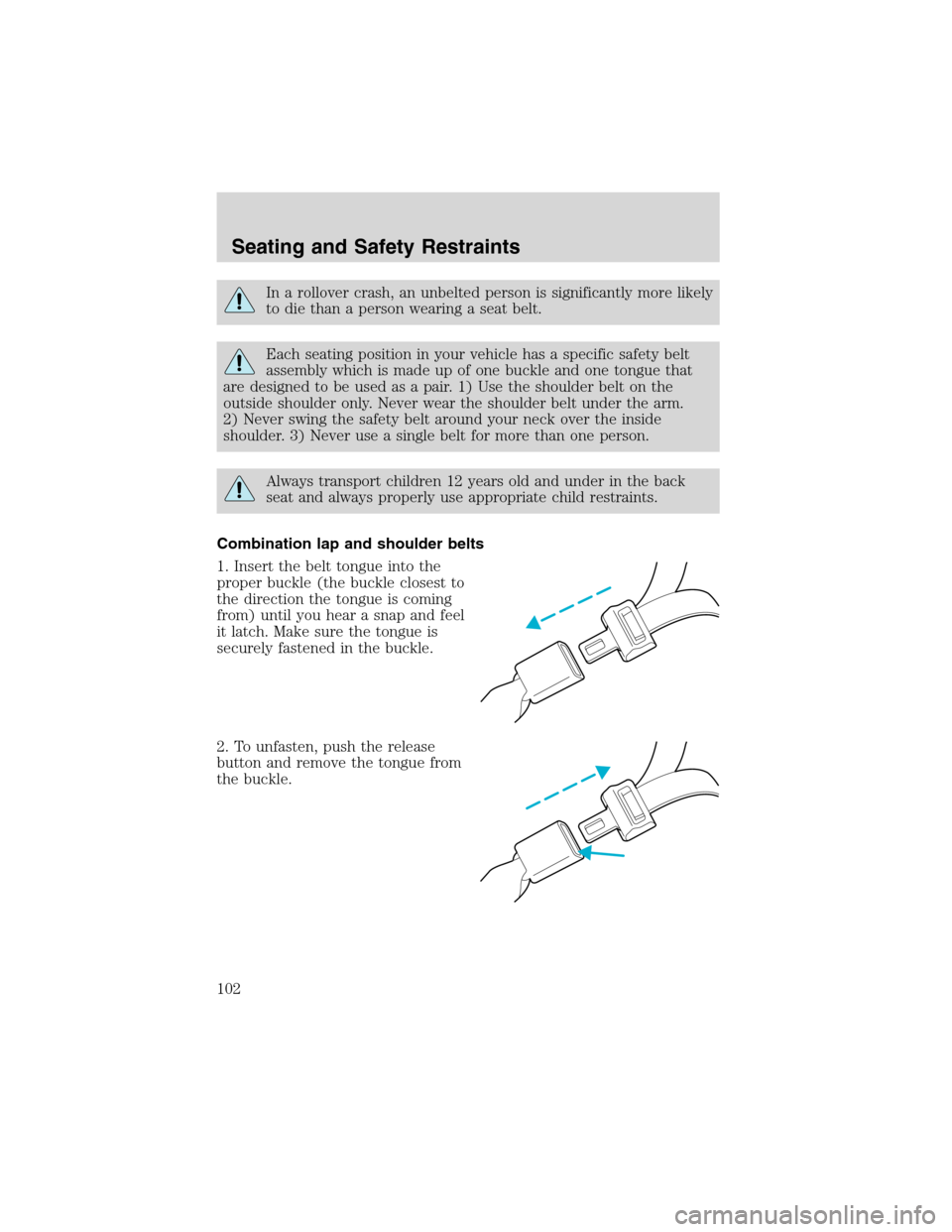
1. Insert the belt tongue into the
proper buckle (the buckle closest to
the direction the tongue is coming
from) until you hear a snap and feel
it latch. Make sure the tongue is
securely fastened in the buckle.
2. To unfasten, push the release
button and remove the tongue from
the buckle.
Seating and Safety Restraints
102
Page 103 of 240
The front and rear outboard safety restraints in the vehicle are
combination lap and shoulder belts. The front and rear seat passenger
outboard safety belts have locking cinch tongues described below:
Safety belts with locking cinch tongue
The locking cinch tongue will slide up and down the belt webbing when
the belt is in the stowed position or while putting seat belts on. When
the locking cinch tongue of the lap/shoulder combination seat belt is
latched into the buckle, the cinch tongue will allow the lap portion to
become shorter, but locks the webbing in place to restrict it from
becoming longer.
Before you can reach and latch a combination lap and shoulder belt
having a cinch tongue into the buckle, you may have to lengthen the lap
belt portion of it.
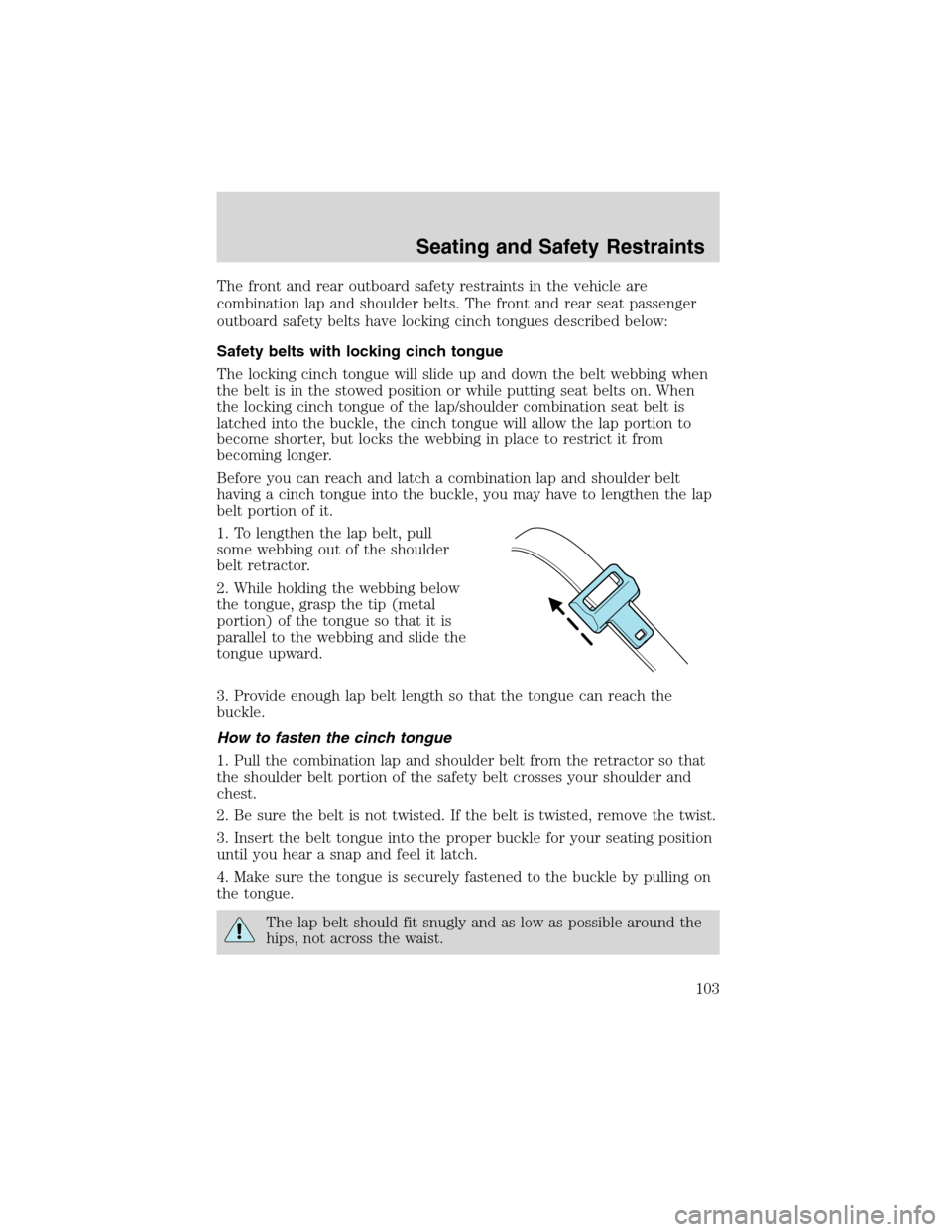
1. To lengthen the lap belt, pull
some webbing out of the shoulder
belt retractor.
2. While holding the webbing below
the tongue, grasp the tip (metal
portion) of the tongue so that it is
parallel to the webbing and slide the
tongue upward.
3. Provide enough lap belt length so that the tongue can reach the
buckle.
How to fasten the cinch tongue
1. Pull the combination lap and shoulder belt from the retractor so that
the shoulder belt portion of the safety belt crosses your shoulder and
chest.
2. Be sure the belt is not twisted. If the belt is twisted, remove the twist.
3. Insert the belt tongue into the proper buckle for your seating position
until you hear a snap and feel it latch.
4. Make sure the tongue is securely fastened to the buckle by pulling on
the tongue.
The lap belt should fit snugly and as low as possible around the
hips, not across the waist.
Seating and Safety Restraints
103
Page 121 of 240
SAFETY SEATS FOR CHILDREN
Child and infant or child safety seats
Use a safety seat that is recommended for the size and weight of the
child. Carefully follow all of the manufacturer’s instructions with the
safety seat you put in your vehicle. If you do not install and use the
safety seat properly, the child may be injured in a sudden stop or
collision.
When installing a child safety seat:
•Review and follow the information
presented in theAir Bag
Supplemental Restraint System
section in this chapter.
•Use the correct safety belt buckle
for that seating position.
•Insert the belt tongue into the
proper buckle until you hear a
snap and feel it latch. Make sure
the tongue is securely fastened in
the buckle.
•Keep the buckle release button
pointing up and away from the
safety seat, with the tongue
between the child seat and the
release button, to prevent
accidental unbuckling.
•Place seat back in upright position.
Ford recommends the use of a child safety seat having a top tether
strap. Install the child safety seat in a seating position which is capable
Seating and Safety Restraints
121
Page 123 of 240
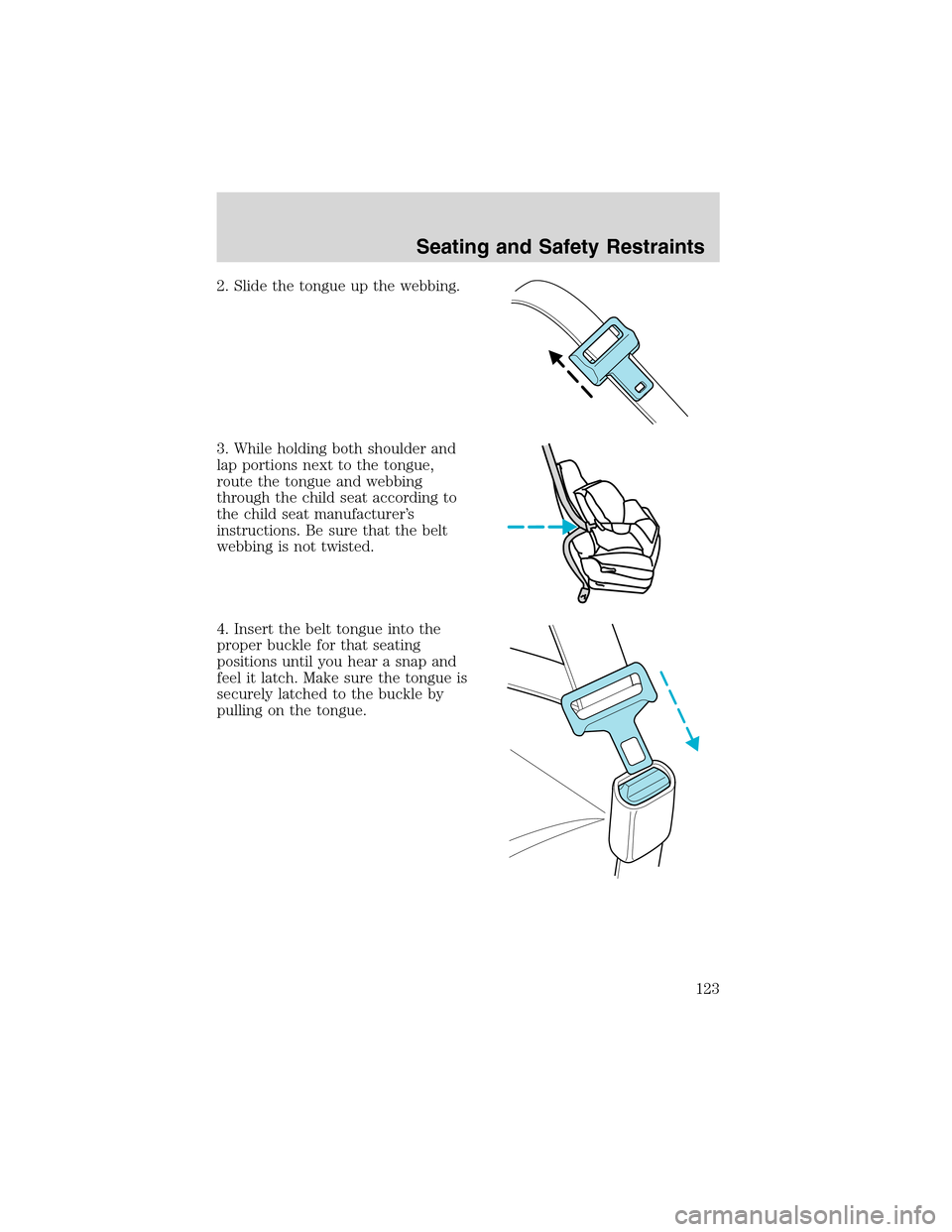
2. Slide the tongue up the webbing.
3. While holding both shoulder and
lap portions next to the tongue,
route the tongue and webbing
through the child seat according to
the child seat manufacturer’s
instructions. Be sure that the belt
webbing is not twisted.
4. Insert the belt tongue into the
proper buckle for that seating
positions until you hear a snap and
feel it latch. Make sure the tongue is
securely latched to the buckle by
pulling on the tongue.
Seating and Safety Restraints
123
Page 124 of 240
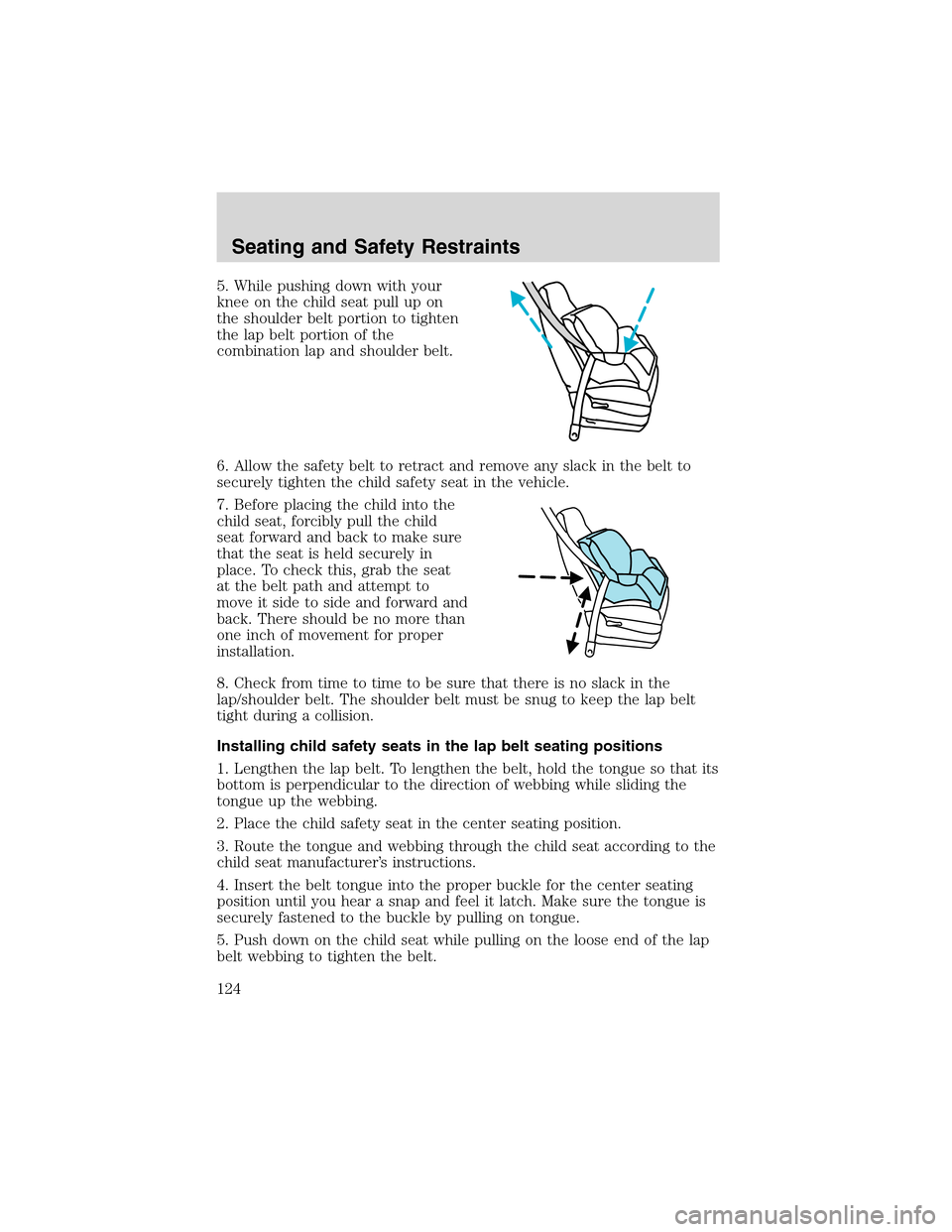
5. While pushing down with your
knee on the child seat pull up on
the shoulder belt portion to tighten
the lap belt portion of the
combination lap and shoulder belt.
6. Allow the safety belt to retract and remove any slack in the belt to
securely tighten the child safety seat in the vehicle.
7. Before placing the child into the
child seat, forcibly pull the child
seat forward and back to make sure
that the seat is held securely in
place. To check this, grab the seat
at the belt path and attempt to
move it side to side and forward and
back. There should be no more than
one inch of movement for proper
installation.
8. Check from time to time to be sure that there is no slack in the
lap/shoulder belt. The shoulder belt must be snug to keep the lap belt
tight during a collision.
Installing child safety seats in the lap belt seating positions
1. Lengthen the lap belt. To lengthen the belt, hold the tongue so that its
bottom is perpendicular to the direction of webbing while sliding the
tongue up the webbing.
2. Place the child safety seat in the center seating position.
3. Route the tongue and webbing through the child seat according to the
child seat manufacturer’s instructions.
4. Insert the belt tongue into the proper buckle for the center seating
position until you hear a snap and feel it latch. Make sure the tongue is
securely fastened to the buckle by pulling on tongue.
5. Push down on the child seat while pulling on the loose end of the lap
belt webbing to tighten the belt.
Seating and Safety Restraints
124
Page 125 of 240
6. Before placing the child into the child seat, forcibly tilt the child seat
from side to side and in forward direction to make sure that the seat is
securely held in place. To check this, grab the seat at the belt path and
attempt to move it side to side and forward and back. There should be
no more than one inch of movement for proper installation.
Attaching child safety seats with tether straps
Most new forward-facing child safety seats include a tether strap which
goes over the back of the seat and hooks to an anchoring point. Tether
straps are available as an accessory for many older safety seats. Contact
the manufacturer of your child seat for information about ordering a
tether strap.
Children should be placed in the rear in an appropriate child
safety seat that is properly secured to the vehicle.
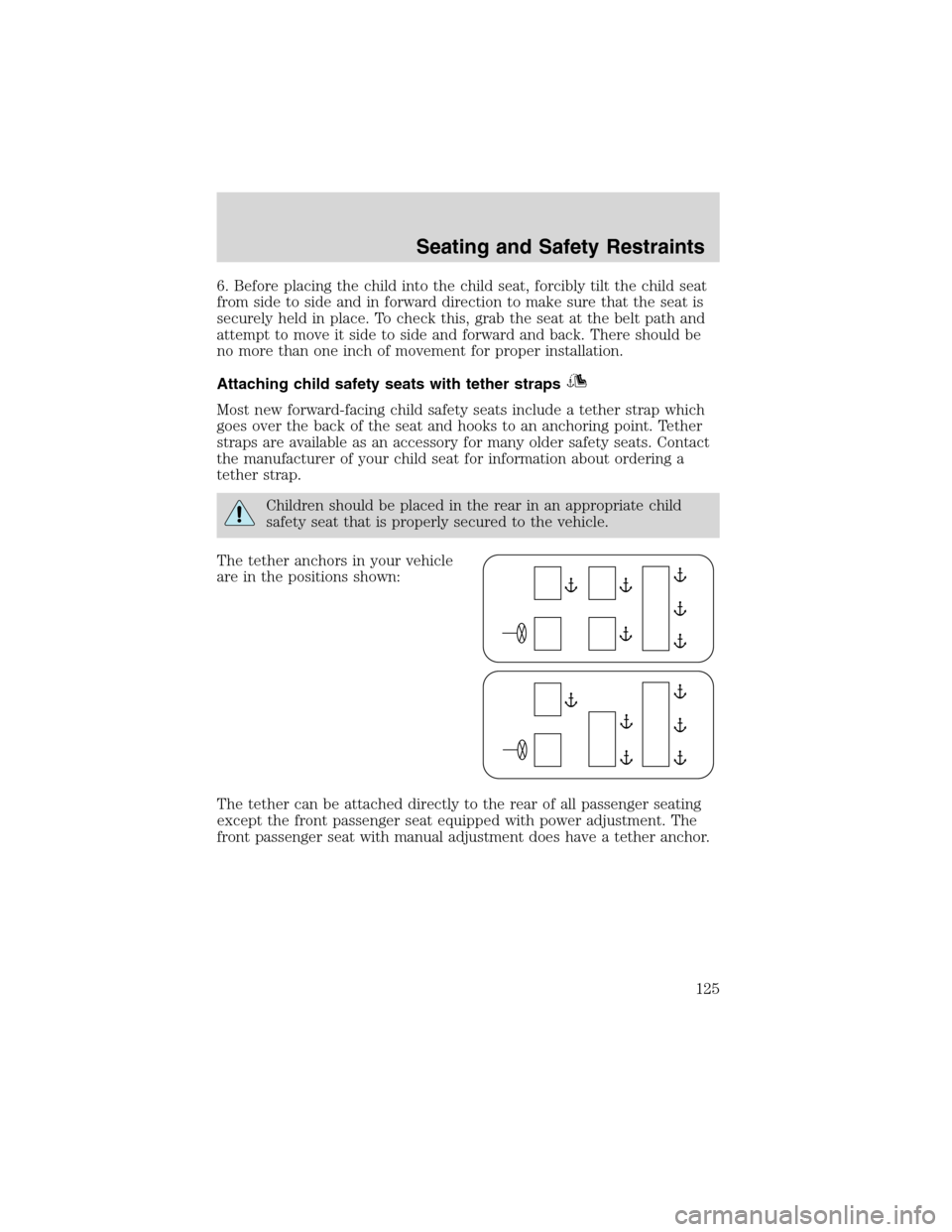
The tether anchors in your vehicle
are in the positions shown:
The tether can be attached directly to the rear of all passenger seating
except the front passenger seat equipped with power adjustment. The
front passenger seat with manual adjustment does have a tether anchor.
Seating and Safety Restraints
125
Page 127 of 240
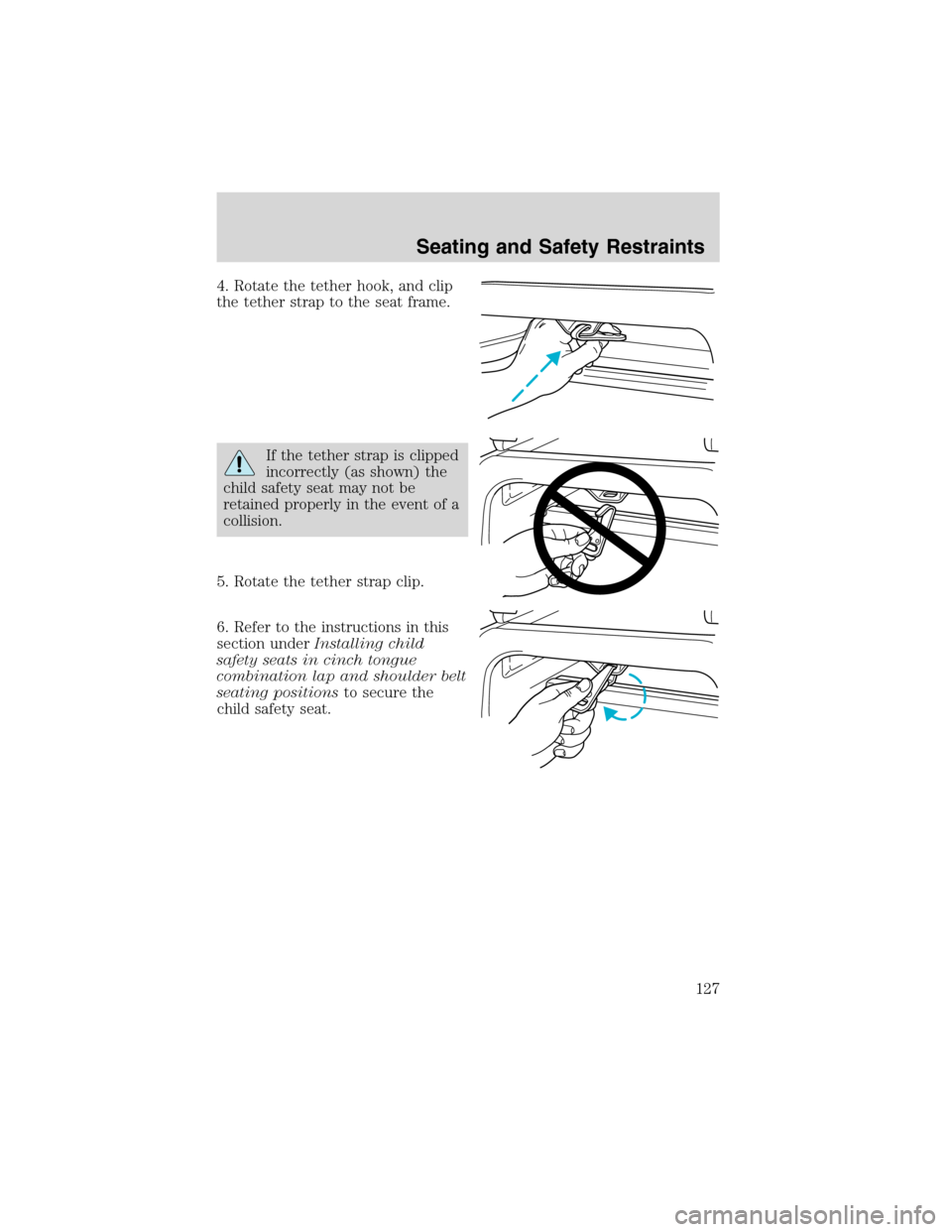
4. Rotate the tether hook, and clip
the tether strap to the seat frame.
If the tether strap is clipped
incorrectly (as shown) the
child safety seat may not be
retained properly in the event of a
collision.
5. Rotate the tether strap clip.
6. Refer to the instructions in this
section underInstalling child
safety seats in cinch tongue
combination lap and shoulder belt
seating positionsto secure the
child safety seat.
Seating and Safety Restraints
127
Page 135 of 240
brake pedal pulsation may be observed during ABS braking; any
pulsations or mechanical noise you may feel or hear is normal.
ABS warning lamp
ABS
TheABSlamp in the instrument cluster momentarily illuminates when
the ignition is turned to ON. If the light does not illuminate during start
up, remains on or flashes, the ABS may be disabled and the ABS may
need to be serviced.
Even when the ABS is disabled,
normal braking is still effective. (If
your BRAKE warning lamp
illuminates with the parking brake
released, have your brake system serviced immediately.)
Using ABS
When hard braking is required, apply continuous force on the brake
pedal; do not pump the brake pedal since this will reduce the
effectiveness of the ABS and will increase your vehicle’s stopping
distance. The ABS will be activated immediately, allowing you to retain
full steering control during hard braking and on slippery surfaces.
However, the ABS does not decrease stopping distance.
Parking brake
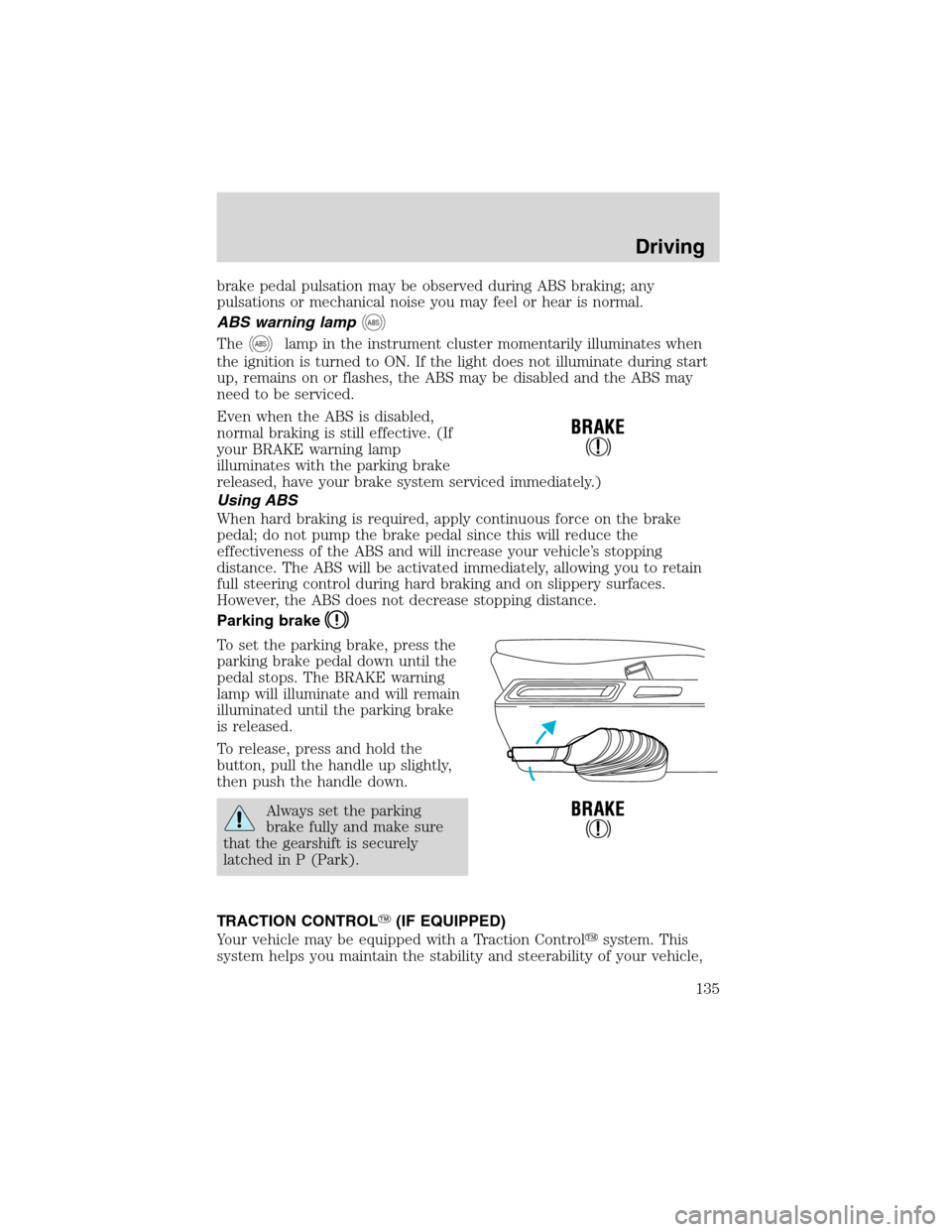
To set the parking brake, press the
parking brake pedal down until the
pedal stops. The BRAKE warning
lamp will illuminate and will remain
illuminated until the parking brake
is released.
To release, press and hold the
button, pull the handle up slightly,
then push the handle down.
Always set the parking
brake fully and make sure
that the gearshift is securely
latched in P (Park).
TRACTION CONTROL�(IF EQUIPPED)
Your vehicle may be equipped with a Traction Control�system. This
system helps you maintain the stability and steerability of your vehicle,
Driving
135