Page 8 of 64
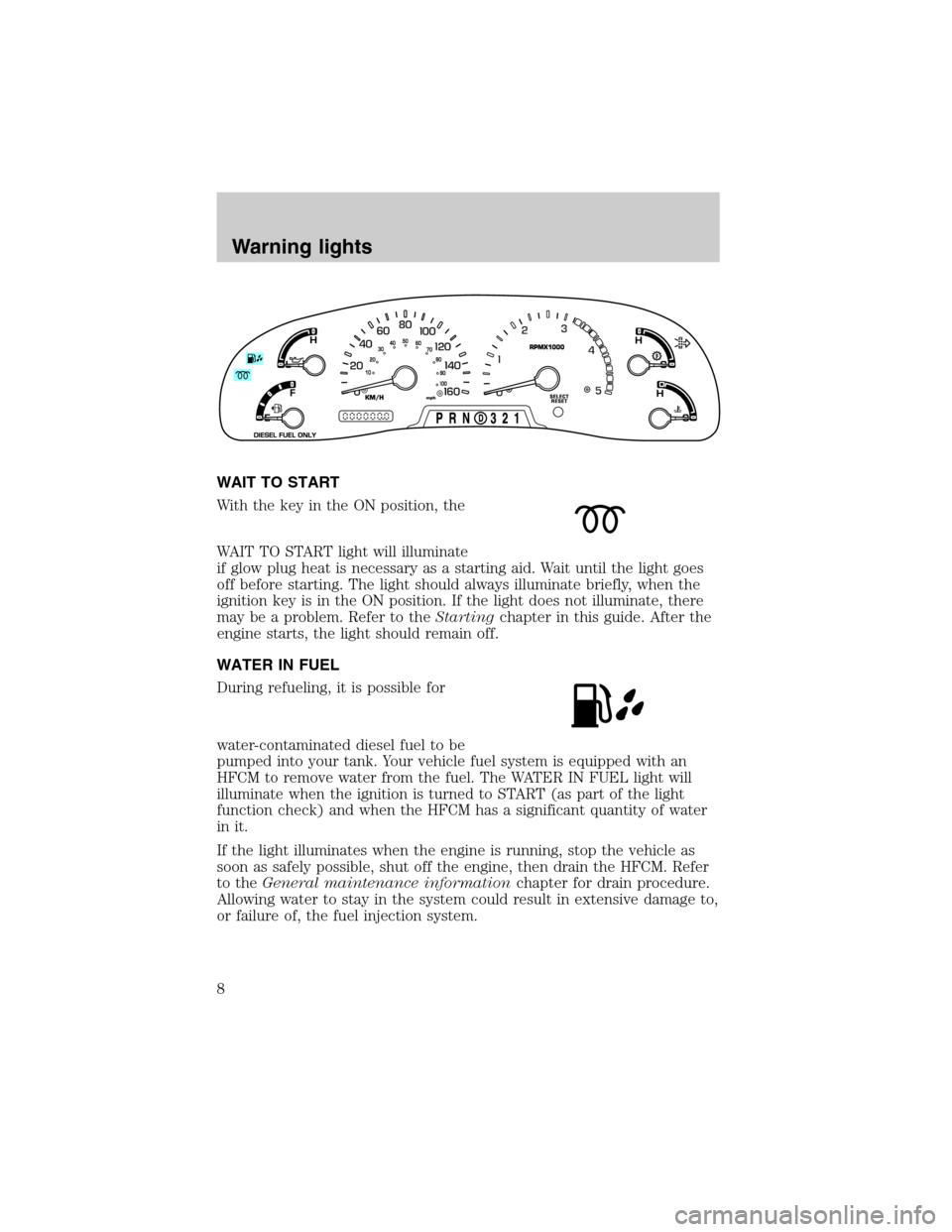
WAIT TO START
With the key in the ON position, the
WAIT TO START light will illuminate
if glow plug heat is necessary as a starting aid. Wait until the light goes
off before starting. The light should always illuminate briefly, when the
ignition key is in the ON position. If the light does not illuminate, there
may be a problem. Refer to theStartingchapter in this guide. After the
engine starts, the light should remain off.
WATER IN FUEL
During refueling, it is possible for
water-contaminated diesel fuel to be
pumped into your tank. Your vehicle fuel system is equipped with an
HFCM to remove water from the fuel. The WATER IN FUEL light will
illuminate when the ignition is turned to START (as part of the light
function check) and when the HFCM has a significant quantity of water
in it.
If the light illuminates when the engine is running, stop the vehicle as
soon as safely possible, shut off the engine, then drain the HFCM. Refer
to theGeneral maintenance informationchapter for drain procedure.
Allowing water to stay in the system could result in extensive damage to,
or failure of, the fuel injection system.
Warning lights
8
Page 11 of 64

5. After the engine starts, allow it to idle for about 15 seconds. (Do not
increase engine speed until the oil pressure gauge indicates normal
pressure.)
STOPPING THE ENGINE
Turn the ignition to OFF. To prolong engine life (after extended high
speed or maximum GVW operation), it is recommended that a hot engine
be allowed to operate at low idle for about 7–10 minutes which would
allow sufficient time for the turbocharged engine to cool down.
COLD WEATHER OPERATION
Changing to a lighter grade engine oil also makes starting easier under
these conditions. Refer toEngine oil specificationsin theGeneral
maintenance informationchapter.
At temperatures below–7°C (20°F), Number 2–D Diesel fuel may
thicken enough to clog the fuel filter. Your vehicle is equipped with an
HFCM which acts as a fuel filter/heater/water separator to keep the wax
melted which will help prevent fuel filter clogging. However, if the engine
starts but stalls after a short time and will not restart, the fuel filter(s)
may be clogged. For best results in cold weather, use Number 1–D Diesel
fuel or“winterized”Number 2–D Diesel fuel which has an additive to
minimize wax formation.
Your vehicle is also equipped with a bypass relief valve, located on the
fuel control module, which provides fuel flow to the engine if the fuel
pickup should become plugged by ice or wax. To allow this bypass valve
to function and avoid engine fuel starvation, it is recommended that,
during cold weather operation 0°C (32°F) or below, the fuel level in your
tank should not be allowed to drop below 1/4 full. This will help prevent
air from entering the fuel system and stalling the engine.
In cold weather below 0°C (32°F) your Diesel engine will slowly increase
to a higher idle speed if left idling in P (Park). As the engine warms-up,
the engine sound level will decrease due to the activation of
PCM-controlled sound reduction features.
Operation in snow
Vehicle operation in heavy snowfall or in dry loose snow that may swirl
around the front of the vehicle may feed excessive amounts of snow into
the air intake system. This could plug the air cleaner with snow and
cause the engine to stall.
Refer toAir filter restriction gaugein theDiesel informationchapter
and Engine air filter in theWarning lightschapter for more information.
Starting
11
Page 39 of 64
The complexity of the Diesel engine makes it so the owner is
discouraged from attempting to perform maintenance other than the
services described in this supplement.
If you experience difficult starting, rough idling, excessive exhaust
smoke, a decrease in engine performance or excess fuel consumption,
perform the following checks:
•a plugged air inlet system or engine air filter element.
•water in the fuel filter/water separator.
•a clogged fuel filter.
•contaminated fuel.
•air in the fuel system, due to loose connections.
•an open or pinched sensor hose.
•low engine oil level.
•wrong fuel or oil viscosity for climactic conditions.
If these checks do not help you correct the engine performance problem
you are experiencing, consult an authorized dealer.
FUELING
Do not use starting fluid such as ether or gasoline in the Diesel
air intake system. Such fluids can cause immediate explosive
damage to the engine and possible personal injury.
If you fuel your vehicle at a truck stop, you may notice that the fuel
nozzle may shut off every 5–10 seconds. This is due to the flow rates
being designed for larger heavy duty trucks. You may have to fuel at a
slower rate (don’t depress the nozzle trigger fully).
Do not run your Diesel vehicle out of fuel as this will allow air to enter
the fuel system which will make restarting difficult. Longer engine
cranking time may be required once air is in the fuel system. If air enters
the fuel system (either through running the fuel tank(s) empty or during
a fuel filter change), the engine will self-purge the trapped air once it
starts running. The engine may run roughly and produce white smoke
while air is in the fuel system; this is normal and should stop after a
short time.
Minor troubleshooting guide
39