Page 31 of 64
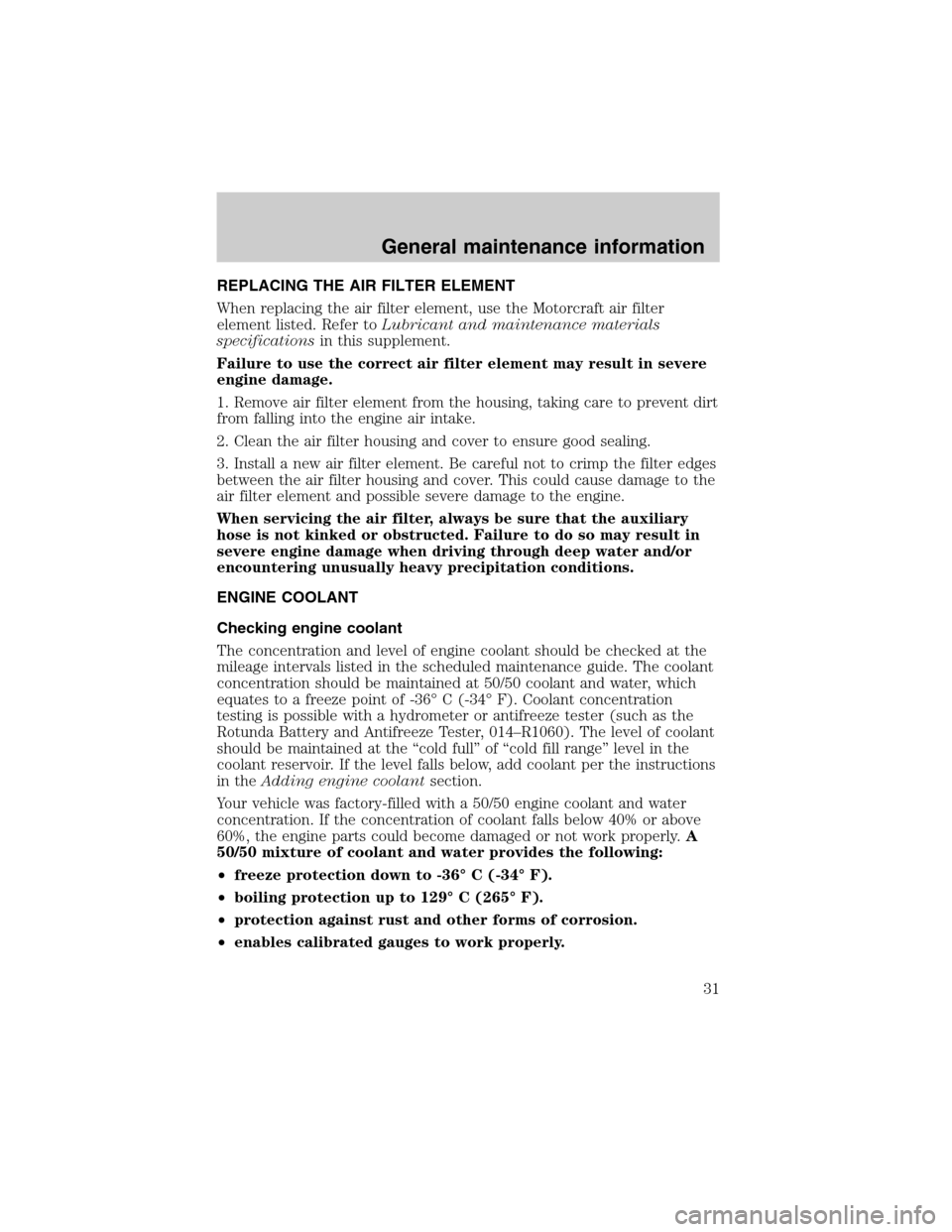
REPLACING THE AIR FILTER ELEMENT
When replacing the air filter element, use the Motorcraft air filter
element listed. Refer toLubricant and maintenance materials
specificationsin this supplement.
Failure to use the correct air filter element may result in severe
engine damage.
1. Remove air filter element from the housing, taking care to prevent dirt
from falling into the engine air intake.
2. Clean the air filter housing and cover to ensure good sealing.
3. Install a new air filter element. Be careful not to crimp the filter edges
between the air filter housing and cover. This could cause damage to the
air filter element and possible severe damage to the engine.
When servicing the air filter, always be sure that the auxiliary
hose is not kinked or obstructed. Failure to do so may result in
severe engine damage when driving through deep water and/or
encountering unusually heavy precipitation conditions.
ENGINE COOLANT
Checking engine coolant
The concentration and level of engine coolant should be checked at the
mileage intervals listed in the scheduled maintenance guide. The coolant
concentration should be maintained at 50/50 coolant and water, which
equates to a freeze point of -36°C (-34°F). Coolant concentration
testing is possible with a hydrometer or antifreeze tester (such as the
Rotunda Battery and Antifreeze Tester, 014–R1060). The level of coolant
should be maintained at the“cold full”of“cold fill range”level in the
coolant reservoir. If the level falls below, add coolant per the instructions
in theAdding engine coolantsection.
Your vehicle was factory-filled with a 50/50 engine coolant and water
concentration. If the concentration of coolant falls below 40% or above
60%, the engine parts could become damaged or not work properly.A
50/50 mixture of coolant and water provides the following:
•freeze protection down to -36°C (-34°F).
•boiling protection up to 129°C (265°F).
•protection against rust and other forms of corrosion.
•enables calibrated gauges to work properly.
General maintenance information
31
Page 40 of 64
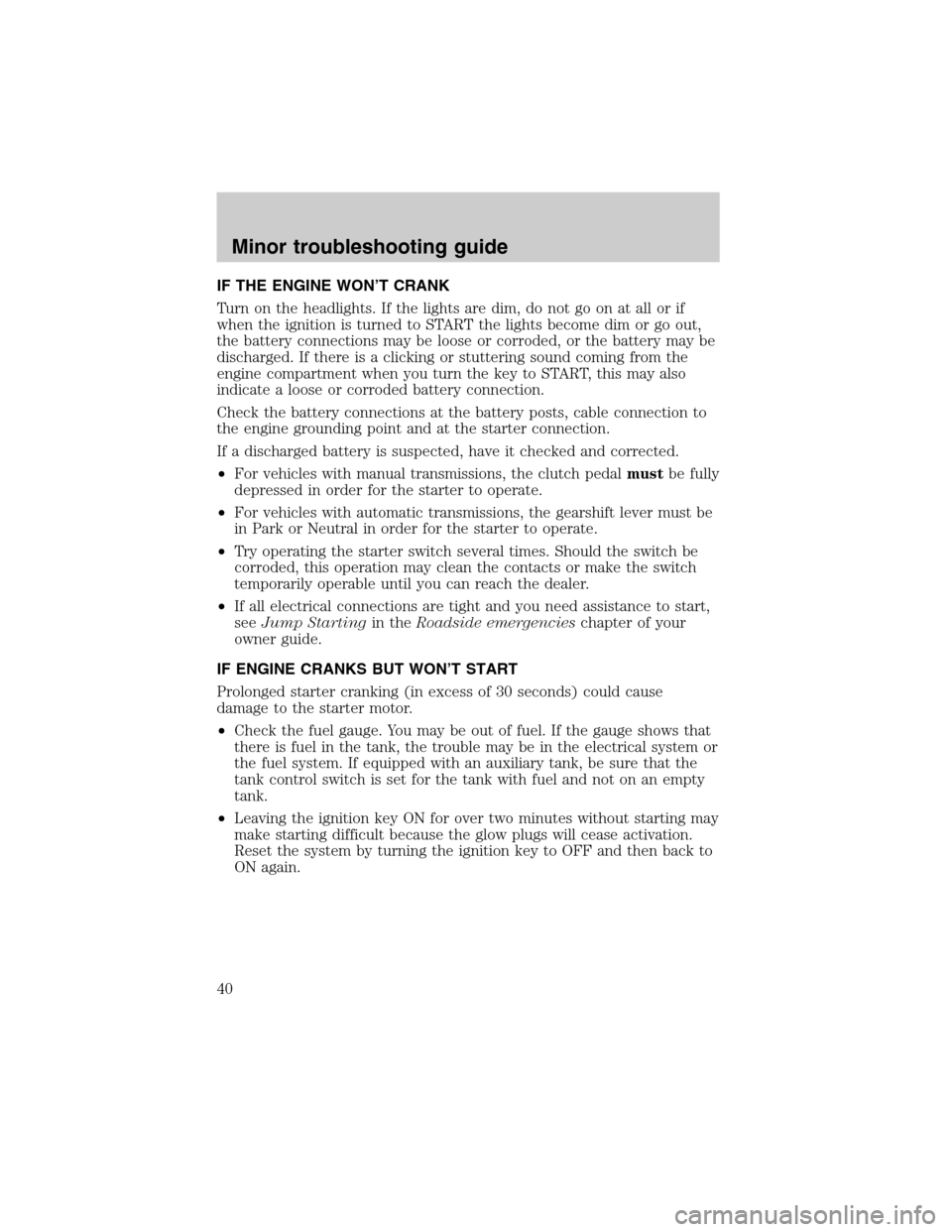
IF THE ENGINE WON’T CRANK
Turn on the headlights. If the lights are dim, do not go on at all or if
when the ignition is turned to START the lights become dim or go out,
the battery connections may be loose or corroded, or the battery may be
discharged. If there is a clicking or stuttering sound coming from the
engine compartment when you turn the key to START, this may also
indicate a loose or corroded battery connection.
Check the battery connections at the battery posts, cable connection to
the engine grounding point and at the starter connection.
If a discharged battery is suspected, have it checked and corrected.
•For vehicles with manual transmissions, the clutch pedalmustbe fully
depressed in order for the starter to operate.
•For vehicles with automatic transmissions, the gearshift lever must be
in Park or Neutral in order for the starter to operate.
•Try operating the starter switch several times. Should the switch be
corroded, this operation may clean the contacts or make the switch
temporarily operable until you can reach the dealer.
•If all electrical connections are tight and you need assistance to start,
seeJump Startingin theRoadside emergencieschapter of your
owner guide.
IF ENGINE CRANKS BUT WON’T START
Prolonged starter cranking (in excess of 30 seconds) could cause
damage to the starter motor.
•Check the fuel gauge. You may be out of fuel. If the gauge shows that
there is fuel in the tank, the trouble may be in the electrical system or
the fuel system. If equipped with an auxiliary tank, be sure that the
tank control switch is set for the tank with fuel and not on an empty
tank.
•Leaving the ignition key ON for over two minutes without starting may
make starting difficult because the glow plugs will cease activation.
Reset the system by turning the ignition key to OFF and then back to
ON again.
Minor troubleshooting guide
40
Page 43 of 64
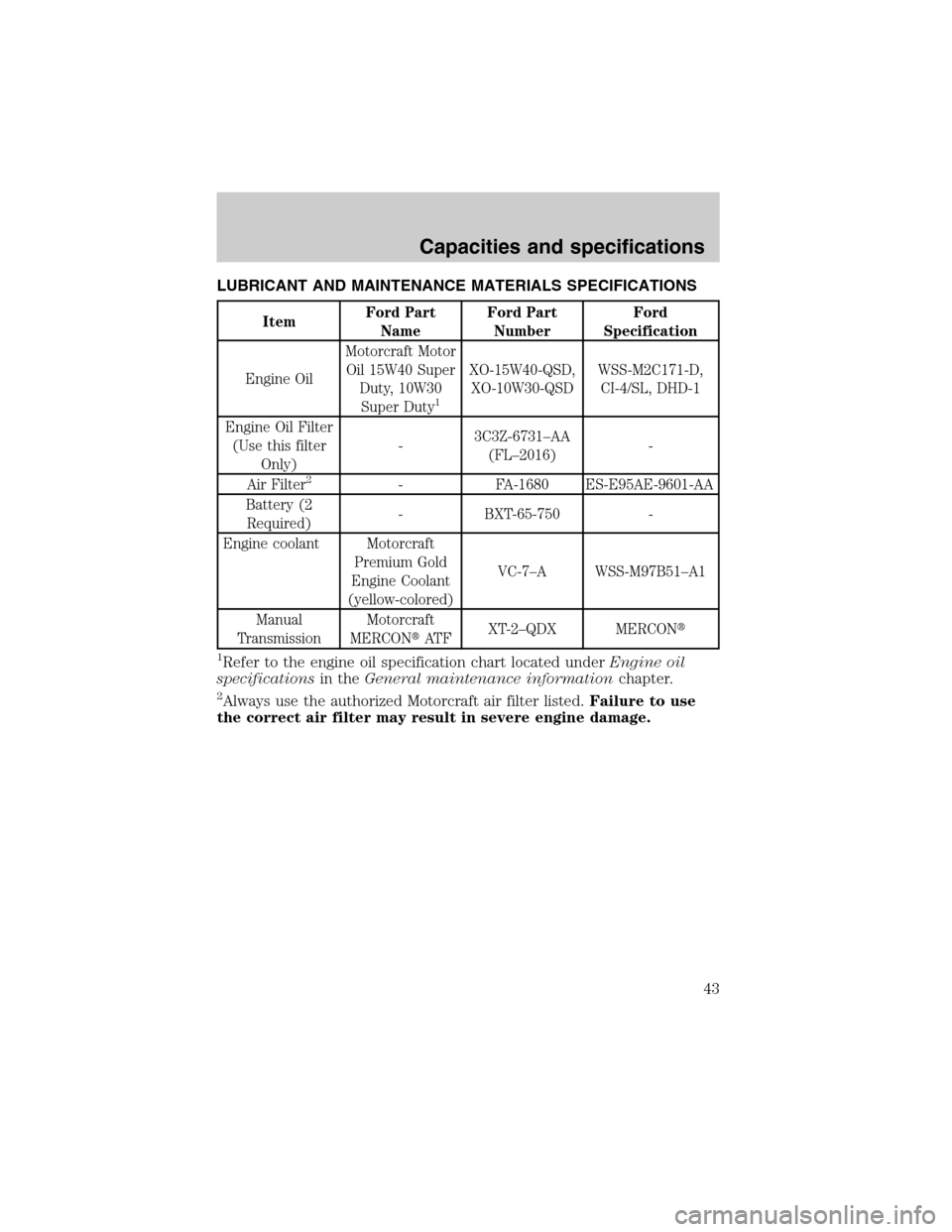
LUBRICANT AND MAINTENANCE MATERIALS SPECIFICATIONS
ItemFord Part
NameFord Part
NumberFord
Specification
Engine OilMotorcraft Motor
Oil 15W40 Super
Duty, 10W30
Super Duty
1
XO-15W40-QSD,
XO-10W30-QSDWSS-M2C171-D,
CI-4/SL, DHD-1
Engine Oil Filter
(Use this filter
Only)-3C3Z-6731–AA
(FL–2016)-
Air Filter
2- FA-1680 ES-E95AE-9601-AA
Battery (2
Required)- BXT-65-750 -
Engine coolant Motorcraft
Premium Gold
Engine Coolant
(yellow-colored)VC-7–A WSS-M97B51–A1
Manual
TransmissionMotorcraft
MERCON�AT FXT-2–QDX MERCON�
1Refer to the engine oil specification chart located underEngine oil
specificationsin theGeneral maintenance informationchapter.
2Always use the authorized Motorcraft air filter listed.Failure to use
the correct air filter may result in severe engine damage.
Capacities and specifications
43
Page 44 of 64
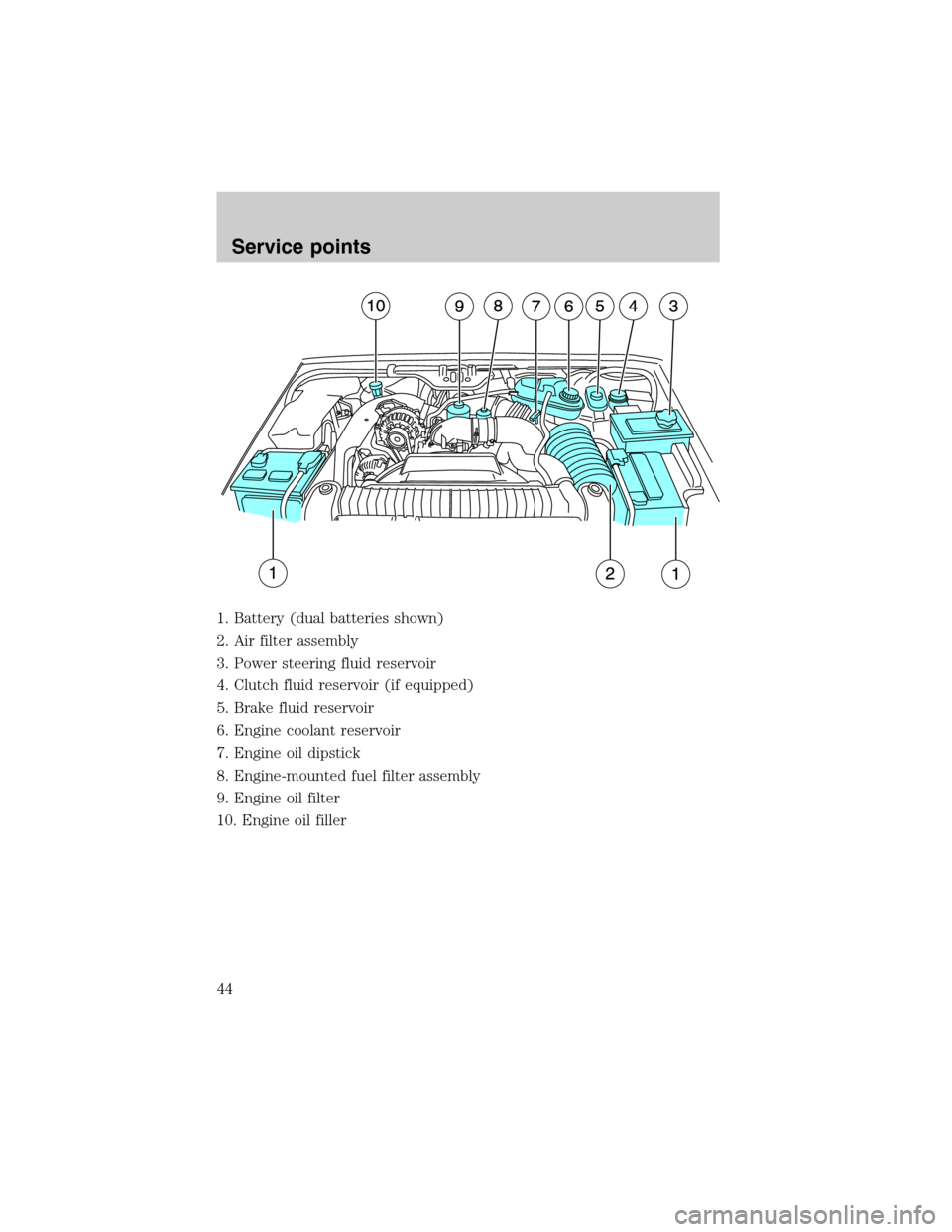
1. Battery (dual batteries shown)
2. Air filter assembly
3. Power steering fluid reservoir
4. Clutch fluid reservoir (if equipped)
5. Brake fluid reservoir
6. Engine coolant reservoir
7. Engine oil dipstick
8. Engine-mounted fuel filter assembly
9. Engine oil filter
10. Engine oil filler
Service points
44
Page 49 of 64

Any adverse condition should be brought to the attention of your dealer
or qualified service technician as soon as possible for the proper service
advice. The owner maintenance service checks are generally not covered
by warranties so you may be charged for labor, parts or lubricants used.
Maximum Oil Change Interval:
Normal Schedule: 7,500 miles or 6 months, whichever occurs first.
Special Operating Conditions: 5,000 miles or 6 months, see appropriate
schedule.
Check every month:
•Check function of all interior and exterior lights
•Check tires for wear and proper air pressure
•Check engine oil fluid level
•Check windshield washer solvent fluid level
•Check and drain fuel filter/water separator
Check every six months:
•Check lap/shoulder belts and seat latches for wear and function
•Check air pressure in spare tire
•Check that externally-mounted spare tire is tight (see Owner’s Guide)
•Check power steering fluid level
•Check washer spray, wiper operation and clean all wiper blades
•Check parking brake for proper operation
•Check and lubricate all hinges, latches and outside locks
•Check and lubricate door rubber weatherstrips
•Check and clean body and door drain holes
•Check safety warning lamps (brake, ABS, air bag, safety belt) for
operation
•Check cooling system fluid level and coolant strength
•Check battery connections and clean if necessary
•Check clutch fluid level, if equipped
General Owner’s Information
49