Page 147 of 256
Understanding gearshift positions
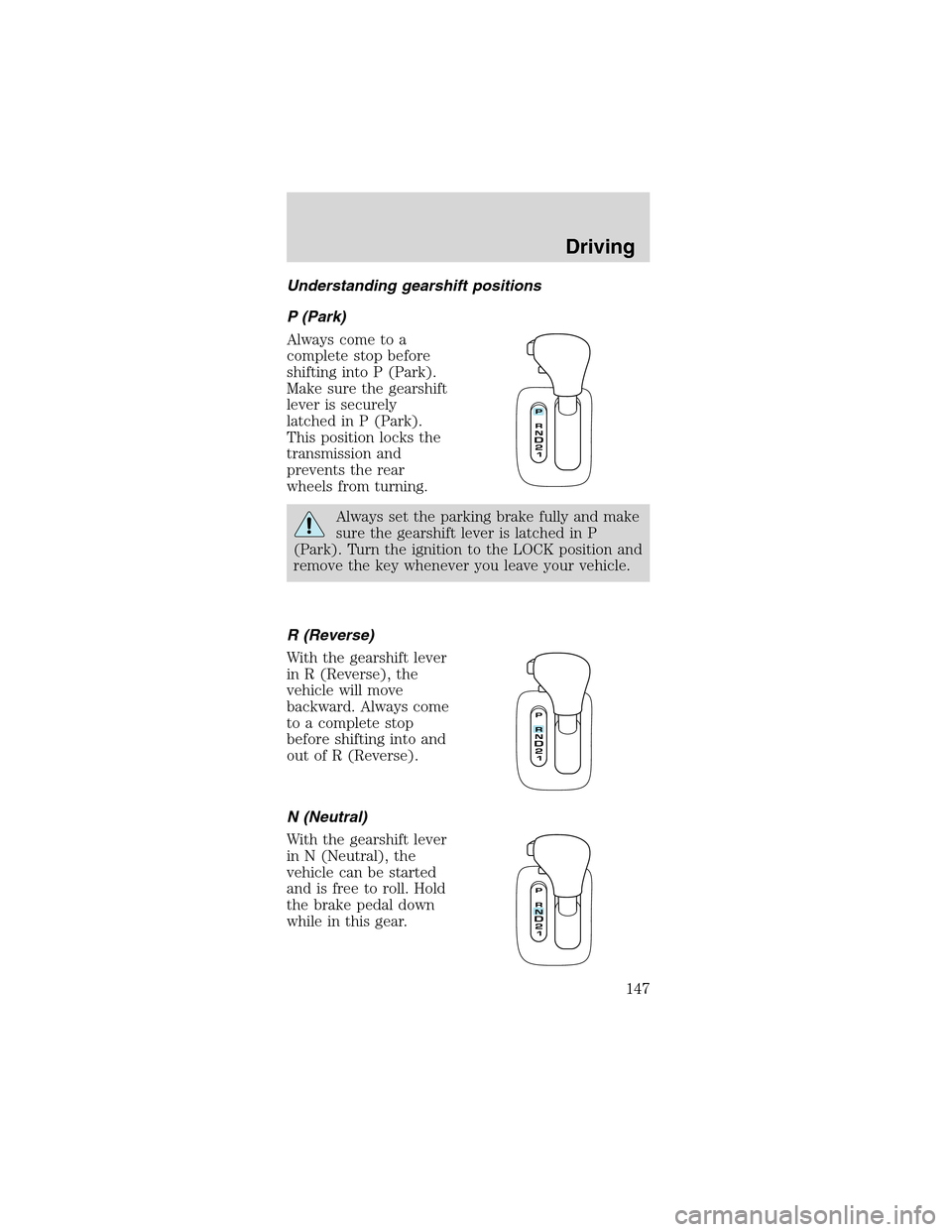
P (Park)
Always come to a
complete stop before
shifting into P (Park).
Make sure the gearshift
lever is securely
latched in P (Park).
This position locks the
transmission and
prevents the rear
wheels from turning.
Always set the parking brake fully and make
sure the gearshift lever is latched in P
(Park). Turn the ignition to the LOCK position and
remove the key whenever you leave your vehicle.
R (Reverse)
With the gearshift lever
in R (Reverse), the
vehicle will move
backward. Always come
to a complete stop
before shifting into and
out of R (Reverse).
N (Neutral)
With the gearshift lever
in N (Neutral), the
vehicle can be started
and is free to roll. Hold
the brake pedal down
while in this gear.
Driving
147
Page 152 of 256
4. Turn the ignition key
to position 3 (OFF).
Do not park your vehicle in Neutral, it may
move unexpectedly and injure someone. Use
1 (First) gear and set the parking brake fully.
Reverse
You must be at a complete stop to shift into R
(Reverse). You can shift into R (Reverse) only by
moving the gearshift lever through the neutral plane.
R (Reverse) can not be engaged directly from 5 (5th
gear). This is a feature that protects the
transmission from accidentally shifting into R
(Reverse) when you downshift from 5 (Fifth).
Make sure that your vehicle is at a complete
stop before you shift into R (Reverse). Failure
to do so may damage the transmission.
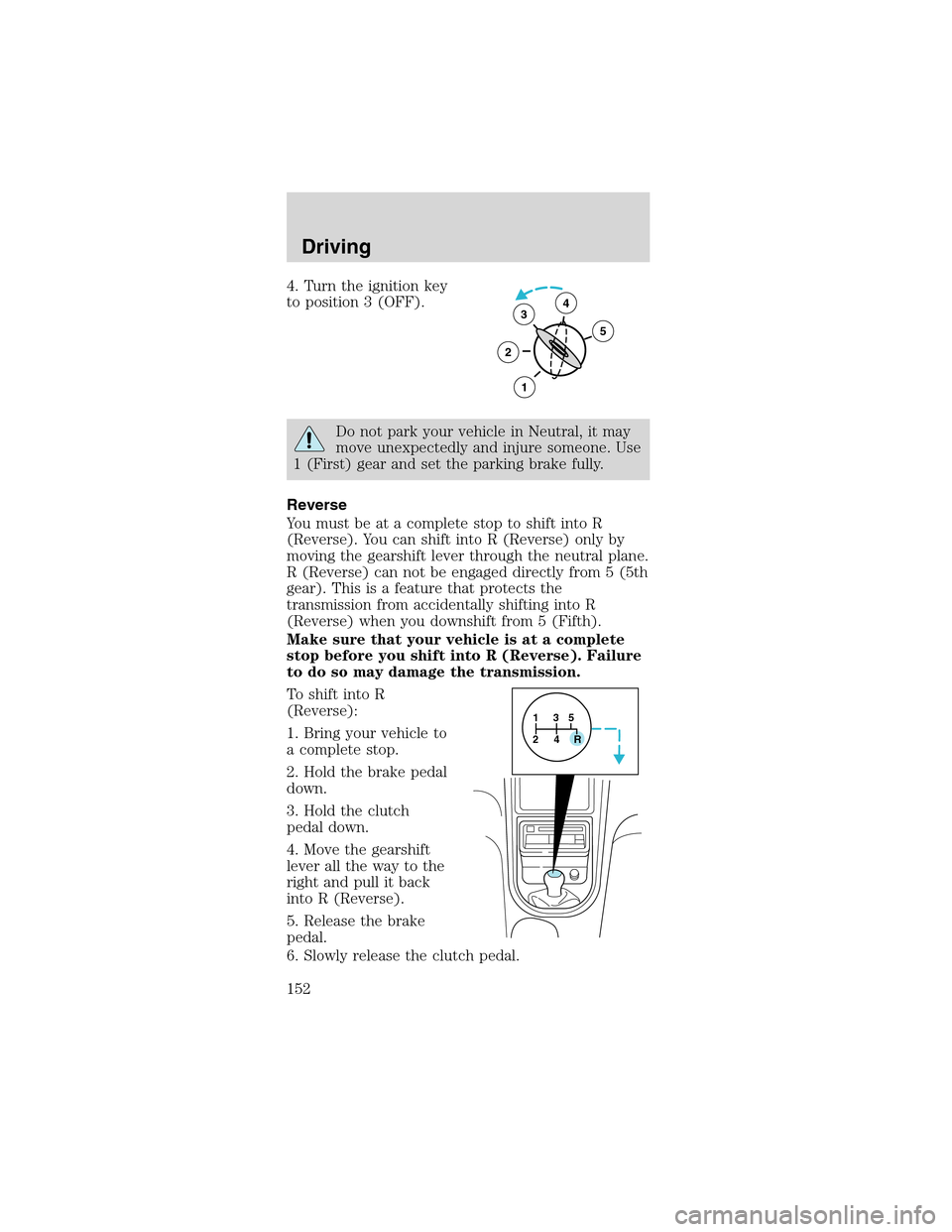
To shift into R
(Reverse):
1. Bring your vehicle to
a complete stop.
2. Hold the brake pedal
down.
3. Hold the clutch
pedal down.
4. Move the gearshift
lever all the way to the
right and pull it back
into R (Reverse).
5. Release the brake
pedal.
6. Slowly release the clutch pedal.
3
2
1
5
4
1
24R3
5
Driving
152
Page 153 of 256
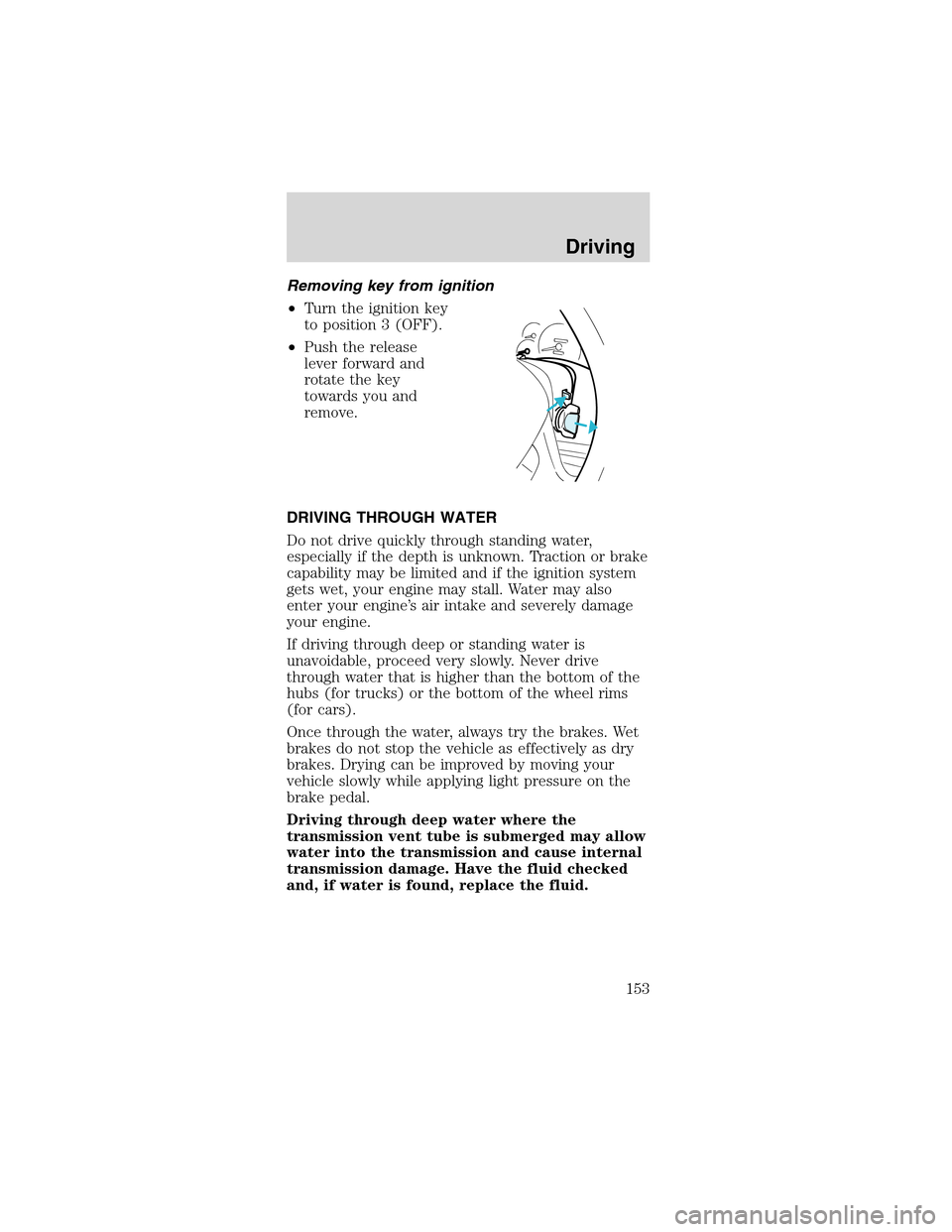
Removingkeyfrom ignition
•Turn the ignition key
to position 3 (OFF).
•Push the release
lever forward and
rotate the key
towards you and
remove.
DRIVING THROUGH WATER
Do not drive quickly through standing water,
especially if the depth is unknown. Traction or brake
capability may be limited and if the ignition system
gets wet, your engine may stall. Water may also
enter your engine’s air intake and severely damage
your engine.
If driving through deep or standing water is
unavoidable, proceed very slowly. Never drive
through water that is higher than the bottom of the
hubs (for trucks) or the bottom of the wheel rims
(for cars).
Once through the water, always try the brakes. Wet
brakes do not stop the vehicle as effectively as dry
brakes. Drying can be improved by moving your
vehicle slowly while applying light pressure on the
brake pedal.
Driving through deep water where the
transmission vent tube is submerged may allow
water into the transmission and cause internal
transmission damage. Have the fluid checked
and, if water is found, replace the fluid.
Driving
153
Page 158 of 256
portfoliointhe glove compartment in Ford vehicles
and is mailed to you if you own a Mercury or
Lincoln. In Canada, the card is found in the Owner
Information Guide in the glove compartment.
U.S. Ford or Mercury vehicle customers who require
roadside assistance, call 1–800–241–3673; Lincoln
vehicle customers call 1–800–521–4140.
Canadian customers who require roadside assistance,
call 1–800–665–2006.
If you need to arrange roadside assistance for
yourself, Ford Motor Company will reimburse a
reasonable amount. To obtain reimbursement
information, U.S. Ford or Mercury vehicles
customers call 1-800-241-3673; Lincoln vehicle
customers call 1–800–521–4140.
Canadian customers who need to obtain
reimbursement information, call 1–800–665–2006.
ROADSIDE COVERAGE BEYOND BASIC
WARRANTY
In the United States, you may purchase additional
roadside assistance coverage beyond this period
through the Ford Auto Club by contacting your Ford
or Lincoln Mercury dealer.
Similarly in Canada, for uninterrupted Roadside
Assistance coverage, you may purchase extended
coverage prior to your Basic Warranty’s Roadside
Assistance expiring. For more information and
enrollment, contact 1–877–294–2582 or visit our
website at www.ford.ca.
HAZARD FLASHER
Use only in an emergency to warn traffic of vehicle
breakdown, approaching danger, etc. The hazard
flashers can be operated when the ignition is off.
Roadside Emergencies
158
Page 159 of 256
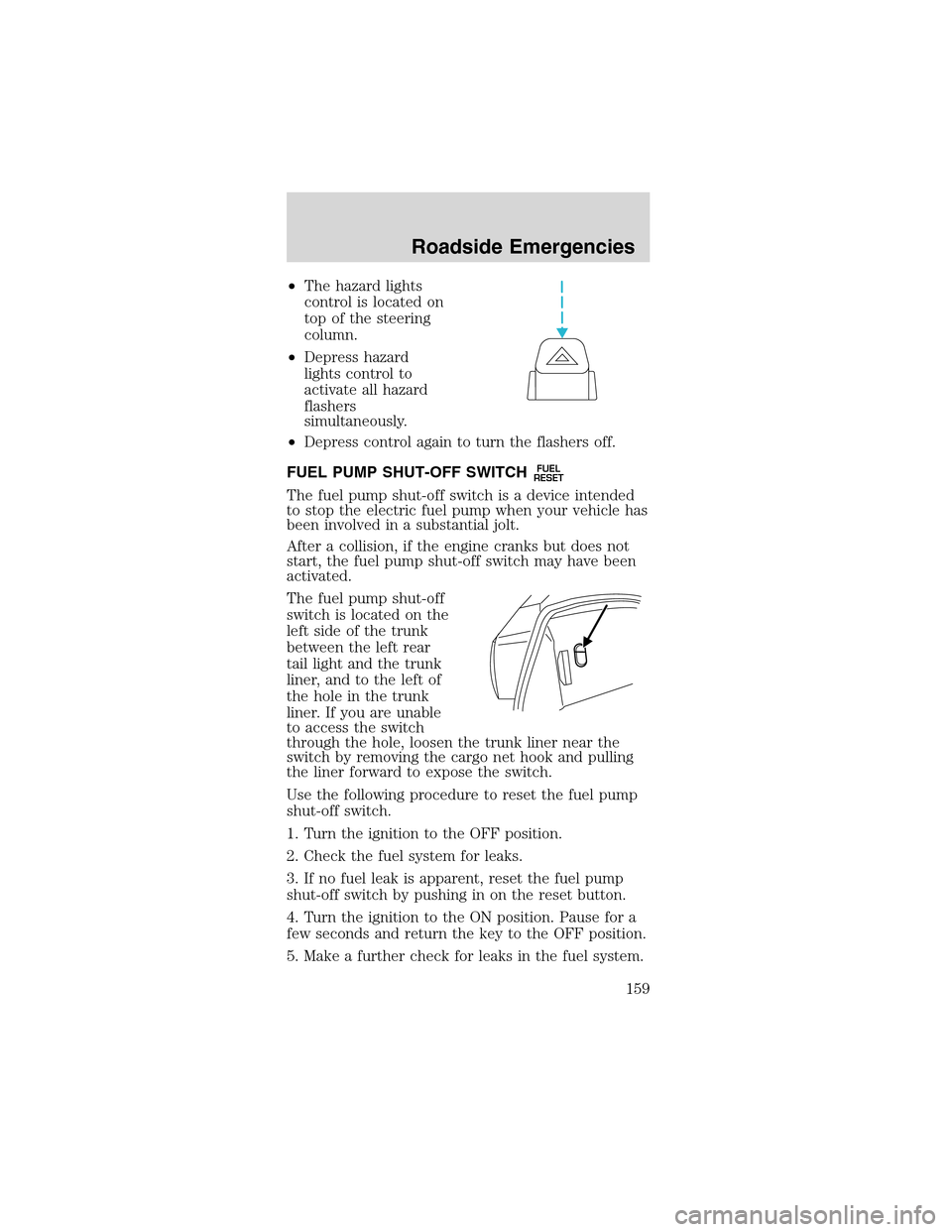
•The hazard lights
control is located on
top of the steering
column.
•Depress hazard
lights control to
activate all hazard
flashers
simultaneously.
•Depress control again to turn the flashers off.
FUEL PUMP SHUT-OFF SWITCH
FUEL
RESET
The fuel pump shut-off switch is a device intended
to stop the electric fuel pump when your vehicle has
been involved in a substantial jolt.
After a collision, if the engine cranks but does not
start, the fuel pump shut-off switch may have been
activated.
The fuel pump shut-off
switch is located on the
left side of the trunk
between the left rear
tail light and the trunk
liner, and to the left of
the hole in the trunk
liner. If you are unable
to access the switch
through the hole, loosen the trunk liner near the
switch by removing the cargo net hook and pulling
the liner forward to expose the switch.
Use the following procedure to reset the fuel pump
shut-off switch.
1. Turn the ignition to the OFF position.
2. Check the fuel system for leaks.
3. If no fuel leak is apparent, reset the fuel pump
shut-off switch by pushing in on the reset button.
4. Turn the ignition to the ON position. Pause for a
few seconds and return the key to the OFF position.
5. Make a further check for leaks in the fuel system.
Roadside Emergencies
159
Page 164 of 256
The high-current fuses are coded as follows.
Fuse/Relay
LocationFuse Amp
RatingPower Distribution Box
Description
Relay 1—Fog lamp interrupt
Relay 2—Interval wiper
Relay 3—Wiper HI/LO
Relay 4—Starter
Relay 5—Fog lamps
1 50A** (4.6L),
30A CB
(3.8L)Electric cooling fan motor
2 30A** Headlamps
3 40A** Starter motor relay, Ignition
switch
4 40A** Ignition switch
5 40A** Ignition switch
6 40A** Instrument cluster,
Powertrain Control Module
(PCM)
7 30A** Secondary air injection
(3.8L only)
8 50A** Anti-lock Brake Sytsem
(ABS) module
9 20A** Auxiliary power point
10 30A** Parklamps
11 30A** Rear window defrost control
12 40A** Power windows, Power
locks
13 30A* MACH 1000 left amplifiers
14 20A* Fuel pump
15 30A* MACH 1000 right amplifiers
16 20A* Horn
17 20A* ABS
18 30A* Power seats
19 10A* Intercooler pump (Cobra
only)
20 20A* Alternator
21—Not used
Roadside Emergencies
164
Page 216 of 256
Usethe following guidelines to avoid static build-up
when filling an ungrounded fuel container:
•Place approved fuel container on the ground.
•DO NOT fill a fuel container while it is in the
vehicle (including the cargo area).
•Keep the fuel pump nozzle in contact with the
fuel container while filling.
•DO NOT use a device that would hold the fuel
pump handle in the fill position.
Fuel Filler Cap
Your fuel tank filler cap has an indexed design with
a 1/8 turn on/off feature.
When fueling your vehicle:
1. Turn the engine off.
2. Carefully turn the filler cap counterclockwise 1/8
of a turn until it stops.
3. Pull to remove the cap from the fuel filler pipe.
4. To install the cap, align the tabs on the cap with
the notches on the filler pipe.
5. Turn the filler cap clockwise 1/8 of a turn until it
stops.
“Check Fuel Cap”illuminates when the ignition is
turned to the ON position to ensure your bulb is
working. When this light turns on, check the fuel
filler cap. Continuing to operate the vehicle with the
Check Fuel Cap light on, can activate the Service
Engine Soon warning. When the fuel filler cap is
properly re-installed, the light(s) will turn off after a
period of normal driving.It may take a long
period of time for the system to detect an
improperly installed fuel filler cap.
If you must replace the fuel filler cap, replace
it with a fuel filler cap that is designed for
your vehicle. The customer warranty may be
void for any damage to the fuel tank or fuel
system if the correct genuine Ford or
Motorcraft fuel filler cap is not used.
Maintenance and Specifications
216
Page 219 of 256
•You may need to cycle the ignition from OFF to
ON several times after refueling, to allow the fuel
system to pump the fuel from the tank to the
engine.
•Your“Service Engine Soon”indicator may come
on. For more information on the“Service Engine
Soon”indicator, refer to theInstrument cluster
chapter.
Fuel Filter
For fuel filter replacement, see your dealer or a
qualified service technician. Refer to the scheduled
maintenance guide for the appropriate intervals for
changing the fuel filter.
Replace the fuel filter with an authorized
Motorcraft part. The customer warranty may
be void for any damage to the fuel system if an
authorized Motorcraft fuel filter is not used.
ESSENTIALS OF GOOD FUEL ECONOMY
Measuring techniques
Your best source of information about actual fuel
economy is you, the driver. You must gather
information as accurately and consistently as
possible. Fuel expense, frequency of fill-ups or fuel
gauge readings are NOT accurate as a measure of
fuel economy. We do not recommend taking fuel
economy measurements during the first 1,600 km
(1,000 miles) of driving (engine break-in period).
You will get a more accurate measurement after
3,000 km–5,000 km (2,000 miles-3,000 miles).
Filling the tank
The advertised fuel capacity of the fuel tank on your
vehicle is equal to the rated refill capacity of the fuel
tank as listed in theRefill capacitiessection of this
chapter.
The advertised capacity is the amount of the
indicated capacity and the empty reserve combined.
Indicated capacity is the difference in the amount of
Maintenance and Specifications
219