2003 FORD MUSTANG fuel
[x] Cancel search: fuelPage 183 of 256
for the hearing impaired: 1-800-232-5952 or by
writing to the Center at the following address:
Ford Motor Company
Customer Relationship Center
16800 Executive Plaza Drive
P.O. Box 6248
Dearborn, Michigan 48121
UTILIZING THE MEDIATION/ARBITRATION
PROGRAM (CANADA ONLY)
In those cases where you continue to feel that the
efforts by Ford and the dealer to resolve a
factory-related vehicle service concern have been
unsatisfactory, Ford of Canada participates in an
impartial third party mediation/arbitration program
administered by the Canadian Motor Vehicle
Arbitration Plan (CAMVAP).
The CAMVAP program is a straight-forward and
relatively speedy alternative to resolve a
disagreement when all other efforts to produce a
settlement have failed. This procedure is without
cost to you and is designed to eliminate the need for
lengthy and expensive legal proceedings.
In the CAMVAP program, impartial third-party
arbitrators conduct hearings at mutually convenient
times and places in an informal environment. These
impartial arbitrators review the positions of the
parties, make decisions and, when appropriate,
render awards to resolve disputes. CAMVAP
decisions are fast, fair, and final; the arbitrator’s
award is binding both to you and Ford of Canada.
CAMVAP services are available in all territories and
provinces. For more information, without charge or
obligation, call your CAMVAP Provincial
Administrator directly at 1-800-207-0685.
GETTING ASSISTANCE OUTSIDE THE U.S. AND
CANADA
Before exporting your vehicle to a foreign country,
contact the appropriate foreign embassy or
consulate. These officials can inform you of local
vehicle registration regulations and where to find
unleaded fuel.
Customer Assistance
183
Page 184 of 256
If you cannot find unleaded fuel or can only get fuel
with an anti-knock index lower than is
recommended for your vehicle, contact a district or
owner relations/customer relationship office.
The use of leaded fuel in your vehicle without
proper conversion may damage the effectiveness of
your emission control system and may cause engine
knocking or serious engine damage. Ford Motor
Company/Ford of Canada is not responsible for any
damage caused by use of improper fuel.
In the United States, using leaded fuel may also
result in difficulty importing your vehicle back into
the U.S.
If your vehicle must be serviced while you are
traveling or living in Central or South America, the
Caribbean, or the Middle East, contact the nearest
Ford dealership. If the dealership cannot help you,
write or call:
FORD MOTOR COMPANY
WORLDWIDE DIRECT MARKET OPERATIONS
1555 Fairlane Drive
Fairlane Business Park #3
Allen Park, Michigan 48101
U.S.A.
Telephone: (313) 594-4857
FAX: (313) 390-0804
If you are in another foreign country, contact the
nearest Ford dealership. If the dealership employees
cannot help you, they can direct you to the nearest
Ford affiliate office.
If you buy your vehicle in North America and then
relocate outside of the U.S. or Canada, register your
vehicle identification number (VIN) and new address
with Ford Motor Company Worldwide Direct Market
Operations.
ORDERING ADDITIONAL OWNER’S
LITERATURE
To order the publications in this portfolio, contact
Helm, Incorporated at:
Customer Assistance
184
Page 187 of 256
WASHING THE EXTERIOR
Wash your vehicle regularly with cool or lukewarm
water and a neutral Ph shampoo, such as Detail
Wash (ZC-3–A), which is available from your dealer.
•Never use strong household detergents or soap,
such as dish washing or laundry liquid. These
products can discolor and spot painted surfaces.
•Never wash a vehicle that is“hot to the touch”or
during exposure to strong, direct sunlight.
•Always use a clean sponge or carwash mitt with
plenty of water for best results.
•Dry the vehicle with a chamois or soft terry cloth
towel in order to eliminate water spotting.
•It is especially important to wash the vehicle
regularly during the winter months, as dirt and
road salt are difficult to remove and cause
damage to the vehicle.
•Immediately remove items such as gasoline, diesel
fuel, bird droppings and insect deposits because
they can cause damage to the vehicle’s paintwork
and trim over time.
•Remove any exterior accessories, such as
antennas, before entering a car wash.
•Suntan lotions and insect repellents can
damage any painted surface; if these
substances come in contact with your
vehicle, wash off as soon as possible.
WAXING
Applying a polymer paint sealant to your vehicle
every six months will assist in reducing minor
scratches and paint damage.
•Wash the vehicle first.
•Do not use waxes that contain abrasives.
•Do not allow paint sealant to come in contact with
any non-body (low-gloss black) colored trim, such
as grained door handles, roof racks, bumpers, side
moldings, mirror housings or the windshield cowl
area. The paint sealant will“gray”or stain the
parts over time.
Cleaning
187
Page 188 of 256
PAINT CHIPS
Your dealer has touch-up paint and sprays to match
your vehicle’s color. Take your color code (printed
on a sticker in the driver’s door jam) to your dealer
to ensure you get the correct color.
•Remove particles such as bird droppings, tree sap,
insect deposits, tar spots, road salt and industrial
fallout before repairing paint chips.
•Always read the instructions before using the
products.
ALUMINUM WHEELS AND COVERS
Aluminum wheel rims or covers are coated with a
clearcoat paint finish. In order to maintain their
shine:
•Clean with Motorcraft Wheel and Tire Cleaner
(ZC-37–A), which is available from your dealer.
•Never apply any cleaning chemical to hot or warm
wheel rims or covers.
•Some automatic car washes may cause damage to
the finish on your wheel rims or covers.
Chemical-strength cleaners, or cleaning chemicals,
in combination with brush agitation to remove
brake dust and dirt, could wear away the
clearcoat finish over time.
•Do not use hydrofluoric acid-based or high
caustic-based wheel cleaners, steel wool, fuels or
strong household detergent.
•To remove tar and grease, use Ford Extra
Strength Tar and Road Oil Removal
(B7A-19520–AA), available from your dealer.
ENGINE
Engines are more efficient when they are clean
because grease and dirt buildup keep the engine
warmer than normal. When washing:
•Take care when using a power washer to clean
the engine. The high-pressure fluid could
penetrate the sealed parts and cause damage.
Cleaning
188
Page 190 of 256
PLASTIC (NON-PAINTED) EXTERIOR PARTS
Use only approved products to clean plastic parts.
These products are available from your dealer.
•For routine cleaning, use Detail Wash (ZC-3–A).
•If tar or grease spots are present, use Ford Extra
Strength Tar and Road Oil Removal
(B7A-19520–AA).
WINDOWS AND WIPER BLADES
The windshield, rear window and wiper blades
should be cleaned regularly. If the wiper does not
wipe properly, substances on the windshield, rear
window or the wiper blades may be the cause. These
may include hot wax treatments used by commercial
car washes, tree sap, or other organic contamination.
To clean these items, please follow these tips:
•The windshield or rear window may be cleaned
with a non-abrasive cleaner such as Motorcraft
Ultra Clear Spray Glass Cleaner (ZC-23), available
from your dealer.
•Do not use abrasives, as they may cause
scratches.
•Do not use fuel, kerosene, or paint thinner to
clean any parts.
•Wiper blades can be cleaned with isopropyl
(rubbing) alcohol or windshield washer solution.
Be sure to replace wiper blades when they appear
worn or do not function properly.
INSTRUMENT PANEL AND CLUSTER LENS
Clean the instrument panel with a damp cloth, then
dry with a dry cloth.
•Avoid cleaners or polish that increase the gloss of
the upper portion of the instrument panel. The
dull finish in this area helps protect the driver
from undesirable windshield reflection.
Cleaning
190
Page 194 of 256
SERVICE RECOMMENDATIONS
To help you service your vehicle:
•We highlight do-it-yourself items in the engine
compartment for easy location.
•We provide a scheduled maintenance guide which
makes tracking routine service easy.
If your vehicle requires professional service, your
dealership can provide the necessary parts and
service. Check yourWarranty Guide/Owner
Information Guideto find out which parts and
services are covered.
Use only recommended fuels, lubricants, fluids and
service parts conforming to specifications. Motorcraft
parts are designed and built to provide the best
performance in your vehicle.
PRECAUTIONS WHEN SERVICING YOUR
VEHICLE
Be especially careful when inspecting or servicing
your vehicle.
•Do not work on a hot engine.
•When the engine is running, keep loose clothing,
jewelry or long hair away from moving parts.
•Do not work on a vehicle with the engine running
in an enclosed space, unless you are sure you
have enough ventilation.
•Keep all lit cigarettes, open flames and other lit
material away from the battery and all fuel related
parts.
If you disconnect the battery, the engine must
“relearn”its idle conditions before your vehicle will
drive properly, as explained in theBatterysection in
this chapter.
Working with the engine off
•Automatic transmission:
1. Set the parking brake and ensure the gearshift is
securely latched in P (Park).
Maintenance and Specifications
194
Page 199 of 256

WINDSHIELD WASHER FLUID
Check the washer fluid
whenever you stop for
fuel. The reservoir is
highlighted with a
symbol.
Add fluid to fill the
reservoir if the level is
low. In very cold
weather, do not fill the
reservoir completely.
Only use a washer fluid that meets Ford
specification ESR-M17P5–A . Refer toLubricant
specificationsin this chapter.
State or local regulations on volatile organic
compounds may restrict the use of methanol, a
common windshield washer antifreeze additive.
Washer fluids containing non-methanol antifreeze
agents should be used only if they provide cold
weather protection without damaging the vehicle’s
paint finish, wiper blades or washer system.
Note:Do not put washer fluid in the engine coolant
reservoir. Washer fluid placed in the cooling system
may harm engine and cooling system components.
ENGINE OIL
Checking the engine oil
Refer to the scheduled maintenance guide for the
appropriate intervals for checking the engine oil.
1. Make sure the vehicle is on level ground.
2. Turn the engine off and wait 5 to 10 minutes for
the oil to drain into the oil pan.
3. Set the parking brake and ensure the gearshift is
securely latched in P (Park) (automatic
transmissions) or 1 (First) (manual transmissions).
4. Open the hood. Protect yourself from engine heat.
Maintenance and Specifications
199
Page 202 of 256
Engine oil and filter recommendations
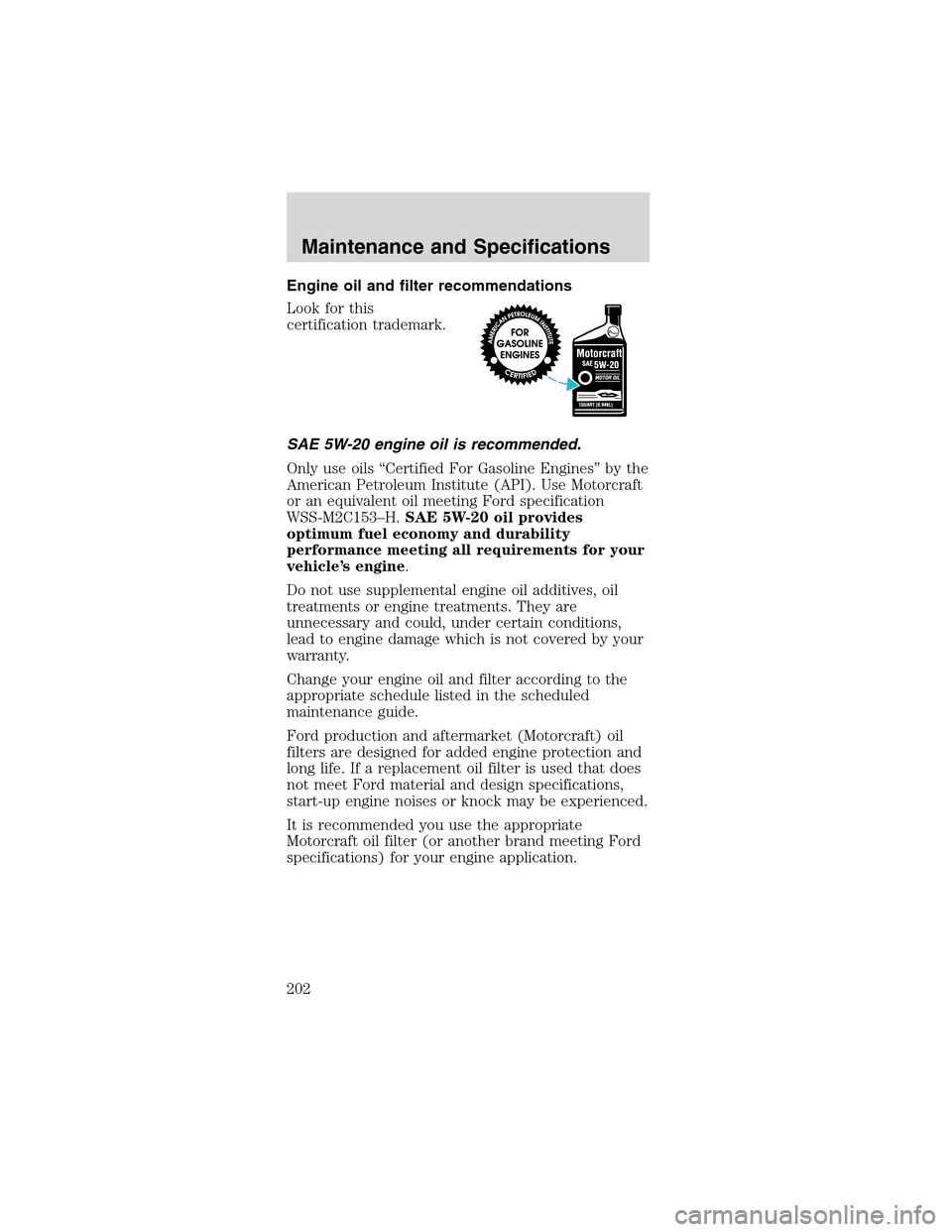
Look for this
certification trademark.
SAE 5W-20 engine oil is recommended.
Only use oils“Certified For Gasoline Engines”by the
American Petroleum Institute (API). Use Motorcraft
or an equivalent oil meeting Ford specification
WSS-M2C153–H.SAE 5W-20 oil provides
optimum fuel economy and durability
performance meeting all requirements for your
vehicle’s engine.
Do not use supplemental engine oil additives, oil
treatments or engine treatments. They are
unnecessary and could, under certain conditions,
lead to engine damage which is not covered by your
warranty.
Change your engine oil and filter according to the
appropriate schedule listed in the scheduled
maintenance guide.
Ford production and aftermarket (Motorcraft) oil
filters are designed for added engine protection and
long life. If a replacement oil filter is used that does
not meet Ford material and design specifications,
start-up engine noises or knock may be experienced.
It is recommended you use the appropriate
Motorcraft oil filter (or another brand meeting Ford
specifications) for your engine application.
Maintenance and Specifications
202