Page 143 of 256

surfaces.The system operates by detecting and
controlling wheel spin. The system borrows many of
the electronic and mechanical elements already
present in the anti-lock braking system (ABS).
Wheel-speed sensors allow excess rear wheel spin to
be detected by the Traction Control�portion of the
ABS computer. Any excessive wheel spin is
controlled by automatically applying and releasing
the rear brakes in conjunction with engine torque
reductions. Engine torque reduction is realized via
the fully electronic spark and fuel injection systems.
This process is very sensitive to driving conditions
and very fast acting. The rear wheels“search”for
optimum traction several times a second and
adjustments are made accordingly.
The Traction Control�system will allow your
vehicle to make better use of available traction on
slippery surfaces. The system is a driver aid which
makes your vehicle easier to handle primarily on
snow, ice covered and gravel roads.
During Traction
Control�operation,
the traction control
active light will
illuminate, you may hear an electric motor type of
sound coming from the engine compartment and the
engine will not“rev-up”when you push further on
the accelerator. This is normal system behavior.
The Traction Control�
on/off switch, located
below the radio,
illuminates when the
system is OFF. The
Traction Control�system will revert to the ON
position every time the ignition is turned OFF and
ON.
If you should become stuck in snow or ice or on a
very slippery road surface, try switching the Traction
Control�system off. This may allow excess wheel
spin to“dig”the vehicle out and enable a successful
“rocking”maneuver.
Driving
143
Page 146 of 256
Driving with an automatic overdrive
transmission with console gearshift and O/D off
switch
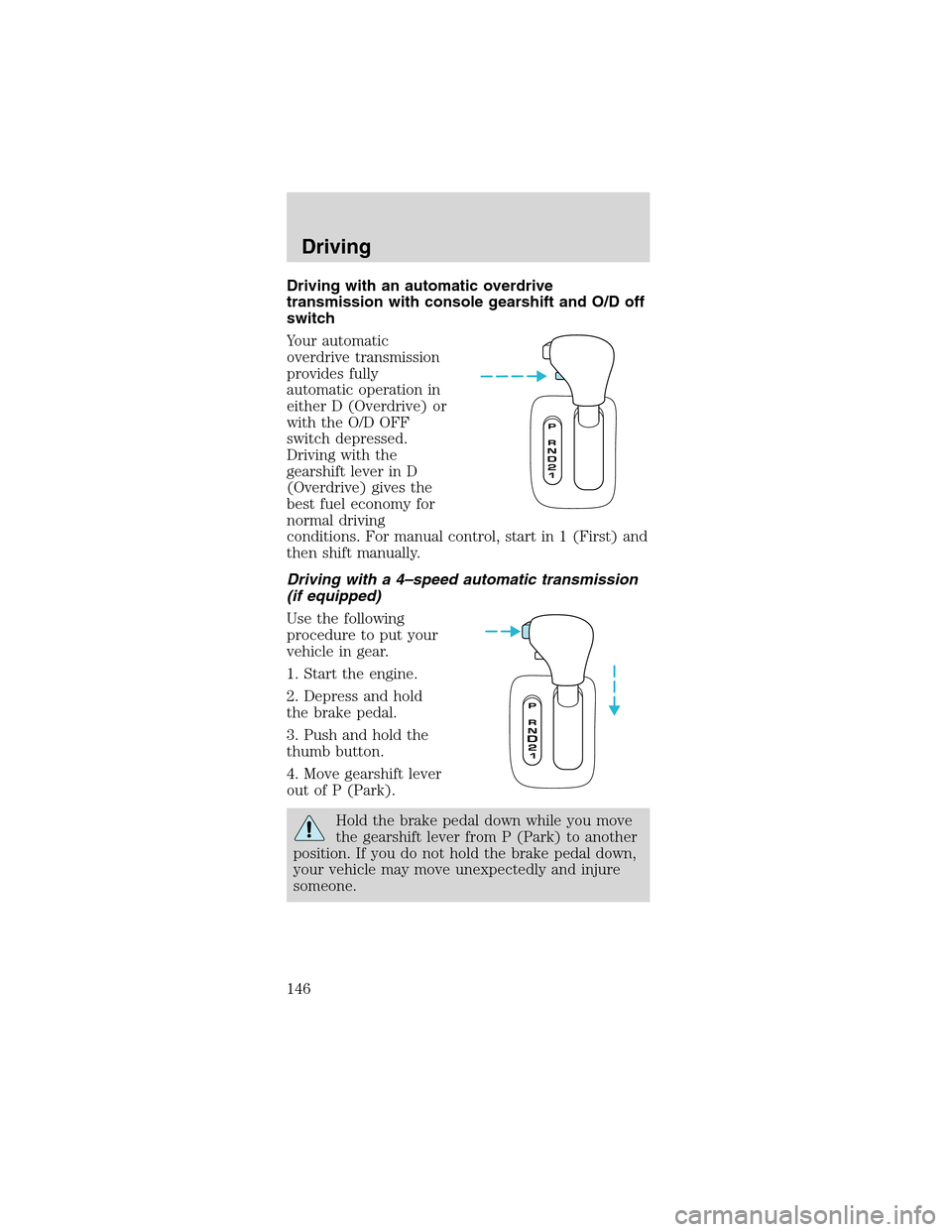
Your automatic
overdrive transmission
provides fully
automatic operation in
either D (Overdrive) or
with the O/D OFF
switch depressed.
Driving with the
gearshift lever in D
(Overdrive) gives the
best fuel economy for
normal driving
conditions. For manual control, start in 1 (First) and
then shift manually.
Driving with a 4–speed automatic transmission
(if equipped)
Use the following
procedure to put your
vehicle in gear.
1. Start the engine.
2. Depress and hold
the brake pedal.
3. Push and hold the
thumb button.
4. Move gearshift lever
out of P (Park).
Hold the brake pedal down while you move
the gearshift lever from P (Park) to another
position. If you do not hold the brake pedal down,
your vehicle may move unexpectedly and injure
someone.
Driving
146
Page 148 of 256
(Overdrive)
The normal driving
position for the best
fuel economy.
Transmission operates
in gears one through
four.
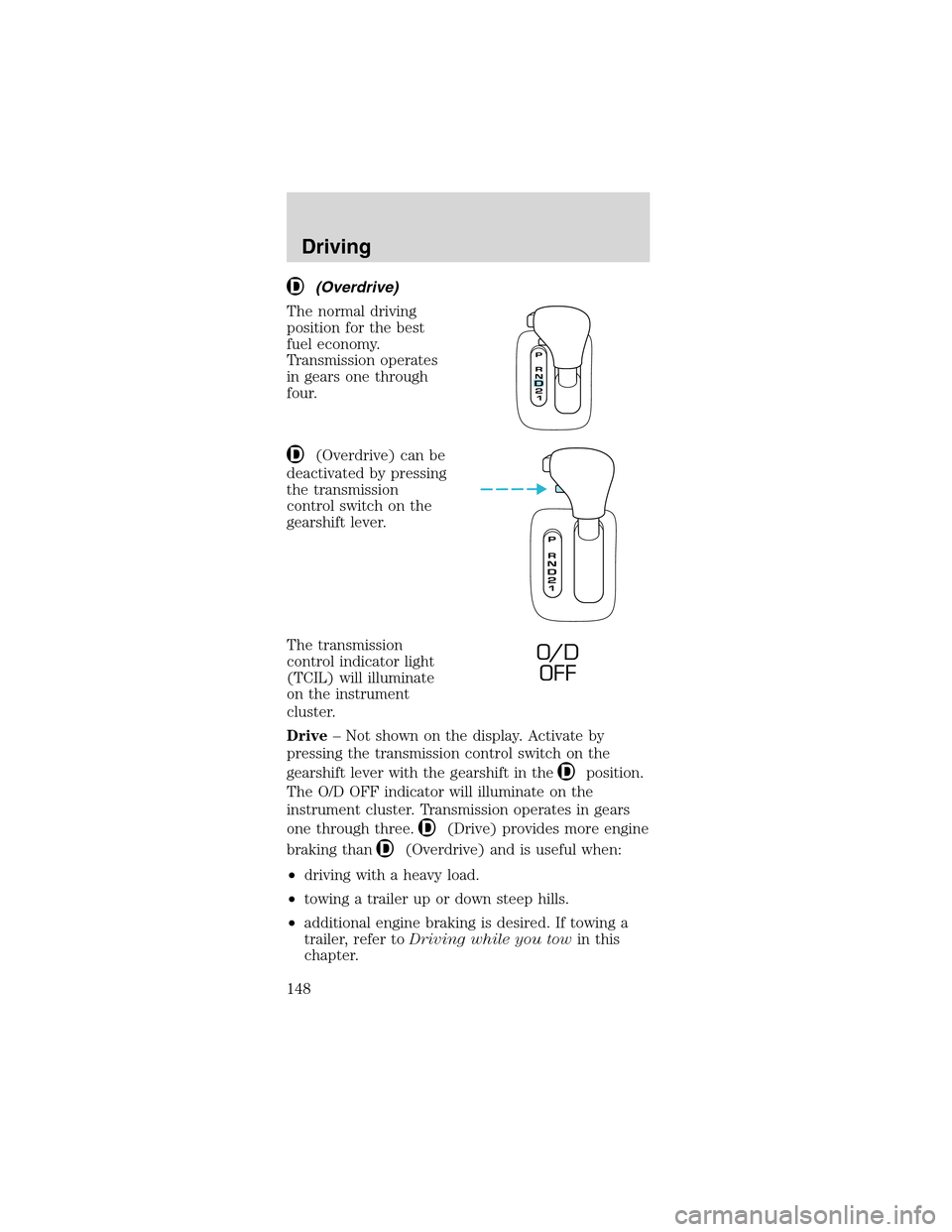
(Overdrive) can be
deactivated by pressing
the transmission
control switch on the
gearshift lever.
The transmission
control indicator light
(TCIL) will illuminate
on the instrument
cluster.
Drive–Not shown on the display. Activate by
pressing the transmission control switch on the
gearshift lever with the gearshift in the
position.
The O/D OFF indicator will illuminate on the
instrument cluster. Transmission operates in gears
one through three.
(Drive) provides more engine
braking than
(Overdrive) and is useful when:
•driving with a heavy load.
•towing a trailer up or down steep hills.
•additional engine braking is desired. If towing a
trailer, refer toDriving while you towin this
chapter.
O/ D
OFF
Driving
148
Page 151 of 256
Recommended shift speeds
Do not downshift into 1 (First) when your
vehicle is moving faster then 24 km/h (15 mph).
This will damage the clutch.
Upshift according to the following chart:
Upshifts when accelerating
(recommended for best fuel economy)
Shift from:
1 - 2 18 km/h (11 mph)
2 - 3 31 km/h (19 mph)
3 - 4 48 km/h (30 mph)
4 - 5 64 km/h (40 mph)
Parking your vehicle
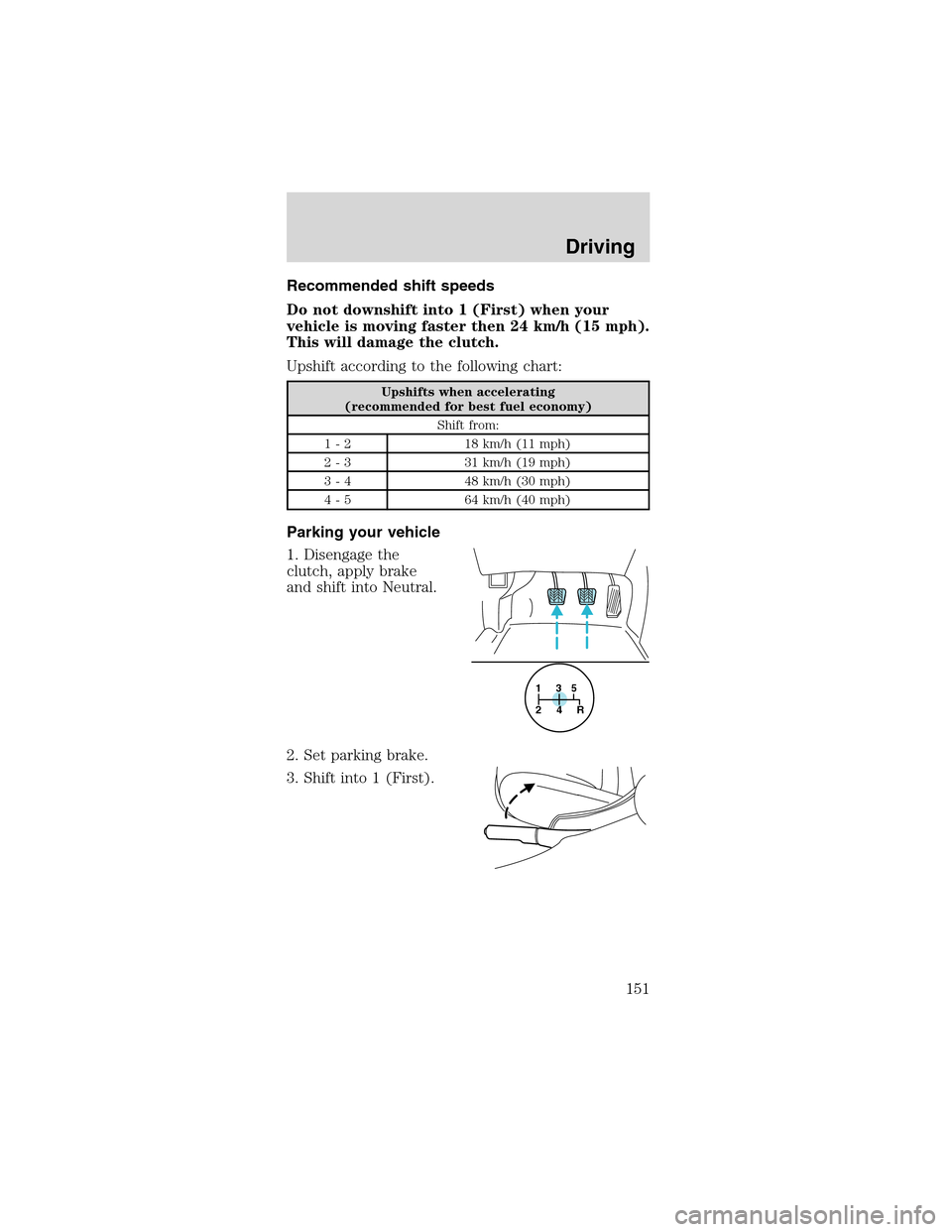
1. Disengage the
clutch, apply brake
and shift into Neutral.
2. Set parking brake.
3. Shift into 1 (First).
1
24R3
5
Driving
151
Page 157 of 256
GETTINGROADSIDEASSISTANCE
To fully assist you should you have a vehicle
concern, Ford Motor Company offers a
complimentary roadside assistance program. This
program is separate from the New Vehicle Limited
Warranty. The service is available:
•24–hours, seven days a week
•for the New Vehicle Limited Warranty period of
three years or 60,000 km (36,000 miles),
whichever occurs first on Ford and Mercury
vehicles, and four years or 80,000 km (50,000
miles) on Lincoln vehicles.
Roadside assistance will cover:
•changing a flat tire
•jump-starts
•lock-out assistance
•limited fuel delivery
•towing of your disabled vehicle to the nearest
Ford Motor Company dealership, or your selling
dealer if within 56.3 km (35 miles) of the nearest
Ford Motor Company dealership (one tow per
disablement). Even non-warranty related tows,
like accidents or getting stuck in the mud or
snow, are covered (some exclusions apply, such as
impound towing or repossession).
Canadian customers refer to your Owner
Information Guide for information on:
•Coverage period
•Exact fuel amounts
•Towing of your disabled vehicle
•Emergency travel expense reimbursement
•Travel planning benefits
USING ROADSIDE ASSISTANCE
Complete the roadside assistance identification card
and place it in your wallet for quick reference. In the
United States, this card is found in the Owner Guide
Roadside Emergencies
157
Page 159 of 256
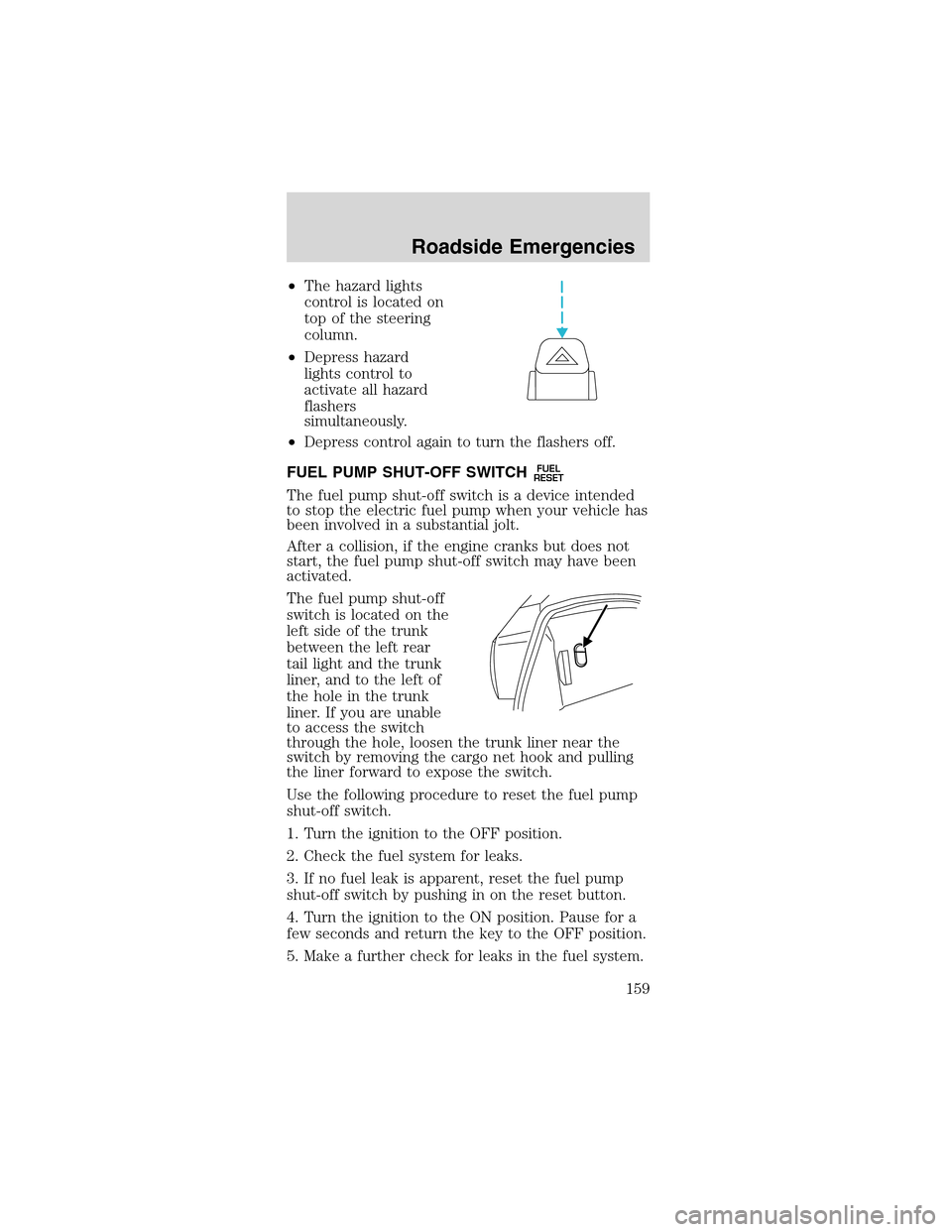
•The hazard lights
control is located on
top of the steering
column.
•Depress hazard
lights control to
activate all hazard
flashers
simultaneously.
•Depress control again to turn the flashers off.
FUEL PUMP SHUT-OFF SWITCH
FUEL
RESET
The fuel pump shut-off switch is a device intended
to stop the electric fuel pump when your vehicle has
been involved in a substantial jolt.
After a collision, if the engine cranks but does not
start, the fuel pump shut-off switch may have been
activated.
The fuel pump shut-off
switch is located on the
left side of the trunk
between the left rear
tail light and the trunk
liner, and to the left of
the hole in the trunk
liner. If you are unable
to access the switch
through the hole, loosen the trunk liner near the
switch by removing the cargo net hook and pulling
the liner forward to expose the switch.
Use the following procedure to reset the fuel pump
shut-off switch.
1. Turn the ignition to the OFF position.
2. Check the fuel system for leaks.
3. If no fuel leak is apparent, reset the fuel pump
shut-off switch by pushing in on the reset button.
4. Turn the ignition to the ON position. Pause for a
few seconds and return the key to the OFF position.
5. Make a further check for leaks in the fuel system.
Roadside Emergencies
159
Page 164 of 256
The high-current fuses are coded as follows.
Fuse/Relay
LocationFuse Amp
RatingPower Distribution Box
Description
Relay 1—Fog lamp interrupt
Relay 2—Interval wiper
Relay 3—Wiper HI/LO
Relay 4—Starter
Relay 5—Fog lamps
1 50A** (4.6L),
30A CB
(3.8L)Electric cooling fan motor
2 30A** Headlamps
3 40A** Starter motor relay, Ignition
switch
4 40A** Ignition switch
5 40A** Ignition switch
6 40A** Instrument cluster,
Powertrain Control Module
(PCM)
7 30A** Secondary air injection
(3.8L only)
8 50A** Anti-lock Brake Sytsem
(ABS) module
9 20A** Auxiliary power point
10 30A** Parklamps
11 30A** Rear window defrost control
12 40A** Power windows, Power
locks
13 30A* MACH 1000 left amplifiers
14 20A* Fuel pump
15 30A* MACH 1000 right amplifiers
16 20A* Horn
17 20A* ABS
18 30A* Power seats
19 10A* Intercooler pump (Cobra
only)
20 20A* Alternator
21—Not used
Roadside Emergencies
164
Page 172 of 256
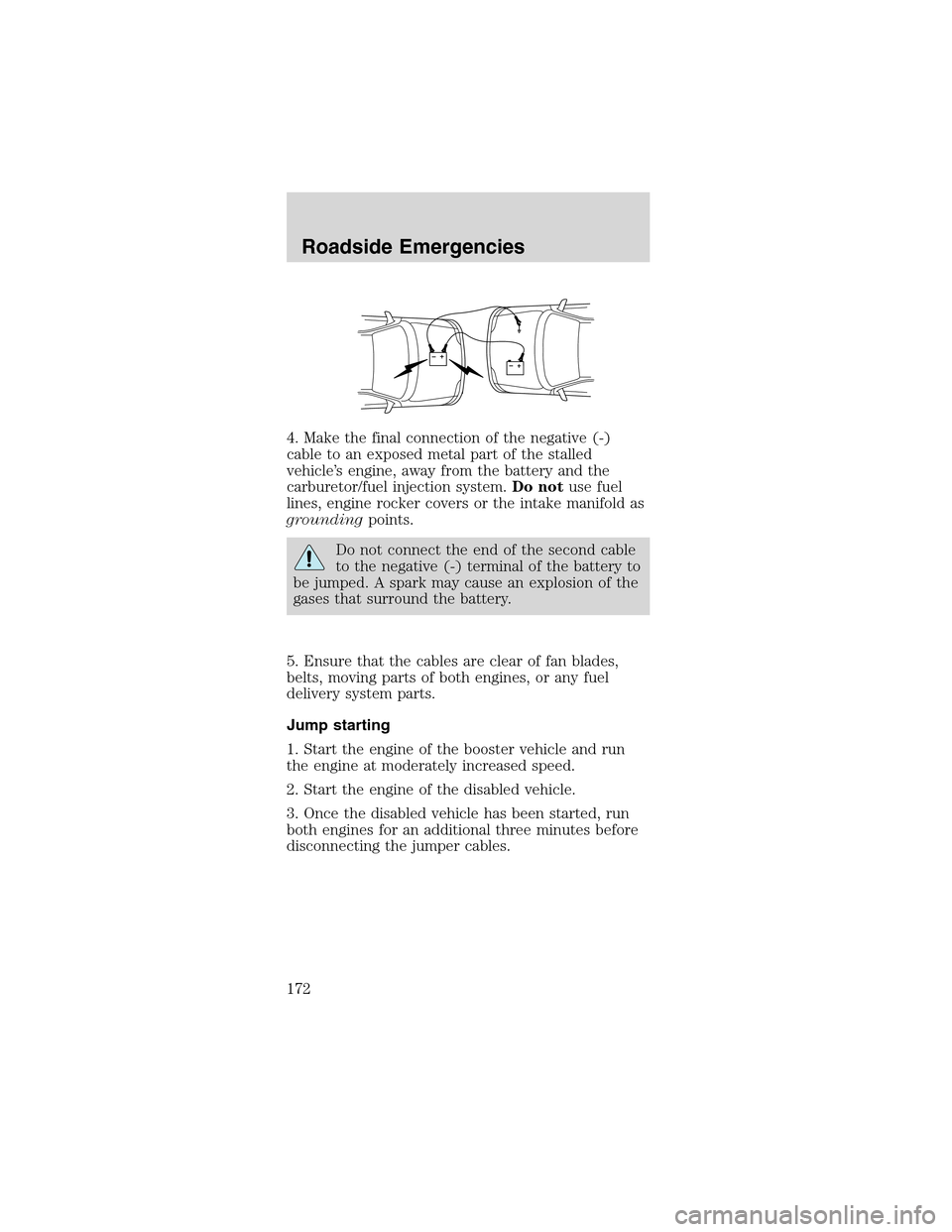
4. Make the final connection of the negative (-)
cable to an exposed metal part of the stalled
vehicle’s engine, away from the battery and the
carburetor/fuel injection system.Do notuse fuel
lines, engine rocker covers or the intake manifold as
groundingpoints.
Do not connect the end of the second cable
to the negative (-) terminal of the battery to
be jumped. A spark may cause an explosion of the
gases that surround the battery.
5. Ensure that the cables are clear of fan blades,
belts, moving parts of both engines, or any fuel
delivery system parts.
Jump starting
1. Start the engine of the booster vehicle and run
the engine at moderately increased speed.
2. Start the engine of the disabled vehicle.
3. Once the disabled vehicle has been started, run
both engines for an additional three minutes before
disconnecting the jumper cables.
+–+–
Roadside Emergencies
172