Page 106 of 256
Failure to replace the Belt and Retractor
assembly could increase the risk of injury in
collisions.
Vehicle sensitive mode
The vehicle sensitive mode is the normal retractor
mode, allowing free shoulder belt length adjustment
to your movements and locking in response to
vehicle movement. For example, if the driver brakes
suddenly or turns a corner sharply, or the vehicle
receives an impact of approximately 8 km/h (5 mph)
or more, the combination safety belts will lock to
help reduce forward movement of the driver and
passengers.
The safety belt system can also be made to lock
manually by quickly pulling on the shoulder belt.
Automatic locking mode
In this mode, the shoulder belt is automatically
pre-locked. The belt will still retract to remove any
slack in the shoulder belt.
The automatic locking mode is not available on the
driver safety belt.
When to use the automatic locking mode
•Any timea child safety seat is installed in a
passenger front or outboard rear seating position
(if equipped). Children 12 years old and under
should be properly restrained in the rear seat
whenever possible. Refer toSafety Restraints for
ChildrenorSafety Seats for Childrenlater in
this chapter.
Seating and Safety Restraints
106
Page 111 of 256
Reasons given... Consider...
“The people I’m
with don’t wear
belts”Set the example, teen deaths occur 4
times more often in vehicles with TWO
or MORE people. Children and younger
brothers/sisters imitate behavior they
see.
“I have an air
bag”Air bags offer greater protection when
used with safety belts. Frontal airbags
are not designed to inflate in rear and
side crashes or rollovers.
“I’d rather be
thrown clear”Not a good idea.Peoplewho are
ejected are 40 times more likely to
DIE.Safety belts help prevent ejection,
WE CAN’T“PICK OUR CRASH”.
Do not sit on top of a buckled safety belt to
avoid the Belt Minder chime. Sitting on the
safety belt will increase the risk of injury in an
accident. To disable (one-time) or deactivate the
Belt Minder feature please follow the directions
stated below.
One time disable
Any time the safety belt is buckled and then
unbuckled during an ignition ON cycle, BeltMinder
will be disabled for that ignition cycle only.
Deactivating/activating the BeltMinder feature
Read steps1-9thoroughly before proceeding
with the deactivation/activation programming
procedure.
The BeltMinder feature can be deactivated/activated
by performing the following procedure:
Before following the procedure, make sure that:
•The parking brake is set.
•The gearshift is in P (Park) (automatic
transmission) or the neutral position (manual
transmission).
•The ignition switch is in the OFF position.
•All vehicle doors are closed.
Seating and Safety Restraints
111
Page 133 of 256
STARTING
Positions of the ignition
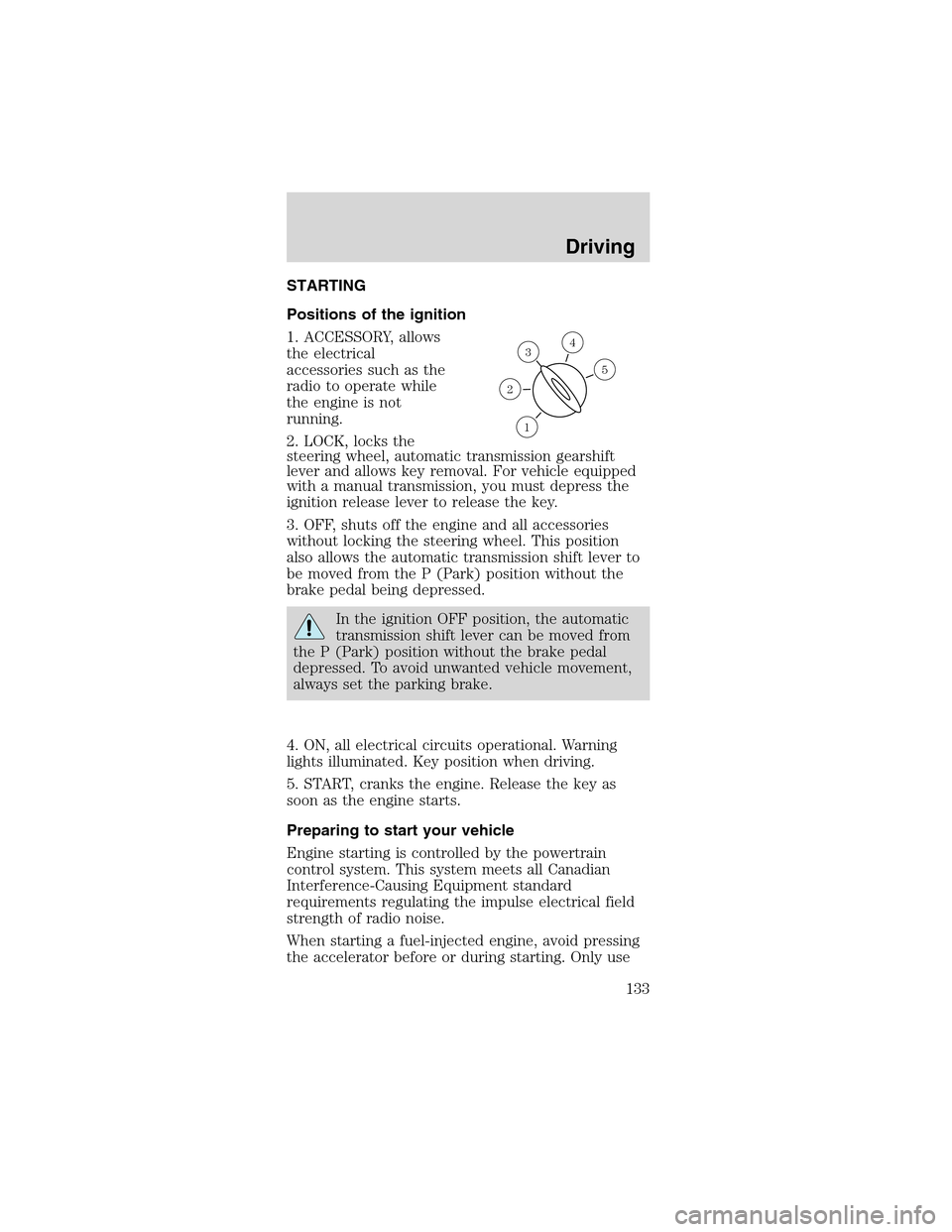
1. ACCESSORY, allows
the electrical
accessories such as the
radio to operate while
the engine is not
running.
2. LOCK, locks the
steering wheel, automatic transmission gearshift
lever and allows key removal. For vehicle equipped
with a manual transmission, you must depress the
ignition release lever to release the key.
3. OFF, shuts off the engine and all accessories
without locking the steering wheel. This position
also allows the automatic transmission shift lever to
be moved from the P (Park) position without the
brake pedal being depressed.
In the ignition OFF position, the automatic
transmission shift lever can be moved from
the P (Park) position without the brake pedal
depressed. To avoid unwanted vehicle movement,
always set the parking brake.
4. ON, all electrical circuits operational. Warning
lights illuminated. Key position when driving.
5. START, cranks the engine. Release the key as
soon as the engine starts.
Preparing to start your vehicle
Engine starting is controlled by the powertrain
control system. This system meets all Canadian
Interference-Causing Equipment standard
requirements regulating the impulse electrical field
strength of radio noise.
When starting a fuel-injected engine, avoid pressing
the accelerator before or during starting. Only use
3
1
2
5
4
Driving
133
Page 135 of 256
2.Makesure the headlamps and vehicle accessories
are off.
If starting a vehicle with an automatic transmission:
•Make sure the
parking brake is set.
•Make sure the gearshift is in P (Park).
If starting a vehicle with a manual transmission:
•Make sure the parking brake is set.
•Push the clutch
pedal to the floor.
3. Turn the key to 4
(ON) without turning
the key to 5 (START).
1
2
34
5
Driving
135
Page 136 of 256
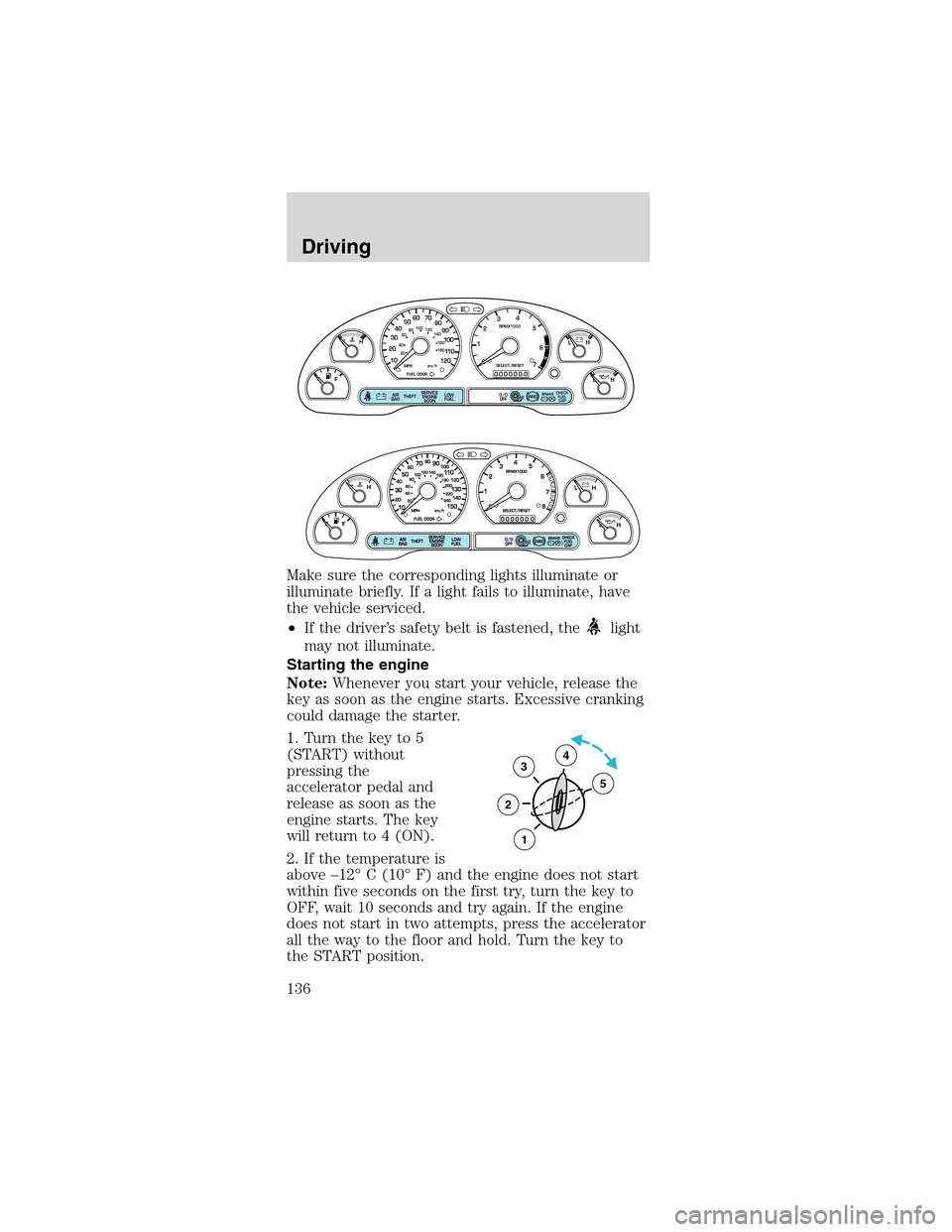
Makesurethecorrespondinglights illuminate or
illuminate briefly. If a light fails to illuminate, have
the vehicle serviced.
•If the driver’s safety belt is fastened, the
light
may not illuminate.
Starting the engine
Note:Whenever you start your vehicle, release the
key as soon as the engine starts. Excessive cranking
could damage the starter.
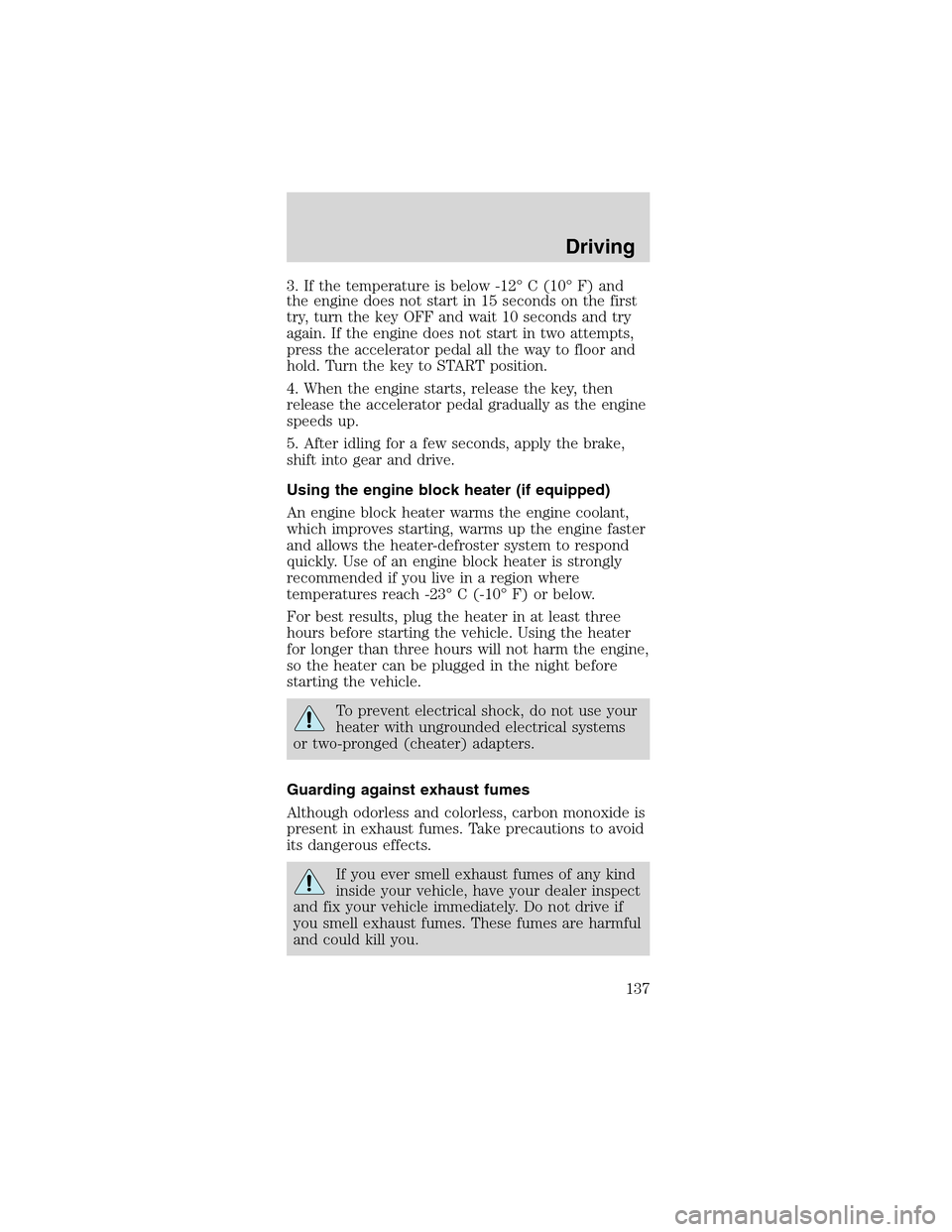
1. Turn the key to 5
(START) without
pressing the
accelerator pedal and
release as soon as the
engine starts. The key
will return to 4 (ON).
2. If the temperature is
above–12°C (10°F) and the engine does not start
within five seconds on the first try, turn the key to
OFF, wait 10 seconds and try again. If the engine
does not start in two attempts, press the accelerator
all the way to the floor and hold. Turn the key to
the START position.
P! BRAKE
L
0
00000 00
C
E
FH
LH
10 203020 406080100
120
140
160
180
405060 70
80
90
100
11 0
1204
5
6
7 3
2
1
H
THEFT
RPMX1000
FUEL DOORSELECT/RESET
LOW
FUELO/D
OFF AIR
BAGSERVICE
ENGINE
SOON
MPH km/h
ABS
.
CHECK
FUEL
CAP
3
2
1
5
4
Driving
136
Page 137 of 256
3. If the temperature is below -12°C (10°F) and
the engine does not start in 15 seconds on the first
try, turn the key OFF and wait 10 seconds and try
again. If the engine does not start in two attempts,
press the accelerator pedal all the way to floor and
hold. Turn the key to START position.
4. When the engine starts, release the key, then
release the accelerator pedal gradually as the engine
speeds up.
5. After idling for a few seconds, apply the brake,
shift into gear and drive.
Using the engine block heater (if equipped)
An engine block heater warms the engine coolant,
which improves starting, warms up the engine faster
and allows the heater-defroster system to respond
quickly. Use of an engine block heater is strongly
recommended if you live in a region where
temperatures reach -23°C (-10°F) or below.
For best results, plug the heater in at least three
hours before starting the vehicle. Using the heater
for longer than three hours will not harm the engine,
so the heater can be plugged in the night before
starting the vehicle.
To prevent electrical shock, do not use your
heater with ungrounded electrical systems
or two-pronged (cheater) adapters.
Guarding against exhaust fumes
Although odorless and colorless, carbon monoxide is
present in exhaust fumes. Take precautions to avoid
its dangerous effects.
If you ever smell exhaust fumes of any kind
inside your vehicle, have your dealer inspect
and fix your vehicle immediately. Do not drive if
you smell exhaust fumes. These fumes are harmful
and could kill you.
Driving
137
Page 138 of 256
Have the exhaust and body ventilation systems
checked whenever:
•the vehicle is raised for service.
•the sound of the exhaust system changes.
•the vehicle has been damaged in a collision.
WARNING:Engine exhaust, some of its
constituents, and certain vehicle
components contain or emit chemicals known to
the State of California to cause cancer and birth
defects or other reproductive harm. In addition,
certain fluids contained in vehicles and certain
products of component wear contain or emit
chemicals known to the State of California to
cause cancer and birth defects or other
reproductive harm.
Important ventilating information
If the engine is idling while the vehicle is stopped in
an open area for long periods of time, open the
windows at least 2.5 cm (one inch).
Adjust the heating or air conditioning (if equipped)
to bring in fresh air.
Improve vehicle ventilation by keeping all air inlet
vents clear of snow, leaves and other debris.
BRAKES
Your service brakes are self-adjusting. Refer to the
scheduled maintenance guide for scheduled
maintenance.
Occasional brake noise is normal and often does not
indicate a performance concern with the vehicle’s
brake system. In normal operation, automotive brake
systems may emit occasional or intermittent squeal
or groan noises when the brakes are applied. Such
noises are usually heard during the first few brake
applications in the morning; however, they may be
heard at any time while braking and can be
aggravated by environmental conditions such as
Driving
138
Page 139 of 256
cold, heat, moisture, road dust, salt or mud. If a
“metal-to-metal,”“continuous grinding”or
“continuous squeal”sound is present while braking,
the brake linings may be worn-out and should be
inspected by a qualified service technician.
If you are driving down a long or steep hill,
shift to a lower gear. Do not apply your
brakes continuously, as they may overheat and
become less effective.
Parking brake
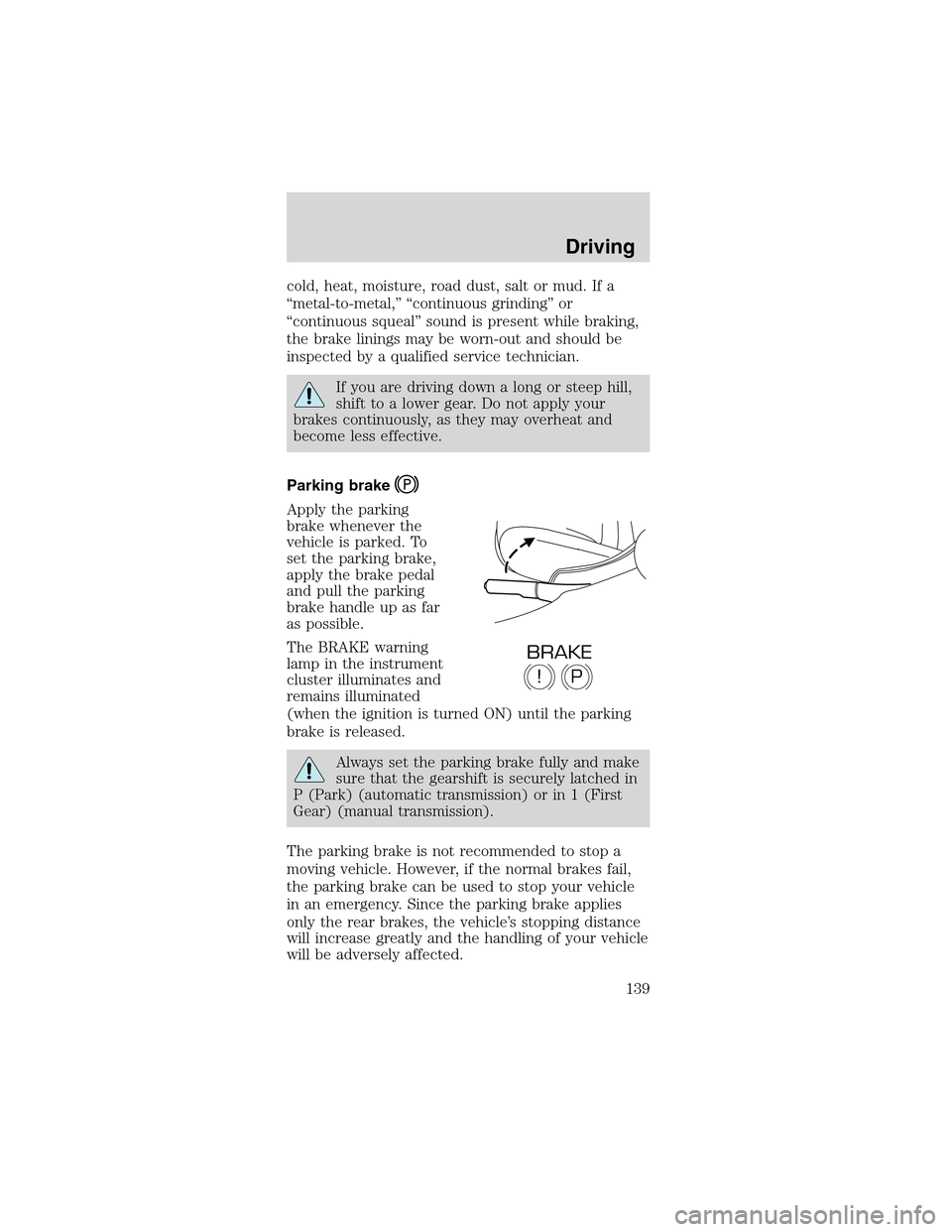
Apply the parking
brake whenever the
vehicle is parked. To
set the parking brake,
apply the brake pedal
and pull the parking
brake handle up as far
as possible.
The BRAKE warning
lamp in the instrument
cluster illuminates and
remains illuminated
(when the ignition is turned ON) until the parking
brake is released.
Always set the parking brake fully and make
sure that the gearshift is securely latched in
P (Park) (automatic transmission) or in 1 (First
Gear) (manual transmission).
The parking brake is not recommended to stop a
moving vehicle. However, if the normal brakes fail,
the parking brake can be used to stop your vehicle
in an emergency. Since the parking brake applies
only the rear brakes, the vehicle’s stopping distance
will increase greatly and the handling of your vehicle
will be adversely affected.
P!
BRAKE
Driving
139