Page 139 of 320
•A second key on the same key ring as thecoded key
If any of these items are present, you need to keep these objects from
touching thecoded keywhile starting the engine. These objects and
devices cannot damage thecoded key,but can cause a momentary“no
start”condition if they are too close to the key during engine start. If a
problem occurs, turn ignition OFF and restart the engine with all other
objects on the key ring held away from the ignition key. Check to make
sure thecoded keyis an approved Fordcoded key.
If your keys are lost or stolen you will need to do the following:
•Use your spare key to start the vehicle, or
•Have your vehicle towed to a dealership or a locksmith. The key codes
will need to be erased from your vehicle and new key codes will need
to be re-coded.
Replacing coded keys can be very costly and you may want to store an
extra programmed key away from the vehicle in a safe place to prevent
an unforeseen inconvenience.
The correctcoded keymust be used for your vehicle. The use of the
wrong type ofcoded keymay lead to a“no start”condition.
If an unprogrammed key is used in the ignition it will cause a“no
start”condition.
Programming spare keys
A maximum of eight keys can be coded to your vehicle. Only
SecuriLock�keys can be used. To program acoded keyyourself, you
will need two previously programmedcoded keys(keys that already
operate your vehicle’s engine) and the new unprogrammed key(s) readily
accessible for timely implementation of each step in the procedure.
If two previously programmed coded keys are not available, you must
bring your vehicle to your dealership to have the spare coded key(s)
programmed.
Please read and understand the entire procedure before you begin.
Locks and Security
139
Page 297 of 320
Tire rotation
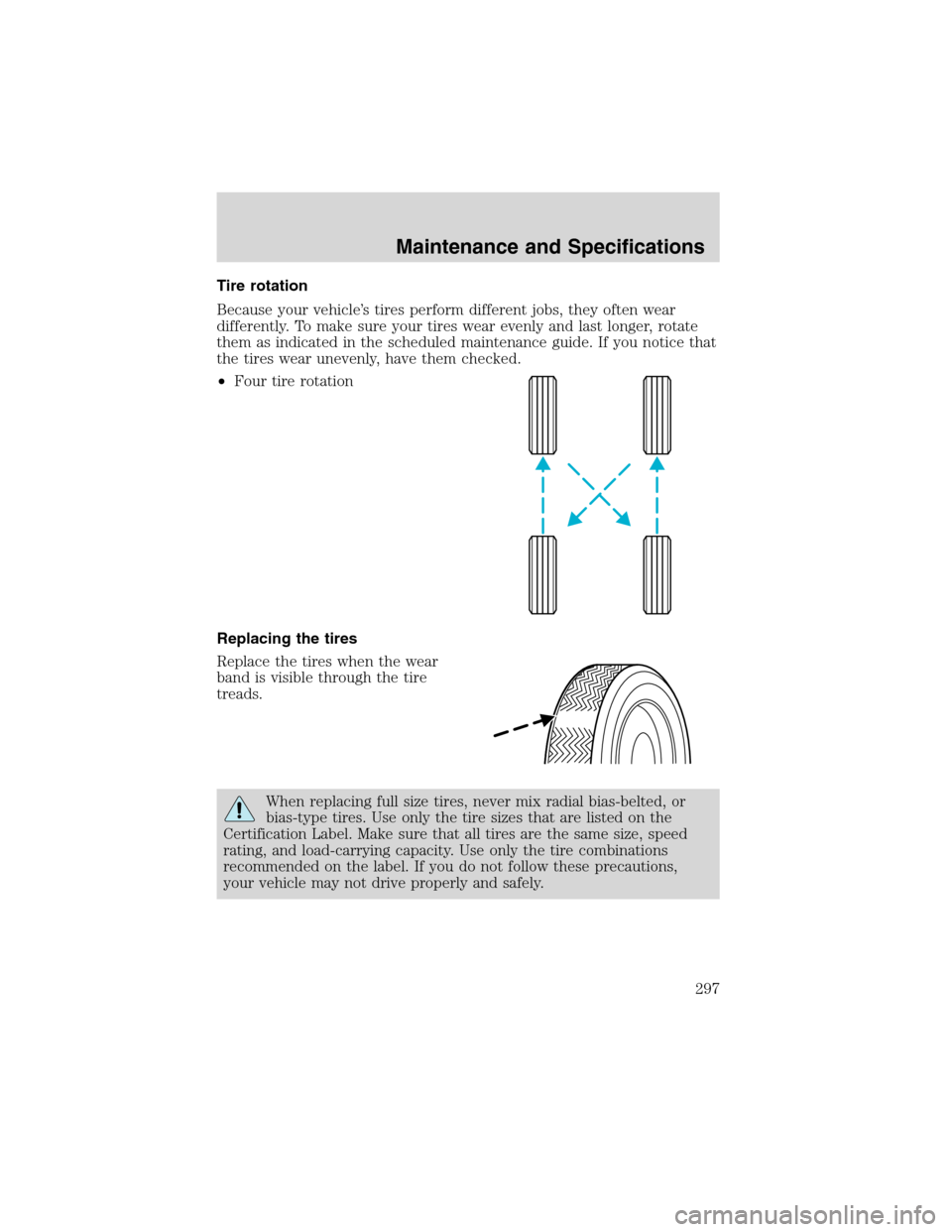
Because your vehicle’s tires perform different jobs, they often wear
differently. To make sure your tires wear evenly and last longer, rotate
them as indicated in the scheduled maintenance guide. If you notice that
the tires wear unevenly, have them checked.
•Four tire rotation
Replacing the tires
Replace the tires when the wear
band is visible through the tire
treads.
When replacing full size tires, never mix radial bias-belted, or
bias-type tires. Use only the tire sizes that are listed on the
Certification Label. Make sure that all tires are the same size, speed
rating, and load-carrying capacity. Use only the tire combinations
recommended on the label. If you do not follow these precautions,
your vehicle may not drive properly and safely.
Maintenance and Specifications
297
Page 318 of 320

opening the trunk ...................130
panic alarm .............................130
replacement/additional
transmitters .............................132
replacing the batteries ...........132
Reverse sensing system ...........206
Roadside assistance ..................227
Roof rack ...................................127
S
Safety belts (see Safety
restraints) ............14, 155, 158–162
Safety Canopy ...........................173
Safety defects, reporting ..........258
Safety restraints ........155, 158–162
belt minder .............................164
extension assembly ................167
for adults .........................159–161
for children .....................176–177
lap belt ....................................163
warning light and
chime ...................12, 14, 163–164
Safety seats for children ..........180
Seat belts
(see Safety restraints) .............155
Seats ..........................................141
child safety seats ....................180
climate control ........................144
memory seat ...................131, 144
SecuriLock passive
anti-theft system ...............137–139
Servicing your vehicle ..............265
Snowplowing .................................7
Spare tire (see Changing
the Tire) ....................................236Spark plugs,
specifications .....................300, 305
Special notice
utility-type vehicles ....................7
Specification chart,
lubricants ...........................303, 305
Speed control ............................103
Speedometer ...............................17
Starting your vehicle ........191–193
jump starting ..........................241
Steering
speed sensitive .......................198
Steering wheel
controls ............................103, 106
T
Tachometer .................................18
Tire warning ..............................298
Tires ...................236, 295–296, 298
changing ..........................236, 238
checking the pressure ............296
replacing ..................................297
rotating ....................................297
snow tires and chains ............299
tire grades ...............................296
treadwear ................................295
Towing .......................................221
recreational towing .................226
trailer towing ..........................221
wrecker ....................................247
Traction control
active light ................................12
Transmission .............................202
fluid, checking and adding
(automatic) .............................291
fluid, refill capacities ..............300
Index
318