Page 96 of 320
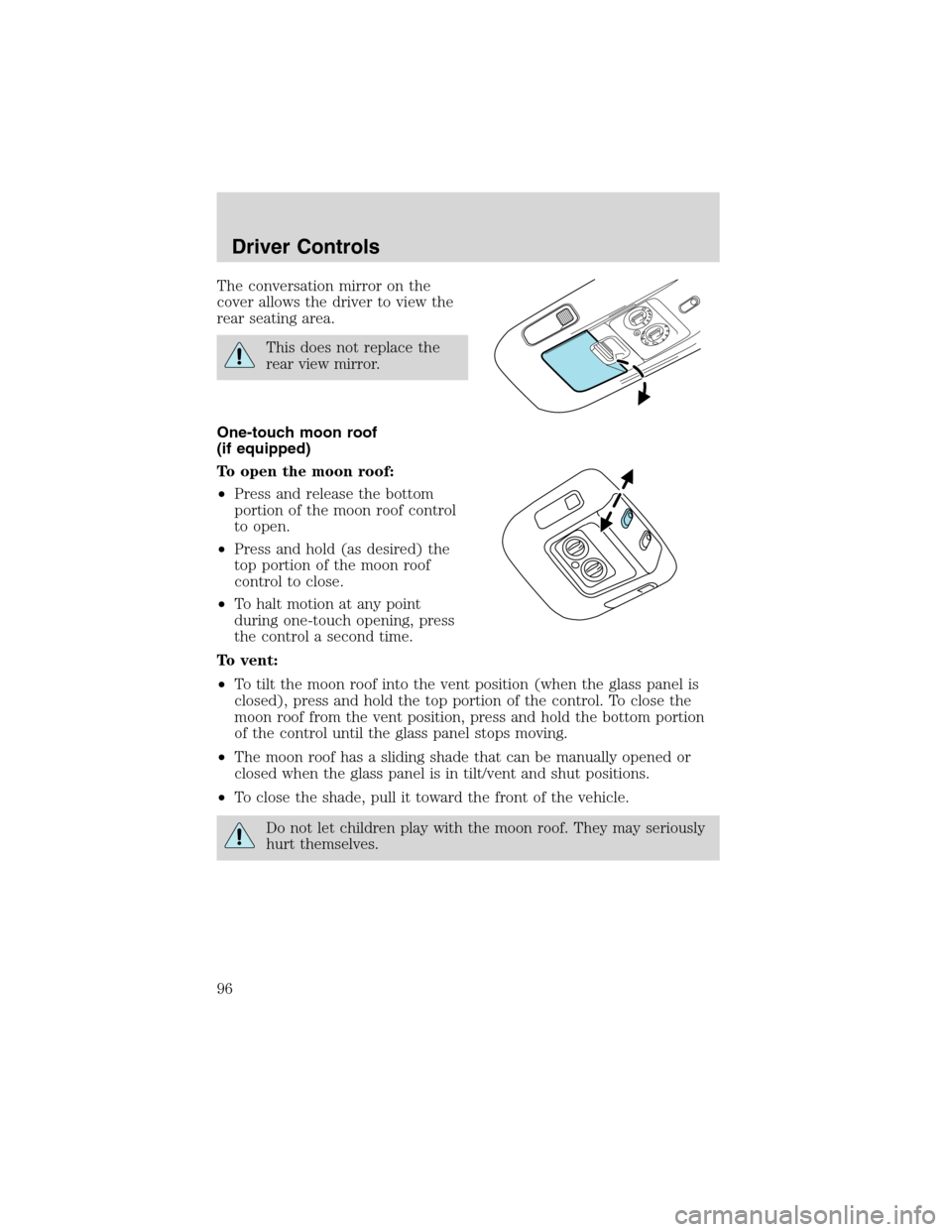
The conversation mirror on the
cover allows the driver to view the
rear seating area.
This does not replace the
rear view mirror.
One-touch moon roof
(if equipped)
To open the moon roof:
•Press and release the bottom
portion of the moon roof control
to open.
•Press and hold (as desired) the
top portion of the moon roof
control to close.
•To halt motion at any point
during one-touch opening, press
the control a second time.
To vent:
•To tilt the moon roof into the vent position (when the glass panel is
closed), press and hold the top portion of the control. To close the
moon roof from the vent position, press and hold the bottom portion
of the control until the glass panel stops moving.
•The moon roof has a sliding shade that can be manually opened or
closed when the glass panel is in tilt/vent and shut positions.
•To close the shade, pull it toward the front of the vehicle.
Do not let children play with the moon roof. They may seriously
hurt themselves.
Driver Controls
96
Page 97 of 320
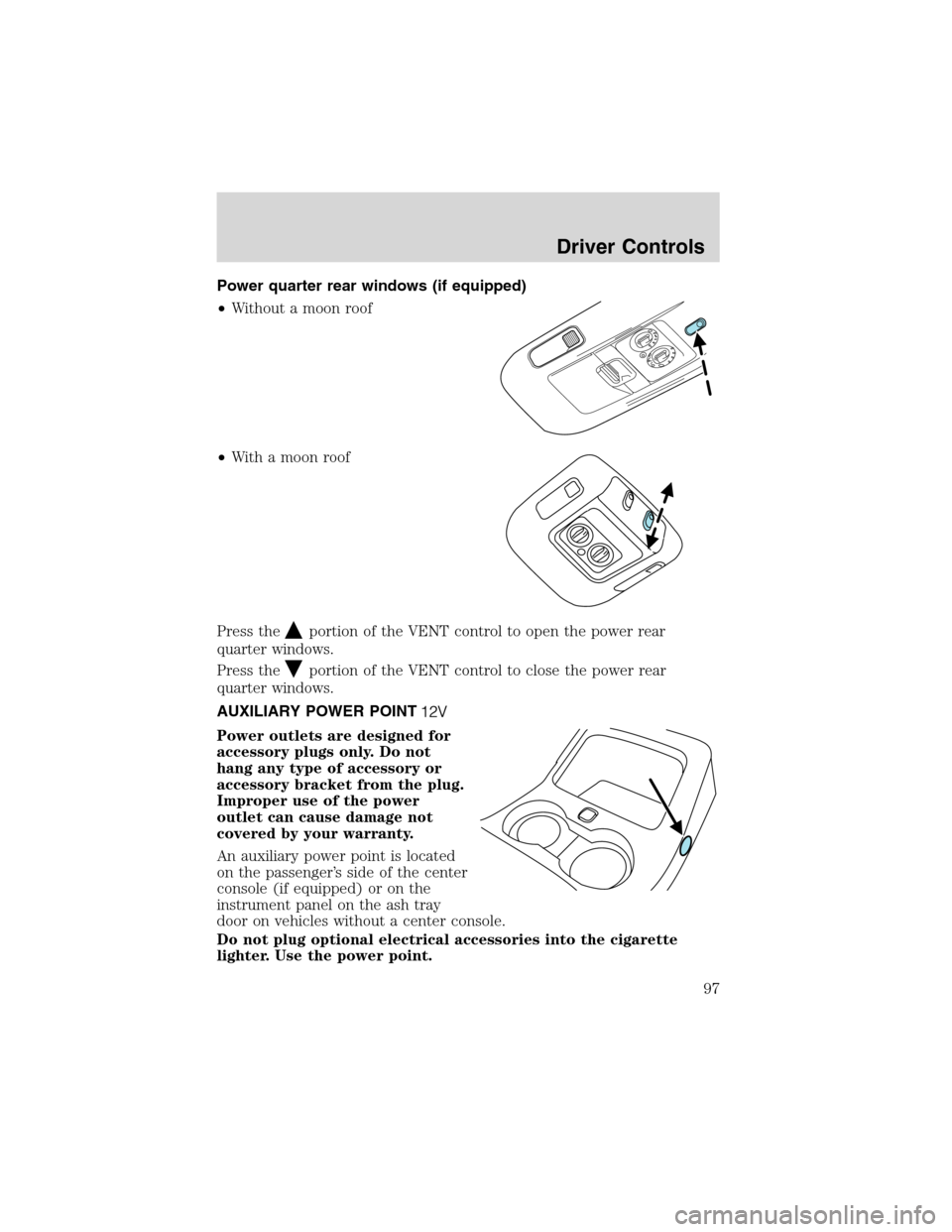
Power quarter rear windows (if equipped)
•Without a moon roof
•With a moon roof
Press the
portion of the VENT control to open the power rear
quarter windows.
Press the
portion of the VENT control to close the power rear
quarter windows.
AUXILIARY POWER POINT
Power outlets are designed for
accessory plugs only. Do not
hang any type of accessory or
accessory bracket from the plug.
Improper use of the power
outlet can cause damage not
covered by your warranty.
An auxiliary power point is located
on the passenger’s side of the center
console (if equipped) or on the
instrument panel on the ash tray
door on vehicles without a center console.
Do not plug optional electrical accessories into the cigarette
lighter. Use the power point.
Driver Controls
97
Page 127 of 320
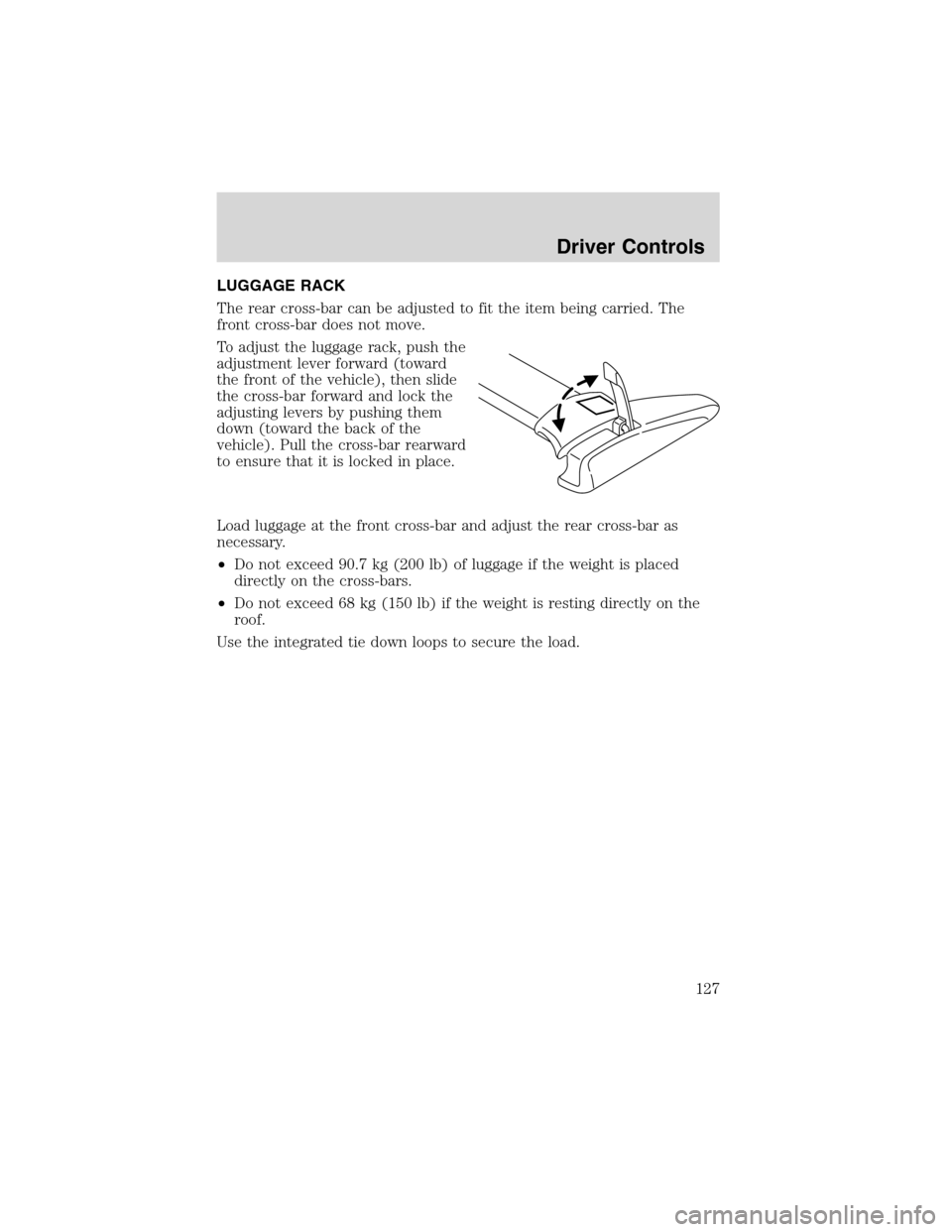
LUGGAGE RACK
The rear cross-bar can be adjusted to fit the item being carried. The
front cross-bar does not move.
To adjust the luggage rack, push the
adjustment lever forward (toward
the front of the vehicle), then slide
the cross-bar forward and lock the
adjusting levers by pushing them
down (toward the back of the
vehicle). Pull the cross-bar rearward
to ensure that it is locked in place.
Load luggage at the front cross-bar and adjust the rear cross-bar as
necessary.
•Do not exceed 90.7 kg (200 lb) of luggage if the weight is placed
directly on the cross-bars.
•Do not exceed 68 kg (150 lb) if the weight is resting directly on the
roof.
Use the integrated tie down loops to secure the load.
Driver Controls
127
Page 128 of 320
KEYS
The key operates all locks on your vehicle. In case of loss, replacement
keys are available from your dealer.
You should always carry a second key with you in a safe place in case
you require it in an emergency.
Refer toSecuriLock�Passive Anti-Theft Systemfor more information.
POWER DOOR LOCKS
If the door does not unlock when the control is pressed, seeInterior
power door lock disable featurein theRemote entry sectionin this
chapter.
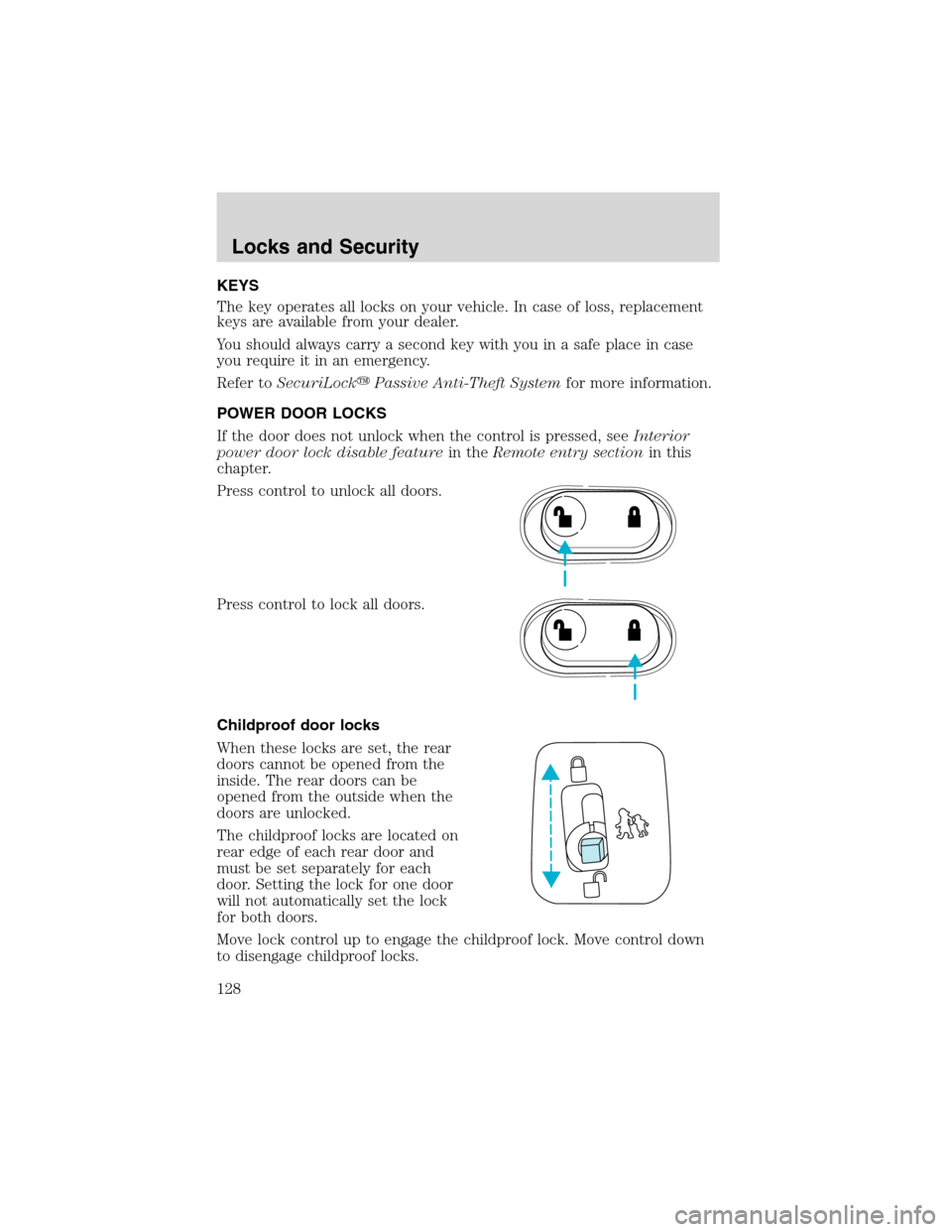
Press control to unlock all doors.
Press control to lock all doors.
Childproof door locks
When these locks are set, the rear
doors cannot be opened from the
inside. The rear doors can be
opened from the outside when the
doors are unlocked.
The childproof locks are located on
rear edge of each rear door and
must be set separately for each
door. Setting the lock for one door
will not automatically set the lock
for both doors.
Move lock control up to engage the childproof lock. Move control down
to disengage childproof locks.
Locks and Security
128
Page 175 of 320
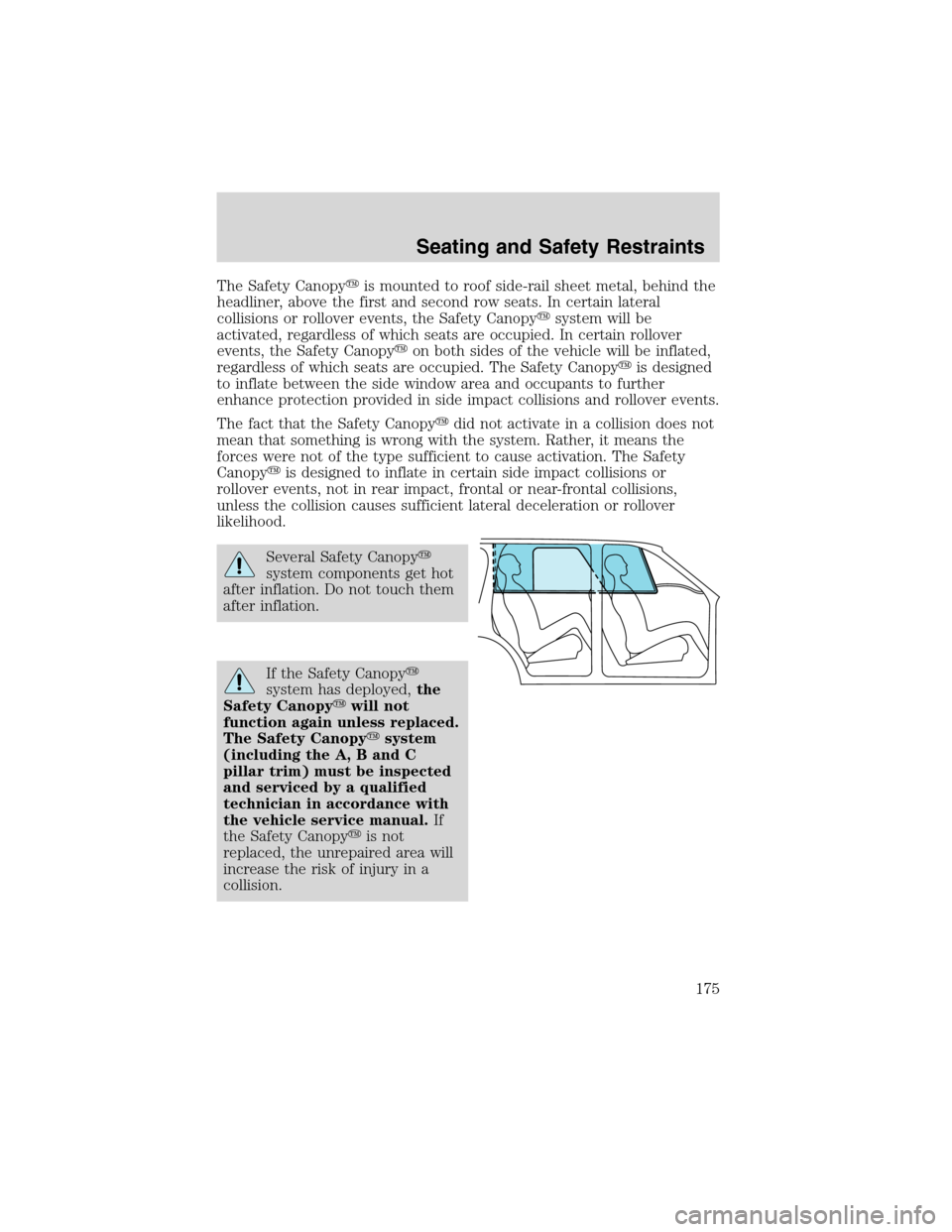
The Safety Canopy�is mounted to roof side-rail sheet metal, behind the
headliner, above the first and second row seats. In certain lateral
collisions or rollover events, the Safety Canopy�system will be
activated, regardless of which seats are occupied. In certain rollover
events, the Safety Canopy�on both sides of the vehicle will be inflated,
regardless of which seats are occupied. The Safety Canopy�is designed
to inflate between the side window area and occupants to further
enhance protection provided in side impact collisions and rollover events.
The fact that the Safety Canopy�did not activate in a collision does not
mean that something is wrong with the system. Rather, it means the
forces were not of the type sufficient to cause activation. The Safety
Canopy�is designed to inflate in certain side impact collisions or
rollover events, not in rear impact, frontal or near-frontal collisions,
unless the collision causes sufficient lateral deceleration or rollover
likelihood.
Several Safety Canopy�
system components get hot
after inflation. Do not touch them
after inflation.
If the Safety Canopy�
system has deployed,the
Safety Canopy�will not
function again unless replaced.
The Safety Canopy�system
(including the A, B and C
pillar trim) must be inspected
and serviced by a qualified
technician in accordance with
the vehicle service manual.If
the Safety Canopy�is not
replaced, the unrepaired area will
increase the risk of injury in a
collision.
Seating and Safety Restraints
175
Page 233 of 320

Fuse/Relay
LocationFuse Amp
RatingPassenger Compartment Fuse Panel
Description
14 15A* Climate control blend door actuator,
Daytime Running Lamps (DRL) relays,
Digital Transmission Range Sensor (DTRS)
back-up lamp
15 5A* AdvanceTrac�switch, Instrument cluster
16 10A* ABS module
17 15A* Foglamps
18 10A* Electrochromic mirror, Auxiliary A/C,
Climate-controlled seats module,
Temperature solenoid, Turn signal flasher,
Sunload sensor, Electronic park brake
relay coil
19 10A* Restraints Control Module (RCM)
20 30A* Air suspension module (air spring
solenoids and height sensors), 4x4 module
21 15A* Instrument cluster (interior lamps),
Interior lamps, Electronic park brake relay,
Tire Pressure Monitoring System (TPMS)
22 10A* Door lock switch illumination, Moonroof
switch illumination, Radio (delayed
accessory signal), Flip window switch
23 10A* RH low beam
24 15A* Battery saver relay, Front map/Dome lamp,
2nd row dome/map lamp, Glove
compartment lamp, Cargo lamp, Rail
lamps, Vanity mirror lamps, Underhood
lamp
25 10A* LH low beam
26 20A* Horn relay, Horns
27 5A* Compass, Reverse sensing system module,
Brake shift interlock (BSI) solenoid,
Overdrive cancel switch, Air suspension
module (Run/Start sense)
Roadside Emergencies
233
Page 235 of 320
Fuse/Relay
LocationFuse Amp
RatingPassenger Compartment Fuse Panel
Description
106 30A** Trailer tow battery charge relay
107 30A** Auxiliary blower relay, Auxiliary blower
motor
108 30A** Power passenger seat switch, Passenger
power lumbar switch
109 30A** Driver seat motor switch, Driver lumbar
switch, Adjustable pedal switch, Memory
module
110 30A** Spare
111 50A** Air suspension solid state relay, Air
suspension compressor
112 30A** ABS module (valves)
113 30A** Front wiper motor, Front washer pump
114 40A** Rear window defrost relay, Heated mirrors
(Fuse # 8)
115 30A** 4x4 module, Transfer case shift motor
116 40A** Front blower relay, Front blower motor
117 30A** RH 3rd row power seat
118 30A** Driver and passenger climate control seat
module
401 30A** Power window circuit breaker, Main
window switch, Window motors, Window
switches, Moonroof module
R01 Starter relay Starter motor solenoid
R02 Delayed
accessory
relayFuse # 22, CB # 401, Power windows,
Switch backlighting, Radio, Moonroof, Flip
windows
R03 Hi-beam
relayFuse # 35, Hi-beam headlamps, Hi-beam
indicator, DRL relays
R04 Rear window
defroster
relayFuse # 8 (heated mirrors), Rear window
defroster
Roadside Emergencies
235
Page 259 of 320
WASHING THE EXTERIOR
Wash your vehicle regularly with cool or lukewarm water and a neutral
Ph shampoo, such as Detail Wash (ZC-3–A), which is available from your
dealer.
•Never use strong household detergents or soap, such as dish washing
or laundry liquid. These products can discolor and spot painted
surfaces.
•Never wash a vehicle that is“hot to the touch”or during exposure to
strong, direct sunlight.
•Always use a clean sponge or carwash mitt with plenty of water for
best results.
•Dry the vehicle with a chamois or soft terry cloth towel in order to
eliminate water spotting.
•It is especially important to wash the vehicle regularly during the
winter months, as dirt and road salt are difficult to remove and cause
damage to the vehicle.
•Immediately remove items such as gasoline, diesel fuel, bird droppings
and insect deposits because they can cause damage to the vehicle’s
paintwork and trim over time.
•Remove any exterior accessories, such as antennas, before entering a
car wash.
•Suntan lotions and insect repellents can damage any painted
surface; if these substances come in contact with your vehicle,
wash off as soon as possible.
•If your vehicle is equipped with running boards, do not use
rubber, plastic and vinyl protectant products on the running
board surface, as the area may become slippery.
WAXING
Applying a polymer paint sealant to your vehicle every six months will
assist in reducing minor scratches and paint damage.
•Wash the vehicle first.
•Do not use waxes that contain abrasives.
•Do not allow paint sealant to come in contact with any non-body
(low-gloss black) colored trim, such as grained body-side cladding,
roof racks, bumper step surfaces, mirror housings or the windshield
cowl area. The paint sealant will“gray”or stain the parts over time.
Cleaning
259