Page 225 of 320
Trailer lamps
Trailer lamps are required on most towed vehicles. Make sure your
trailer lamps conform to local and Federal regulations. See your dealer or
trailer rental agency for proper instructions and equipment for hooking
up trailer lamps.
Driving while you tow
When towing a trailer:
•Turn off the speed control. The speed control may shut off
automatically when you are towing on long, steep grades.
•Consult your local motor vehicle speed regulations for towing a trailer.
•To eliminate excessive shifting, use a lower gear. This will also assist
in transmission cooling. (For additional information, refer to the
Driving with a 4–speed automatic transmissionsection in this
chapter.
•Anticipate stops and brake gradually.
•Do not exceed the GCWR rating or transmission damage may occur.
Servicing after towing
If you tow a trailer for long distances, your vehicle will require more
frequent service intervals. Refer to your scheduled maintenance guide for
more information.
Trailer towing tips
•Practice turning, stopping and backing up before starting on a trip to
get the feel of the vehicle trailer combination. When turning, make
wider turns so the trailer wheels will clear curbs and other obstacles.
•Allow more distance for stopping with a trailer attached.
•If you are driving down a long or steep hill, shift to a lower gear. Do
not apply the brakes continuously, as they may overheat and become
less effective.
•The trailer tongue weight should be 10–15% of the loaded trailer
weight.
•After you have traveled 80 km (50 miles), thoroughly check your
hitch, electrical connections and trailer wheel lug nuts.
•To aid in engine/transmission cooling and A/C efficiency during hot
weather while stopped in traffic, place the gearshift lever in P (Park).
•Vehicles with trailers should not be parked on a grade. If you must
park on a grade, place wheel chocks under the trailer’s wheels.
Driving
225
Page 232 of 320
The fuses are coded as follows.
Fuse/Relay
LocationFuse Amp
RatingPassenger Compartment Fuse Panel
Description
1 10A* Front wiper motor, Instrument cluster,
Rear wiper motor, Tire Pressure
Monitoring System (TPMS)
2 20A* Turn signal flasher, Stoplamp switch,
Hazard flasher, IVD (AdvanceTrac)
stoplamps relay
3 7.5A* Power mirrors, Memory seat switch,
Memory seat module
4 10A* DVD player, Rear seat audio controls,
CDDJ
5 7.5A* Powertrain Control Module (PCM) (KA
power), SC deactivate switch, Manual
climate control mode switch, Stoplamp
switch, Brake-shift interlock (BSI)
solenoid, EATC control head, BSM module,
Speed control servo, 3rd row seat relay
6 15A* Headlamp switch, Parklamps, License plate
lamps, Trailer tow electric brake controller,
BSM parklamps relay
7 7.5A* Radio
8 10A* Rear window defroster switch, Heated
mirrors
9 10A* Alternator
10 20A* Back-up lamps, Back-up lamp relay, Trailer
tow parklamp relay
11 10A* A/C clutch relay, 4x4 IWE solenoid
12 10A* Speed control servo, Speed control
13 10A* EATC control head, Manual climate control
head
Roadside Emergencies
232
Page 233 of 320

Fuse/Relay
LocationFuse Amp
RatingPassenger Compartment Fuse Panel
Description
14 15A* Climate control blend door actuator,
Daytime Running Lamps (DRL) relays,
Digital Transmission Range Sensor (DTRS)
back-up lamp
15 5A* AdvanceTrac�switch, Instrument cluster
16 10A* ABS module
17 15A* Foglamps
18 10A* Electrochromic mirror, Auxiliary A/C,
Climate-controlled seats module,
Temperature solenoid, Turn signal flasher,
Sunload sensor, Electronic park brake
relay coil
19 10A* Restraints Control Module (RCM)
20 30A* Air suspension module (air spring
solenoids and height sensors), 4x4 module
21 15A* Instrument cluster (interior lamps),
Interior lamps, Electronic park brake relay,
Tire Pressure Monitoring System (TPMS)
22 10A* Door lock switch illumination, Moonroof
switch illumination, Radio (delayed
accessory signal), Flip window switch
23 10A* RH low beam
24 15A* Battery saver relay, Front map/Dome lamp,
2nd row dome/map lamp, Glove
compartment lamp, Cargo lamp, Rail
lamps, Vanity mirror lamps, Underhood
lamp
25 10A* LH low beam
26 20A* Horn relay, Horns
27 5A* Compass, Reverse sensing system module,
Brake shift interlock (BSI) solenoid,
Overdrive cancel switch, Air suspension
module (Run/Start sense)
Roadside Emergencies
233
Page 234 of 320

Fuse/Relay
LocationFuse Amp
RatingPassenger Compartment Fuse Panel
Description
28 5A* SecuriLock transceiver
29 30A* Trailer tow electric brake controller
30 30A* BSM (door locks), Liftgate glass release
relay, Liftgate glass release motor,
Door/Liftgate locks, Parklamps relay
(BSM), Headlamps relay (BSM), Door
lock/Unlock relay (BSM)
31 25A* Radio
32 15A* CMS, Transmission solenoids
33 20A* Canister vent solenoid, EVR CC, HEGOs,
VMV solenoid, IMTV solenoid, A/C clutch
relay coil
34 20A* PCM, Fuel injectors, Idle air control (IAC)
solenoid, Mass air flow sensor
35 20A* Instrument cluster high beam indicator,
High beam headlamps
36 10A* Trailer tow right turn lamp
37 20A* Cargo area power point
38 25A* Rear wiper motor, Washer pump (rear
window wash)
39 20A* Instrument panel or floor console power
point, Rear console power point
40 20A* Headlamp switch, High beam relay coil, LH
low beam fuse # 25, LH low beam fuse #
23, BSM (autolamps headlamp relay), DRL
41 20A* Cigar lighter, OBD II Connector
42 10A* Trailer tow left turn lamp
101 30A** Starter relay, Starter solenoid
102 30A** Ignition switch, Starter solenoid
103 30A** ABS module (pump motor)
104 30A** LH 3rd row power seat
105 30A** Spare
Roadside Emergencies
234
Page 236 of 320

Fuse/Relay
LocationFuse Amp
RatingPassenger Compartment Fuse Panel
Description
R05 T/T battery
charge relayTT 7 wire connector, Battery charge
R06 Front blower
relayBlower motor, Blower motor speed control
(EATC)
R201 T/T park
lamp relayTrailer tow park lamps feed
R202 Fog lamp
relayFront fog lamps
R203 PCM relay Fuse # 32, Fuse # 33, Fuse # 34, Fuel
pump relay, PCM solenoids and sensors
R301 T/T back-up
lamp relayBack-up lamps, TT connector (back-up
lamps), Electrochromic mirror
R302 Speed
control relayElectric cooling fan clutch, Speed control
servo
R303 Fuel pump
relayFuel pump shut-off switch, PCM fuel
pump monitor, Fuel pump
R304 Battery
saver relayRail lamps, Vanity mirror lamps, Dome
lamp, Glove box lamp, Instrument cluster
R305 Horn relay Dual note horn
* Mini Fuses ** Maxi Fuses
CHANGING THE TIRES
If you get a flat tire while driving, do not apply the brake heavily.
Instead, gradually decrease your speed. Hold the steering wheel firmly
and slowly move to a safe place on the side of the road.
The use of tire sealants is not recommended and may compromise the
integrity of your tires. The use of tire sealants may also affect your tire
pressure monitoring system (if equipped).
Spare tire information
Your vehicle is equipped with a spare tire that may be used as a spare or
a regular tire. The spare is identical to the other tires on your vehicle,
although the wheel may not match.
Roadside Emergencies
236
Page 238 of 320
7. To remove the spare tire, turn the handle counterclockwise until the
tire is lowered to the ground and the cable is slightly slack.
8. Slide the retainer through the center of the spare tire wheel.
Tire change procedure
To prevent the vehicle from moving when you change a tire, be
sure the parking brake is set, then block (in both directions) the
wheel that is diagonally opposite (other side and end of the vehicle) to
the tire being changed.
If the vehicle slips off the jack, you or someone else could be
seriously injured.
On vehicles equipped with Air Suspension, turn OFF the Air
Suspension switch prior to jacking, hoisting or towing your
vehicle.
Refer to the instruction sheet (located in the rear floor compartment
behind the 3rd row seat with the jack tray tools assembly kit) for
detailed tire change instructions.
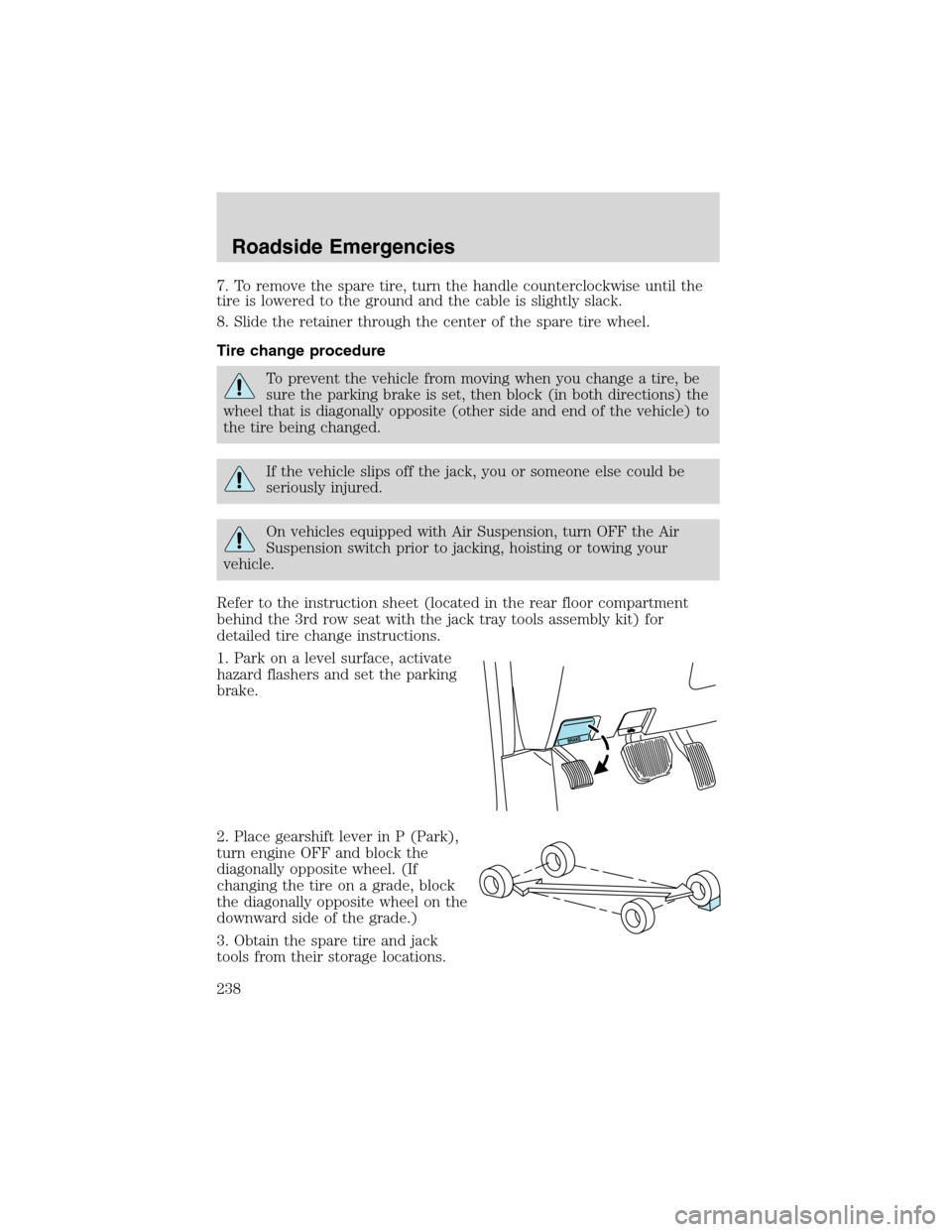
1. Park on a level surface, activate
hazard flashers and set the parking
brake.
2. Place gearshift lever in P (Park),
turn engine OFF and block the
diagonally opposite wheel. (If
changing the tire on a grade, block
the diagonally opposite wheel on the
downward side of the grade.)
3. Obtain the spare tire and jack
tools from their storage locations.
Roadside Emergencies
238
Page 239 of 320
4. Use the tip of the jack handle to
remove any wheel trim. Loosen each
wheel lug nut one-half turn
counterclockwise but do not remove
them until the wheel is raised off
the ground.
5. Position the jack according to the
jack locator arrows found on the
frame and turn the jack handle and
extension tool assembly clockwise.
Lift the vehicle so the tire is no
further than 2.5 cm (1 inch) off the
ground when installing the spare
tire.
When one of the rear wheels is off the ground, the transmission
alone will not prevent the vehicle from moving or slipping off the
jack, even if the transmission is in P (Park). To prevent the vehicle
from moving when you change the tire, be sure that the parking brake
is set and the diagonally opposite wheel is blocked. If the vehicle slips
off the jack, someone could be seriously injured.
•Front
Roadside Emergencies
239
Page 242 of 320
Preparing your vehicle
When the battery is disconnected or a new battery is installed, the
transmission must relearn its shift strategy. As a result, the transmission
may have firm and/or soft shifts. This operation is considered normal and
will not affect function or durability of the transmission. Over time, the
adaptive learning process will fully update transmission operation.
1.Use only a 12–volt supply to start your vehicle.
2. Do not disconnect the battery of the disabled vehicle as this could
damage the vehicle’s electrical system.
3. Park the booster vehicle close to the hood of the disabled vehicle
making sure the two vehiclesdo nottouch. Set the parking brake on
both vehicles and stay clear of the engine cooling fan and other moving
parts.
4. Check all battery terminals and remove any excessive corrosion before
you attach the battery cables. Ensure that vent caps are tight and level.
5. Turn the heater fan on in both vehicles to protect any electrical
surges. Turn all other accessories off.
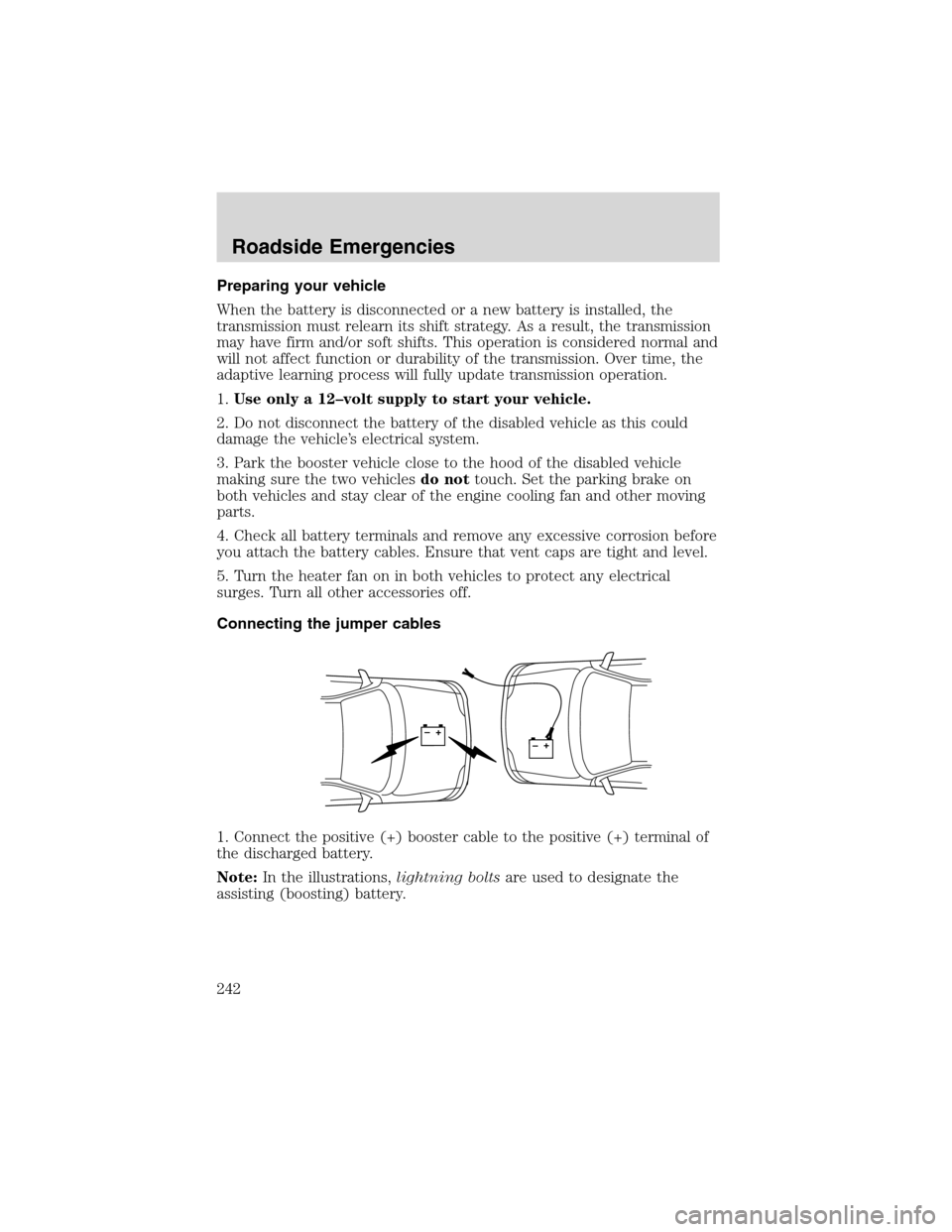
Connecting the jumper cables
1. Connect the positive (+) booster cable to the positive (+) terminal of
the discharged battery.
Note:In the illustrations,lightning boltsare used to designate the
assisting (boosting) battery.
+–+–
Roadside Emergencies
242