Page 238 of 320
7. To remove the spare tire, turn the handle counterclockwise until the
tire is lowered to the ground and the cable is slightly slack.
8. Slide the retainer through the center of the spare tire wheel.
Tire change procedure
To prevent the vehicle from moving when you change a tire, be
sure the parking brake is set, then block (in both directions) the
wheel that is diagonally opposite (other side and end of the vehicle) to
the tire being changed.
If the vehicle slips off the jack, you or someone else could be
seriously injured.
On vehicles equipped with Air Suspension, turn OFF the Air
Suspension switch prior to jacking, hoisting or towing your
vehicle.
Refer to the instruction sheet (located in the rear floor compartment
behind the 3rd row seat with the jack tray tools assembly kit) for
detailed tire change instructions.
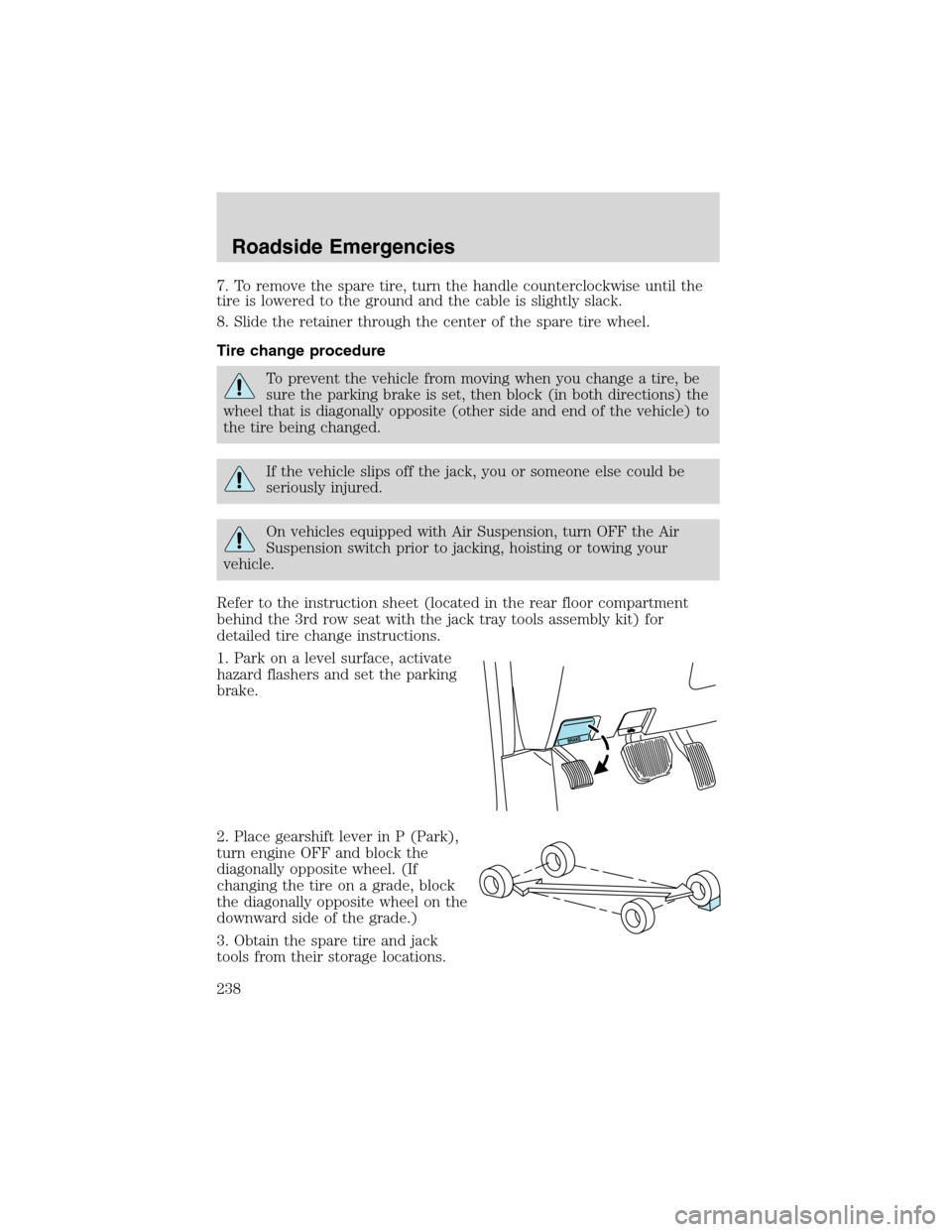
1. Park on a level surface, activate
hazard flashers and set the parking
brake.
2. Place gearshift lever in P (Park),
turn engine OFF and block the
diagonally opposite wheel. (If
changing the tire on a grade, block
the diagonally opposite wheel on the
downward side of the grade.)
3. Obtain the spare tire and jack
tools from their storage locations.
Roadside Emergencies
238
Page 239 of 320
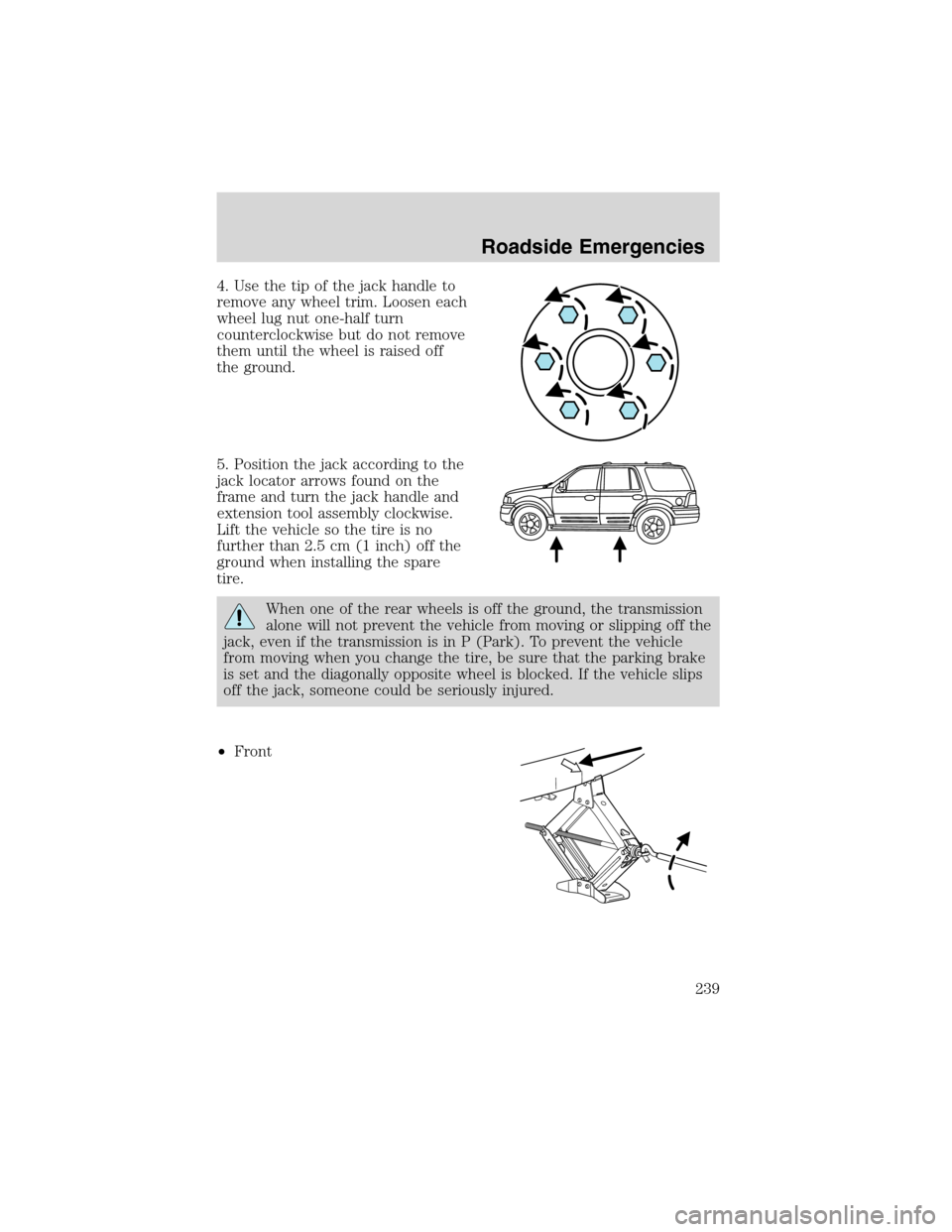
4. Use the tip of the jack handle to
remove any wheel trim. Loosen each
wheel lug nut one-half turn
counterclockwise but do not remove
them until the wheel is raised off
the ground.
5. Position the jack according to the
jack locator arrows found on the
frame and turn the jack handle and
extension tool assembly clockwise.
Lift the vehicle so the tire is no
further than 2.5 cm (1 inch) off the
ground when installing the spare
tire.
When one of the rear wheels is off the ground, the transmission
alone will not prevent the vehicle from moving or slipping off the
jack, even if the transmission is in P (Park). To prevent the vehicle
from moving when you change the tire, be sure that the parking brake
is set and the diagonally opposite wheel is blocked. If the vehicle slips
off the jack, someone could be seriously injured.
•Front
Roadside Emergencies
239
Page 299 of 320

Changing tires with TPMS
It is recommended that you always
have your tires serviced by a dealer
or qualified technician.Each tire is
equipped with a tire pressure
sensor mounted on the wheel
inside the tire behind the valve
stem. The tire pressure sensor
must be unbolted from the wheel prior to tire removal. The
sensor can be removed by loosening the nut at the valve stem.
Failure to remove the sensor may damage it.The rubber grommet
(washer) between the wheel and the tire pressure sensor needs to be
replaced when any tire is changed to minimize air leaks.
The tire pressure should be checked periodically (at least monthly) using
a tire gauge, refer toChecking the tire pressurein this chapter.
SNOW TIRES AND CHAINS
Snow tires must be the same size and grade as the tires you
currently have on your vehicle.
The tires on your vehicle have all weather treads to provide traction in
rain and snow. However, in some climates, you may need to use snow
tires and chains.
Follow these guidelines when using snow tires and chains:
•Use only cable type chains or chains offered by Ford as an accessory
or equivalent. Other conventional link type chains may contact and
cause damage to the vehicle’s wheel house and/or body.
•Do not install chains on the front wheels. Chains on the front wheels
may interfere with suspension components.
•Install chains securely, verifying that the chains do not touch any
wiring, brake lines or fuel lines.
•Drive cautiously. If you hear the chains rub or bang against your
vehicle, stop and re-tighten the chains. If this does not work, remove
the chains to prevent damage to your vehicle.
•If possible, avoid fully loading your vehicle.
•Remove the tire chains when they are no longer needed. Do not use
tire chains on dry roads.
•The suspension insulation and bumpers will help prevent vehicle
damage. Do not remove these components from your vehicle when
using snow tires and chains.
Maintenance and Specifications
299
Page 315 of 320
cleaning ...................................260
coolant .....................................274
fail-safe coolant ......................279
idle speed control ...................272
lubrication
specifications ..................303, 305
refill capacities ........................300
service points ..................267–268
starting after a collision .........228
Engine block heater .................194
Engine oil ..................................269
change oil soon warning,
message center .......................269
checking and adding ..............269
dipstick ....................................269
filter, specifications ........271, 300
recommendations ...................271
refill capacities ........................300
specifications ..................303, 305
Exhaust fumes ..........................194
F
Fail safe cooling ........................279
Floor mats .................................126
Fluid capacities .........................300
Foglamps .....................................81
Four-Wheel Drive
vehicles ................................14, 208
control trac .............................208
description ..............................209
driving off road .......................211
electronic shift ........................210
indicator light .........................208
preparing to drive
your vehicle ............................198
Fuel ............................................280
calculating fuel
economy ..........................116, 285
cap ...........................................282capacity ...................................300
choosing the right fuel ...........283
comparisons with EPA
fuel economy estimates .........288
detergent in fuel .....................284
filling your vehicle
with fuel ..................280, 282, 285
filter, specifications ........284, 300
fuel pump shut-off switch .....228
gauge .........................................17
improving fuel economy ........285
low fuel warning light ..............12
octane rating ...................283, 305
quality ......................................284
running out of fuel .................284
safety information relating
to automotive fuels ................280
Fuses ..................................230–231
G
Garage door opener ..................108
Gas cap (see Fuel cap) ............282
Gas mileage
(see Fuel economy) .................285
Gauges .........................................15
battery voltage gauge ...............16
engine coolant temperature
gauge .........................................15
engine oil pressure gauge ........16
fuel gauge ..................................17
odometer ...................................17
speedometer .............................17
tachometer ................................18
trip odometer ............................18
GAWR (Gross Axle
Weight Rating) ..........................219
calculating ...............................221
definition .................................219
driving with a heavy load ......219
location ....................................219
Index
315