Page 134 of 240

Apply just enough power to the wheels to climb the hill. Too much
power will cause the tires to slip, spin or lose traction, resulting in loss of
vehicle control.
Descend a hill in the same gear you
would use to climb up the hill to
avoid excessive brake application
and brake overheating. Do not
descend in neutral; instead,
disengage overdrive or manually
shift to a lower gear. When
descending a steep hill, avoid
sudden hard braking as you could
lose control. When you brake hard,
the front wheels can’t turn and if
they aren’t turning, you won’tbe
able to steer. The front wheels have to be turning in order to steer the
vehicle. Rapid pumping of the brake pedal will help you slow the vehicle
and still maintain steering control.
If your vehicle has anti-lock brakes, apply the brakes steadily. Do not
“pump”the brakes.
Driving on snow and ice
4x4 vehicles have advantages over 2WD vehicles in snow and ice but can
skid like any other vehicle.
Should you start to slide while driving on snowy or icy roads, turn the
steering wheel in the direction of the slide until you regain control.
Avoid sudden applications of power and quick changes of direction on
snow and ice. Apply the accelerator slowly and steadily when starting
from a full stop.
Avoid sudden braking as well. Although a 4x4 vehicle may accelerate
better than a two-wheel drive vehicle in snow and ice, it won’t stop any
faster, because as in other vehicles, braking occurs at all four wheels. Do
not become overconfident as to road conditions.
Make sure you allow sufficient distance between you and other vehicles
for stopping. Drive slower than usual and consider using one of the lower
gears. In emergency stopping situations, avoid locking of the wheels. Use
a“squeeze”technique, push on the brake pedal with a steadily increasing
force which allows the wheels to brake yet continue to roll so that you
may steer in the direction you want to travel. If you lock the wheels,
release the brake pedal and repeat the squeeze technique. If your vehicle
Driving
134
Page 135 of 240
is equipped with a Four Wheel Anti-Lock Brake System (ABS), apply the
brake steadily. Do not“pump”the brakes. Refer to theBrakessection of
this chapter for additional information on the operation of the anti-lock
brake system.
Never drive with chains on the front tires of 4x4 vehicles without also
putting them on the rear tires. This could cause the rear to slide and
swing around during braking.
Tires, Replacement Requirements
Do not use a size and type of tire and wheel other than that
originally provided by Ford Motor Company because it can affect
the safety and performance of your vehicle, which could result in an
increased risk of loss of vehicle control, vehicle rollover, and/or serious
personal injury or death.
Do not use a size and type of tire and wheel other than that originally
provided by Ford Motor Company because it can affect the safety and
performance of your vehicle, which could lead to loss of vehicle control
or rollover and serious injury. Make sure all tires and wheels on the
vehicle are of the same size, type, tread design, brand and load-carrying
capacity. If you have questions regarding tire replacement, see an
authorized Ford or Lincoln/Mercury dealer.
If you nevertheless decide to equip your 4x4 for off-road use with tires
larger than what Ford Motor Company recommends, you should not use
these tires for highway driving.
If you use any tire/wheel combination not recommended by Ford Motor
Company, it may adversely affect vehicle handling and could cause
steering, suspension, axle or transfer case failure.
Do not use“aftermarket lift kits”or other suspension modifications,
whether or not they are used with larger tires and wheels.
These“aftermarket lift kits”could adversely affect the vehicle’s handling
characteristics, which could lead to loss of vehicle control or rollover and
serious injury.
Tires can be damaged during off-road use. For your safety, tires that are
damaged should not be used for highway driving because they are more
likely to blow out or fail.
You should carefully observe the recommended tire inflation pressure
found on the safety compliance certification label attached to the left
front door lock facing or door latch post pillar. Failure to follow tire
Driving
135
Page 149 of 240
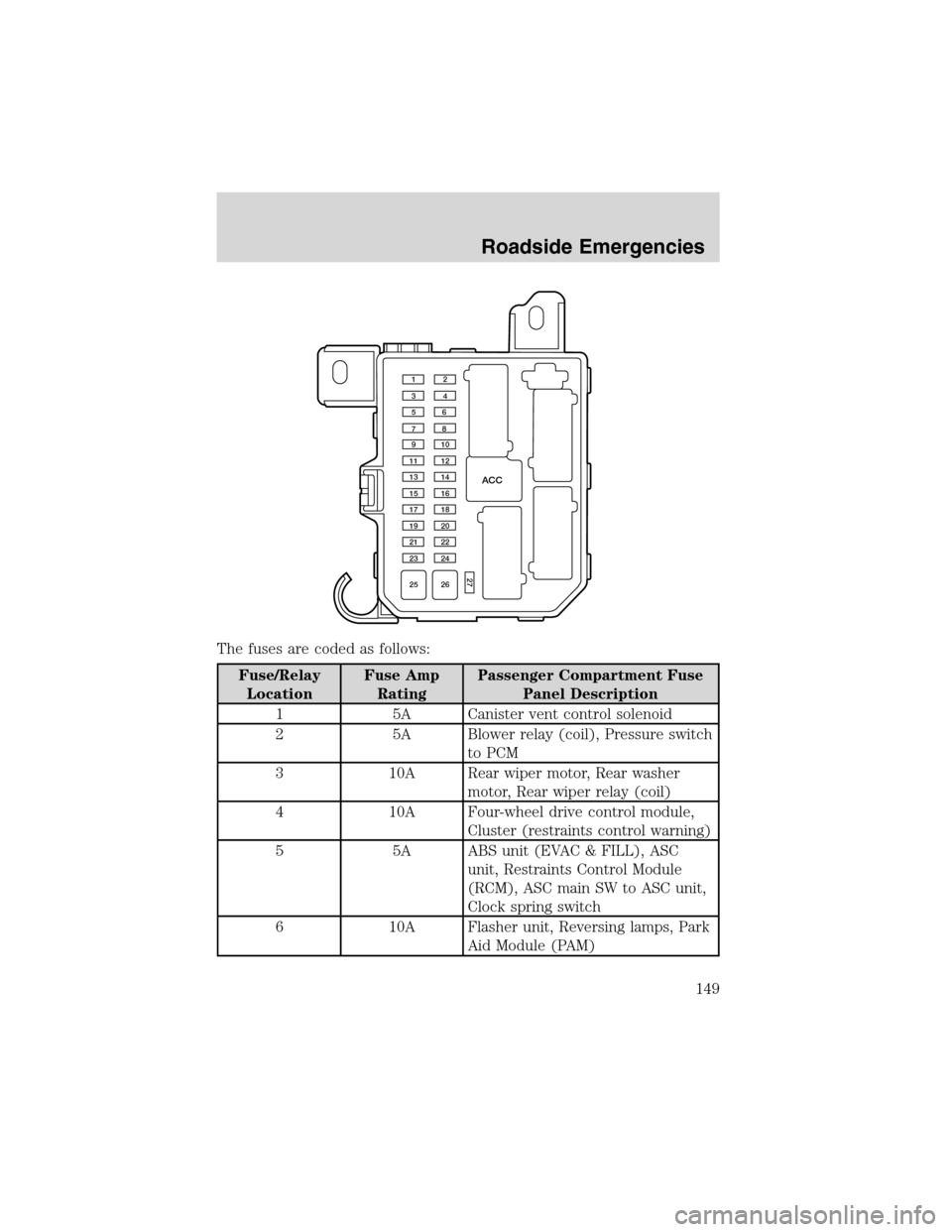
The fuses are coded as follows:
Fuse/Relay
LocationFuse Amp
RatingPassenger Compartment Fuse
Panel Description
1 5A Canister vent control solenoid
2 5A Blower relay (coil), Pressure switch
to PCM
3 10A Rear wiper motor, Rear washer
motor, Rear wiper relay (coil)
4 10A Four-wheel drive control module,
Cluster (restraints control warning)
5 5A ABS unit (EVAC & FILL), ASC
unit, Restraints Control Module
(RCM), ASC main SW to ASC unit,
Clock spring switch
6 10A Flasher unit, Reversing lamps, Park
Aid Module (PAM)
ACC
12
34
56
78
910
11 12
13 14
15 16
17 18
19 20
21 22
23 24
25 26
27
Roadside Emergencies
149
Page 150 of 240
Fuse/Relay
LocationFuse Amp
RatingPassenger Compartment Fuse
Panel Description
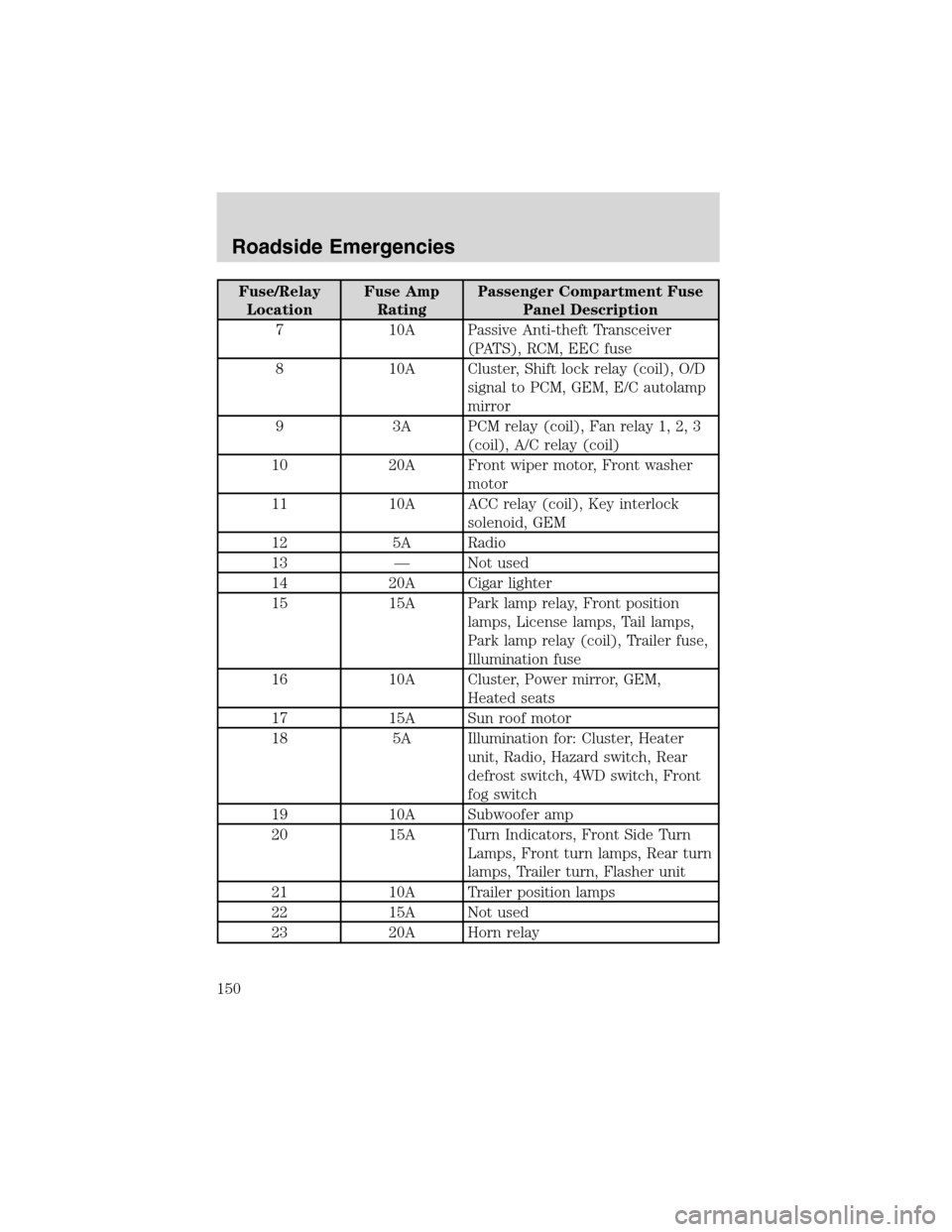
7 10A Passive Anti-theft Transceiver
(PATS), RCM, EEC fuse
8 10A Cluster, Shift lock relay (coil), O/D
signal to PCM, GEM, E/C autolamp
mirror
9 3A PCM relay (coil), Fan relay 1, 2, 3
(coil), A/C relay (coil)
10 20A Front wiper motor, Front washer
motor
11 10A ACC relay (coil), Key interlock
solenoid, GEM
12 5A Radio
13—Not used
14 20A Cigar lighter
15 15A Park lamp relay, Front position
lamps, License lamps, Tail lamps,
Park lamp relay (coil), Trailer fuse,
Illumination fuse
16 10A Cluster, Power mirror, GEM,
Heated seats
17 15A Sun roof motor
18 5A Illumination for: Cluster, Heater
unit, Radio, Hazard switch, Rear
defrost switch, 4WD switch, Front
fog switch
19 10A Subwoofer amp
20 15A Turn Indicators, Front Side Turn
Lamps, Front turn lamps, Rear turn
lamps, Trailer turn, Flasher unit
21 10A Trailer position lamps
22 15A Not used
23 20A Horn relay
Roadside Emergencies
150
Page 151 of 240
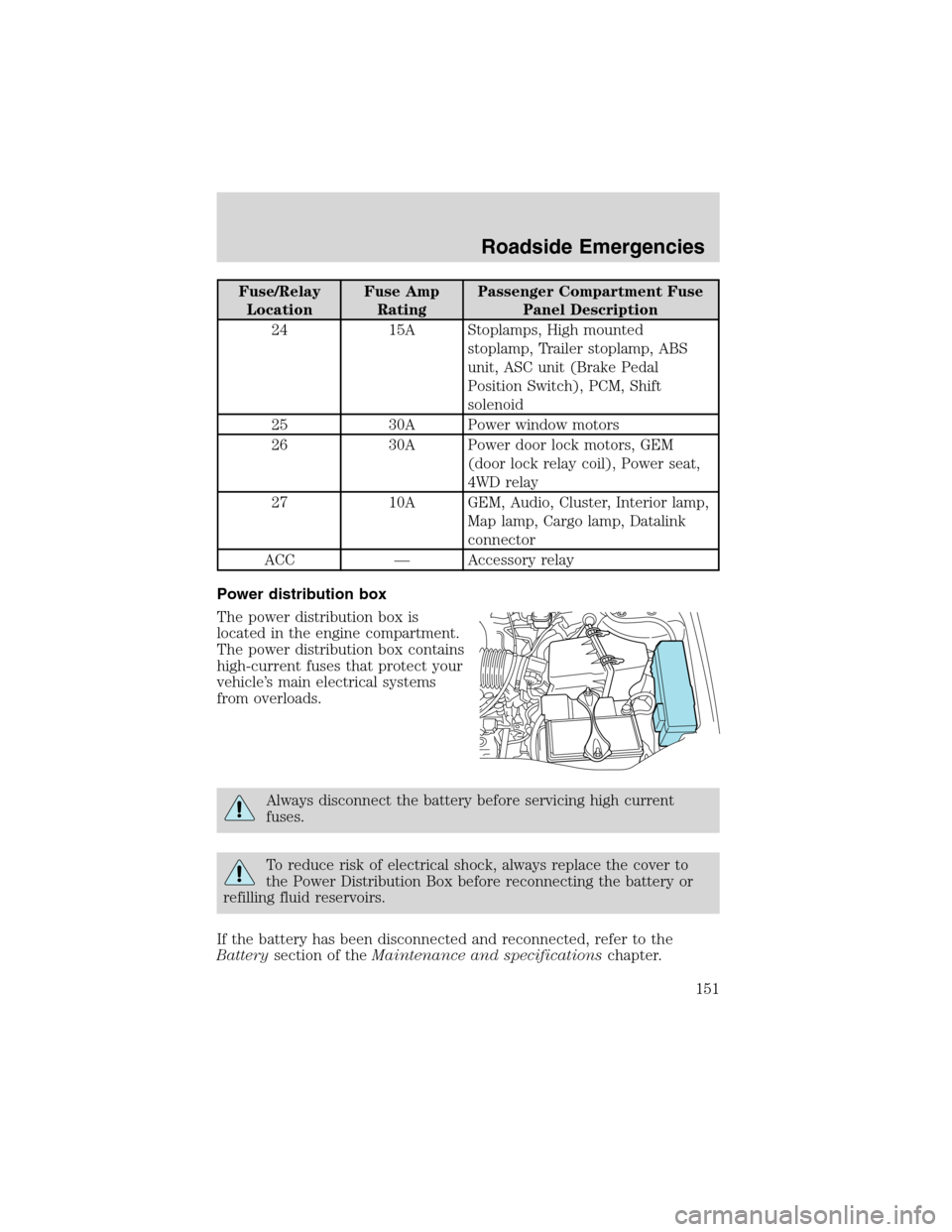
Fuse/Relay
LocationFuse Amp
RatingPassenger Compartment Fuse
Panel Description
24 15A Stoplamps, High mounted
stoplamp, Trailer stoplamp, ABS
unit, ASC unit (Brake Pedal
Position Switch), PCM, Shift
solenoid
25 30A Power window motors
26 30A Power door lock motors, GEM
(door lock relay coil), Power seat,
4WD relay
27 10A GEM, Audio, Cluster, Interior lamp,
Map lamp, Cargo lamp, Datalink
connector
ACC—Accessory relay
Power distribution box
The power distribution box is
located in the engine compartment.
The power distribution box contains
high-current fuses that protect your
vehicle’s main electrical systems
from overloads.
Always disconnect the battery before servicing high current
fuses.
To reduce risk of electrical shock, always replace the cover to
the Power Distribution Box before reconnecting the battery or
refilling fluid reservoirs.
If the battery has been disconnected and reconnected, refer to the
Batterysection of theMaintenance and specificationschapter.
Roadside Emergencies
151
Page 153 of 240
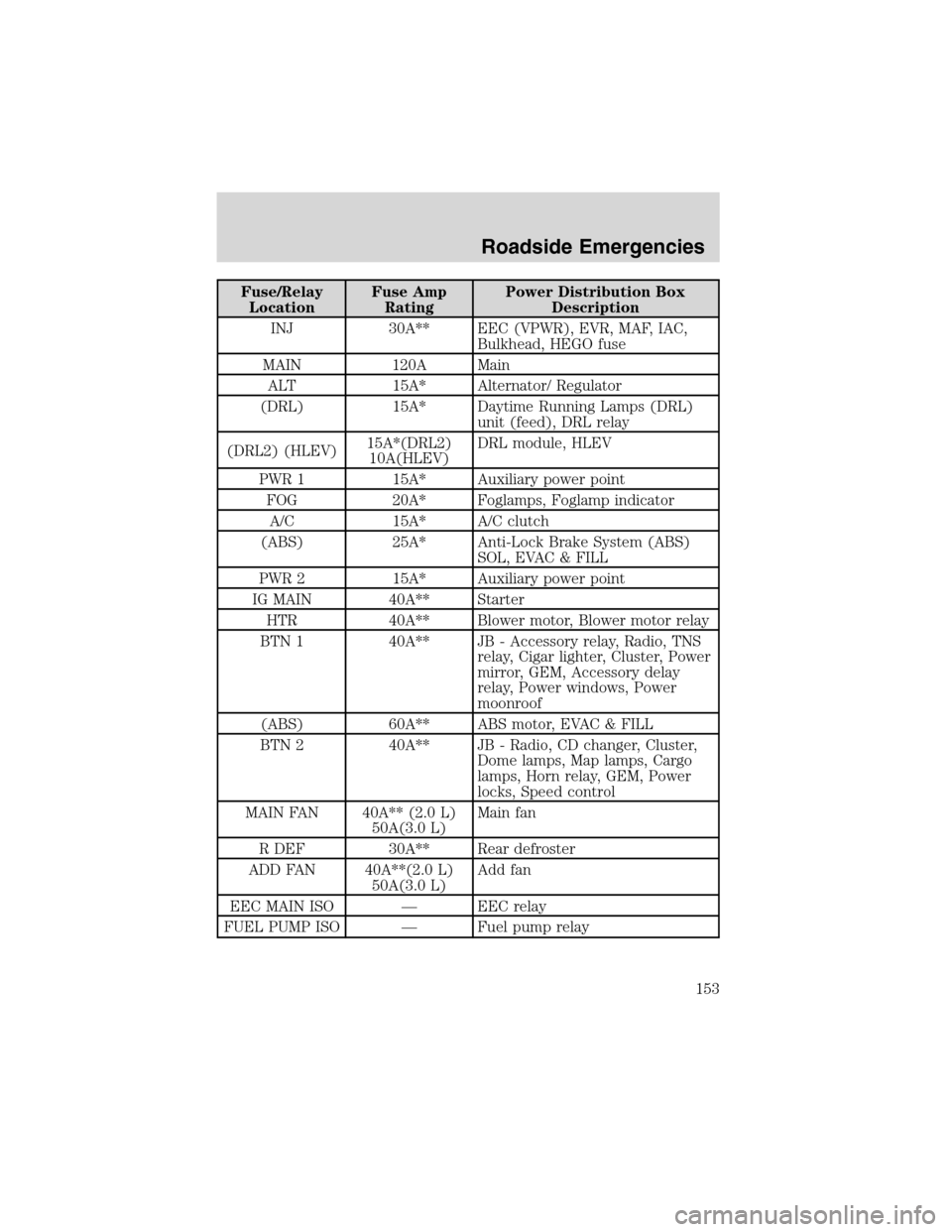
Fuse/Relay
LocationFuse Amp
RatingPower Distribution Box
Description
INJ 30A** EEC (VPWR), EVR, MAF, IAC,
Bulkhead, HEGO fuse
MAIN 120A Main
ALT 15A* Alternator/ Regulator
(DRL) 15A* Daytime Running Lamps (DRL)
unit (feed), DRL relay
(DRL2) (HLEV)15A*(DRL2)
10A(HLEV)DRL module, HLEV
PWR 1 15A* Auxiliary power point
FOG 20A* Foglamps, Foglamp indicator
A/C 15A* A/C clutch
(ABS) 25A* Anti-Lock Brake System (ABS)
SOL, EVAC & FILL
PWR 2 15A* Auxiliary power point
IG MAIN 40A** Starter
HTR 40A** Blower motor, Blower motor relay
BTN 1 40A** JB - Accessory relay, Radio, TNS
relay, Cigar lighter, Cluster, Power
mirror, GEM, Accessory delay
relay, Power windows, Power
moonroof
(ABS) 60A** ABS motor, EVAC & FILL
BTN 2 40A** JB - Radio, CD changer, Cluster,
Dome lamps, Map lamps, Cargo
lamps, Horn relay, GEM, Power
locks, Speed control
MAIN FAN 40A** (2.0 L)
50A(3.0 L)Main fan
R DEF 30A** Rear defroster
ADD FAN 40A**(2.0 L)
50A(3.0 L)Add fan
EEC MAIN ISO—EEC relay
FUEL PUMP ISO—Fuel pump relay
Roadside Emergencies
153
Page 155 of 240
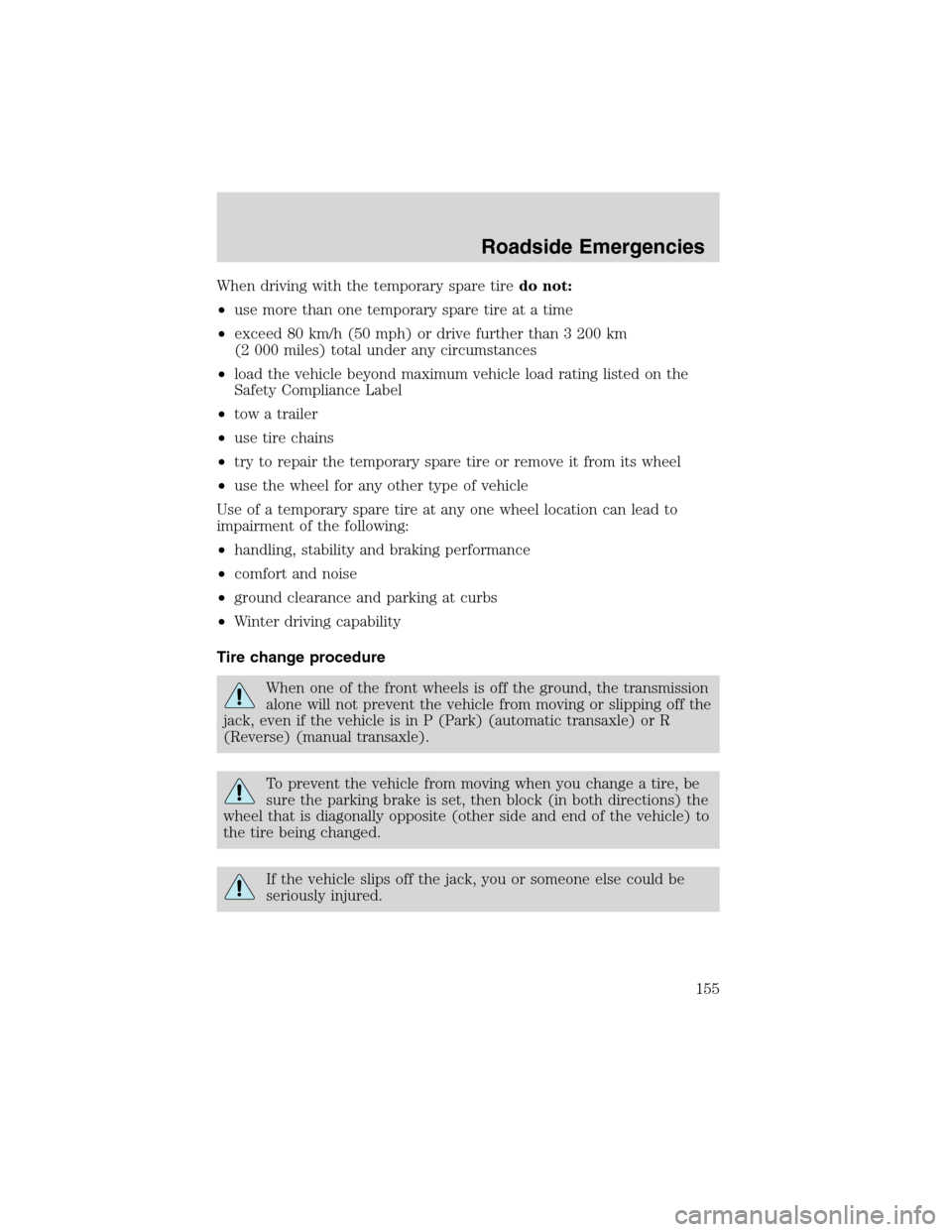
When driving with the temporary spare tiredo not:
•use more than one temporary spare tire at a time
•exceed 80 km/h (50 mph) or drive further than 3 200 km
(2 000 miles) total under any circumstances
•load the vehicle beyond maximum vehicle load rating listed on the
Safety Compliance Label
•tow a trailer
•use tire chains
•try to repair the temporary spare tire or remove it from its wheel
•use the wheel for any other type of vehicle
Use of a temporary spare tire at any one wheel location can lead to
impairment of the following:
•handling, stability and braking performance
•comfort and noise
•ground clearance and parking at curbs
•Winter driving capability
Tire change procedure
When one of the front wheels is off the ground, the transmission
alone will not prevent the vehicle from moving or slipping off the
jack, even if the vehicle is in P (Park) (automatic transaxle) or R
(Reverse) (manual transaxle).
To prevent the vehicle from moving when you change a tire, be
sure the parking brake is set, then block (in both directions) the
wheel that is diagonally opposite (other side and end of the vehicle) to
the tire being changed.
If the vehicle slips off the jack, you or someone else could be
seriously injured.
Roadside Emergencies
155
Page 156 of 240
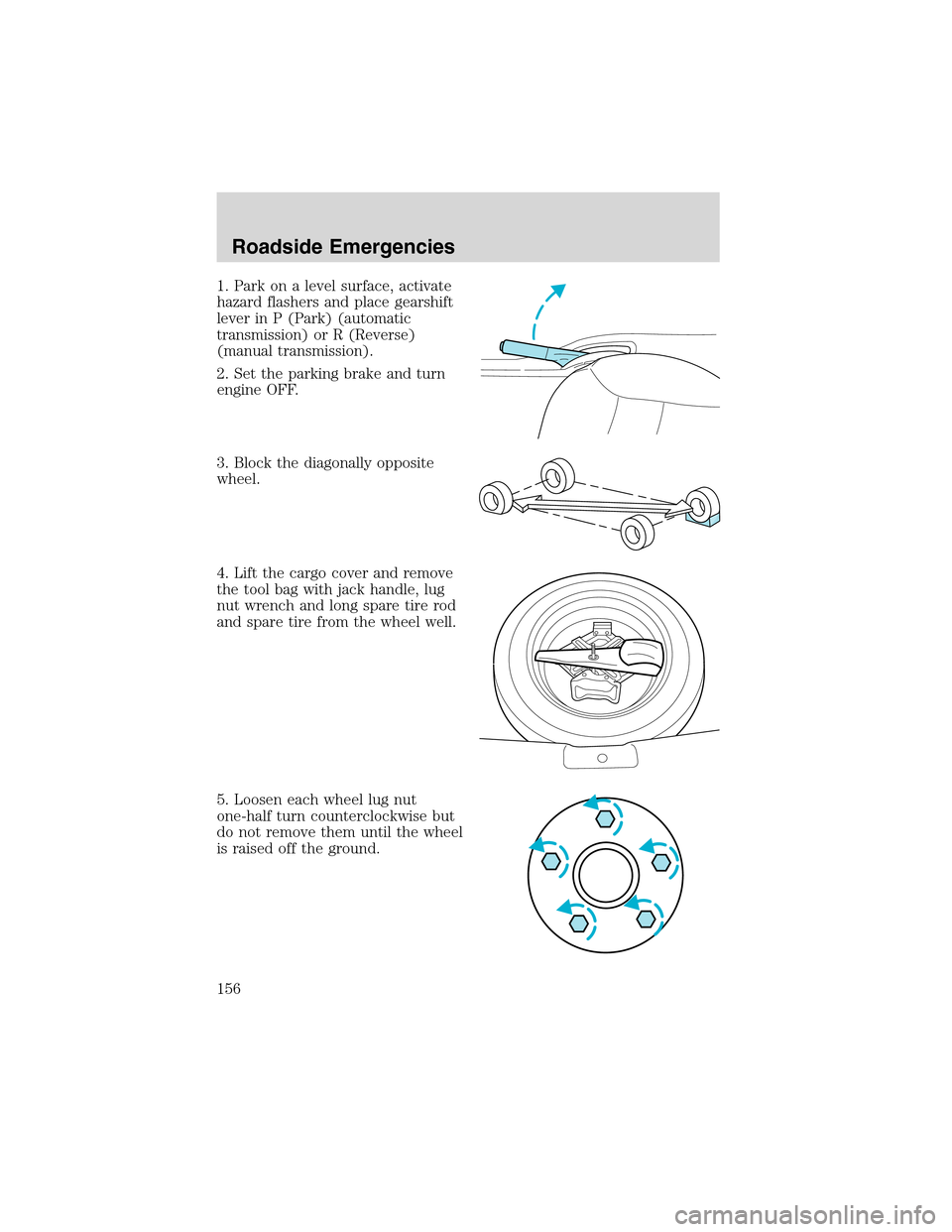
1. Park on a level surface, activate
hazard flashers and place gearshift
lever in P (Park) (automatic
transmission) or R (Reverse)
(manual transmission).
2. Set the parking brake and turn
engine OFF.
3. Block the diagonally opposite
wheel.
4. Lift the cargo cover and remove
the tool bag with jack handle, lug
nut wrench and long spare tire rod
and spare tire from the wheel well.
5. Loosen each wheel lug nut
one-half turn counterclockwise but
do not remove them until the wheel
is raised off the ground.
Roadside Emergencies
156