2003 FORD ESCAPE lock
[x] Cancel search: lockPage 197 of 240
To reduce the risk of personal injury, make sure the engine is
cool before unscrewing the coolant pressure relief cap. The
cooling system is under pressure; steam and hot liquid can come out
forcefully when the cap is loosened slightly.
1. Before you begin, turn the engine off and let it cool.
2. When the engine is cool, wrap a thick cloth around the coolant
pressure relief cap on the coolant reservoir (an opaque plastic bottle).
Slowly turn cap counterclockwise (left) until pressure begins to release.
3. Step back while the pressure releases.
4. When you are sure that all the pressure has been released, use the
cloth to turn it counterclockwise and remove the cap.
5. Fill the coolant reservoir slowly with the proper coolant mixture (see
above), to within the“cold fill range”or the“cold full”level on the
reservoir. If you removed the radiator cap in an overflow system, fill the
radiator until the coolant is visible and radiator is almost full.
6. Replace the cap. Turn until tightly installed. (Cap must be tightly
installed to prevent coolant loss.)
After any coolant has been added, check the coolant concentration, refer
toChecking Engine Coolantsection. If the concentration is not 50/50
(protection to–34°F/–36°C), drain some coolant and adjust the
concentration. It may take several drains and additions to obtain a 50/50
coolant concentration.
Whenever coolant has been added, the coolant level in the coolant
reservoir should be checked the next few times you drive the vehicle. If
necessary, add enough 50/50 concentration of engine coolant and
distilled water to bring the liquid level to the proper level.
If you have to add more than 1.0 liter (1.0 quart) of engine coolant per
month, have your dealer check the engine cooling system. Your cooling
system may have a leak. Operating an engine with a low level of coolant
can result in engine overheating and possible engine damage.
Recycled engine coolant
Ford Motor Company recommends the use of a recycled engine coolant
produced by Ford-approved processes in vehicles originally equipped
with Motorcraft Premium Engine Coolant (green-colored). However, not
all coolant recycling processes produce coolant that meets Ford
specification ESE-M97B44–A. Use of such coolant may harm the engine
and cooling system components.
Maintenance and Specifications
197
Page 201 of 240
Fuel Filler Cap
Your fuel tank filler cap has an indexed design with a 1/8 turn on/off
feature.
When fueling your vehicle:
1. Turn the engine off.
2. Carefully turn the filler cap counterclockwise 1/8 of a turn until it
stops.
3. Pull to remove the cap from the fuel filler pipe.
4. To install the cap, align the tabs on the cap with the notches on the
filler pipe.
5. Turn the filler cap clockwise 1/8 of a turn until it stops.
After refueling, if the“CHECK FUEL CAP”indicator comes on and stays
on when you start the engine, the fuel filler cap may not be properly
installed. Turn off the engine, remove the fuel filler cap, align the cap
properly and reinstall it securely. The“CHECK FUEL CAP”indicator
should turn off after three driving cycles with the fuel filler cap properly
installed. A driving cycle consists of a cold engine start-up followed by
mixed city/highway driving.
If you must replace the fuel filler cap, replace it with a fuel filler
cap that is designed for your vehicle. The customer warranty may
be void for any damage to the fuel tank or fuel system if the
correct genuine Ford or Motorcraft fuel filler cap is not used.
The fuel system may be under pressure. If the fuel filler cap is
venting vapor or if you hear a hissing sound, wait until it stops
before completely removing the fuel filler cap. Otherwise, fuel may
spray out and injure you or others.
If you do not use the proper fuel filler cap, excessive pressure or
vacuum in the fuel tank may damage the fuel system or cause
the fuel cap to disengage in a collision, which may result in possible
personal injury.
Choosing the right fuel
Use only UNLEADED FUEL. The use of leaded fuel is prohibited by law
and could damage your vehicle.
Do not use fuel containing methanol. It can damage critical fuel system
components.
Maintenance and Specifications
201
Page 226 of 240
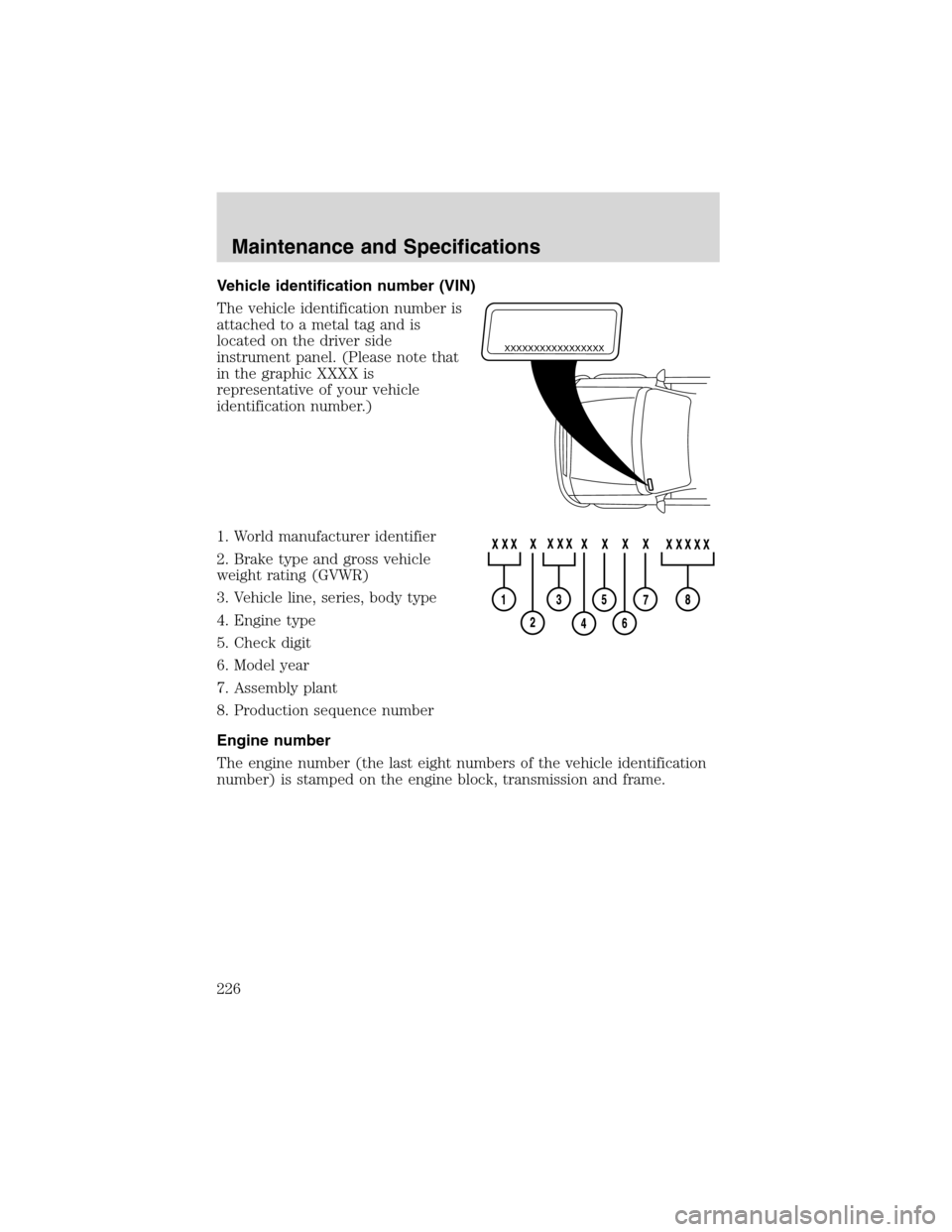
Vehicle identification number (VIN)
The vehicle identification number is
attached to a metal tag and is
located on the driver side
instrument panel. (Please note that
in the graphic XXXX is
representative of your vehicle
identification number.)
1. World manufacturer identifier
2. Brake type and gross vehicle
weight rating (GVWR)
3. Vehicle line, series, body type
4. Engine type
5. Check digit
6. Model year
7. Assembly plant
8. Production sequence number
Engine number
The engine number (the last eight numbers of the vehicle identification
number) is stamped on the engine block, transmission and frame.
XXXXXXXXXXXXXXXXX
Maintenance and Specifications
226
Page 227 of 240
FORD ACCESSORIES FOR YOUR VEHICLE
A wide selection of genuine Ford accessories are available for your
vehicle through your local authorized Ford, Lincoln Mercury or Ford of
Canada dealer. These quality accessories have been specifically
engineered to fulfill your automotive needs; they are custom designed to
complement the style and aerodynamic appearance of your vehicle. In
addition, each accessory is made from high quality materials and meets
or exceeds Ford’s rigorous engineering and safety specifications. Ford
Motor Company will repair or replace any properly dealer-installed Ford
accessory found to be defective in factory-supplied materials or
workmanship during the warranty period, as well as any component
damaged by the defective accessory. The accessory will be warranted for
whichever provides you the greatest benefit:
•12 months or 20 000 km (12 000 miles) (whichever occurs first), or
•the remainder of your new vehicle limited warranty.
This means that genuine Ford accessories purchased along with your
new vehicle and installed by the dealer are covered for the full length of
your New Vehicle’s Limited Warranty—3 years or 60 000 km (36 000 miles)
(whichever occurs first). Contact your dealer for details and a copy of
the warranty.
Not all accessories are available for all models.
Vehicle Security
Non-decorative wheel protector locks
Remote keyless entry
Styled wheel protector locks
Vehicle security systems
Comfort and convenience
Cabin air filtration
Cargo net
Cargo organizers
Cargo shades
Cargo trays
Carpeted cargo mat
Cellular phone hands free system with voice recognition
Engine block heater
Accessories
227
Page 229 of 240
Protection and appearance equipment
Air bag anti-theft locks
All weather floor mats
Bumper guards
Car/truck covers
Cargo liners, interior (soft and rigid)
Carpet floor mats
Door edge guards
Front end covers (full and sport)
Grill guard
Hood deflectors
Locking gas cap
Molded splash guards
Moonroof deflector
Rear air deflectors
Side window air deflectors
Step/sill plates
Tail lamp surrounds (black and chrome)
Universal floor mats
For maximum vehicle performance, keep the following information in
mind when adding accessories or equipment to your vehicle:
•When adding accessories, equipment, passengers and luggage to your
vehicle, do not exceed the total weight capacity of the vehicle or of
the front or rear axle (GVWR or GAWR as indicated on the Safety
compliance certification label). Consult your dealer for specific weight
information.
•The Federal Communications Commission (FCC) and Canadian Radio
Telecommunications Commission (CRTC) regulate the use of mobile
communications systems - such as two-way radios, telephones and
theft alarms - that are equipped with radio transmitters. Any such
equipment installed in your vehicle should comply with FCC or CRTC
regulations and should be installed only by a qualified service
technician.
Accessories
229
Page 231 of 240
A
Air bag supplemental restraint
system ....................................95, 99
and child safety seats ..............97
description ..........................95, 99
disposal ....................................101
driver air bag ....................97, 100
indicator light ...................98, 101
operation ...........................97, 100
passenger air bag .............97, 100
side air bag ................................99
Air cleaner filter ...............212, 218
All Wheel Drive (AWD),
driving off road .........................128
Ambulance packages ....................7
Antifreeze (see Engine
coolant) .....................................194
Anti-lock brake system
(see Brakes) ..............................118
Anti-theft system ........................72
arming the system ....................72
disarming a triggered system ..73
Audio system
(see Radio) ................15, 18, 22, 26
Automatic transaxle
fluid, adding ............................209
fluid, checking ........................209
Automatic transmission
driving an automatic
overdrive .................................122
fluid, refill capacities ..............218
fluid, specification ..................223
Auxiliary power point .................47
Axle
lubricant specifications ..221, 223
refill capacities ........................218
B
Battery .......................................192acid, treating emergencies .....192
jumping a disabled battery ....159
maintenance-free ....................192
replacement, specifications ...218
servicing ..................................192
BeltMinder ...................................90
Brakes ........................................118
anti-lock ...................................118
anti-lock brake system (ABS)
warning light ...........................118
fluid, checking and adding ....209
fluid, refill capacities ..............218
fluid, specifications .........221, 223
lubricant specifications ..221, 223
parking ....................................119
shift interlock ..........................120
Bulbs ............................................38
C
Calculating load ........................141
Capacities for refilling fluids ....218
Cargo area shade ........................54
Cassette tape player .............15, 22
CD-single premium ...............18, 26
Cell phone use ............................52
Certification Label ....................225
Changing a tire .........................154
Child safety restraints ..............102
child safety belts ....................102
Child safety seats ......................105
attaching with tether straps ..109
in front seat ............................107
in rear seat ..............................107
Cleaning your vehicle
engine compartment ..............178
instrument panel ....................180
interior .....................................181
Index
231
Page 232 of 240
interior trim ............................180
plastic parts ............................179
washing ....................................177
waxing .....................................177
wheels ......................................178
wiper blades ............................180
Climate control (see Air
conditioning or Heating) ......30–31
Clutch
fluid ..................................209, 212
operation while driving ..........125
recommended shift speeds ....126
Console ........................................52
overhead ....................................45
Controls
power seat .................................75
Coolant
checking and adding ..............194
refill capacities ................198, 218
specifications ..................221, 223
Cruise control (see Speed
control) ........................................49
Customer Assistance
Ford accessories for your
vehicle .....................................182
Ford Extended Service
Plan ..........................................169
Getting assistance outside
the U.S. and Canada ..............173
Getting the service you
need .........................................167
Ordering additional owner’s
literature .................................174
The Dispute Settlement
Board .......................................170
Utilizing the
Mediation/Arbitration
Program ...................................173D
Daytime running lamps
(see Lamps) ................................33
Defrost
rear window ..............................32
Dipstick
automatic transmission
fluid ..........................................209
engine oil .................................188
Doors
lubricant specifications ..........221
Driving under special
conditions ..................124, 131, 133
sand .........................................132
snow and ice ...........................134
through water .................132, 138
E
Emergencies, roadside
jump-starting ..........................159
Emission control system ..........206
Engine ........................................223
cleaning ...................................178
coolant .....................................194
idle speed control ...................192
lubrication
specifications ..................221, 223
refill capacities ........................218
service points ..................185–186
starting after a collision .........146
Engine block heater .................117
Engine oil ..................................188
checking and adding ..............188
dipstick ....................................188
filter, specifications ........191, 218
recommendations ...................191
refill capacities ........................218
specifications ..................221, 223
Index
232
Page 234 of 240

J
Jack ............................................154
positioning ...............................154
storage .....................................154
Jump-starting your vehicle ......159
K
Keys
positions of the ignition .........114
L
Lamps
autolamp system .......................33
bulb replacement
specifications chart ..................38
cargo lamps ...............................34
daytime running light ...............33
fog lamps ...................................33
headlamps .................................33
headlamps, flash to pass ..........34
instrument panel, dimming .....34
interior lamps .....................36–38
replacing bulbs ....... 38–39, 41–42
Lane change indicator
(see Turn signal) ........................36
Liftgate ........................................53
Lights, warning and indicator ....10
anti-lock brakes (ABS) ..........118
Load limits .................................139
GAWR ......................................139
GVWR ......................................139
trailer towing ..........................139
Loading instructions .................140
Locks
childproof ..................................65
Lubricant specifications ...221, 223
Lumbar support, seats .........76–77M
Manual transaxle .......................125
fluid, checking and adding ....211
reverse .....................................126
Manual transmission
fluid capacities ........................218
lubricant specifications ..........223
Mirrors .........................................46
automatic dimming rearview
mirror ........................................47
fold away ...................................49
heated ........................................49
side view mirrors (power) .......49
Moon roof ....................................53
Motorcraft parts ................203, 218
O
Octane rating ............................202
Oil (see Engine oil) ..................188
Overdrive ...................................122
P
Parking .......................................127
Parking brake ............................119
Parts (see Motorcraft parts) ....218
Power distribution box
(see Fuses) ...............................151
Power door locks ........................63
Power point .................................47
Power steering ..........................119
fluid, checking and adding ....208
fluid, refill capacity ................218
fluid, specifications .........221, 223
Power Windows ...........................48
Index
234