2003 DODGE RAM power steering fluid
[x] Cancel search: power steering fluidPage 1831 of 2895
PUMP
TABLE OF CONTENTS
page page
PUMP
DESCRIPTION.........................38
OPERATION...........................38
DIAGNOSIS AND TESTING - PUMP LEAKAGE . 39
STANDARD PROCEDURE
STANDARD PROCEDURE - POWER
STEERING PUMP - INITIAL OPERATION....39
STANDARD PROCEDURE - FLUSHING
POWER STEERING SYSTEM............39
REMOVAL
REMOVAL - GAS......................40
REMOVAL - DIESEL...................40
INSTALLATION
INSTALLATION - GAS..................41
INSTALLATION - DIESEL................41
SPECIFICATIONS
TORQUE CHART......................41
FLUID
DESCRIPTION.........................42
STANDARD PROCEDURE - POWER
STEERING FLUID LEVEL CHECKING......42
FLUID COOLER
REMOVAL.............................42
INSTALLATION.........................42
HOSES - I.F.S.
REMOVAL
REMOVAL - RETURN HOSE - GEAR TO
COOLER............................43
REMOVAL - PRESSURE HOSE...........43
REMOVAL - RETURN HOSE - RESERVOIR
TO COOLER.........................43INSTALLATION
INSTALLATION - RETURN HOSE - GEAR TO
COOLER............................43
INSTALLATION - PRESSURE HOSE.......43
INSTALLATION - RETURN HOSE -
RESERVOIR TO COOLER...............43
HOSES - LINK/COIL
REMOVAL
REMOVAL - RETURN HOSE - GEAR TO
COOLER............................43
REMOVAL - PRESSURE HOSE...........44
REMOVAL - RETURN HOSE - RESERVOIR
TO COOLER.........................44
INSTALLATION
INSTALLATION - RETURN HOSE - GEAR TO
COOLER............................44
INSTALLATION - PRESSURE HOSE.......44
INSTALLATION - RETURN HOSE -
RESERVOIR TO COOLER...............44
POWER STEERING PRESSURE SWITCH
DESCRIPTION.........................45
OPERATION...........................45
REMOVAL - 3.7L, 4.7L & 5.7L..............45
INSTALLATION - 3.7L, 4.7L & 5.7L..........45
PULLEY
REMOVAL.............................45
INSTALLATION.........................46
RESERVOIR
REMOVAL.............................46
INSTALLATION.........................46
PUMP
DESCRIPTION
CAUTION: MOPARTATF+4 is to be used in the
power steering system. No other power steering or
automatic transmission fluid is to be used in the
system. Damage may result to the power steering
pump and system if any other fluid is used, and do
not overfill.
The pump is connected to the steering gear via the
pressure hose and the return hose. The pump shaft
has a pressed-on pulley that is belt driven by the
crankshaft pulley.All vehicles are equipped with a power steering
fluid cooler.
NOTE: Power steering pumps are not interchange-
able with pumps installed on other vehicles.
OPERATION
Hydraulic pressure is provided for the power steer-
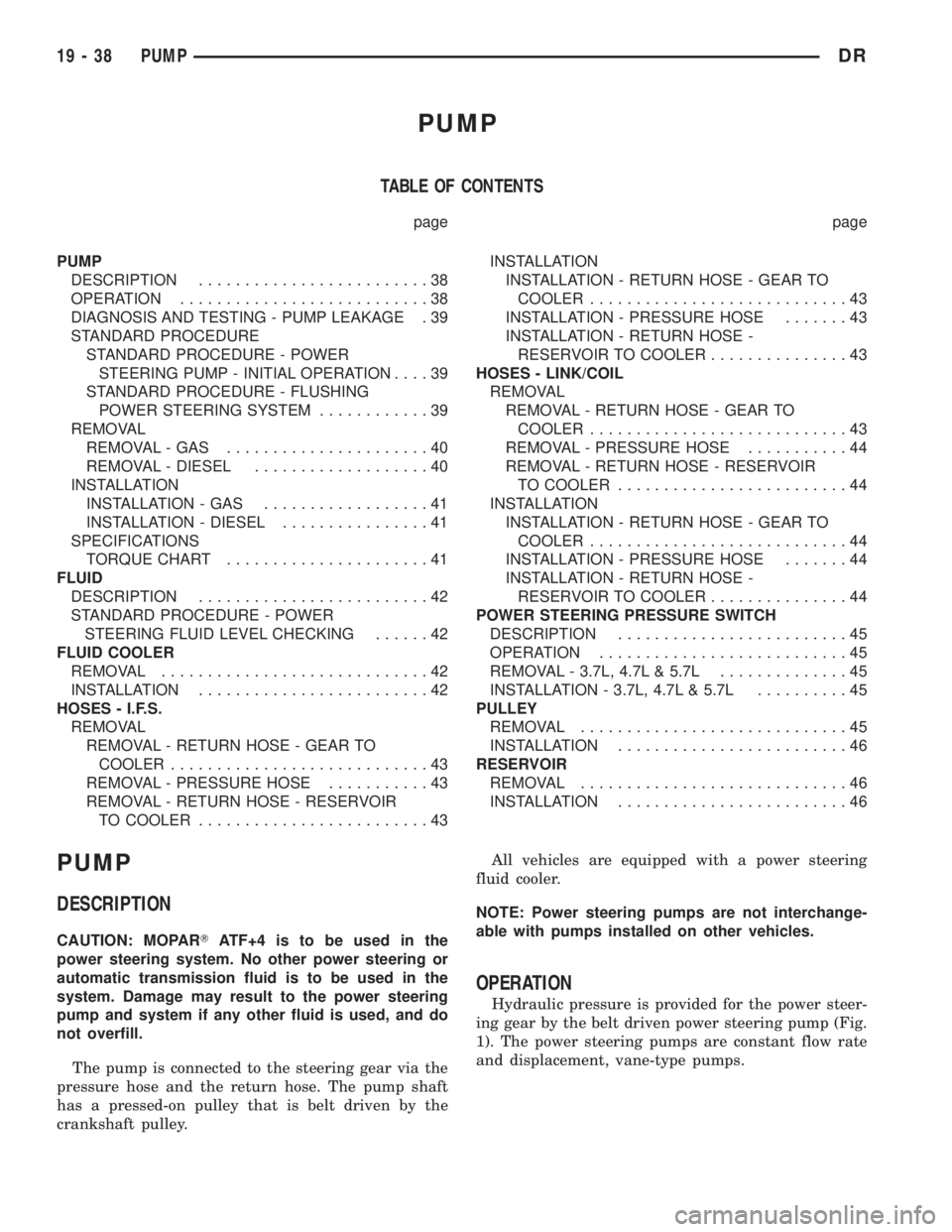
ing gear by the belt driven power steering pump (Fig.
1). The power steering pumps are constant flow rate
and displacement, vane-type pumps.
19 - 38 PUMPDR
Page 1832 of 2895
DIAGNOSIS AND TESTING - PUMP LEAKAGE
The pump is serviced as an assembly and should
not be disassembled. The plastic pump reservoir and
the reservoir o-rings can be replaced.
Check for leaks in the following areas:
²Pump shaft seal behind the pulley
²Pump to reservoir O-ring
²Reservoir cap
²Pressure and return lines
²Flow control valve fitting
STANDARD PROCEDURE
STANDARD PROCEDURE - POWER STEERING
PUMP - INITIAL OPERATION
WARNING: THE FLUID LEVEL SHOULD BE
CHECKED WITH ENGINE OFF TO PREVENT INJURY
FROM MOVING COMPONENTS.
CAUTION: MOPARTATF+4 is to be used in the
power steering system. No other power steering or
automatic transmission fluid is to be used in the
system. Damage may result to the power steering
pump and system if any other fluid is used, and do
not overfill.
Wipe filler cap clean, then check the fluid level.
The dipstick should indicateCOLDwhen the fluid is
at normal temperature.(1) Turn steering wheel all the way to the left
(2) Fill the pump fluid reservoir to the proper level
and let the fluid settle for at least two (2) minutes.
(3) Raise the front wheels off the ground.
(4) Slowly turn the steering wheel lock-to-lock 20
times with the engine off while checking the fluid
level.
NOTE: For vehicles with long return lines or oil
coolers turn wheel 40 times.
(5) Start the engine. With the engine idling main-
tain the fluid level.
(6) Lower the front wheels and let the engine idle
for two minutes.
(7) Turn the steering wheel in both direction and
verify power assist and quiet operation of the pump.
If the fluid is extremely foamy or milky looking,
allow the vehicle to stand a few minutes and repeat
the procedure.
CAUTION: Do not run a vehicle with foamy fluid for
an extended period. This may cause pump damage.
STANDARD PROCEDURE - FLUSHING POWER
STEERING SYSTEM
Flushing is required when the power steering/hy-
draulic booster system fluid has become contami-
nated. Contaminated fluid in the steering/booster
system can cause seal deterioration and affect steer-
ing gear/booster spool valve operation.
(1) Raise the front end of the vehicle off the
ground until the wheels are free to turn.
(2) Remove the return line from the pump.
NOTE: If vehicle is equipped with a hydraulic
booster remove both return lines from the pump.
(3) Plug the return line port/ports at the pump.
(4) Position the return line/lines into a large con-
tainer to catch the fluid.
(5) While an assistant is filling the pump reservoir
start the engine.
(6) With the engine running at idle turn the wheel
back and forth.
NOTE: Do not contact or hold the wheel against the
steering stops.
(7) Run a quart of fluid through the system then
stop the engine and install the return line/lines.
(8) Fill the system with fluid and perform Steering
Pump Initial Operation, (Refer to 19 - STEERING/
PUMP - STANDARD PROCEDURE).
(9) Start the engine and run it for fifteen minutes
then stop the engine.
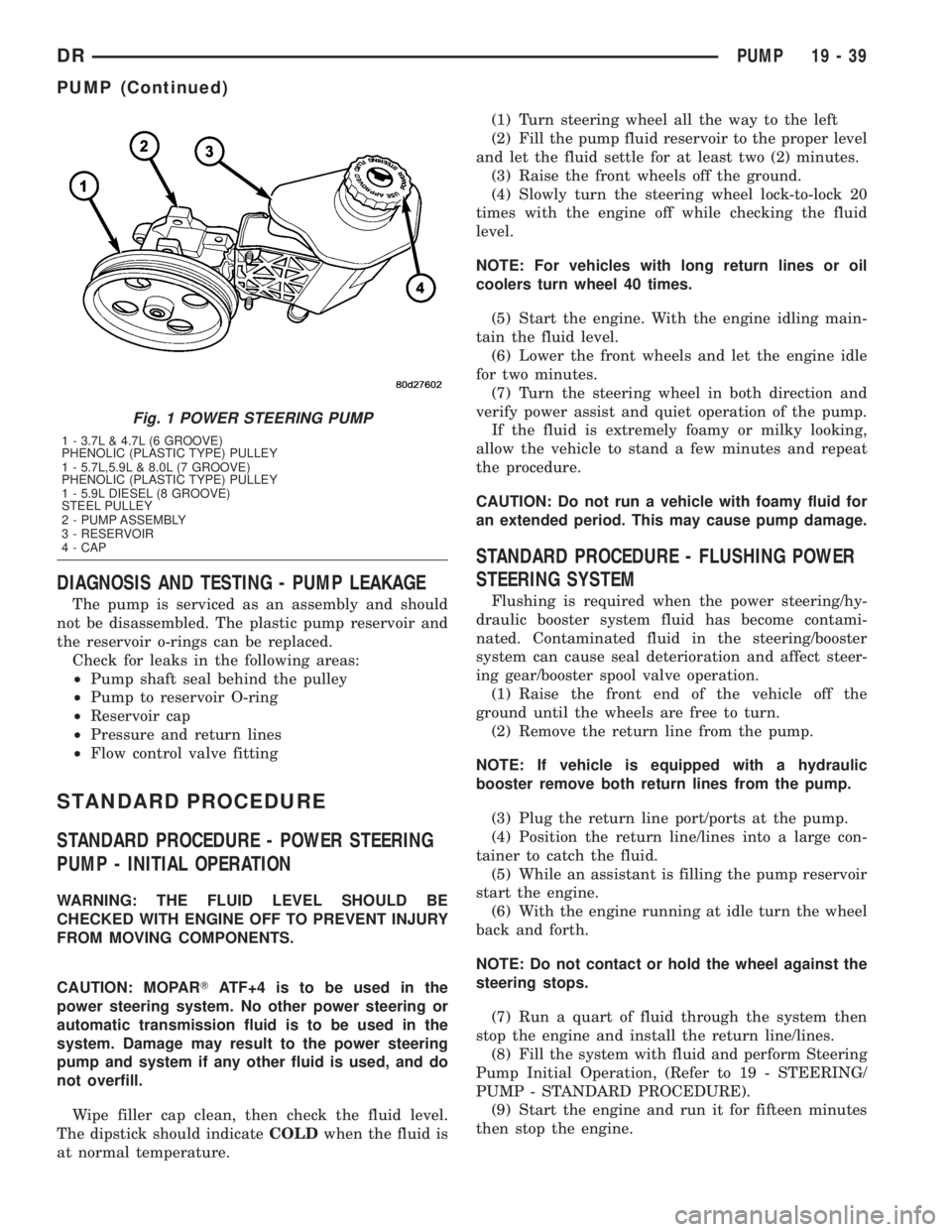
Fig. 1 POWER STEERING PUMP
1 - 3.7L & 4.7L (6 GROOVE)
PHENOLIC (PLASTIC TYPE) PULLEY
1 - 5.7L,5.9L & 8.0L (7 GROOVE)
PHENOLIC (PLASTIC TYPE) PULLEY
1 - 5.9L DIESEL (8 GROOVE)
STEEL PULLEY
2 - PUMP ASSEMBLY
3 - RESERVOIR
4 - CAP
DRPUMP 19 - 39
PUMP (Continued)
Page 1833 of 2895
(10) Remove the return line/lines from the pump
and plug the pump port/ports.
(11) Pour fresh fluid into the reservoir and check
the draining fluid for contamination. If the fluid is
still contaminated, then flush the system again.
(12) Install the return line/lines and perform
Steering Pump Initial Operation, (Refer to 19 -
STEERING/PUMP - STANDARD PROCEDURE).
REMOVAL
REMOVAL - GAS
(1) Drain and siphon the power steering fluid from
the reservoir.
(2) Remove the serpentine belt.
CAUTION: Do not remove the fitting on the pump
that the high pressure hose screws into. The fitting
may come loose unless it is backed up using
another wrench. If the fitting does come loose, it
must be retightened before continuing. (57 - 67Nm,
40 - 50 lbft) If this fitting comes out of the pump
body, the internal spring and valve parts will fall out
of the pump and they cannot be reinstalled prop-
erly. If this occurs the pump needs to be replaced
with a new pump.
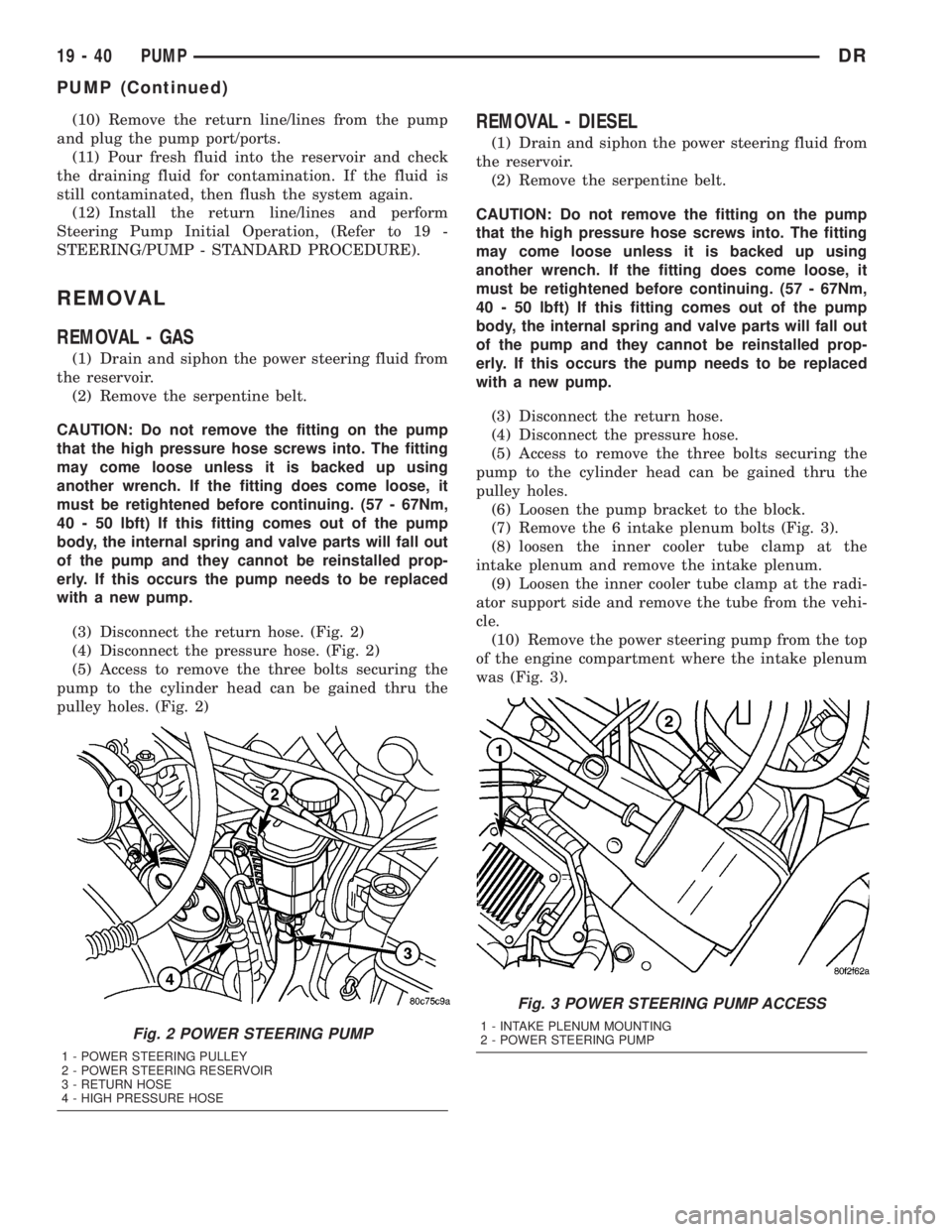
(3) Disconnect the return hose. (Fig. 2)
(4) Disconnect the pressure hose. (Fig. 2)
(5) Access to remove the three bolts securing the
pump to the cylinder head can be gained thru the
pulley holes. (Fig. 2)
REMOVAL - DIESEL
(1) Drain and siphon the power steering fluid from
the reservoir.
(2) Remove the serpentine belt.
CAUTION: Do not remove the fitting on the pump
that the high pressure hose screws into. The fitting
may come loose unless it is backed up using
another wrench. If the fitting does come loose, it
must be retightened before continuing. (57 - 67Nm,
40 - 50 lbft) If this fitting comes out of the pump
body, the internal spring and valve parts will fall out
of the pump and they cannot be reinstalled prop-
erly. If this occurs the pump needs to be replaced
with a new pump.
(3) Disconnect the return hose.
(4) Disconnect the pressure hose.
(5) Access to remove the three bolts securing the
pump to the cylinder head can be gained thru the
pulley holes.
(6) Loosen the pump bracket to the block.
(7) Remove the 6 intake plenum bolts (Fig. 3).
(8) loosen the inner cooler tube clamp at the
intake plenum and remove the intake plenum.
(9) Loosen the inner cooler tube clamp at the radi-
ator support side and remove the tube from the vehi-
cle.
(10) Remove the power steering pump from the top
of the engine compartment where the intake plenum
was (Fig. 3).
Fig. 2 POWER STEERING PUMP
1 - POWER STEERING PULLEY
2 - POWER STEERING RESERVOIR
3 - RETURN HOSE
4 - HIGH PRESSURE HOSE
Fig. 3 POWER STEERING PUMP ACCESS
1 - INTAKE PLENUM MOUNTING
2 - POWER STEERING PUMP
19 - 40 PUMPDR
PUMP (Continued)
Page 1835 of 2895
FLUID
DESCRIPTION
The recommended fluid for the power steering sys-
tem is MopartATF +4.
MopartATF+4, when new is red in color. The
ATF+4 is dyed red so it can be identified from other
fluids used in the vehicle such as engine oil or anti-
freeze. The red color is not permanent and is not an
indicator of fluid condition, As the vehicle is driven,
the ATF+4 will begin to look darker in color and may
eventually become brown.THIS IS NORMAL.
ATF+4 also has a unique odor that may change with
age. Consequently, odor and color cannot be used to
indicate the fluid condition or the need for a fluid
change.
STANDARD PROCEDURE - POWER STEERING
FLUID LEVEL CHECKING
WARNING: FLUID LEVEL SHOULD BE CHECKED
WITH THE ENGINE OFF TO PREVENT PERSONAL
INJURY FROM MOVING PARTS.
CAUTION: MOPARTATF+4 is to be used in the
power steering system. No other power steering or
automatic transmission fluid is to be used in the
system. Damage may result to the power steering
pump and system if any other fluid is used, and do
not overfill.
The power steering fluid level can be viewed on the
dipstick attached to the filler cap. There are two
ranges listed on the dipstick, COLD and HOT. Before
opening power steering system, wipe the reservoir
filler cap free of dirt and debris. Remove the cap and
check the fluid level on its dipstick. When the fluid is
at normal ambient temperature, approximately 21ÉC
to 27ÉC (70ÉF to 80ÉF), the fluid level should read
between the minimum and maximum area of the cold
range. When the fluid is hot, fluid level is allowed to
read up to the highest end of the HOT range. Only
add fluid when the vehicle is cold.
Use only MopartATF+4Do not overfill the
power steering system.
FLUID COOLER
REMOVAL
(1) Drain and siphon the power steering fluid.
(2) Disconnect the return and supply hoses con-
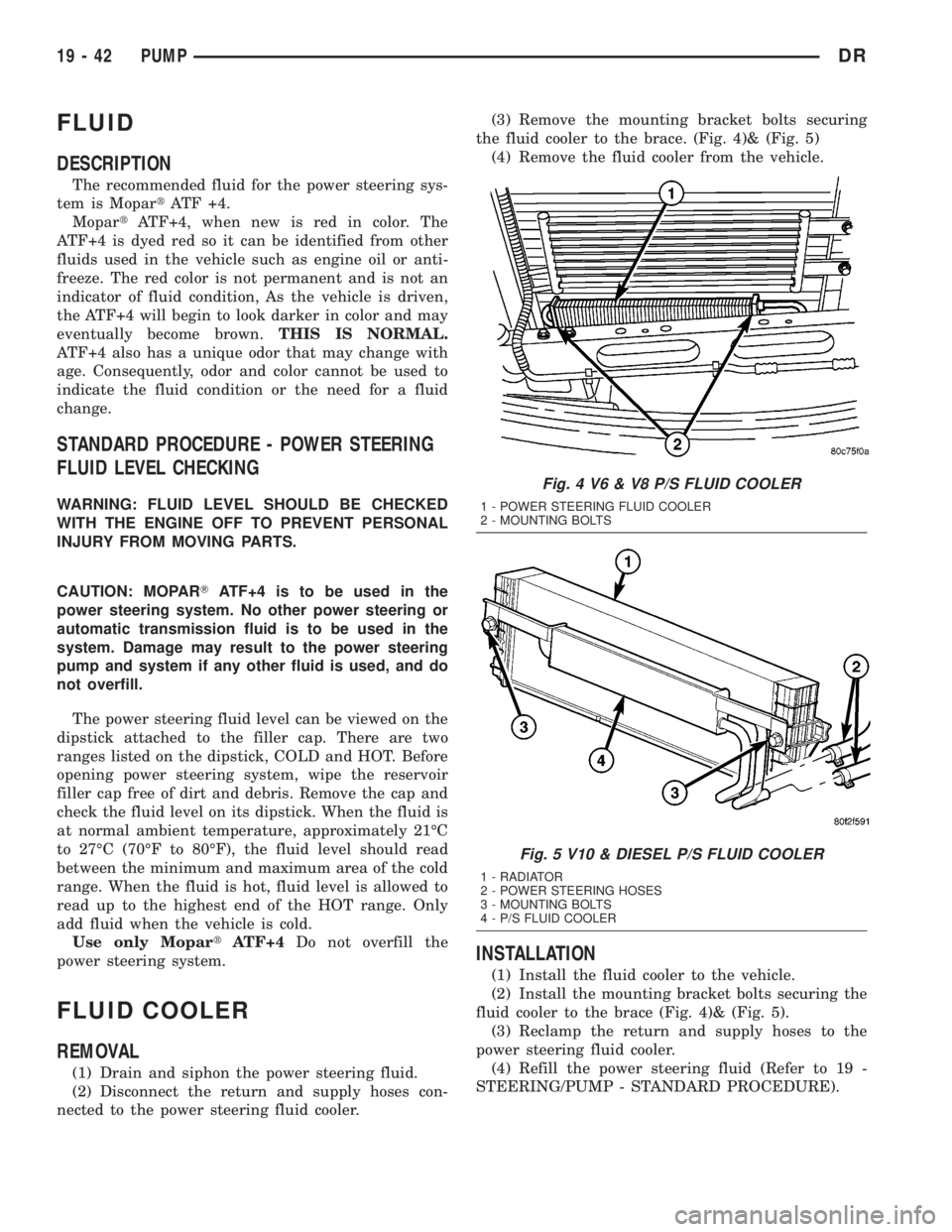
nected to the power steering fluid cooler.(3) Remove the mounting bracket bolts securing
the fluid cooler to the brace. (Fig. 4)& (Fig. 5)
(4) Remove the fluid cooler from the vehicle.
INSTALLATION
(1) Install the fluid cooler to the vehicle.
(2) Install the mounting bracket bolts securing the
fluid cooler to the brace (Fig. 4)& (Fig. 5).
(3) Reclamp the return and supply hoses to the
power steering fluid cooler.
(4) Refill the power steering fluid (Refer to 19 -
STEERING/PUMP - STANDARD PROCEDURE).
Fig. 4 V6 & V8 P/S FLUID COOLER
1 - POWER STEERING FLUID COOLER
2 - MOUNTING BOLTS
Fig. 5 V10 & DIESEL P/S FLUID COOLER
1 - RADIATOR
2 - POWER STEERING HOSES
3 - MOUNTING BOLTS
4 - P/S FLUID COOLER
19 - 42 PUMPDR
Page 1838 of 2895
POWER STEERING PRESSURE
SWITCH
DESCRIPTION
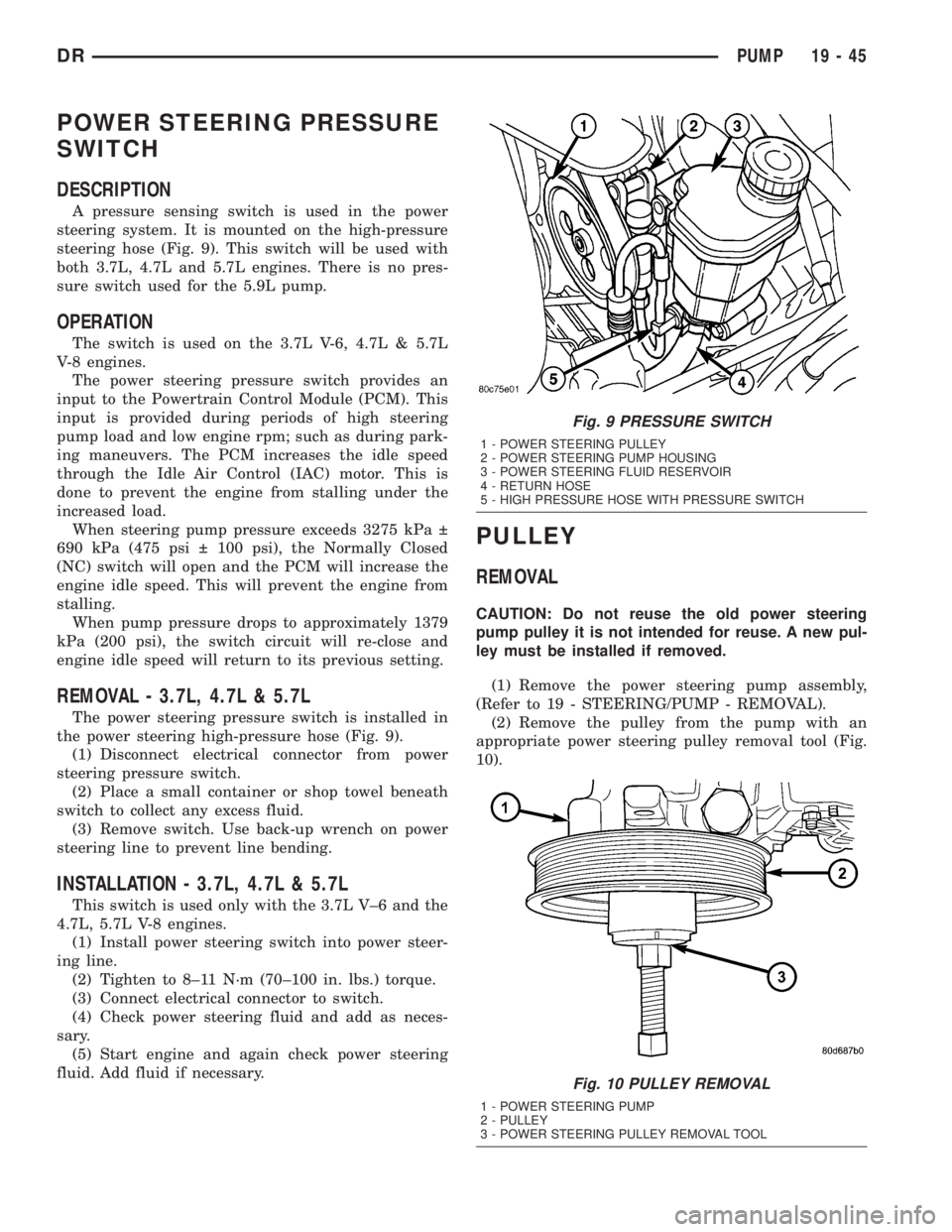
A pressure sensing switch is used in the power
steering system. It is mounted on the high-pressure
steering hose (Fig. 9). This switch will be used with
both 3.7L, 4.7L and 5.7L engines. There is no pres-
sure switch used for the 5.9L pump.
OPERATION
The switch is used on the 3.7L V-6, 4.7L & 5.7L
V-8 engines.
The power steering pressure switch provides an
input to the Powertrain Control Module (PCM). This
input is provided during periods of high steering
pump load and low engine rpm; such as during park-
ing maneuvers. The PCM increases the idle speed
through the Idle Air Control (IAC) motor. This is
done to prevent the engine from stalling under the
increased load.
When steering pump pressure exceeds 3275 kPa
690 kPa (475 psi 100 psi), the Normally Closed
(NC) switch will open and the PCM will increase the
engine idle speed. This will prevent the engine from
stalling.
When pump pressure drops to approximately 1379
kPa (200 psi), the switch circuit will re-close and
engine idle speed will return to its previous setting.
REMOVAL - 3.7L, 4.7L & 5.7L
The power steering pressure switch is installed in
the power steering high-pressure hose (Fig. 9).
(1) Disconnect electrical connector from power
steering pressure switch.
(2) Place a small container or shop towel beneath
switch to collect any excess fluid.
(3) Remove switch. Use back-up wrench on power
steering line to prevent line bending.
INSTALLATION - 3.7L, 4.7L & 5.7L
This switch is used only with the 3.7L V±6 and the
4.7L, 5.7L V-8 engines.
(1) Install power steering switch into power steer-
ing line.
(2) Tighten to 8±11 N´m (70±100 in. lbs.) torque.
(3) Connect electrical connector to switch.
(4) Check power steering fluid and add as neces-
sary.
(5) Start engine and again check power steering
fluid. Add fluid if necessary.
PULLEY
REMOVAL
CAUTION: Do not reuse the old power steering
pump pulley it is not intended for reuse. A new pul-
ley must be installed if removed.
(1) Remove the power steering pump assembly,
(Refer to 19 - STEERING/PUMP - REMOVAL).
(2) Remove the pulley from the pump with an
appropriate power steering pulley removal tool (Fig.
10).
Fig. 9 PRESSURE SWITCH
1 - POWER STEERING PULLEY
2 - POWER STEERING PUMP HOUSING
3 - POWER STEERING FLUID RESERVOIR
4 - RETURN HOSE
5 - HIGH PRESSURE HOSE WITH PRESSURE SWITCH
Fig. 10 PULLEY REMOVAL
1 - POWER STEERING PUMP
2 - PULLEY
3 - POWER STEERING PULLEY REMOVAL TOOL
DRPUMP 19 - 45
Page 1839 of 2895
INSTALLATION
CAUTION: Do not reuse the old power steering
pump pulley it is not intended for reuse. A new pul-
ley must be installed if removed.
(1) Replace the pulley if it's bent, cracked, or loose.
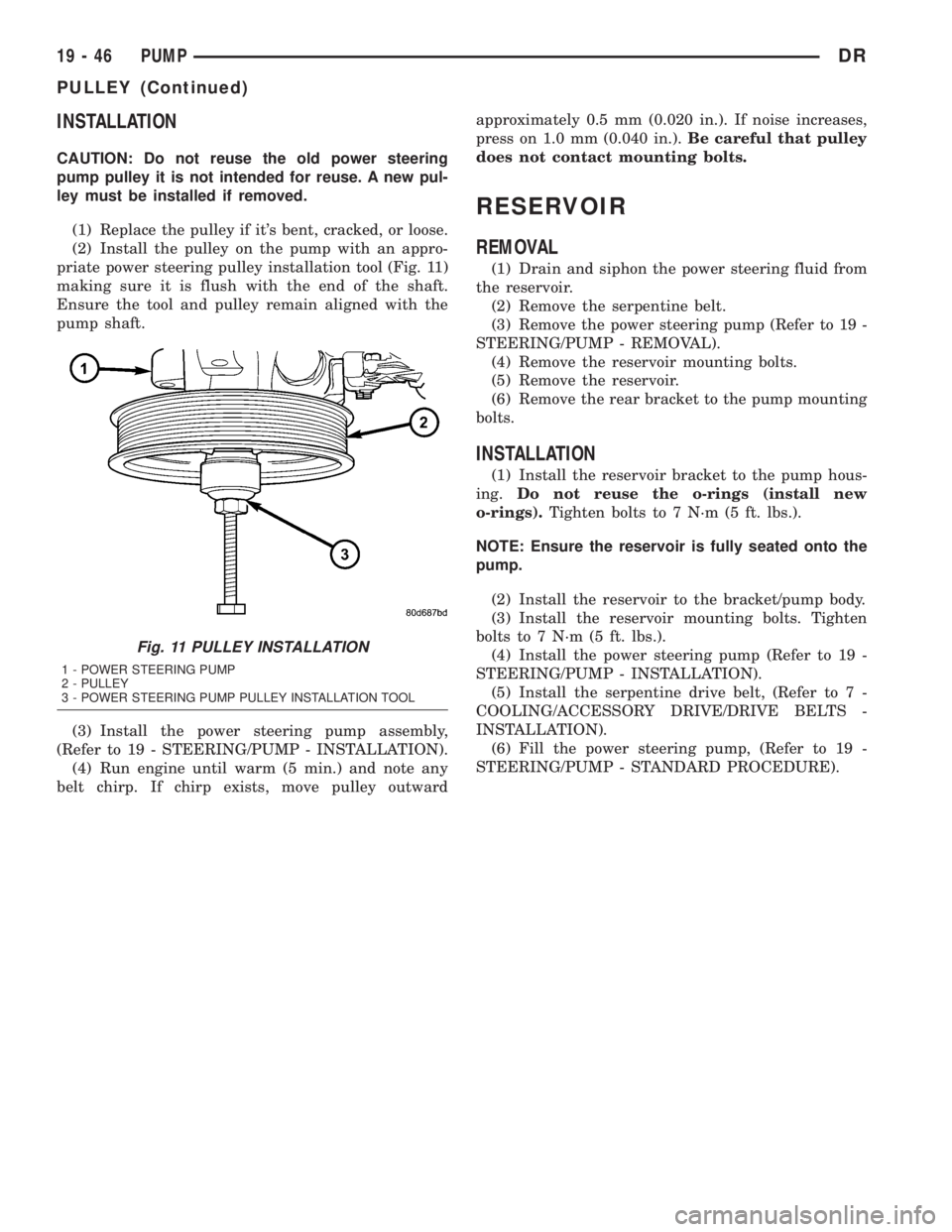
(2) Install the pulley on the pump with an appro-
priate power steering pulley installation tool (Fig. 11)
making sure it is flush with the end of the shaft.
Ensure the tool and pulley remain aligned with the
pump shaft.
(3) Install the power steering pump assembly,
(Refer to 19 - STEERING/PUMP - INSTALLATION).
(4) Run engine until warm (5 min.) and note any
belt chirp. If chirp exists, move pulley outwardapproximately 0.5 mm (0.020 in.). If noise increases,
press on 1.0 mm (0.040 in.).Be careful that pulley
does not contact mounting bolts.
RESERVOIR
REMOVAL
(1) Drain and siphon the power steering fluid from
the reservoir.
(2) Remove the serpentine belt.
(3) Remove the power steering pump (Refer to 19 -
STEERING/PUMP - REMOVAL).
(4) Remove the reservoir mounting bolts.
(5) Remove the reservoir.
(6) Remove the rear bracket to the pump mounting
bolts.
INSTALLATION
(1) Install the reservoir bracket to the pump hous-
ing.Do not reuse the o-rings (install new
o-rings).Tighten bolts to 7 N´m (5 ft. lbs.).
NOTE: Ensure the reservoir is fully seated onto the
pump.
(2) Install the reservoir to the bracket/pump body.
(3) Install the reservoir mounting bolts. Tighten
bolts to 7 N´m (5 ft. lbs.).
(4) Install the power steering pump (Refer to 19 -
STEERING/PUMP - INSTALLATION).
(5) Install the serpentine drive belt, (Refer to 7 -
COOLING/ACCESSORY DRIVE/DRIVE BELTS -
INSTALLATION).
(6) Fill the power steering pump, (Refer to 19 -
STEERING/PUMP - STANDARD PROCEDURE).
Fig. 11 PULLEY INSTALLATION
1 - POWER STEERING PUMP
2 - PULLEY
3 - POWER STEERING PUMP PULLEY INSTALLATION TOOL
19 - 46 PUMPDR
PULLEY (Continued)
Page 2215 of 2895
ADJUSTMENTS - BRAKE TRANSMISSION
SHIFT INTERLOCK
Correct cable adjustment is important to proper
interlock operation. The gearshift cable must be cor-
rectly adjusted in order to shift out of PARK.
ADJUSTMENT PROCEDURE
(1) Remove the steering column trim as necessary
for access to the brake transmission shift interlock.
(2) Shift the transmission into the PARK position.
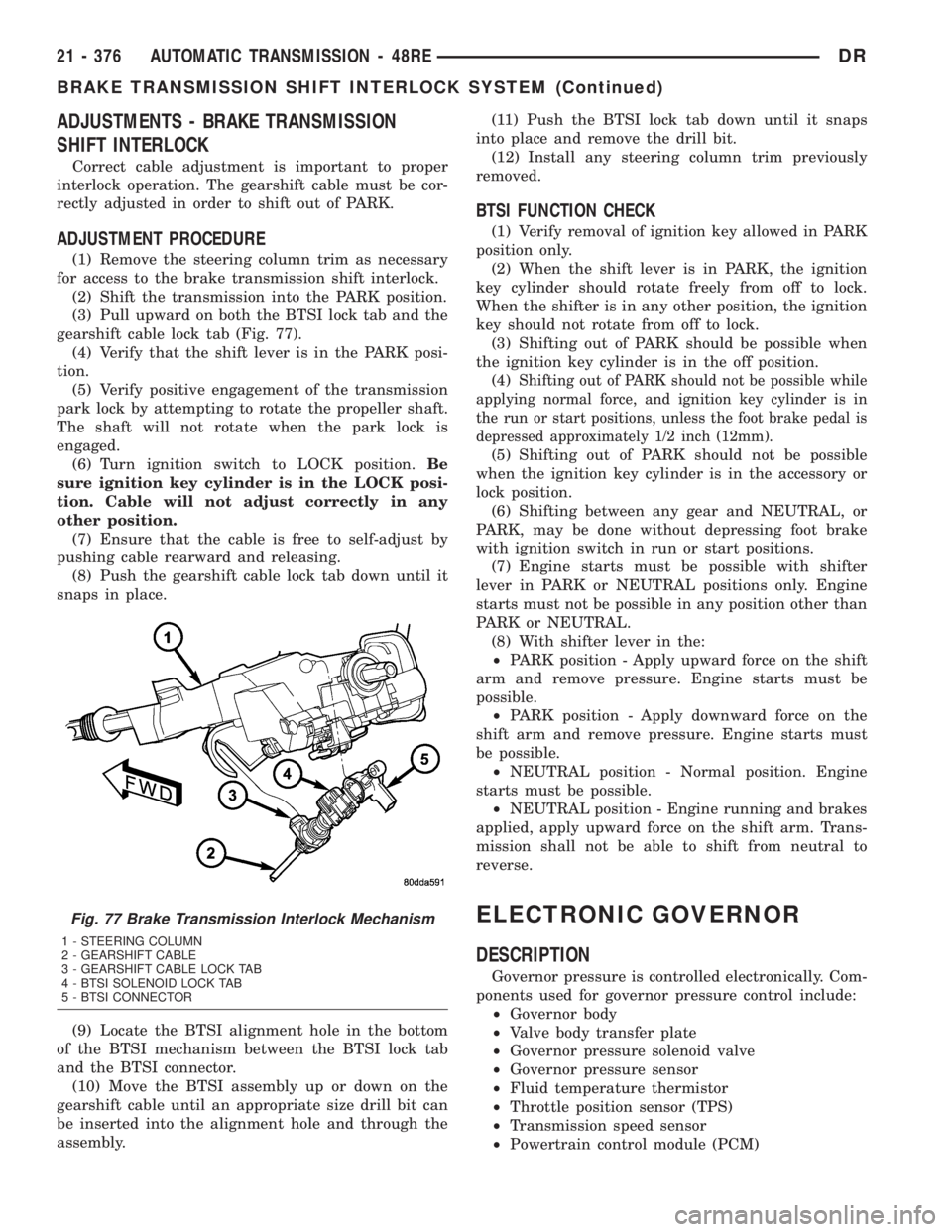
(3) Pull upward on both the BTSI lock tab and the
gearshift cable lock tab (Fig. 77).
(4) Verify that the shift lever is in the PARK posi-
tion.
(5) Verify positive engagement of the transmission
park lock by attempting to rotate the propeller shaft.
The shaft will not rotate when the park lock is
engaged.
(6) Turn ignition switch to LOCK position.Be
sure ignition key cylinder is in the LOCK posi-
tion. Cable will not adjust correctly in any
other position.
(7) Ensure that the cable is free to self-adjust by
pushing cable rearward and releasing.
(8) Push the gearshift cable lock tab down until it
snaps in place.
(9) Locate the BTSI alignment hole in the bottom
of the BTSI mechanism between the BTSI lock tab
and the BTSI connector.
(10) Move the BTSI assembly up or down on the
gearshift cable until an appropriate size drill bit can
be inserted into the alignment hole and through the
assembly.(11) Push the BTSI lock tab down until it snaps
into place and remove the drill bit.
(12) Install any steering column trim previously
removed.
BTSI FUNCTION CHECK
(1) Verify removal of ignition key allowed in PARK
position only.
(2) When the shift lever is in PARK, the ignition
key cylinder should rotate freely from off to lock.
When the shifter is in any other position, the ignition
key should not rotate from off to lock.
(3) Shifting out of PARK should be possible when
the ignition key cylinder is in the off position.
(4)
Shifting out of PARK should not be possible while
applying normal force, and ignition key cylinder is in
the run or start positions, unless the foot brake pedal is
depressed approximately 1/2 inch (12mm).
(5) Shifting out of PARK should not be possible
when the ignition key cylinder is in the accessory or
lock position.
(6) Shifting between any gear and NEUTRAL, or
PARK, may be done without depressing foot brake
with ignition switch in run or start positions.
(7) Engine starts must be possible with shifter
lever in PARK or NEUTRAL positions only. Engine
starts must not be possible in any position other than
PARK or NEUTRAL.
(8) With shifter lever in the:
²PARK position - Apply upward force on the shift
arm and remove pressure. Engine starts must be
possible.
²PARK position - Apply downward force on the
shift arm and remove pressure. Engine starts must
be possible.
²NEUTRAL position - Normal position. Engine
starts must be possible.
²NEUTRAL position - Engine running and brakes
applied, apply upward force on the shift arm. Trans-
mission shall not be able to shift from neutral to
reverse.
ELECTRONIC GOVERNOR
DESCRIPTION
Governor pressure is controlled electronically. Com-
ponents used for governor pressure control include:
²Governor body
²Valve body transfer plate
²Governor pressure solenoid valve
²Governor pressure sensor
²Fluid temperature thermistor
²Throttle position sensor (TPS)
²Transmission speed sensor
²Powertrain control module (PCM)
Fig. 77 Brake Transmission Interlock Mechanism
1 - STEERING COLUMN
2 - GEARSHIFT CABLE
3 - GEARSHIFT CABLE LOCK TAB
4 - BTSI SOLENOID LOCK TAB
5 - BTSI CONNECTOR
21 - 376 AUTOMATIC TRANSMISSION - 48REDR
BRAKE TRANSMISSION SHIFT INTERLOCK SYSTEM (Continued)
Page 2859 of 2895
BIN - INSTALLATION, STORAGE.........23-62
BIN - INSTALLATION, UNDER SEAT
STORAGE...........................23-81
BIN - REMOVAL, STORAGE.............23-62
BIN - REMOVAL, UNDER SEAT STORAGE . . 23-81
BIN COVERING - INSTALLATION, UNDER
SEAT STORAGE......................23-81
BIN COVERING - REMOVAL, UNDER
SEAT STORAGE......................23-81
BIN LATCH - INSTALLATION, UNDER
SEAT STORAGE......................23-81
BIN LATCH - REMOVAL, UNDER SEAT
STORAGE...........................23-81
BLADE - DESCRIPTION, WIPER.........8R-19
BLADE - INSTALLATION, WIPER.........8R-20
BLADE - OPERATION, WIPER...........8R-19
BLADE - REMOVAL, WIPER............8R-19
BLEEDING - STANDARD PROCEDURE......5-27
BLEEDING - STANDARD PROCEDURE,
ABS BRAKE..........................5-40
BLEEDING - STANDARD PROCEDURE,
MANUAL.............................5-5
BLEEDING - STANDARD PROCEDURE,
MASTER CYLINDER...................5-20
BLEEDING - STANDARD PROCEDURE,
PRESSURE...........................5-5
BLEND DOOR - INSTALLATION..........24-25
BLEND DOOR - REMOVAL.............24-24
BLEND DOOR ACTUATOR -
DESCRIPTION.......................24-16
BLEND DOOR ACTUATOR -
INSTALLATION.......................24-17
BLEND DOOR ACTUATOR - OPERATION . . . 24-16
BLEND DOOR ACTUATOR - REMOVAL....24-17
BLOCK - CLEANING, ENGINE . 9-127,9-200,9-249,
9-38,9-380
BLOCK - DESCRIPTION, BLOWER
MOTOR RESISTOR...................24-17
BLOCK - DESCRIPTION, ENGINE.....9-126,9-37
BLOCK - INSPECTION, ENGINE....9-127,9-200,
9-249,9-38,9-380
BLOCK - INSTALLATION, BLOWER
MOTOR RESISTOR...................24-18
BLOCK - INSTALLATION, BRAKE
JUNCTION...........................5-19
BLOCK - OPERATION, BLOWER MOTOR
RESISTOR..........................24-17
BLOCK - REMOVAL, BLOWER MOTOR
RESISTOR..........................24-18
BLOCK - REMOVAL, BRAKE JUNCTION....5-19
BLOCK HEATER - 5.9L DIESEL -
DESCRIPTION, ENGINE.................7-43
BLOCK HEATER - 5.9L DIESEL -
INSTALLATION, ENGINE................7-44
BLOCK HEATER - 5.9L DIESEL -
OPERATION, ENGINE...................7-43
BLOCK HEATER - 5.9L DIESEL -
REMOVAL, ENGINE....................7-43
BLOCK HEATER - DESCRIPTION, ENGINE . . . 7-42
BLOCK HEATER - DIAGNOSIS AND
TESTING, ENGINE.....................7-42
BLOCK HEATER - INSTALLATION,
ENGINE.............................7-43
BLOCK HEATER - OPERATION, ENGINE....7-42
BLOCK HEATER - REMOVAL, ENGINE......7-43
BLOCK REFACING - STANDARD
PROCEDURE, CYLINDER
...............9-312
BLOWER MOTOR - DESCRIPTION
.......24-25
BLOWER MOTOR - DIAGNOSIS AND
TESTING
...........................24-26
BLOWER MOTOR - INSTALLATION
.......24-26
BLOWER MOTOR - OPERATION
.........24-25
BLOWER MOTOR - REMOVAL
...........24-26
BLOWER MOTOR RESISTOR -
DIAGNOSIS AND TESTING
.............24-18
BLOWER MOTOR RESISTOR BLOCK -
DESCRIPTION
.......................24-17
BLOWER MOTOR RESISTOR BLOCK -
INSTALLATION
.......................24-18
BLOWER MOTOR RESISTOR BLOCK -
OPERATION
.........................24-17
BLOWER MOTOR RESISTOR BLOCK -
REMOVAL
..........................24-18
BLOWER MOTOR SWITCH -
DESCRIPTION
.......................24-18
BLOWER MOTOR SWITCH - DIAGNOSIS
AND TESTING
.......................24-18BLOWER MOTOR SWITCH -
INSTALLATION.......................24-19
BLOWER MOTOR SWITCH - OPERATION . . 24-18
BLOWER MOTOR SWITCH - REMOVAL . . . 24-19
BODY - ADJUSTMENTS, VALVE . . 21-308,21-487
BODY - ASSEMBLY, VALVE......21-299,21-477,
21-590
BODY & CABLE - DESCRIPTION,
ANTENNA...........................8A-4
BODY & CABLE - INSTALLATION,
ANTENNA...........................8A-6
BODY & CABLE - OPERATION, ANTENNA . . . 8A-4
BODY & CABLE - REMOVAL, ANTENNA....8A-6
BODY - CLEANING, VALVE......21-298,21-476,
21-588
BODY - DESCRIPTION, THROTTLE.......14-45
BODY - DESCRIPTION, VALVE . . . 21-267,21-445,
21-584
BODY - DISASSEMBLY, VALVE . . . 21-287,21-465,
21-586
BODY - INSPECTION, VALVE....21-298,21-476,
21-588
BODY - INSTALLATION, THROTTLE.......14-47
BODY - INSTALLATION, VALVE . . . 21-307,21-486,
21-590
BODY - OPERATION, THROTTLE.........14-45
BODY - OPERATION, VALVE.....21-272,21-450,
21-585
BODY - REMOVAL, THROTTLE..........14-45
BODY - REMOVAL, VALVE . 21-286,21-464,21-585
BODY AND CABLE - DIAGNOSIS AND
TESTING, ANTENNA...................8A-4
BODY CODE PLATE - DESCRIPTION.....Intro.-4
BODY ISOLATORS - INSTALLATION......23-37
BODY ISOLATORS - REMOVAL..........23-36
BODY LUBRICATION - STANDARD
PROCEDURE.........................23-3
BODY OPENING DIMENSIONS -
SPECIFICATIONS.....................23-99
BODY PANEL REPAIR - STANDARD
PROCEDURE, PLASTIC.................23-3
BODY SIDE MOLDINGS - INSTALLATION . . 23-36
BODY SIDE MOLDINGS - REMOVAL......23-36
BODY, SPECIAL TOOLS................23-14
BODY VENT - INSTALLATION...........23-72
BODY VENT - REMOVAL...............23-72
BOOST PRESSURE - DIAGNOSIS AND
TESTING, TURBOCHARGER.............11-10
BOOSTER - DESCRIPTION, POWER
BRAKE..............................5-25
BOOSTER - DIAGNOSIS AND TESTING,
HYDRAULIC..........................5-25
BOOSTER - DIAGNOSIS AND TESTING,
MASTER CYLINDER/POWER.............5-20
BOOSTER - INSTALLATION, HYDRO-
BOOST BRAKE........................5-27
BOOSTER - INSTALLATION, POWER
BRAKE..............................5-25
BOOSTER - OPERATION, POWER BRAKE . . . 5-25
BOOSTER - REMOVAL, HYDRO-BOOST
BRAKE..............................5-27
BOOSTER - REMOVAL, POWER BRAKE....5-25
BOOT - INSTALLATION, 4WD FLOOR
SHIFT..............................23-64
BOOT - INSTALLATION, EXTENSION
HOUSING SEAL AND DUST......21-652,21-716
BOOT - REMOVAL, 4WD FLOOR SHIFT....23-63
BOOT - REMOVAL, EXTENSION HOUSING
SEAL AND DUST..............21-652,21-716
BORE - DE-GLAZE - STANDARD
PROCEDURE, CYLINDER...............9-313
BORE HONING - STANDARD
PROCEDURE, CYLINDER . 9-126,9-233,9-360,9-37
BORE REPAIR - STANDARD
PROCEDURE, CAM...................9-315
BORE REPAIR - STANDARD
PROCEDURE, CYLINDER...............9-313
BOX - INSTALLATION, CARGO..........23-37
BOX - INSTALLATION, GLOVE...........23-53
BOX - REMOVAL, CARGO..............23-37
BOX - REMOVAL, GLOVE..............23-53
BOX - TIE DOWN - INSTALLATION,
CARGO
............................23-37
BOX - TIE DOWN - REMOVAL, CARGO
....23-37
BOX LAMP/SWITCH - INSTALLATION,
GLOVE
.............................8L-25
BOX LAMP/SWITCH - REMOVAL, GLOVE
. . 8L-25
BOX LATCH - INSTALLATION, GLOVE
.....23-53BOX LATCH - REMOVAL, GLOVE.........23-53
B-PILLAR GRAB HANDLE -
INSTALLATION.......................23-69
B-PILLAR GRAB HANDLE - REMOVAL....23-69
B-PILLAR LOWER TRIM - INSTALLATION . . 23-65
B-PILLAR LOWER TRIM - REMOVAL.....23-64
B-PILLAR UPPER TRIM - INSTALLATION . . 23-65
B-PILLAR UPPER TRIM - REMOVAL......23-65
BRACKET - INSTALLATION, REARVIEW
MIRROR SUPPORT...................23-71
BRACKET - INSTALLATION, STEERING
COLUMN OPENING SUPPORT...........23-62
BRACKET - REMOVAL, STEERING
COLUMN OPENING SUPPORT...........23-61
BRACKETS - INSTALLATION, SEAT BACK
REAR - FOOTMANS LOOP..............23-85
BRACKETS - REMOVAL, SEAT BACK
REAR - FOOTMANS LOOP..............23-85
BRAKE - CLEANING, REAR DRUM IN
HAT ................................5-33
BRAKE - DESCRIPTION, CONTROLLER
ANTILOCK...........................8E-3
BRAKE - DESCRIPTION, PARKING........5-30
BRAKE - INSPECTION, REAR DRUM IN
HAT ................................5-33
BRAKE - INSTALLATION, CONTROLLER
ANTILOCK...........................8E-3
BRAKE - OPERATION, CONTROLLER
ANTILOCK...........................8E-3
BRAKE - OPERATION, PARKING..........5-30
BRAKE - REMOVAL, CONTROLLER
ANTILOCK...........................8E-3
BRAKE BLEEDING - STANDARD
PROCEDURE, ABS.....................5-40
BRAKE BOOSTER - DESCRIPTION,
POWER.............................5-25
BRAKE BOOSTER - INSTALLATION,
HYDRO-BOOST.......................5-27
BRAKE BOOSTER - INSTALLATION,
POWER.............................5-25
BRAKE BOOSTER - OPERATION, POWER . . . 5-25
BRAKE BOOSTER - REMOVAL,
HYDRO-BOOST.......................5-27
BRAKE BOOSTER - REMOVAL, POWER....5-25
BRAKE CABLE - INSTALLATION, FRONT
PARKING............................5-32
BRAKE CABLE - INSTALLATION, REAR
PARK...............................5-32
BRAKE CABLE - REMOVAL, FRONT
PARKING............................5-31
BRAKE CABLE - REMOVAL, REAR PARK . . . 5-31
BRAKE CALIPER ADAPTER MOUNT -
INSTALLATION, DISC...................5-17
BRAKE CALIPERS - DESCRIPTION, DISC . . . 5-11
BRAKE CALIPERS - OPERATION, DISC.....5-12
BRAKE FLUID CONTAMINATION -
DIAGNOSIS AND TESTING..............5-18
BRAKE FLUID LEVEL - STANDARD
PROCEDURE.........................5-18
BRAKE FLUID, SPECIFICATIONS..........5-18
BRAKE HOSE - INSTALLATION, FRONT......5-9
BRAKE HOSE - INSTALLATION, REAR.......5-9
BRAKE HOSE - REMOVAL, REAR..........5-8
BRAKE INDICATOR - DESCRIPTION,
BRAKE/PARK........................8J-18
BRAKE INDICATOR - DIAGNOSIS AND
TESTING...........................8J-19
BRAKE INDICATOR - OPERATION,
BRAKE/PARK........................8J-19
BRAKE JUNCTION BLOCK -
INSTALLATION........................5-19
BRAKE JUNCTION BLOCK - REMOVAL.....5-19
BRAKE LAMP - INSTALLATION...........8L-8
BRAKE LAMP - REMOVAL...............8L-8
BRAKE LAMP SWITCH - DESCRIPTION....8L-8
BRAKE LAMP SWITCH - DIAGNOSIS
AND TESTING........................8L-9
BRAKE LAMP SWITCH - INSTALLATION . . . 8L-10
BRAKE LAMP SWITCH - OPERATION......8L-8
BRAKE LAMP SWITCH - REMOVAL.......8L-9
BRAKE PADS/SHOES - INSTALLATION.....5-10
BRAKE PADS/SHOES - REMOVAL
.........5-10
BRAKE PROPORTIONING -
DESCRIPTION, ELECTRONIC VARIABLE
....5-43
BRAKE PROPORTIONING - OPERATION,
ELECTRONIC VARIABLE
................5-43
BRAKE SHOES - ADJUSTMENT, PARKING
. . 5-34
BRAKE, SPECIFICATIONS - BASE
..........5-7
4 INDEXDR
Description Group-Page Description Group-Page Description Group-Page