2003 DODGE RAM Power Systems
[x] Cancel search: Power SystemsPage 1794 of 2895
STEERING
TABLE OF CONTENTS
page page
STEERING
DESCRIPTION..........................1
OPERATION............................1
DIAGNOSIS AND TESTING
DIAGNOSIS AND TESTING - POWER
STEERING SYSTEM....................2
DIAGNOSIS AND TESTING - POWER
STEERING FLOW AND PRESSURE........4
SPECIAL TOOLS
STEERING...........................5COLUMN...............................6
GEAR - INDEPENDENT FRONT SUSPENSION..16
GEAR - LINK/COIL.......................19
LINKAGE - INDEPENDENT FRONT
SUSPENSION...........................31
LINKAGE - LINK/COIL....................33
PUMP.................................38
STEERING
DESCRIPTION
CAUTION: MOPARTATF+4 is to be used in the
power steering system. No other power steering or
automatic transmission fluid is to be used in the
system. Damage may result to the power steering
pump and system if any other fluid is used, and do
not overfill.
Power steering systems consist of:
²Steering column
²Rack and pinion steering gear
²Belt driven hydraulic steering pump
²Pump pressure and return hoses
²Oil Cooler
OPERATION
The steering column shaft is attached to the gear
pinion. The rotation of the pinion moves the gear
rack from side-to-side. This lateral action of the rack
pushes and pulls the tie rods to change the direction
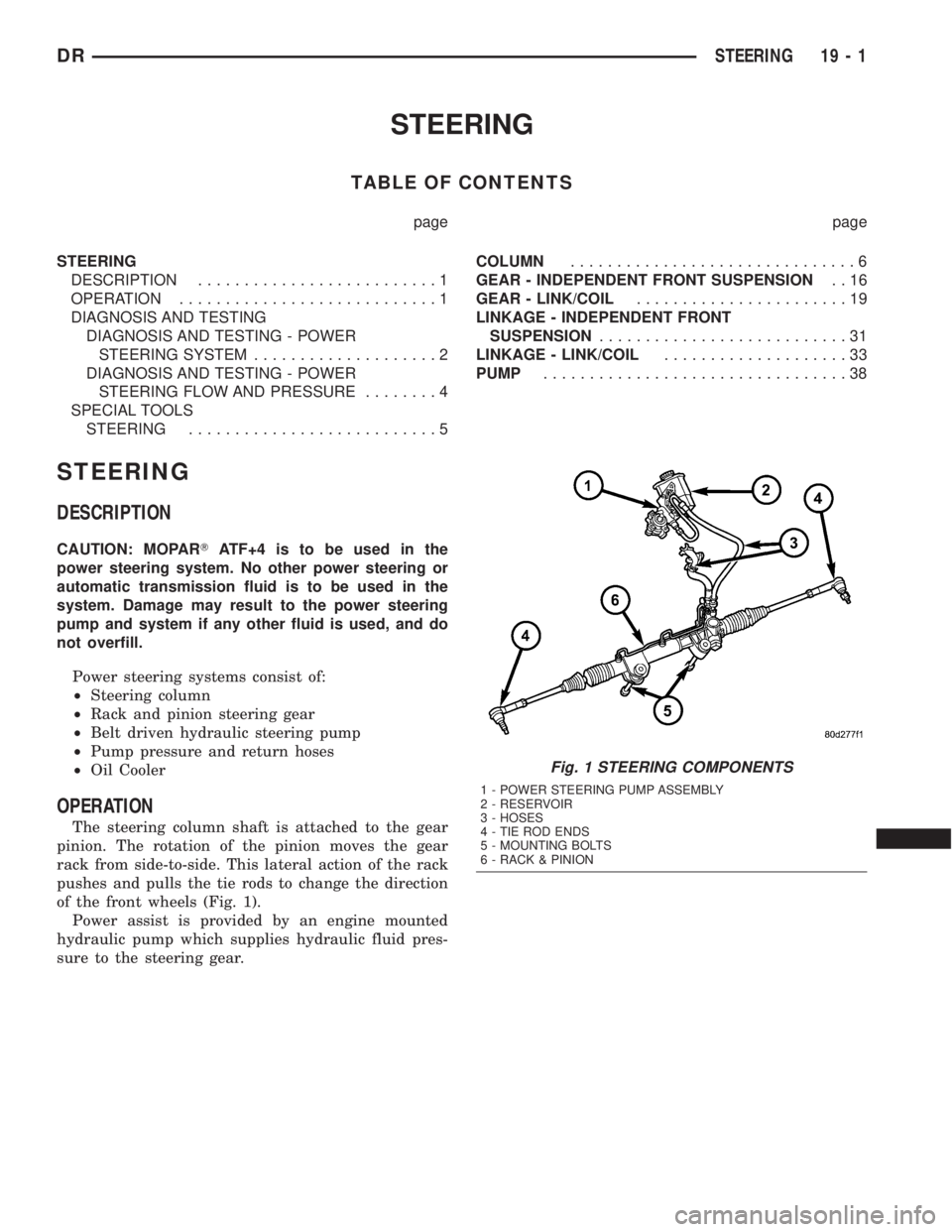
of the front wheels (Fig. 1).
Power assist is provided by an engine mounted
hydraulic pump which supplies hydraulic fluid pres-
sure to the steering gear.
Fig. 1 STEERING COMPONENTS
1 - POWER STEERING PUMP ASSEMBLY
2 - RESERVOIR
3 - HOSES
4 - TIE ROD ENDS
5 - MOUNTING BOLTS
6 - RACK & PINION
DRSTEERING 19 - 1
Page 1795 of 2895
DIAGNOSIS AND TESTING
DIAGNOSIS AND TESTING - POWER STEERING
SYSTEM
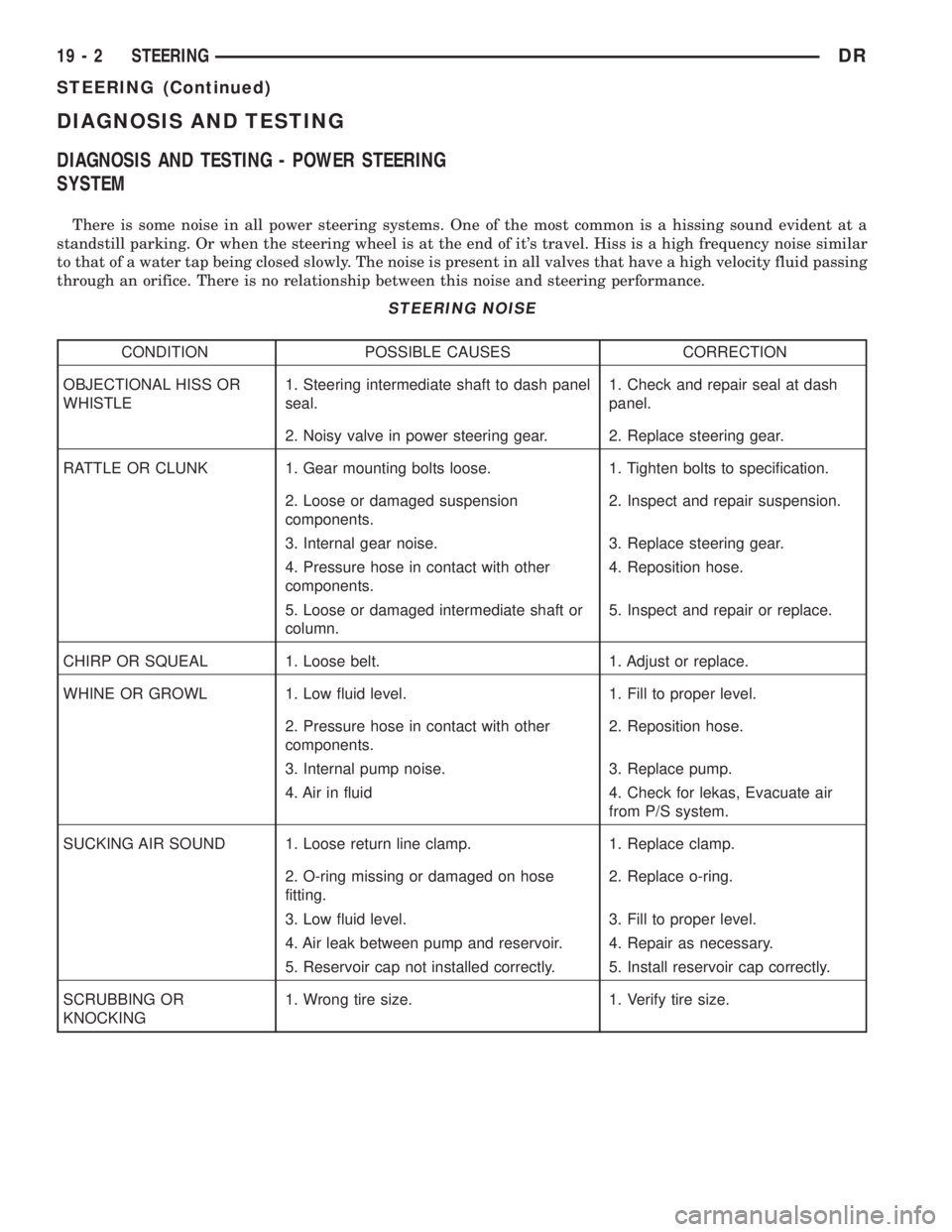
There is some noise in all power steering systems. One of the most common is a hissing sound evident at a
standstill parking. Or when the steering wheel is at the end of it's travel. Hiss is a high frequency noise similar
to that of a water tap being closed slowly. The noise is present in all valves that have a high velocity fluid passing
through an orifice. There is no relationship between this noise and steering performance.
STEERING NOISE
CONDITION POSSIBLE CAUSES CORRECTION
OBJECTIONAL HISS OR
WHISTLE1. Steering intermediate shaft to dash panel
seal.1. Check and repair seal at dash
panel.
2. Noisy valve in power steering gear. 2. Replace steering gear.
RATTLE OR CLUNK 1. Gear mounting bolts loose. 1. Tighten bolts to specification.
2. Loose or damaged suspension
components.2. Inspect and repair suspension.
3. Internal gear noise. 3. Replace steering gear.
4. Pressure hose in contact with other
components.4. Reposition hose.
5. Loose or damaged intermediate shaft or
column.5. Inspect and repair or replace.
CHIRP OR SQUEAL 1. Loose belt. 1. Adjust or replace.
WHINE OR GROWL 1. Low fluid level. 1. Fill to proper level.
2. Pressure hose in contact with other
components.2. Reposition hose.
3. Internal pump noise. 3. Replace pump.
4. Air in fluid 4. Check for lekas, Evacuate air
from P/S system.
SUCKING AIR SOUND 1. Loose return line clamp. 1. Replace clamp.
2. O-ring missing or damaged on hose
fitting.2. Replace o-ring.
3. Low fluid level. 3. Fill to proper level.
4. Air leak between pump and reservoir. 4. Repair as necessary.
5. Reservoir cap not installed correctly. 5. Install reservoir cap correctly.
SCRUBBING OR
KNOCKING1. Wrong tire size. 1. Verify tire size.
19 - 2 STEERINGDR
STEERING (Continued)
Page 2800 of 2895
(1) Recover refrigerant(Refer to 24 - HEATING &
AIR CONDITIONING/PLUMBING - STANDARD
PROCEDURE).
(2) Remove and disassemble the HVAC housing.
(Refer to 24 - HEATING & AIR CONDITIONING/
DISTRIBUTION/HVAC HOUSING - REMOVAL)
(Refer to 24 - HEATING & AIR CONDITIONING/
DISTRIBUTION/HVAC HOUSING - DISASSEMBLY)
(3) Remove the levers from the driver and passen-
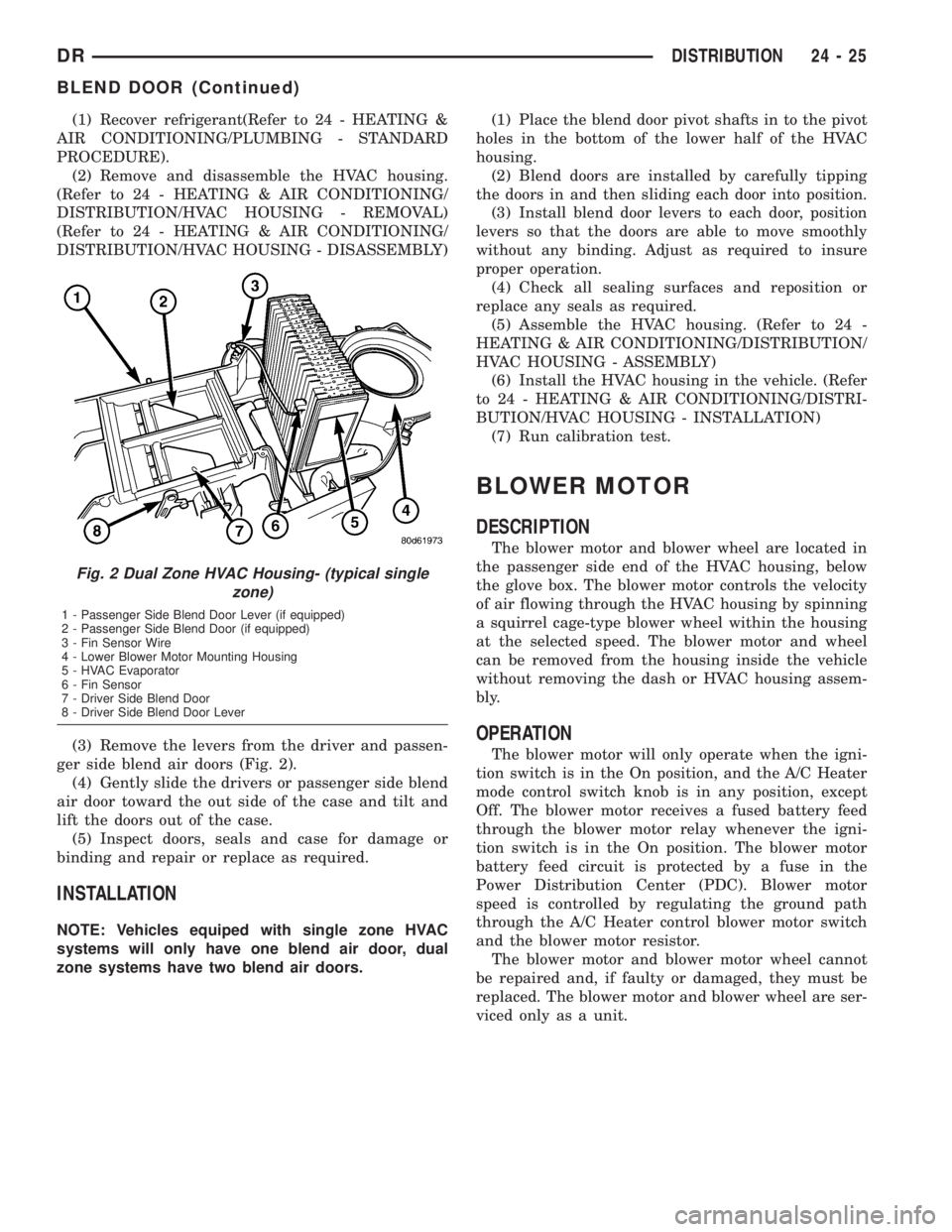
ger side blend air doors (Fig. 2).
(4) Gently slide the drivers or passenger side blend
air door toward the out side of the case and tilt and
lift the doors out of the case.
(5) Inspect doors, seals and case for damage or
binding and repair or replace as required.
INSTALLATION
NOTE: Vehicles equiped with single zone HVAC
systems will only have one blend air door, dual
zone systems have two blend air doors.(1) Place the blend door pivot shafts in to the pivot
holes in the bottom of the lower half of the HVAC
housing.
(2) Blend doors are installed by carefully tipping
the doors in and then sliding each door into position.
(3) Install blend door levers to each door, position
levers so that the doors are able to move smoothly
without any binding. Adjust as required to insure
proper operation.
(4) Check all sealing surfaces and reposition or
replace any seals as required.
(5) Assemble the HVAC housing. (Refer to 24 -
HEATING & AIR CONDITIONING/DISTRIBUTION/
HVAC HOUSING - ASSEMBLY)
(6) Install the HVAC housing in the vehicle. (Refer
to 24 - HEATING & AIR CONDITIONING/DISTRI-
BUTION/HVAC HOUSING - INSTALLATION)
(7) Run calibration test.
BLOWER MOTOR
DESCRIPTION
The blower motor and blower wheel are located in
the passenger side end of the HVAC housing, below
the glove box. The blower motor controls the velocity
of air flowing through the HVAC housing by spinning
a squirrel cage-type blower wheel within the housing
at the selected speed. The blower motor and wheel
can be removed from the housing inside the vehicle
without removing the dash or HVAC housing assem-
bly.
OPERATION
The blower motor will only operate when the igni-
tion switch is in the On position, and the A/C Heater
mode control switch knob is in any position, except
Off. The blower motor receives a fused battery feed
through the blower motor relay whenever the igni-
tion switch is in the On position. The blower motor
battery feed circuit is protected by a fuse in the
Power Distribution Center (PDC). Blower motor
speed is controlled by regulating the ground path
through the A/C Heater control blower motor switch
and the blower motor resistor.
The blower motor and blower motor wheel cannot
be repaired and, if faulty or damaged, they must be
replaced. The blower motor and blower wheel are ser-
viced only as a unit.
Fig. 2 Dual Zone HVAC Housing- (typical single
zone)
1 - Passenger Side Blend Door Lever (if equipped)
2 - Passenger Side Blend Door (if equipped)
3 - Fin Sensor Wire
4 - Lower Blower Motor Mounting Housing
5 - HVAC Evaporator
6 - Fin Sensor
7 - Driver Side Blend Door
8 - Driver Side Blend Door Lever
DRDISTRIBUTION 24 - 25
BLEND DOOR (Continued)
Page 2830 of 2895
EMISSIONS CONTROL
TABLE OF CONTENTS
page page
EMISSIONS CONTROL
DESCRIPTION
DESCRIPTION - STATE DISPLAY TEST
MODE...............................1
DESCRIPTION - CIRCUIT ACTUATION TEST
MODE...............................1
DESCRIPTION - DIAGNOSTIC TROUBLE
CODES..............................1
DESCRIPTION - TASK MANAGER..........1DESCRIPTION - MONITORED SYSTEMS....1
DESCRIPTION - TRIP DEFINITION.........4
DESCRIPTION - COMPONENT MONITORS . . 4
OPERATION
OPERATION..........................4
OPERATION - TASK MANAGER...........5
OPERATION - NON-MONITORED CIRCUITS . . 8
EVAPORATIVE EMISSIONS................10
EMISSIONS CONTROL
DESCRIPTION
DESCRIPTION - STATE DISPLAY TEST MODE
The switch inputs to the Powertrain Control Mod-
ule (PCM) have two recognized states; HIGH and
LOW. For this reason, the PCM cannot recognize the
difference between a selected switch position versus
an open circuit, a short circuit, or a defective switch.
If the State Display screen shows the change from
HIGH to LOW or LOW to HIGH, assume the entire
switch circuit to the PCM functions properly. Connect
the DRB scan tool to the data link connector and
access the state display screen. Then access either
State Display Inputs and Outputs or State Display
Sensors.
DESCRIPTION - CIRCUIT ACTUATION TEST
MODE
The Circuit Actuation Test Mode checks for proper
operation of output circuits or devices the Powertrain
Control Module (PCM) may not internally recognize.
The PCM attempts to activate these outputs and
allow an observer to verify proper operation. Most of
the tests provide an audible or visual indication of
device operation (click of relay contacts, fuel spray,
etc.). Except for intermittent conditions, if a device
functions properly during testing, assume the device,
its associated wiring, and driver circuit work cor-
rectly. Connect the DRB scan tool to the data link
connector and access the Actuators screen.
DESCRIPTION - DIAGNOSTIC TROUBLE CODES
A Diagnostic Trouble Code (DTC) indicates the
PCM has recognized an abnormal condition in the
system.Remember that DTC's are the results of a sys-
tem or circuit failure, but do not directly iden-
tify the failed component or components.
BULB CHECK
Each time the ignition key is turned to the ON
position, the malfunction indicator (check engine)
lamp on the instrument panel should illuminate for
approximately 2 seconds then go out. This is done for
a bulb check.
OBTAINING DTC'S USING DRB SCAN TOOL
(1) Obtain the applicable Powertrain Diagnostic
Manual.
(2) Obtain the DRB Scan Tool.
(3) Connect the DRB Scan Tool to the data link
(diagnostic) connector. This connector is located in
the passenger compartment; at the lower edge of
instrument panel; near the steering column.
(4) Turn the ignition switch on and access the
ªRead Faultº screen.
(5) Record all the DTC's and ªfreeze frameº infor-
mation shown on the DRB scan tool.
(6) To erase DTC's, use the ªErase Trouble Codeº
data screen on the DRB scan tool.Do not erase any
DTC's until problems have been investigated
and repairs have been performed.
DESCRIPTION - TASK MANAGER
The PCM is responsible for efficiently coordinating
the operation of all the emissions-related compo-
nents. The PCM is also responsible for determining if
the diagnostic systems are operating properly. The
software designed to carry out these responsibilities
is call the 'Task Manager'.
DESCRIPTION - MONITORED SYSTEMS
There are new electronic circuit monitors that
check fuel, emission, engine and ignition perfor-
DREMISSIONS CONTROL 25 - 1
Page 2831 of 2895
mance. These monitors use information from various
sensor circuits to indicate the overall operation of the
fuel, engine, ignition and emission systems and thus
the emissions performance of the vehicle.
The fuel, engine, ignition and emission systems
monitors do not indicate a specific component prob-
lem. They do indicate that there is an implied prob-
lem within one of the systems and that a specific
problem must be diagnosed.
If any of these monitors detect a problem affecting
vehicle emissions, the Malfunction Indicator Lamp
(MIL) will be illuminated. These monitors generate
Diagnostic Trouble Codes that can be displayed with
the MIL or a scan tool.
The following is a list of the system monitors:
²Misfire Monitor
²Fuel System Monitor
²Oxygen Sensor Monitor
²Oxygen Sensor Heater Monitor
²Catalyst Monitor
²Leak Detection Pump Monitor (if equipped)
All these system monitors require two consecutive
trips with the malfunction present to set a fault.
Refer to the appropriate Powertrain Diagnos-
tics Procedures manual for diagnostic proce-
dures.
The following is an operation and description of
each system monitor :
OXYGEN SENSOR (O2S) MONITOR
Effective control of exhaust emissions is achieved
by an oxygen feedback system. The most important
element of the feedback system is the O2S. The O2S
is located in the exhaust path. Once it reaches oper-
ating temperature 300É to 350ÉC (572É to 662ÉF), the
sensor generates a voltage that is inversely propor-
tional to the amount of oxygen in the exhaust. The
information obtained by the sensor is used to calcu-
late the fuel injector pulse width. This maintains a
14.7 to 1 Air Fuel (A/F) ratio. At this mixture ratio,
the catalyst works best to remove hydrocarbons (HC),
carbon monoxide (CO) and nitrogen oxide (NOx) from
the exhaust.
The O2S is also the main sensing element for the
Catalyst and Fuel Monitors.
The O2S can fail in any or all of the following
manners:
²slow response rate
²reduced output voltage
²dynamic shift
²shorted or open circuits
Response rate is the time required for the sensor to
switch from lean to rich once it is exposed to a richer
than optimum A/F mixture or vice versa. As the sen-
sor starts malfunctioning, it could take longer todetect the changes in the oxygen content of the
exhaust gas.
The output voltage of the O2S ranges from 0 to 1
volt. A good sensor can easily generate any output
voltage in this range as it is exposed to different con-
centrations of oxygen. To detect a shift in the A/F
mixture (lean or rich), the output voltage has to
change beyond a threshold value. A malfunctioning
sensor could have difficulty changing beyond the
threshold value.
OXYGEN SENSOR HEATER MONITOR
If there is an oxygen sensor (O2S) shorted to volt-
age DTC, as well as a O2S heater DTC, the O2S
fault MUST be repaired first. Before checking the
O2S fault, verify that the heater circuit is operating
correctly.
Effective control of exhaust emissions is achieved
by an oxygen feedback system. The most important
element of the feedback system is the O2S. The O2S
is located in the exhaust path. Once it reaches oper-
ating temperature 300É to 350ÉC (572 É to 662ÉF), the
sensor generates a voltage that is inversely propor-
tional to the amount of oxygen in the exhaust. The
information obtained by the sensor is used to calcu-
late the fuel injector pulse width. This maintains a
14.7 to 1 Air Fuel (A/F) ratio. At this mixture ratio,
the catalyst works best to remove hydrocarbons (HC),
carbon monoxide (CO) and nitrogen oxide (NOx) from
the exhaust.
The voltage readings taken from the O2S sensor
are very temperature sensitive. The readings are not
accurate below 300ÉC. Heating of the O2S sensor is
done to allow the engine controller to shift to closed
loop control as soon as possible. The heating element
used to heat the O2S sensor must be tested to ensure
that it is heating the sensor properly.
The O2S sensor circuit is monitored for a drop in
voltage. The sensor output is used to test the heater
by isolating the effect of the heater element on the
O2S sensor output voltage from the other effects.
LEAK DETECTION PUMP MONITOR (IF EQUIPPED)
The leak detection assembly incorporates two pri-
mary functions: it must detect a leak in the evapora-
tive system and seal the evaporative system so the
leak detection test can be run.
The primary components within the assembly are:
A three port solenoid that activates both of the func-
tions listed above; a pump which contains a switch,
two check valves and a spring/diaphragm, a canister
vent valve (CVV) seal which contains a spring loaded
vent seal valve.
Immediately after a cold start, between predeter-
mined temperature thresholds limits, the three port
solenoid is briefly energized. This initializes the
25 - 2 EMISSIONS CONTROLDR
EMISSIONS CONTROL (Continued)
Page 2833 of 2895
verter. The PCM calculates the A/F mixture from the
output of the O2S. A low voltage indicates high oxy-
gen content (lean mixture). A high voltage indicates a
low content of oxygen (rich mixture).
When the upstream O2S detects a lean condition,
there is an abundance of oxygen in the exhaust gas.
A functioning converter would store this oxygen so it
can use it for the oxidation of HC and CO. As the
converter absorbs the oxygen, there will be a lack of
oxygen downstream of the converter. The output of
the downstream O2S will indicate limited activity in
this condition.
As the converter loses the ability to store oxygen,
the condition can be detected from the behavior of
the downstream O2S. When the efficiency drops, no
chemical reaction takes place. This means the con-
centration of oxygen will be the same downstream as
upstream. The output voltage of the downstream
O2S copies the voltage of the upstream sensor. The
only difference is a time lag (seen by the PCM)
between the switching of the O2S's.
To monitor the system, the number of lean-to-rich
switches of upstream and downstream O2S's is
counted. The ratio of downstream switches to
upstream switches is used to determine whether the
catalyst is operating properly. An effective catalyst
will have fewer downstream switches than it has
upstream switches i.e., a ratio closer to zero. For a
totally ineffective catalyst, this ratio will be one-to-
one, indicating that no oxidation occurs in the device.
The system must be monitored so that when cata-
lyst efficiency deteriorates and exhaust emissions
increase to over the legal limit, the MIL will be illu-
minated.
DESCRIPTION - TRIP DEFINITION
The term ªTripº has different meanings depending
on what the circumstances are. If the MIL (Malfunc-
tion Indicator Lamp) is OFF, a Trip is defined as
when the Oxygen Sensor Monitor and the Catalyst
Monitor have been completed in the same drive cycle.
When any Emission DTC is set, the MIL on the
dash is turned ON. When the MIL is ON, it takes 3
good trips to turn the MIL OFF. In this case, it
depends on what type of DTC is set to know what a
ªTripº is.
For the Fuel Monitor or Mis-Fire Monitor (contin-
uous monitor), the vehicle must be operated in the
ªSimilar Condition Windowº for a specified amount of
time to be considered a Good Trip.
If a Non-Contiuous OBDII Monitor fails twice in a
row and turns ON the MIL, re-running that monitor
which previously failed, on the next start-up and
passing the monitor, is considered to be a Good Trip.
These will include the following:
²Oxygen Sensor²Catalyst Monitor
²Purge Flow Monitor
²Leak Detection Pump Monitor (if equipped)
²EGR Monitor (if equipped)
²Oxygen Sensor Heater Monitor
If any other Emission DTC is set (not an OBDII
Monitor), a Good Trip is considered to be when the
Oxygen Sensor Monitor and Catalyst Monitor have
been completed; or 2 Minutes of engine run time if
the Oxygen Sensor Monitor or Catalyst Monitor have
been stopped from running.
It can take up to 2 Failures in a row to turn on the
MIL. After the MIL is ON, it takes 3 Good Trips to
turn the MIL OFF. After the MIL is OFF, the PCM
will self-erase the DTC after 40 Warm-up cycles. A
Warm-up cycle is counted when the ECT (Engine
Coolant Temperature Sensor) has crossed 160ÉF and
has risen by at least 40ÉF since the engine has been
started.
DESCRIPTION - COMPONENT MONITORS
There are several components that will affect vehi-
cle emissions if they malfunction. If one of these com-
ponents malfunctions the Malfunction Indicator
Lamp (MIL) will illuminate.
Some of the component monitors are checking for
proper operation of the part. Electrically operated
components now have input (rationality) and output
(functionality) checks. Previously, a component like
the Throttle Position sensor (TPS) was checked by
the PCM for an open or shorted circuit. If one of
these conditions occurred, a DTC was set. Now there
is a check to ensure that the component is working.
This is done by watching for a TPS indication of a
greater or lesser throttle opening than MAP and
engine rpm indicate. In the case of the TPS, if engine
vacuum is high and engine rpm is 1600 or greater,
and the TPS indicates a large throttle opening, a
DTC will be set. The same applies to low vacuum if
the TPS indicates a small throttle opening.
All open/short circuit checks, or any component
that has an associated limp-in, will set a fault after 1
trip with the malfunction present. Components with-
out an associated limp-in will take two trips to illu-
minate the MIL.
OPERATION
OPERATION
The Powertrain Control Module (PCM) monitors
many different circuits in the fuel injection, ignition,
emission and engine systems. If the PCM senses a
problem with a monitored circuit often enough to
indicate an actual problem, it stores a Diagnostic
Trouble Code (DTC) in the PCM's memory. If the
25 - 4 EMISSIONS CONTROLDR
EMISSIONS CONTROL (Continued)
Page 2866 of 2895
DIESEL ENGINE - DIAGNOSIS AND
TESTING, COOLING SYSTEM.............7-7
DIESEL ENGINE - INSTALLATION, 5.9L . . . 24-39,
24-42,24-44
DIESEL ENGINE - INSTALLATION,
EXCEPT V-10 OR.....................8R-17
DIESEL ENGINE - INSTALLATION, V-10
OR................................8R-17
DIESEL ENGINE - REMOVAL, 5.9L . . 24-37,24-40,
24-43,24-46
DIESEL ENGINE - REMOVAL, EXCEPT
V-10 OR ...........................8R-16
DIESEL ENGINE - REMOVAL, V-10 OR....8R-16
DIESEL ENGINE - STANDARD
PROCEDURE, DRAINING COOLING
SYSTEM 5.9L........................7-19
DIESEL ENGINE - STANDARD
PROCEDURE, REFILLING COOLING
SYSTEM 5.9L........................7-19
DIESEL ENGINE, SPECIAL TOOLS - 5.9L . . 9-294
DIESEL FUEL SYSTEM - DESCRIPTION . . . 14-57
DIESEL FUEL SYSTEM, SPECIAL TOOLS . . 14-60
DIESEL, SPECIFICATIONS - 5.9L.........9-293
DIFFERENTIAL - ASSEMBLY . . . 3-116,3-143,3-38,
3-63,3-88
DIFFERENTIAL - DESCRIPTION....3-114,3-141,
3-36,3-61,3-86
DIFFERENTIAL - DISASSEMBLY....3-115,3-142,
3-37,3-62,3-88
DIFFERENTIAL - INSTALLATION....3-117,3-144,
3-38,3-63,3-88
DIFFERENTIAL - OPERATION . . 3-114,3-141,3-36,
3-61,3-86
DIFFERENTIAL - REMOVAL . . . 3-115,3-142,3-36,
3-61,3-86
DIFFERENTIAL CASE BEARINGS -
INSTALLATION.....3-121,3-148,3-39,3-65,3-94
DIFFERENTIAL CASE BEARINGS -
REMOVAL.........3-121,3-148,3-39,3-64,3-93
DIFFERENTIAL TRAC-RITE - ASSEMBLY . . 3-120,
3-147
DIFFERENTIAL TRAC-RITE - CLEANING . . . 3-119,
3-146
DIFFERENTIAL TRAC-RITE -
DESCRIPTION..................3-118,3-145
DIFFERENTIAL TRAC-RITE -
DISASSEMBLY..................3-118,3-145
DIFFERENTIAL TRAC-RITE - INSPECTION . 3-119,
3-146
DIFFERENTIAL TRAC-RITE - OPERATION . . 3-118,
3-145
DIFFERENTIAL-TRAC-LOK - ASSEMBLY....3-92
DIFFERENTIAL-TRAC-LOK -
DESCRIPTION........................3-89
DIFFERENTIAL-TRAC-LOK - DIAGNOSIS
AND TESTING........................3-89
DIFFERENTIAL-TRAC-LOK -
DISASSEMBLY........................3-90
DIFFERENTIAL-TRAC-LOK - OPERATION....3-89
DIMENSIONS - SPECIFICATIONS, BODY
OPENING...........................23-99
DIMENSIONS - SPECIFICATIONS, FRAME . . 13-17
DIODE - INSTALLATION............8W-01-14
DIODE - REMOVAL................8W-01-14
DIODE REPLACEMENT - STANDARD
PROCEDURE.........................24-7
DISC - INSTALLATION, CLUTCH...........6-6
DISC - REMOVAL, CLUTCH...............6-6
DISC BRAKE CALIPER ADAPTER MOUNT
- INSTALLATION......................5-17
DISC BRAKE CALIPERS - DESCRIPTION....5-11
DISC BRAKE CALIPERS - OPERATION.....5-12
DISCHARGE (ESD) SENSITIVE DEVICES -
STANDARD PROCEDURE,
ELECTROSTATIC...................8W-01-8
DISPLAY TEST MODE - DESCRIPTION,
STATE ..............................25-1
DISTRIBUTION - DESCRIPTION, POWER . 8W-97-1
DISTRIBUTION - OPERATION, POWER . . 8W-97-1
DISTRIBUTION DUCTS - INSTALLATION,
FLOOR.............................24-27
DISTRIBUTION DUCTS - REMOVAL,
FLOOR
.............................24-27
DISTRIBUTION SYSTEMS, SPECIAL
TOOLS - POWER
...................8W-97-2
DISTRIBUTOR - DESCRIPTION
..........8I-16
DISTRIBUTOR - INSTALLATION
..........8I-18
DISTRIBUTOR - OPERATION
............8I-16DISTRIBUTOR - REMOVAL..............8I-17
DISTRIBUTOR BUSHING - INSTALLATION . 9-258
DISTRIBUTOR BUSHING - REMOVAL.....9-258
DISTRIBUTOR CAP - 5.9L V-8 -
DIAGNOSIS AND TESTING..............8I-18
DISTRIBUTOR ROTOR - 5.9L V-8 -
DIAGNOSIS AND TESTING..............8I-19
DOME LAMP - DESCRIPTION...........8L-24
DOME LAMP - INSTALLATION..........8L-24
DOME LAMP - OPERATION.............8L-24
DOME LAMP - REMOVAL..............8L-24
DOOR - INSTALLATION...........23-18,23-28
DOOR - INSTALLATION, BLEND.........24-25
DOOR - INSTALLATION, DEFROST.......24-27
DOOR - INSTALLATION, FLOOR -
DEFROST...........................24-30
DOOR - INSTALLATION, FUEL FILL.......23-39
DOOR - INSTALLATION, RECIRC.........24-30
DOOR - REMOVAL...............23-18,23-28
DOOR - REMOVAL, BLEND.............24-24
DOOR - REMOVAL, DEFROST...........24-27
DOOR - REMOVAL, FLOOR - DEFROST....24-30
DOOR - REMOVAL, FUEL FILL..........23-39
DOOR - REMOVAL, RECIRC............24-30
DOOR ACTUATOR - DESCRIPTION,
BLEND.............................24-16
DOOR ACTUATOR - DESCRIPTION,
MODE...............................24-20
DOOR ACTUATOR - DESCRIPTION,
RECIRCULATION.....................24-22
DOOR ACTUATOR - INSTALLATION,
BLEND.............................24-17
DOOR ACTUATOR - INSTALLATION,
FLOOR - DEFROST...................24-20
DOOR ACTUATOR - INSTALLATION,
MODE.............................24-22
DOOR ACTUATOR - INSTALLATION,
RECIRCULATION.....................24-23
DOOR ACTUATOR - OPERATION, BLEND . . 24-16
DOOR ACTUATOR - OPERATION, MODE . . . 24-21
DOOR ACTUATOR - OPERATION,
RECIRCULATION.....................24-22
DOOR ACTUATOR - REMOVAL, BLEND....24-17
DOOR ACTUATOR - REMOVAL, FLOOR -
DEFROST...........................24-19
DOOR ACTUATOR - REMOVAL, MODE....24-21
DOOR ACTUATOR - REMOVAL,
RECIRCULATION.....................24-22
DOOR AJAR INDICATOR - DESCRIPTION . . 8J-23
DOOR AJAR INDICATOR - OPERATION....8J-23
DOOR AJAR SWITCH - DESCRIPTION....8L-25
DOOR AJAR SWITCH - OPERATION......8L-25
DOOR GLASS - INSTALLATION.....23-20,23-30
DOOR GLASS - REMOVAL........23-20,23-30
DOOR GLASS RUN WEATHERSTRIP -
INSTALLATION, FRONT................23-92
DOOR GLASS RUN WEATHERSTRIP -
INSTALLATION, REAR.................23-93
DOOR GLASS RUN WEATHERSTRIP -
REMOVAL, FRONT....................23-92
DOOR GLASS RUN WEATHERSTRIP -
REMOVAL, REAR.....................23-93
DOOR INNER BELT MOLDING -
INSTALLATION, FRONT................23-93
DOOR INNER BELT MOLDING -
INSTALLATION, REAR.................23-94
DOOR INNER BELT MOLDING -
REMOVAL, FRONT....................23-93
DOOR INNER BELT MOLDING -
REMOVAL, REAR
.....................23-94
DOOR LOCK MOTOR - DESCRIPTION
......8N-5
DOOR LOCK MOTOR - DIAGNOSIS AND
TESTING
............................8N-5
DOOR LOCK MOTOR - OPERATION
.......8N-5
DOOR MODULE - DESCRIPTION, DRIVER
. . 8N-5
DOOR MODULE - DIAGNOSIS AND
TESTING, DRIVER
.....................8N-6
DOOR MODULE - INSTALLATION,
DRIVER
.............................8N-7
DOOR MODULE - OPERATION, DRIVER
....8N-5
DOOR MODULE - REMOVAL, DRIVER
.....8N-7
DOOR OPENING SEAL - INSTALLATION
. . . 23-92
DOOR OPENING SEAL - REMOVAL
.......23-92
DOOR OUTER BELT MOLDING -
INSTALLATION, FRONT
................23-93
DOOR OUTER BELT MOLDING -
INSTALLATION, REAR
.................23-94DOOR OUTER BELT MOLDING -
REMOVAL, FRONT....................23-93
DOOR OUTER BELT MOLDING -
REMOVAL, REAR.....................23-94
DOOR SILL TRIM COVER -
INSTALLATION, REAR.................23-72
DOOR SILL TRIM COVER - REMOVAL,
REAR..............................23-72
DOUBLE INVERTED FLARING -
STANDARD PROCEDURE.................5-7
DRAG LINK - INSTALLATION............19-35
DRAG LINK - REMOVAL...............19-35
DRAIN AND REFILL - STANDARD
PROCEDURE, FLUID.....21-617,21-652,21-682,
21-716
DRAIN CIRCUIT - OPERATION, FUEL.....14-78
DRAINBACK VALVE - DESCRIPTION,
TORQUE CONVERTER..........21-262,21-440
DRAINBACK VALVE - OPERATION,
TORQUE CONVERTER..........21-262,21-440
DRAINBACK VALVE - STANDARD
PROCEDURE, TORQUE CONVERTER....21-262,
21-440
DRAINING AT FUEL FILTER - STANDARD
PROCEDURES, WATER................14-57
DRAINING COOLING SYSTEM
3.7L/4.7L/5.7L ENGINE - STANDARD
PROCEDURE.........................7-18
DRAINING COOLING SYSTEM 5.9L
DIESEL ENGINE - STANDARD
PROCEDURE.........................7-19
DRAINING COOLING SYSTEM 5.9L/8.0L
ENGINE - STANDARD PROCEDURE........7-18
DRAW TEST - STANDARD PROCEDURE,
IGNITION-OFF.......................8F-11
DRIP RAIL WEATHERSTRIP -
INSTALLATION.......................23-91
DRIP RAIL WEATHERSTRIP - REMOVAL . . 23-91
DRIP RAIL WEATHERSTRIP RETAINER -
INSTALLATION.......................23-92
DRIP RAIL WEATHERSTRIP RETAINER -
REMOVAL..........................23-92
DRIVE - DIAGNOSIS AND TESTING,
ELECTRONICLY CONTOLLED VISCOUS
FAN ................................7-56
DRIVE - DIAGNOSIS AND TESTING,
VISCOUS FAN........................7-54
DRIVE BELT - DIAGNOSIS AND TESTING,
ACCESSORY.................7-25,7-28,7-31
DRIVE BELTS - 3.7L / 4.7L -
INSTALLATION........................7-27
DRIVE BELTS - 3.7L / 4.7L - REMOVAL....7-27
DRIVE BELTS - 5.9L - INSTALLATION......7-31
DRIVE BELTS - 5.9L - REMOVAL.........7-30
DRIVE BELTS - 5.9L DIESEL -
INSTALLATION........................7-34
DRIVE BELTS - 5.9L DIESEL - REMOVAL . . . 7-34
DRIVE LEARN - STANDARD PROCEDURE . . 8E-21
DRIVE SYSTEM - DESCRIPTION, TIMING . . 9-164
DRIVE SYSTEM - OPERATION, TIMING....9-164
DRIVE VISCOUS CLUTCH - 5.9L DIESEL
- DESCRIPTION, FAN...................7-55
DRIVE VISCOUS CLUTCH - 5.9L DIESEL
- OPERATION, FAN....................7-55
DRIVE VISCOUS CLUTCH -
DESCRIPTION, FAN....................7-54
DRIVE VISCOUS CLUTCH - OPERATION,
FAN ................................7-54
DRIVER AIRBAG - DESCRIPTION........8O-22
DRIVER AIRBAG - INSTALLATION.......8O-24
DRIVER AIRBAG - OPERATION..........8O-23
DRIVER AIRBAG - REMOVAL...........8O-23
DRIVER DOOR MODULE - DESCRIPTION . . . 8N-5
DRIVER DOOR MODULE - DIAGNOSIS
AND TESTING........................8N-6
DRIVER DOOR MODULE - INSTALLATION . . 8N-7
DRIVER DOOR MODULE - OPERATION....8N-5
DRIVER DOOR MODULE - REMOVAL......8N-7
DRIVER SEAT SWITCH - DESCRIPTION . . . 8N-15
DRIVER SEAT SWITCH - DIAGNOSIS
AND TESTING.......................8N-15
DRIVER SEAT SWITCH - INSTALLATION
. . 8N-16
DRIVER SEAT SWITCH - OPERATION
.....8N-15
DRIVER SEAT SWITCH - REMOVAL
......8N-16
DRIVER SIDE BEZEL - INSTALLATION,
INSTRUMENT PANEL
..................23-59
DRIVER SIDE BEZEL - REMOVAL,
INSTRUMENT PANEL
..................23-58
DRINDEX 11
Description Group-Page Description Group-Page Description Group-Page
Page 2880 of 2895
PLANETARY GEARTRAIN/OUTPUT SHAFT
- INSPECTION................21-245,21-422
PLANETARY GEARTRAIN/OUTPUT SHAFT
- OPERATION.................21-243,21-420
PLASTIC BODY PANEL REPAIR -
STANDARD PROCEDURE................23-3
PLATE - DESCRIPTION, BODY CODE....Intro.-4
PLATE - DESCRIPTION, ENGINE DATA....9-297
PLATE - INSTALLATION, FLEX . . 9-137,9-205,9-47
PLATE - INSTALLATION, FRONT SKID.....13-24
PLATE - INSTALLATION, SUPPORT........5-29
PLATE - INSTALLATION, TRANSFER
CASE SKID.........................13-26
PLATE - REMOVAL, FLEX.....9-137,9-205,9-47
PLATE - REMOVAL, FRONT SKID........13-24
PLATE - REMOVAL, SUPPORT...........5-29
PLATE - REMOVAL, TRANSFER CASE
SKID..............................13-26
PLATE LAMP - INSTALLATION, LICENSE . . 8L-16
PLATE LAMP - REMOVAL, LICENSE......8L-16
PLATE LAMP UNIT - INSTALLATION,
LICENSE...........................8L-16
PLATE LAMP UNIT - REMOVAL, LICENSE . . 8L-16
PLATES - INSTALLATION, EXTERIOR
NAME.............................23-38
PLATES - REMOVAL, EXTERIOR NAME....23-38
PLUG - DESCRIPTION, SPARK...........8I-27
PLUG - INSTALLATION, CAMSHAFT
CORE HOLE.........................9-201
PLUG - REMOVAL, CAMSHAFT CORE
HOLE..............................9-200
PLUG - REMOVAL, SPARK..............8I-30
PLUG CABLE - DESCRIPTION, SPARK.....8I-33
PLUG CABLE - INSTALLATION, SPARK....8I-35
PLUG CABLE - OPERATION, SPARK.......8I-33
PLUG CABLE - REMOVAL, SPARK........8I-34
PLUG CABLE ORDER, 8.0L V-10 ENGINE
- SPARK .............................8I-5
PLUG CABLE RESISTANCE,
SPECIFICATIONS - SPARK...............8I-5
PLUG CABLES - DIAGNOSIS AND
TESTING, SPARK.....................8I-33
PLUG CONDITIONS - DIAGNOSIS AND
TESTING, SPARK.....................8I-27
PLUGS - INSTALLATION, CORE..........9-130
PLUGS - REMOVAL, CORE.............9-129
PLUGS, SPECIFICATIONS - SPARK........8I-5
PLUMBING - CLEANING, CHARGE AIR
COOLER............................11-16
PLUMBING - DESCRIPTION, CHARGE
AIR COOLER........................11-15
PLUMBING - INSPECTION, CHARGE AIR
COOLER............................11-16
PLUMBING - INSTALLATION, CHARGE
AIR COOLER........................11-16
PLUMBING - OPERATION, CHARGE AIR
COOLER............................11-15
PLUMBING - REMOVAL, CHARGE AIR
COOLER............................11-15
PLY TIRES - DESCRIPTION, RADIAL.......22-6
POLISHING - DESCRIPTION, FINESSE
SANDING/BUFFING...................23-75
PORT - DESCRIPTION, REFRIGERANT
SYSTEM SERVICE.....................24-1
PORT - OPERATION, REFRIGERANT
SYSTEM SERVICE.....................24-2
POSITION SENSOR - DESCRIPTION.....21-618,
21-654
POSITION SENSOR - DESCRIPTION,
ACCELERATOR PEDAL.................14-25
POSITION SENSOR - DESCRIPTION,
CAMSHAFT.........................14-82
POSITION SENSOR - DESCRIPTION,
CAMSHAFT...........................8I-8
POSITION SENSOR - DESCRIPTION,
CRANKSHAFT..................14-26,14-83
POSITION SENSOR - DESCRIPTION,
THROTTLE..........................14-52
POSITION SENSOR - INSTALLATION
....21-619,
21-654
POSITION SENSOR - INSTALLATION,
ACCELERATOR PEDAL
.................14-25
POSITION SENSOR - INSTALLATION,
CAMSHAFT
.........................14-83
POSITION SENSOR - INSTALLATION,
CAMSHAFT
..........................8I-14
POSITION SENSOR - INSTALLATION,
CRANKSHAFT
..................14-30,14-84POSITION SENSOR - INSTALLATION,
THROTTLE..........................14-54
POSITION SENSOR - OPERATION . 21-619,21-654
POSITION SENSOR - OPERATION,
ACCELERATOR PEDAL.................14-25
POSITION SENSOR - OPERATION,
CAMSHAFT.........................14-82
POSITION SENSOR - OPERATION,
CAMSHAFT...........................8I-8
POSITION SENSOR - OPERATION,
CRANKSHAFT..................14-26,14-83
POSITION SENSOR - OPERATION,
THROTTLE..........................14-52
POSITION SENSOR - REMOVAL . . 21-619,21-654
POSITION SENSOR - REMOVAL,
ACCELERATOR PEDAL.................14-25
POSITION SENSOR - REMOVAL,
CAMSHAFT.........................14-83
POSITION SENSOR - REMOVAL,
CAMSHAFT..........................8I-11
POSITION SENSOR - REMOVAL,
CRANKSHAFT..................14-29,14-84
POSITION SENSOR - REMOVAL,
THROTTLE..........................14-53
POSITION SWITCH - DESCRIPTION,
CLUTCH PEDAL.......................6-14
POSITION SWITCH - DIAGNOSIS AND
TESTING, CLUTCH PEDAL...............6-14
POSITION SWITCH - OPERATION,
CLUTCH PEDAL.......................6-14
POTENTIAL - STANDARD PROCEDURE,
TESTING OF VOLTAGE..............8W-01-9
POWER - INSTALLATION, WINDOW
REGULATOR...................23-25,23-34
POWER - REMOVAL, WINDOW
REGULATOR...................23-25,23-34
POWER BRAKE BOOSTER -
DESCRIPTION........................5-25
POWER BRAKE BOOSTER -
INSTALLATION........................5-25
POWER BRAKE BOOSTER - OPERATION . . . 5-25
POWER BRAKE BOOSTER - REMOVAL.....5-25
POWER DISTRIBUTION - DESCRIPTION . 8W-97-1
POWER DISTRIBUTION - OPERATION . . 8W-97-1
POWER DISTRIBUTION SYSTEMS,
SPECIAL TOOLS...................8W-97-2
POWER GROUNDS - DESCRIPTION......8E-10
POWER LOCK SWITCH - DIAGNOSIS
AND TESTING........................8N-4
POWER LOCK SWITCH - INSTALLATION . . . 8N-4
POWER LOCK SWITCH - REMOVAL.......8N-4
POWER LOCKS - DESCRIPTION..........8N-1
POWER LOCKS - DIAGNOSIS AND
TESTING............................8N-3
POWER LOCKS - OPERATION............8N-2
POWER MIRROR SWITCH - DIAGNOSIS
AND TESTING.......................8N-13
POWER MIRROR SWITCH - REMOVAL
. . . 8N-13
POWER MIRRORS - DESCRIPTION
......8N-11
POWER MIRRORS - DIAGNOSIS AND
TESTING
...........................8N-11
POWER MIRRORS - OPERATION
........8N-11
POWER MODULE - DESCRIPTION,
INTEGRATED
......................8W-97-3
POWER MODULE - INSTALLATION,
INTEGRATED
......................8W-97-4
POWER MODULE - OPERATION,
INTEGRATED
......................8W-97-3
POWER MODULE - REMOVAL,
INTEGRATED
......................8W-97-3
POWER OUTLET - DESCRIPTION
......8W-97-7
POWER OUTLET - DIAGNOSIS AND
TESTING
.........................8W-97-7
POWER OUTLET - INSTALLATION
.....8W-97-7
POWER OUTLET - OPERATION
........8W-97-7
POWER OUTLET - REMOVAL
.........8W-97-7
POWER SEAT SYSTEM - DIAGNOSIS
AND TESTING
.......................8N-14
POWER SEAT TRACK - DESCRIPTION
....8N-18
POWER SEAT TRACK - DIAGNOSIS AND
TESTING
...........................8N-18
POWER SEAT TRACK - INSTALLATION
....8N-19
POWER SEAT TRACK - OPERATION
......8N-18
POWER SEAT TRACK - REMOVAL
.......8N-19
POWER SEATS - DESCRIPTION
.........8N-14
POWER SEATS - OPERATION
...........8N-14POWER STEERING FLOW AND
PRESSURE - DIAGNOSIS AND
TESTING............................19-4
POWER STEERING FLUID -
DESCRIPTION.........................0-3
POWER STEERING FLUID LEVEL
CHECKING - STANDARD PROCEDURE....19-42
POWER STEERING GEAR, SPECIAL
TOOLS.............................19-22
POWER STEERING GEAR,
SPECIFICATIONS.....................19-21
POWER STEERING PRESSURE SWITCH -
DESCRIPTION.......................19-45
POWER STEERING PRESSURE SWITCH -
OPERATION.........................19-45
POWER STEERING PUMP - INITIAL
OPERATION - STANDARD PROCEDURE . . . 19-39
POWER STEERING SYSTEM -
DIAGNOSIS AND TESTING..............19-2
POWER STEERING SYSTEM -
STANDARD PROCEDURE, FLUSHING.....19-39
POWER WINDOWS - DESCRIPTION......8N-21
POWER WINDOWS - DIAGNOSIS AND
TESTING...........................8N-21
POWER WINDOWS - OPERATION........8N-21
POWERING SEVERAL LOADS -
STANDARD PROCEDURE, TESTING
FOR A SHORT TO GROUND ON FUSES . 8W-01-10
PRE-ALIGNMENT INSPECTION -
DIAGNOSIS AND TESTING...............2-2
PRECAUTIONS - CAUTION,
REFRIGERANT HOSES/LINES/TUBES......24-33
PRECAUTIONS AND WARNINGS,
WARNING - SAFETY.....................23-1
PRECAUTIONS, STANDARD PROCEDURE
- SAFETY............................8L-7
PRECAUTIONS, WARNING -
WINDSHIELD SAFETY.................23-88
PREFERENCES - STANDARD
PROCEDURE, RKE TRANSMITTER
CUSTOMER..........................8N-9
PRELIMINARY - DIAGNOSIS AND
TESTING..............21-139,21-320,21-491
PRELIMINARY CHECKS - DIAGNOSIS
AND TESTING........................7-10
PREPARATION - STANDARD
PROCEDURE, ENGINE GASKET
SURFACE............................9-10
PRESSURE - DIAGNOSIS AND TESTING,
CHECKING ENGINE OIL.......9-150,9-214,9-64
PRESSURE - DIAGNOSIS AND TESTING,
CYLINDER COMPRESSION . . . 9-182,9-231,9-359,
9-8,9-92
PRESSURE - DIAGNOSIS AND TESTING,
ENGINE OIL...............9-269,9-338,9-396
PRESSURE - DIAGNOSIS AND TESTING,
POWER STEERING FLOW...............19-4
PRESSURE - DIAGNOSIS AND TESTING,
TURBOCHARGER BOOST...............11-10
PRESSURE BLEEDING - STANDARD
PROCEDURE..........................5-5
PRESSURE CAP - DESCRIPTION,
RADIATOR...........................7-60
PRESSURE CAP - OPERATION,
RADIATOR...........................7-61
PRESSURE, DIESEL - FUEL SYSTEM
.....14-60
PRESSURE FOR HIGH SPEEDS -
DESCRIPTION, TIRE
...................22-6
PRESSURE GAUGE - DESCRIPTION, OIL
. . 8J-32
PRESSURE GAUGE - OPERATION, OIL
....8J-32
PRESSURE GAUGES - DIAGNOSIS AND
TESTING
............................22-7
PRESSURE HOSE - INSTALLATION
. . 19-43,19-44
PRESSURE HOSE - REMOVAL
.....19-43,19-44
PRESSURE LEAKAGE - DIAGNOSIS AND
TESTING, CYLINDER COMBUSTION
. 9-182,9-231,
9-359,9-8,9-92
PRESSURE LIMITING VALVE -
DESCRIPTION, FUEL
..................14-72
PRESSURE LIMITING VALVE -
INSTALLATION, FUEL
.................14-73
PRESSURE LIMITING VALVE -
OPERATION, FUEL
....................14-72
PRESSURE LIMITING VALVE - REMOVAL,
FUEL
..............................14-72
PRESSURE (LP) SENSOR -
DESCRIPTION, LINE
.................21-559
DRINDEX 25
Description Group-Page Description Group-Page Description Group-Page