2003 DODGE RAM windshield wipers
[x] Cancel search: windshield wipersPage 690 of 2895

WASHER RESERVOIR
DESCRIPTION
Except on models equipped with an optional V-10
or diesel engine, the molded plastic washer fluid res-
ervoir is mounted on the right rearward facing sur-
face of the cooling module radiator shroud in the
engine compartment (Fig. 14). On models with the
V-10 or diesel engine, the molded plastic washer fluid
reservoir is mounted on the rearward facing surface
of the left vertical member of the radiator support in
the engine compartment. The reservoir is a molded
unit constructed of a translucent plastic that allows
the washer fluid level to be inspected without remov-
ing the washer reservoir cap. The most visible com-
ponent of the washer reservoir is the filler cap unit,
which is secured to and hinges on a hook feature
that is integral to the filler neck near the top of the
reservoir. The bright yellow plastic filler cap snaps
over the filler neck opening and seals the reservoiropening with an integral rubber gasket. The filler
cap is labeled with an International Control and Dis-
play Symbol icon for ªWindshield Washerº and the
text ªWasher Fluid Onlyº that are molded into it and
highlighted in black against the yellow plastic cap for
visibility.
There are dedicated holes near the bottom of the
rearward facing side of the reservoir provided for the
mounting of the washer pump/motor unit and the
washer fluid level switch. A snap post receptacle
molded into the reservoir allows for mounting of the
washer pump without the use of fasteners. The res-
ervoir also features an integral hose routing trough
on its rearward facing side. Except on models with a
V-10 or diesel engine, the washer reservoir is secured
to the cooling module radiator shroud with three
integral tabs, two at the bottom and one at the top.
The two bottom tabs are inserted into two slots near
the bottom of the shroud, while the upper tab slides
into an integral channel-like slot near the top of the
shroud. A molded lock feature on the forward facing
surface of the reservoir engages a molded depression
on the rearward facing surface of the radiator shroud
when the reservoir is fully seated on the shroud,
locking the unit securely in place. On models with a
V-10 or diesel engine, the washer reservoir is secured
with two screws through integral mounting tabs to
the left vertical member of the radiator support. On
many models, a molded plastic coolant recovery con-
tainer or a coolant pressure container must be
detached from the top of the cooling module and
moved aside to access the washer fluid reservoir for
service. This may be accomplished without opening
or draining the engine cooling system.
OPERATION
The washer fluid reservoir provides a secure,
on-vehicle storage location for a large reserve of
washer fluid for operation of the washer system. The
washer reservoir filler neck provides a clearly
marked and readily accessible point from which to
add washer fluid to the reservoir. The washer/pump
motor unit is located in a sump area near the bottom
of the reservoir to be certain that washer fluid will
be available to the pump as the fluid level in the res-
ervoir becomes depleted. The washer pump/motor
unit is mounted in the lowest position in the sump.
The washer fluid level switch is mounted just above
the sump area of the reservoir so that there will be
adequate warning to the vehicle operator that the
washer fluid level is low, well before the washer sys-
tem will no longer operate.
Fig. 14 Washer Reservoir - except V-10 & Diesel
Engine
1-TOPTAB
2 - HOOK FEATURE
3 - CAP
4 - RESERVOIR
5 - TROUGH
6 - HOSE
7 - LOCK FEATURE
8 - WASHER FLUID LEVEL SWITCH
9 - WASHER PUMP/MOTOR
10 - BOTTOM TAB (2)
DRWIPERS/WASHERS 8R - 15
Page 693 of 2895
WIPER ARM
DESCRIPTION
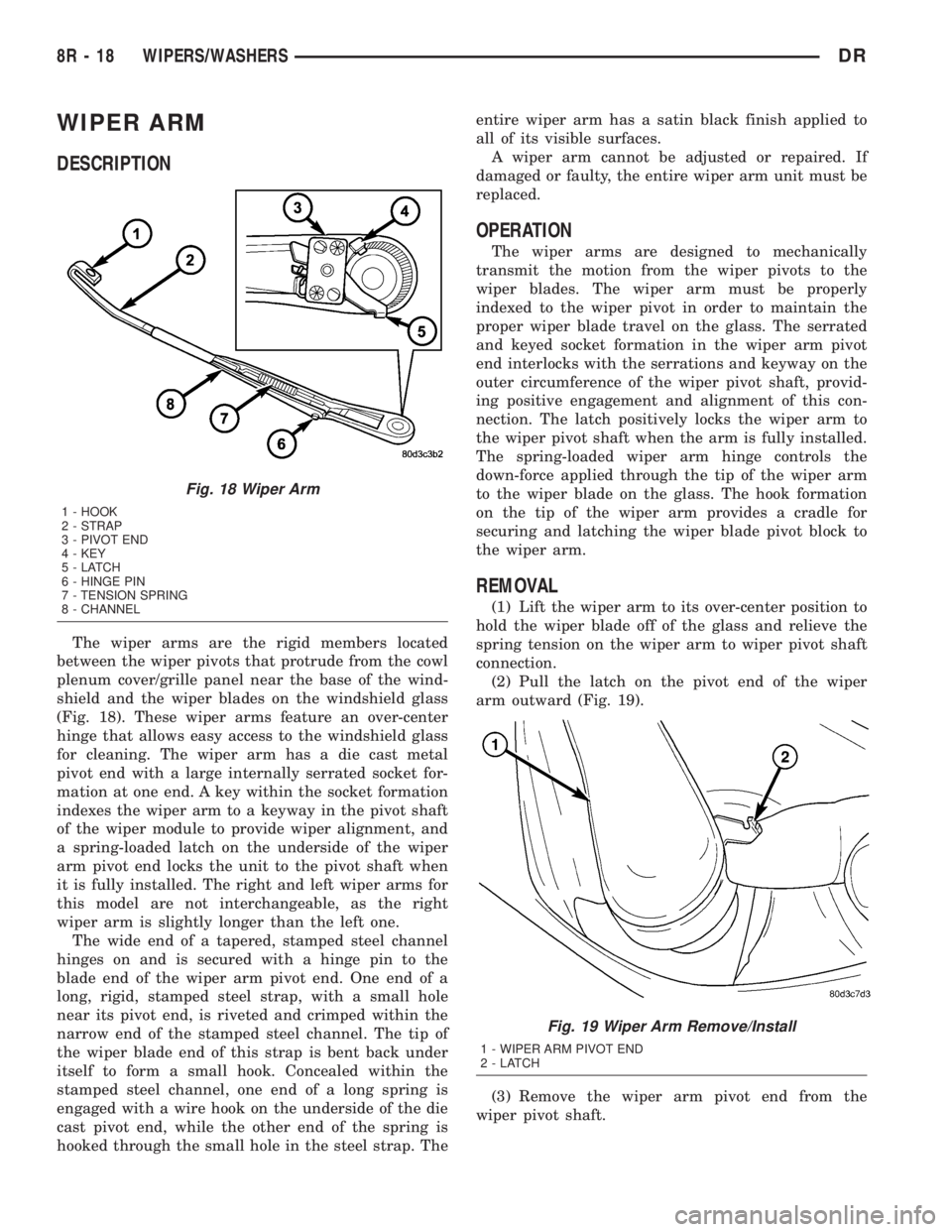
The wiper arms are the rigid members located
between the wiper pivots that protrude from the cowl
plenum cover/grille panel near the base of the wind-
shield and the wiper blades on the windshield glass
(Fig. 18). These wiper arms feature an over-center
hinge that allows easy access to the windshield glass
for cleaning. The wiper arm has a die cast metal
pivot end with a large internally serrated socket for-
mation at one end. A key within the socket formation
indexes the wiper arm to a keyway in the pivot shaft
of the wiper module to provide wiper alignment, and
a spring-loaded latch on the underside of the wiper
arm pivot end locks the unit to the pivot shaft when
it is fully installed. The right and left wiper arms for
this model are not interchangeable, as the right
wiper arm is slightly longer than the left one.
The wide end of a tapered, stamped steel channel
hinges on and is secured with a hinge pin to the
blade end of the wiper arm pivot end. One end of a
long, rigid, stamped steel strap, with a small hole
near its pivot end, is riveted and crimped within the
narrow end of the stamped steel channel. The tip of
the wiper blade end of this strap is bent back under
itself to form a small hook. Concealed within the
stamped steel channel, one end of a long spring is
engaged with a wire hook on the underside of the die
cast pivot end, while the other end of the spring is
hooked through the small hole in the steel strap. Theentire wiper arm has a satin black finish applied to
all of its visible surfaces.
A wiper arm cannot be adjusted or repaired. If
damaged or faulty, the entire wiper arm unit must be
replaced.
OPERATION
The wiper arms are designed to mechanically
transmit the motion from the wiper pivots to the
wiper blades. The wiper arm must be properly
indexed to the wiper pivot in order to maintain the
proper wiper blade travel on the glass. The serrated
and keyed socket formation in the wiper arm pivot
end interlocks with the serrations and keyway on the
outer circumference of the wiper pivot shaft, provid-
ing positive engagement and alignment of this con-
nection. The latch positively locks the wiper arm to
the wiper pivot shaft when the arm is fully installed.
The spring-loaded wiper arm hinge controls the
down-force applied through the tip of the wiper arm
to the wiper blade on the glass. The hook formation
on the tip of the wiper arm provides a cradle for
securing and latching the wiper blade pivot block to
the wiper arm.
REMOVAL
(1) Lift the wiper arm to its over-center position to
hold the wiper blade off of the glass and relieve the
spring tension on the wiper arm to wiper pivot shaft
connection.
(2) Pull the latch on the pivot end of the wiper
arm outward (Fig. 19).
(3) Remove the wiper arm pivot end from the
wiper pivot shaft.
Fig. 18 Wiper Arm
1 - HOOK
2 - STRAP
3 - PIVOT END
4 - KEY
5-LATCH
6 - HINGE PIN
7 - TENSION SPRING
8 - CHANNEL
Fig. 19 Wiper Arm Remove/Install
1 - WIPER ARM PIVOT END
2-LATCH
8R - 18 WIPERS/WASHERSDR
Page 694 of 2895
INSTALLATION
The right and left wiper arms are not interchange-
able. The right wiper arm is slightly longer than the
left. Be certain that each wiper arm is installed on
the proper wiper pivot.
(1) Place the wiper arm hinge in its over-center
position prior to attempting installation.
(2) The wiper arms are indexed to the wiper pivot
shafts with integral keys in the wiper arm pivot ends
and keyways in the wiper pivot shafts. Align the key
of the wiper arm to the keyway on the wiper pivot
shaft.
(3) Once the wiper blade is aligned, push the pivot
of the wiper arm down firmly and evenly over the
wiper pivot shaft until it is fully engaged. When the
wiper arm is fully engaged on the wiper pivot, the
spring-loaded latch (Fig. 19) will snap back into place
against the wiper arm pivot end.
(4) Gently lower the wiper arm until the wiper
blade is in position on the windshield glass.
WIPER BLADE
DESCRIPTION
Each wiper blade is secured by an integral latching
pivot block to the hook formation on the tip of each
wiper arm, and rests on the glass near the base of
the windshield when the wipers are not in operation
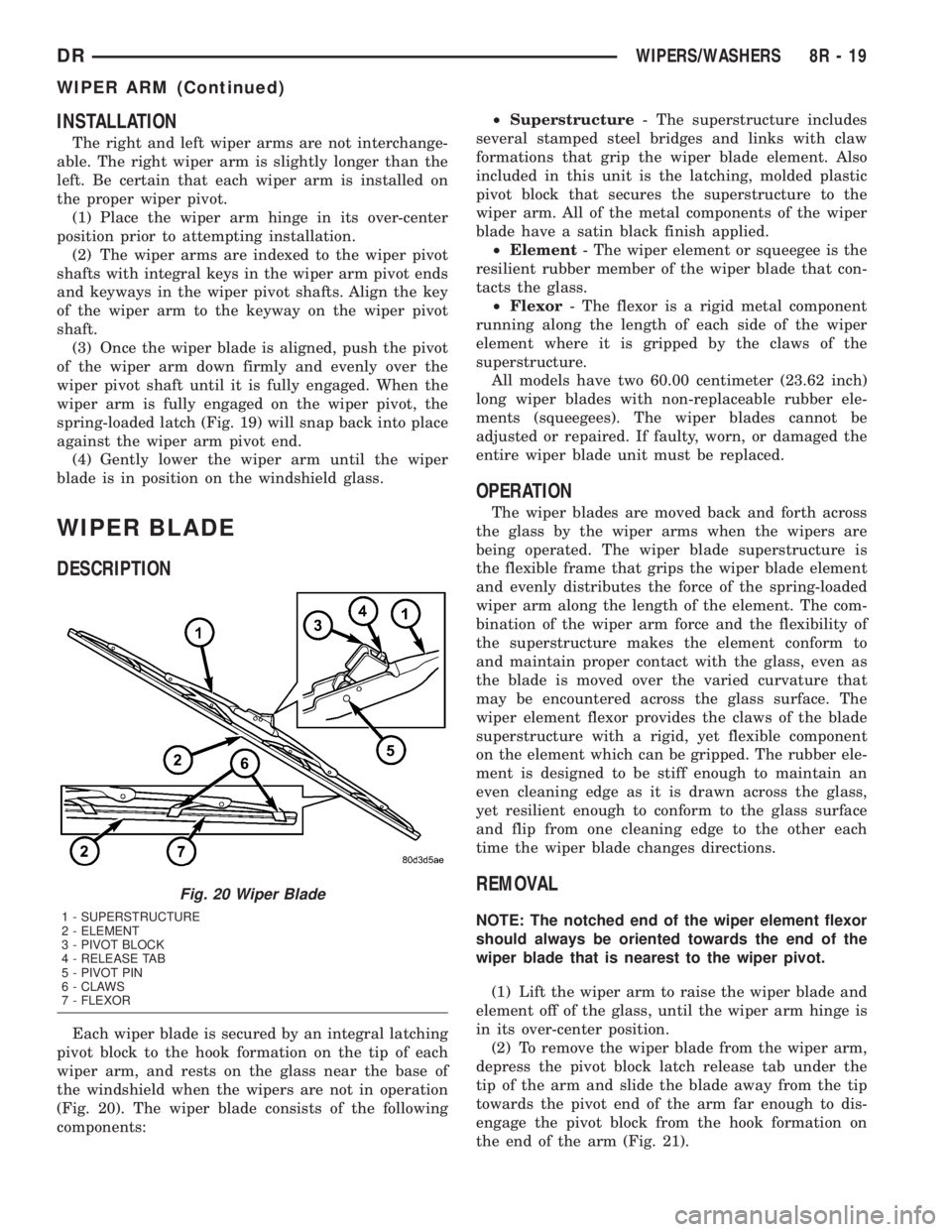
(Fig. 20). The wiper blade consists of the following
components:²Superstructure- The superstructure includes
several stamped steel bridges and links with claw
formations that grip the wiper blade element. Also
included in this unit is the latching, molded plastic
pivot block that secures the superstructure to the
wiper arm. All of the metal components of the wiper
blade have a satin black finish applied.
²Element- The wiper element or squeegee is the
resilient rubber member of the wiper blade that con-
tacts the glass.
²Flexor- The flexor is a rigid metal component
running along the length of each side of the wiper
element where it is gripped by the claws of the
superstructure.
All models have two 60.00 centimeter (23.62 inch)
long wiper blades with non-replaceable rubber ele-
ments (squeegees). The wiper blades cannot be
adjusted or repaired. If faulty, worn, or damaged the
entire wiper blade unit must be replaced.
OPERATION
The wiper blades are moved back and forth across
the glass by the wiper arms when the wipers are
being operated. The wiper blade superstructure is
the flexible frame that grips the wiper blade element
and evenly distributes the force of the spring-loaded
wiper arm along the length of the element. The com-
bination of the wiper arm force and the flexibility of
the superstructure makes the element conform to
and maintain proper contact with the glass, even as
the blade is moved over the varied curvature that
may be encountered across the glass surface. The
wiper element flexor provides the claws of the blade
superstructure with a rigid, yet flexible component
on the element which can be gripped. The rubber ele-
ment is designed to be stiff enough to maintain an
even cleaning edge as it is drawn across the glass,
yet resilient enough to conform to the glass surface
and flip from one cleaning edge to the other each
time the wiper blade changes directions.
REMOVAL
NOTE: The notched end of the wiper element flexor
should always be oriented towards the end of the
wiper blade that is nearest to the wiper pivot.
(1) Lift the wiper arm to raise the wiper blade and
element off of the glass, until the wiper arm hinge is
in its over-center position.
(2) To remove the wiper blade from the wiper arm,
depress the pivot block latch release tab under the
tip of the arm and slide the blade away from the tip
towards the pivot end of the arm far enough to dis-
engage the pivot block from the hook formation on
the end of the arm (Fig. 21).
Fig. 20 Wiper Blade
1 - SUPERSTRUCTURE
2 - ELEMENT
3 - PIVOT BLOCK
4 - RELEASE TAB
5 - PIVOT PIN
6 - CLAWS
7 - FLEXOR
DRWIPERS/WASHERS 8R - 19
WIPER ARM (Continued)
Page 695 of 2895
(3) Extract the hook formation on the tip of the
wiper arm through the opening in the wiper blade
superstructure just ahead of the wiper blade pivot
block/latch unit.
CAUTION: Do not allow the wiper arm to spring
back against the glass without the wiper blade in
place or the glass may be damaged.
(4) Gently lower the tip of the wiper arm onto the
glass.
INSTALLATION
NOTE: The notched end of the wiper element flexor
should always be oriented towards the end of the
wiper blade that is nearest to the wiper pivot.
(1)
Lift the wiper arm off of the windshield glass,
until the wiper arm hinge is in its over-center position.
(2) Position the wiper blade near the hook forma-
tion on the tip of the arm with the notched end of the
wiper element flexor oriented towards the end of the
wiper arm that is nearest to the wiper pivot.
(3) Insert the hook formation on the tip of the
wiper arm through the opening in the wiper blade
superstructure ahead of the wiper blade pivot block/
latch unit far enough to engage the pivot block into
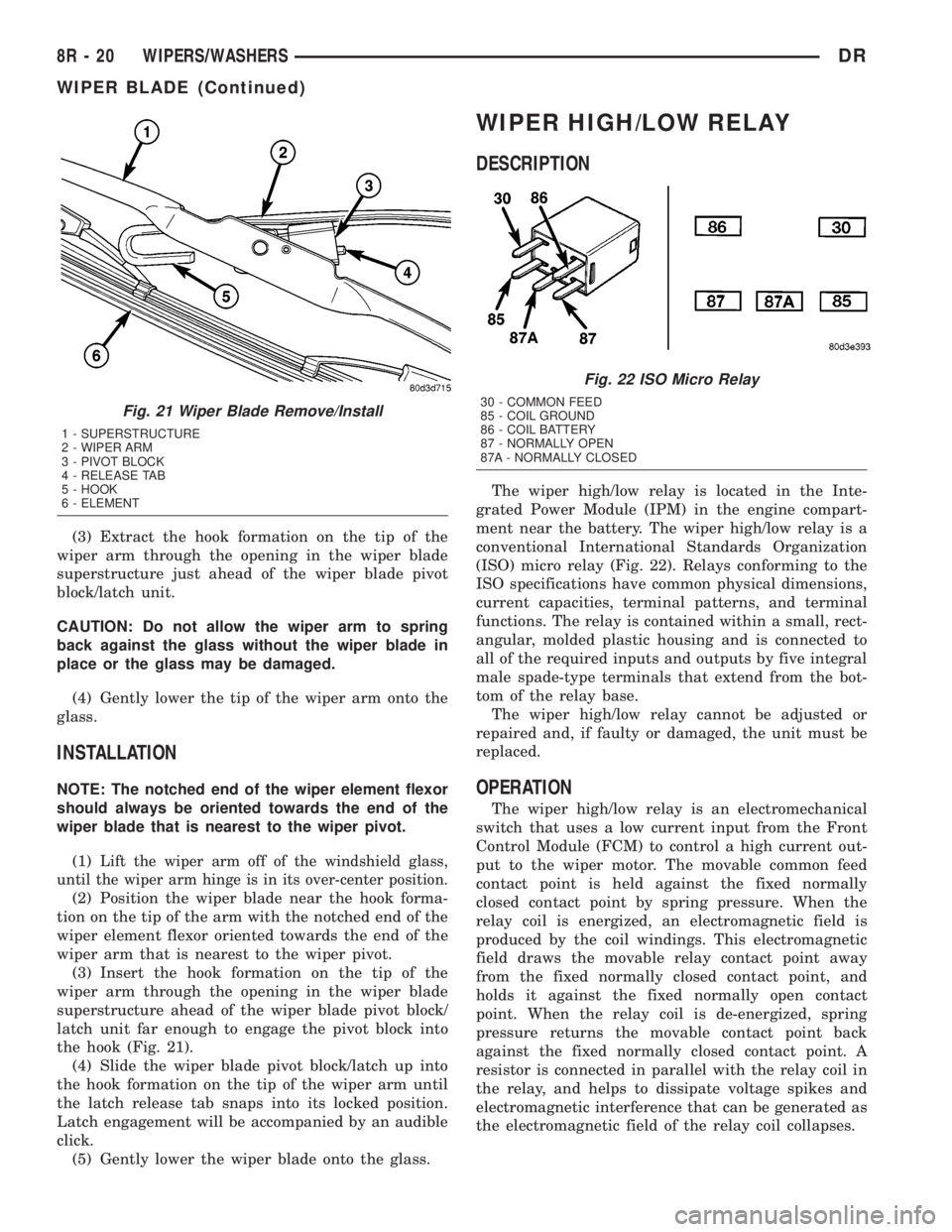
the hook (Fig. 21).
(4) Slide the wiper blade pivot block/latch up into
the hook formation on the tip of the wiper arm until
the latch release tab snaps into its locked position.
Latch engagement will be accompanied by an audible
click.
(5) Gently lower the wiper blade onto the glass.
WIPER HIGH/LOW RELAY
DESCRIPTION
The wiper high/low relay is located in the Inte-
grated Power Module (IPM) in the engine compart-
ment near the battery. The wiper high/low relay is a
conventional International Standards Organization
(ISO) micro relay (Fig. 22). Relays conforming to the
ISO specifications have common physical dimensions,
current capacities, terminal patterns, and terminal
functions. The relay is contained within a small, rect-
angular, molded plastic housing and is connected to
all of the required inputs and outputs by five integral
male spade-type terminals that extend from the bot-
tom of the relay base.
The wiper high/low relay cannot be adjusted or
repaired and, if faulty or damaged, the unit must be
replaced.
OPERATION
The wiper high/low relay is an electromechanical
switch that uses a low current input from the Front
Control Module (FCM) to control a high current out-
put to the wiper motor. The movable common feed
contact point is held against the fixed normally
closed contact point by spring pressure. When the
relay coil is energized, an electromagnetic field is
produced by the coil windings. This electromagnetic
field draws the movable relay contact point away
from the fixed normally closed contact point, and
holds it against the fixed normally open contact
point. When the relay coil is de-energized, spring
pressure returns the movable contact point back
against the fixed normally closed contact point. A
resistor is connected in parallel with the relay coil in
the relay, and helps to dissipate voltage spikes and
electromagnetic interference that can be generated as
the electromagnetic field of the relay coil collapses.
Fig. 21 Wiper Blade Remove/Install
1 - SUPERSTRUCTURE
2 - WIPER ARM
3 - PIVOT BLOCK
4 - RELEASE TAB
5 - HOOK
6 - ELEMENT
Fig. 22 ISO Micro Relay
30 - COMMON FEED
85 - COIL GROUND
86 - COIL BATTERY
87 - NORMALLY OPEN
87A - NORMALLY CLOSED
8R - 20 WIPERS/WASHERSDR
WIPER BLADE (Continued)
Page 2893 of 2895
VOLUME CHECK - STANDARD
PROCEDURE, OIL PUMP..............21-563
WAIT-TO-START INDICATOR -
DESCRIPTION.......................8J-42
WAIT-TO-START INDICATOR -
OPERATION.........................8J-42
WARNING - INSTALLATION.............23-88
WARNING - REMOVAL................23-88
WARNING - SAFETY PRECAUTIONS AND
WARNINGS..........................23-1
WARNING - SERVICE WARNINGS........24-32
WARNING - WINDSHIELD SAFETY
PRECAUTIONS.......................23-88
WARNING, CLUTCH.....................6-2
WARNINGS, GENERAL..............8W-01-7
WARNINGS, RESTRAINT SYSTEM........8O-5
WARNINGS, WARNING - SAFETY
PRECAUTIONS........................23-1
WARNINGS, WARNING - SERVICE.......24-32
WASHER FLUID INDICATOR -
DESCRIPTION.......................8J-42
WASHER FLUID INDICATOR -
OPERATION.........................8J-42
WASHER FLUID LEVEL SWITCH -
DESCRIPTION........................8R-9
WASHER FLUID LEVEL SWITCH -
INSTALLATION......................8R-11
WASHER FLUID LEVEL SWITCH -
OPERATION..........................8R-9
WASHER FLUID LEVEL SWITCH -
REMOVAL..........................8R-10
WASHER HOSES/TUBES - DESCRIPTION . . 8R-11
WASHER HOSES/TUBES - OPERATION....8R-11
WASHER NOZZLE - DESCRIPTION.......8R-12
WASHER NOZZLE - INSTALLATION......8R-12
WASHER NOZZLE - OPERATION.........8R-12
WASHER NOZZLE - REMOVAL..........8R-12
WASHER PUMP/MOTOR - DESCRIPTION . . 8R-13
WASHER PUMP/MOTOR - INSTALLATION . 8R-14
WASHER PUMP/MOTOR - OPERATION . . . 8R-13
WASHER PUMP/MOTOR - REMOVAL.....8R-14
WASHER RESERVOIR - DESCRIPTION....8R-15
WASHER RESERVOIR - OPERATION......8R-15
WASHER SYSTEM - CLEANING, WIPER....8R-6
WASHER SYSTEM - DIAGNOSIS AND
TESTING, WIPER.....................8R-6
WASHER SYSTEM - INSPECTION, WIPER . . 8R-7
WATER DRAINING AT FUEL FILTER -
STANDARD PROCEDURES..............14-57
WATER IN FUEL SENSOR -
DESCRIPTION.......................14-77
WATER IN FUEL SENSOR - OPERATION . . . 14-78
WATER IN FUEL SENSOR - REMOVAL....14-78
WATER LEAKS - DIAGNOSIS AND
TESTING............................23-1
WATER PUMP - 5.7L - INSTALLATION.....7-71
WATER PUMP - 5.7L - REMOVAL.........7-70
WATER PUMP - 5.9L - CLEANING........7-64
WATER PUMP - 5.9L - DESCRIPTION......7-62
WATER PUMP - 5.9L - INSPECTION.......7-64
WATER PUMP - 5.9L - INSTALLATION.....7-64
WATER PUMP - 5.9L - OPERATION.......7-62
WATER PUMP - 5.9L - REMOVAL.........7-63
WATER PUMP - 5.9L DIESEL -
CLEANING...........................7-67
WATER PUMP - 5.9L DIESEL -
DESCRIPTION........................7-67
WATER PUMP - 5.9L DIESEL -
INSPECTION.........................7-68
WATER PUMP - 5.9L DIESEL -
INSTALLATION........................7-68
WATER PUMP - 5.9L DIESEL -
OPERATION
..........................7-67
WATER PUMP - 5.9L DIESEL - REMOVAL
. . 7-67
WATER PUMP - DESCRIPTION
...........7-64
WATER PUMP - DIAGNOSIS AND
TESTING
........................7-62,7-67
WATER PUMP - OPERATION
.............7-64
WATER PUMP BYPASS - DESCRIPTION
....7-64
WATER PUMP BYPASS - OPERATION
......7-65
WATER PUMP BYPASS HOSE WITH AIR
CONDITIONING - INSTALLATION
..........7-70WATER PUMP BYPASS HOSE WITH AIR
CONDITIONING - REMOVAL.............7-68
WATER PUMP BYPASS HOSE WITHOUT
AIR CONDITIONING - INSTALLATION......7-70
WATER PUMP BYPASS HOSE WITHOUT
AIR CONDITIONING - REMOVAL..........7-69
WATER SEPARATOR - DESCRIPTION,
FUEL FILTER........................14-61
WATER SEPARATOR - INSTALLATION,
FUEL FILTER........................14-62
WATER SEPARATOR - OPERATION, FUEL
FILTER.............................14-61
WATER SEPARATOR - REMOVAL, FUEL
FILTER.............................14-61
WATER TO OIL COOLER - REMOVAL......7-74
WATERDAM - INSTALLATION......23-25,23-34
WATERDAM - REMOVAL..........23-25,23-34
WATER-IN-FUEL INDICATOR -
DESCRIPTION.......................8J-43
WATER-IN-FUEL INDICATOR -
OPERATION.........................8J-43
WEAR - STANDARD PROCEDURE,
MEASURING TIMING CHAIN............9-165
WEAR INDICATORS - DIAGNOSIS AND
TESTING, TREAD......................22-7
WEAR PATTERNS - DIAGNOSIS AND
TESTING, TIRE.......................22-8
WEAR, STANDARD PROCEDURE -
MEASURING TIMING CHAIN.............9-76
WEATHERSTRIP - INSTALLATION, DRIP
RAIL..............................23-91
WEATHERSTRIP - INSTALLATION, FRONT
DOOR GLASS RUN.....................23-92
WEATHERSTRIP - INSTALLATION, REAR
DOOR GLASS RUN...................23-93
WEATHERSTRIP - REMOVAL, DRIP RAIL . . 23-91
WEATHERSTRIP - REMOVAL, FRONT
DOOR GLASS RUN...................23-92
WEATHERSTRIP - REMOVAL, REAR
DOOR GLASS RUN...................23-93
WEATHERSTRIP RETAINER -
INSTALLATION, A-PILLAR..............23-91
WEATHERSTRIP RETAINER -
INSTALLATION, DRIP RAIL.............23-92
WEATHERSTRIP RETAINER - REMOVAL,
A-PILLAR...........................23-91
WEATHERSTRIP RETAINER - REMOVAL,
DRIP RAIL..........................23-92
WELD LOCATIONS - SPECIFICATIONS . . . 23-122
WHEEL - INSTALLATION, STEERING......19-15
WHEEL - REMOVAL, STEERING.........19-15
WHEEL ALIGNMENT - DESCRIPTION.......2-1
WHEEL ALIGNMENT - OPERATION.........2-2
WHEEL ALIGNMENT, SPECIAL TOOLS......2-7
WHEEL ANTILOCK - DIAGNOSIS AND
TESTING, REAR.......................5-42
WHEEL BALANCE - STANDARD
PROCEDURE, TIRE....................22-4
WHEEL COVER - REMOVAL............22-14
WHEEL INSPECTION, DIAGNOSIS AND
TESTING...........................22-11
WHEEL INSTALLATION - STANDARD
PROCEDURE, DUAL REAR.............22-12
WHEEL REPLACEMENT - STANDARD
PROCEDURE........................22-12
WHEEL RUNOUT - DIAGNOSIS AND
TESTING, TIRE.......................22-1
WHEEL SPEED SENSOR - DESCRIPTION,
FRONT..............................5-41
WHEEL SPEED SENSOR - DIAGNOSIS
AND TESTING, REAR...................5-43
WHEEL SPEED SENSOR -
INSTALLATION, FRONT.................5-42
WHEEL SPEED SENSOR -
INSTALLATION, REAR..................5-43
WHEEL SPEED SENSOR - OPERATION,
FRONT..............................5-41
WHEEL SPEED SENSOR - REMOVAL,
FRONT..............................5-41
WHEEL SPEED SENSOR - REMOVAL,
REAR...............................5-42
WHEEL WITH MATCHING TIRE -
DESCRIPTION, FULL SIZE, SPARE.......22-15WHEELHOUSE SPLASH SHIELD -
INSTALLATION, FRONT................23-41
WHEELHOUSE SPLASH SHIELD -
INSTALLATION, REAR.................23-41
WHEELHOUSE SPLASH SHIELD -
REMOVAL, FRONT....................23-40
WHEELHOUSE SPLASH SHIELD -
REMOVAL, REAR.....................23-41
WHEELS - DESCRIPTION..............22-11
WHEELS - OPERATION................22-11
WIND NOISE - DIAGNOSIS AND TESTING . . 23-2
WINDOW MOTOR - REMOVAL..........8N-22
WINDOW REGULATOR - MANUAL -
INSTALLATION..................23-26,23-35
WINDOW REGULATOR - MANUAL -
REMOVAL.....................23-26,23-35
WINDOW REGULATOR - POWER -
INSTALLATION..................23-25,23-34
WINDOW REGULATOR - POWER -
REMOVAL.....................23-25,23-34
WINDOW SWITCH - DIAGNOSIS AND
TESTING...........................8N-22
WINDOW SWITCH - INSTALLATION......8N-23
WINDOW SWITCH - REMOVAL..........8N-23
WINDOWS - DESCRIPTION, POWER.....8N-21
WINDOWS - DIAGNOSIS AND TESTING,
POWER............................8N-21
WINDOWS - OPERATION, POWER.......8N-21
WINDSHIELD SAFETY PRECAUTIONS,
WARNING..........................23-88
WIPER & WASHER SYSTEM - CLEANING....8R-6
WIPER & WASHER SYSTEM -
DIAGNOSIS AND TESTING..............8R-6
WIPER & WASHER SYSTEM -
INSPECTION.........................8R-7
WIPER ARM - DESCRIPTION...........8R-18
WIPER ARM - INSTALLATION...........8R-19
WIPER ARM - OPERATION.............8R-18
WIPER ARM - REMOVAL..............8R-18
WIPER BLADE - DESCRIPTION..........8R-19
WIPER BLADE - INSTALLATION.........8R-20
WIPER BLADE - OPERATION...........8R-19
WIPER BLADE - REMOVAL.............8R-19
WIPER HIGH/LOW RELAY -
DESCRIPTION.......................8R-20
WIPER HIGH/LOW RELAY - DIAGNOSIS
AND TESTING.......................8R-21
WIPER HIGH/LOW RELAY -
INSTALLATION......................8R-21
WIPER HIGH/LOW RELAY - OPERATION . . 8R-20
WIPER HIGH/LOW RELAY - REMOVAL....8R-21
WIPER MODULE - DESCRIPTION........8R-22
WIPER MODULE - INSTALLATION.......8R-23
WIPER MODULE - OPERATION..........8R-23
WIPER MODULE - REMOVAL...........8R-23
WIPER ON/OFF RELAY - DESCRIPTION . . . 8R-25
WIPER ON/OFF RELAY - DIAGNOSIS AND
TESTING...........................8R-26
WIPER ON/OFF RELAY - INSTALLATION . . . 8R-26
WIPER ON/OFF RELAY - OPERATION.....8R-25
WIPER ON/OFF RELAY - REMOVAL......8R-26
WIPERS/WASHERS - DESCRIPTION.......8R-1
WIPERS/WASHERS - OPERATION........8R-4
WIRE SPLICING - STANDARD
PROCEDURE
.....................8W-01-15
WIRING - DESCRIPTION, TRAILER TOW
. . 8L-22
WIRING DIAGRAMS - DESCRIPTION,
HOW TO USE
.....................8W-01-1
WIRING HARNESS - DIAGNOSIS AND
TESTING
.........................8W-01-7
WIRING/TERMINAL, SPECIAL TOOLS
. . 8W-01-10
WITHOUT AIR CONDITIONING -
INSTALLATION, WATER PUMP BYPASS
HOSE
...............................7-70
WITHOUT AIR CONDITIONING -
REMOVAL, WATER PUMP BYPASS
HOSE
...............................7-69
WORN THREADS - STANDARD
PROCEDURE,
REPAIR DAMAGED OR
......9-186,9-232,9-289,
9-361,9-9,9-93
38 INDEXDR
Description Group-Page Description Group-Page Description Group-Page