2003 DODGE RAM ad blue
[x] Cancel search: ad bluePage 529 of 2895
Vacuum Fluorescent Display (VFD) unit. The VFD is
soldered onto the cluster electronic circuit board and
is visible through a window with a smoked clear lens
located on the lower edge of the tachometer gauge
dial face of the cluster overlay. The dark lens over
the VFD prevents the indicator from being clearly
visible when it is not illuminated. The words ªSER-
VICE 4x4º appear in an amber color and at the same
lighting level as the odometer/trip odometer informa-
tion when they are illuminated by the instrument
cluster electronic circuit board. The service 4WD
indicator is serviced as a unit with the VFD in the
instrument cluster.
OPERATION
The service 4WD indicator gives an indication to
the vehicle operator when the Transfer Case Control
Module (TCCM) has recorded a Diagnostic Trouble
Code (DTC) for an electronic transfer case circuit or
component malfunction. This indicator is controlled
by a transistor on the instrument cluster circuit
board based upon cluster programming and elec-
tronic messages received by the cluster from the
TCCM over the Programmable Communications
Interface (PCI) data bus. The service 4WD indicator
is completely controlled by the instrument cluster
logic circuit, and that logic will only allow this indi-
cator to operate when the instrument cluster receives
a battery current input on the fused ignition switch
output (run-start) circuit. Therefore, the indicator
will always be off when the ignition switch is in any
position except On or Start. The indicator only illu-
minates when it is switched to ground by the instru-
ment cluster circuitry. The instrument cluster will
turn on the service 4WD indicator for the following
reasons:
²Service 4WD Lamp-On Message- Each time
the cluster receives a service 4WD lamp-on message
from the TCCM, the indicator will be illuminated.
The indicator remains illuminated until the cluster
receives a service 4WD lamp-off message from the
TCCM, or until the ignition switch is turned to the
Off position, whichever occurs first.
²Communication Error- If the cluster receives
no messages from the TCCM for five seconds, the
service 4WD indicator is illuminated by the instru-
ment cluster to indicate a loss of TCCM communica-
tion. The indicator remains controlled and
illuminated by the cluster until a valid message is
received from the TCCM.
²Actuator Test- Each time the cluster is put
through the actuator test, the service 4WD indicator
will be turned on, then off again during the VFD por-
tion of the test to confirm the functionality of the
VFD and the cluster control circuitry.The TCCM continually monitors the electronic
transfer case switch and circuits to determine the
condition of the system. The TCCM then sends the
proper lamp-on or lamp-off messages to the instru-
ment cluster. For further diagnosis of the service
4WD indicator or the instrument cluster circuitry
that controls the VFD, (Refer to 8 - ELECTRICAL/
INSTRUMENT CLUSTER - DIAGNOSIS AND
TESTING). For proper diagnosis of the TCCM, the
PCI data bus, or the electronic message inputs to the
instrument cluster that control the service 4WD indi-
cator, a DRBIIItscan tool is required. Refer to the
appropriate diagnostic information.SPEEDOMETER
DESCRIPTION
A speedometer is standard equipment on all instru-
ment clusters. The speedometer is located next to the
tachometer, just to the right of center in the instru-
ment cluster. The speedometer consists of a movable
gauge needle or pointer controlled by the instrument
cluster circuitry and a fixed 210 degree primary scale
on the gauge dial face that reads left-to-right either
from ª0º to ª120º mph, or from ª0º to ª200º km/h,
depending upon the market for which the vehicle is
manufactured. Each version also has a secondary
inner scale on the gauge dial face that provides the
equivalent opposite units from the primary scale.
Text appearing on the cluster overlay just below the
hub of the speedometer needle abbreviates the unit
of measure for the primary scale (i.e.: MPH or km/h),
followed by the unit of measure for the secondary
scale. The speedometer graphics are black (primary
scale) and blue (secondary scale) against a white
field, making them clearly visible within the instru-
ment cluster in daylight. When illuminated from
behind by the panel lamps dimmer controlled cluster
illumination lighting with the exterior lamps turned
On, the black graphics appear dark blue and the blue
graphics appear light blue. The orange gauge needle
is internally illuminated. Gauge illumination is pro-
vided by replaceable incandescent bulb and bulb
holder units located on the instrument cluster elec-
tronic circuit board. The speedometer is serviced as a
unit with the instrument cluster.
OPERATION
The speedometer gives an indication to the vehicle
operator of the vehicle road speed. This gauge is con-
trolled by the instrument cluster circuit board based
upon cluster programming and electronic messages
received by the cluster from the Powertrain Control
Module (PCM) over the Programmable Communica-
tions Interface (PCI) data bus. The speedometer is an
8J - 36 INSTRUMENT CLUSTERDR
SERVICE 4WD INDICATOR (Continued)
Page 530 of 2895

air core magnetic unit that receives battery current
on the instrument cluster electronic circuit board
through the fused ignition switch output (run-start)
circuit whenever the ignition switch is in the On or
Start positions. The cluster is programmed to move
the gauge needle back to the low end of the scale
after the ignition switch is turned to the Off position.
The instrument cluster circuitry controls the gauge
needle position and provides the following features:
²Vehicle Speed Message- Each time the clus-
ter receives a vehicle speed message from the PCM it
will calculate the correct vehicle speed reading and
position the gauge needle at that relative speed posi-
tion on the gauge scale. The cluster will receive a
new vehicle speed message and reposition the gauge
pointer accordingly about every 88 milliseconds. The
gauge needle will continue to be positioned at the
actual vehicle speed position on the gauge scale until
the ignition switch is turned to the Off position.
²Communication Error- If the cluster fails to
receive a speedometer message, it will hold the gauge
needle at the last indication for about three seconds,
or until the ignition switch is turned to the Off posi-
tion, whichever occurs first. After three seconds, the
gauge needle will return to the left end of the gauge
scale.
²Actuator Test- Each time the cluster is put
through the actuator test, the speedometer needle
will be swept to several calibration points on the
gauge scale in a prescribed sequence in order to con-
firm the functionality of the gauge and the cluster
control circuitry.
The PCM continually monitors the vehicle speed
sensor to determine the vehicle road speed. The PCM
then sends the proper vehicle speed messages to the
instrument cluster. For further diagnosis of the
speedometer or the instrument cluster circuitry that
controls the gauge, (Refer to 8 - ELECTRICAL/IN-
STRUMENT CLUSTER - DIAGNOSIS AND TEST-
ING). For proper diagnosis of the vehicle speed
sensor, the PCM, the PCI data bus, or the electronic
message inputs to the instrument cluster that control
the speedometer, a DRBIIItscan tool is required.
Refer to the appropriate diagnostic information.
TACHOMETER
DESCRIPTION
A tachometer is standard equipment on all instru-
ment clusters. The tachometer is located to the left of
the speedometer, just to the left of center in the
instrument cluster. The tachometer consists of a
movable gauge needle or pointer controlled by the
instrument cluster circuitry and a fixed 210 degree
scale on the gauge dial face that reads left-to-rightfrom ª0º to ª7º for gasoline engines. On vehicles with
a diesel engine, the scale reads from ª0º to ª5º. The
text ªRPM X 1000º imprinted on the cluster overlay
directly below the hub of the tachometer needle iden-
tifies that each number on the tachometer scale is to
be multiplied by 1000 rpm. The tachometer graphics
are black against a white field, making them clearly
visible within the instrument cluster in daylight.
When illuminated from behind by the panel lamps
dimmer controlled cluster illumination lighting with
the exterior lamps turned On, the black graphics
appear blue. The orange gauge needle is internally
illuminated. Gauge illumination is provided by
replaceable incandescent bulb and bulb holder units
located on the instrument cluster electronic circuit
board. The tachometer is serviced as a unit with the
instrument cluster.
OPERATION
The tachometer gives an indication to the vehicle
operator of the engine speed. This gauge is controlled
by the instrument cluster circuit board based upon
cluster programming and electronic messages
received by the cluster from the Powertrain Control
Module (PCM) on vehicles with a gasoline engine, or
from the Engine Control Module (ECM) on vehicles
equipped with a diesel engine over the Programma-
ble Communications Interface (PCI) data bus. The
tachometer is an air core magnetic unit that receives
battery current on the instrument cluster electronic
circuit board through the fused ignition switch out-
put (run-start) circuit whenever the ignition switch is
in the On or Start positions. The cluster is pro-
grammed to move the gauge needle back to the low
end of the scale after the ignition switch is turned to
the Off position. The instrument cluster circuitry
controls the gauge needle position and provides the
following features:
²Engine Speed Message- Each time the cluster
receives an engine speed message from the PCM or
ECM it will calculate the correct engine speed read-
ing and position the gauge needle at that relative
speed position on the gauge scale. The cluster will
receive a new engine speed message and reposition
the gauge pointer accordingly about every 88 milli-
seconds. The gauge needle will continually be reposi-
tioned at the relative engine speed position on the
gauge scale until the engine stops running, or until
the ignition switch is turned to the Off position,
whichever occurs first.
²Communication Error- If the cluster fails to
receive an engine speed message, it will hold the
gauge needle at the last indication for about three
seconds, or until the ignition switch is turned to the
Off position, whichever occurs first. After three sec-
DRINSTRUMENT CLUSTER 8J - 37
SPEEDOMETER (Continued)
Page 533 of 2895
sages to the Front Control Module (FCM) over the
Programmable Communications Interface (PCI) data
bus and flashes the turn signal indicators on and off
accordingly. For further diagnosis of the turn signal
indicators or the instrument cluster circuitry that
controls the indicators, (Refer to 8 - ELECTRICAL/
INSTRUMENT CLUSTER - DIAGNOSIS AND
TESTING). For proper diagnosis of the turn signal
and hazard warning system, the multi-function
switch, the FCM, the PCI data bus, or the electronic
message inputs to the instrument cluster that control
the turn signal indicators, a DRBIIItscan tool is
required. Refer to the appropriate diagnostic infor-
mation.
UPSHIFT INDICATOR
DESCRIPTION
An upshift indicator is standard equipment on all
instrument clusters. However, on vehicles not
equipped with a manual transmission, this indicator
is electronically disabled. The upshift indicator con-
sists of an upward pointed arrow icon, which appears
on the right side of the electronic gear selector indi-
cator Vacuum Fluorescent Display (VFD) unit. The
VFD is soldered onto the cluster electronic circuit
board and is visible through a window with a smoked
clear lens located on the lower edge of the speedom-
eter gauge dial face of the cluster overlay. The dark
lens over the VFD prevents the indicator from being
clearly visible when it is not illuminated. The icon
appears in a blue-green color and at the same light-
ing level as the odometer/trip odometer information
when it is illuminated by the instrument cluster elec-
tronic circuit board. The upshift indicator is serviced
as a unit with the instrument cluster.
OPERATION
The upshift indicator gives an indication to the
vehicle operator when the manual transmission
should be shifted to the next highest gear in order to
achieve the best fuel economy. This indicator is con-
trolled by the instrument cluster circuit board based
upon cluster programming and electronic messages
received by the cluster from the Powertrain Control
Module (PCM) on vehicles with a gasoline engine, or
from the Engine Control Module (ECM) on vehicles
with a diesel engine over the Programmable Commu-
nications Interface (PCI) data bus. The upshift indi-
cator is completely controlled by the instrument
cluster logic circuit, and that logic will only allow
this indicator to operate when the instrument cluster
receives a battery current input on the fused ignition
switch output (run-start) circuit. Therefore, the indi-
cator will always be off when the ignition switch is inany position except On or Start. The indicator only
illuminates when it is switched to ground by the
instrument cluster circuitry. The instrument cluster
will turn on the upshift indicator for the following
reasons:
²Upshift Lamp-On Message- Each time the
cluster receives an upshift lamp-on message from the
PCM or ECM indicating the engine speed and load
conditions are right for a transmission upshift to
occur, the upshift indicator is illuminated. The indi-
cator remains illuminated until the cluster receives
an upshift lamp-off message from the PCM or ECM,
or until the ignition switch is turned to the Off posi-
tion, whichever occurs first. The PCM or ECM will
normally send an upshift lamp-off message three to
five seconds after a lamp-on message, if an upshift is
not performed. The indicator will then remain off
until the vehicle stops accelerating and is brought
back into the range of indicator operation, or until
the transmission is shifted into another gear.
²Actuator Test- Each time the cluster is put
through the actuator test, the upshift indicator will
be turned on, then off again during the VFD portion
of the test to confirm the functionality of the VFD
and the cluster control circuitry.
On vehicles with a gasoline engine, the PCM con-
tinually monitors the engine speed and load condi-
tions to determine the proper fuel and ignition
requirements. On vehicles with a diesel engine, the
ECM continually monitors the engine speed and load
conditions to determine the proper fuel requirements.
The PCM or ECM then sends the proper upshift indi-
cator lamp-on and lamp-off messages to the instru-
ment cluster. For further diagnosis of the upshift
indicator or the instrument cluster circuitry that con-
trols the indicator, (Refer to 8 - ELECTRICAL/IN-
STRUMENT CLUSTER - DIAGNOSIS AND
TESTING). For proper diagnosis of the PCM, the
ECM, the PCI data bus, or the electronic message
inputs to the instrument cluster that control the
upshift indicator, a DRBIIItscan tool is required.
Refer to the appropriate diagnostic information.
VOLTAGE GAUGE
DESCRIPTION
A voltage gauge is standard equipment on all
instrument clusters. The voltage gauge is located in
the upper left quadrant of the instrument cluster,
above the fuel gauge. The voltage gauge consists of a
movable gauge needle or pointer controlled by the
instrument cluster circuitry and a fixed 90 degree
scale on the cluster overlay that reads left-to-right
from ªLº (or Low) to ªHº (or High) for gasoline
engines. On vehicles with a diesel engine, the scale
8J - 40 INSTRUMENT CLUSTERDR
TURN SIGNAL INDICATOR (Continued)
Page 534 of 2895
reads from ª8º to ª18º volts. An International Control
and Display Symbol icon for ªBattery Charging Con-
ditionº is located on the cluster overlay, directly
below the right end of the gauge scale. The voltage
gauge graphics are black against a white field except
for a single red graduation at each end of the gauge
scale, making them clearly visible within the instru-
ment cluster in daylight. When illuminated from
behind by the panel lamps dimmer controlled cluster
illumination lighting with the exterior lamps turned
On, the black graphics appear blue and the red
graphics still appear red. The orange gauge needle is
internally illuminated. Gauge illumination is pro-
vided by replaceable incandescent bulb and bulb
holder units located on the instrument cluster elec-
tronic circuit board. The voltage gauge is serviced as
a unit with the instrument cluster.
OPERATION
The voltage gauge gives an indication to the vehi-
cle operator of the electrical system voltage. This
gauge is controlled by the instrument cluster circuit
board based upon cluster programming and elec-
tronic messages received by the cluster from the
Powertrain Control Module (PCM) on vehicles
equipped with a gasoline engine, or from the Engine
Control Module (ECM) on vehicles equipped with a
diesel engine over the Programmable Communica-
tions Interface (PCI) data bus. The voltage gauge is
an air core magnetic unit that receives battery cur-
rent on the instrument cluster electronic circuit
board through the fused ignition switch output (run-
start) circuit whenever the ignition switch is in the
On or Start positions. The cluster is programmed to
move the gauge needle back to the left end of the
scale after the ignition switch is turned to the Off
position. The instrument cluster circuitry controls
the gauge needle position and provides the following
features:
²System Voltage Message- Each time the clus-
ter receives a system voltage message from the PCM
or ECM indicating the system voltage is between
about 9.5 volts and about 15 volts, the gauge needle
is moved to the relative voltage position on the gauge
scale.
²System Voltage Low (Charge Fail) Message
- Each time the cluster receives three consecutive
messages from the PCM or ECM indicating the elec-
trical system voltage is less than about 9 volts
(charge fail condition), the gauge needle is moved to
the graduation on the far left end of the gauge scale
and the check gauges indicator is illuminated. The
gauge needle remains at the far left end of the gauge
scale and the check gauges indicator remains illumi-
nated until the cluster receives a single message
from the PCM or ECM indicating the electrical sys-tem voltage is greater than about 9.5 volts (but less
than about 15.5 volts), or until the ignition switch is
turned to the Off position, whichever occurs first. On
vehicles equipped with the optional diesel engine, the
ECM is programmed to restrict the voltage gauge
needle to a position above the graduation on the far
left end of the gauge scale and suppress the check
engine indicator operation until after the engine
intake manifold air heater has completed a pre-heat
or post-heat cycle.
²System Voltage High Message- Each time
the cluster receives three consecutive messages from
the PCM or ECM indicating the electrical system
voltage is greater than about 15.5 volts, the gauge
needle is moved to the graduation on the far right
end of the gauge scale and the check gauges indica-
tor is illuminated. The gauge needle remains at the
right end of the gauge scale and the check gauges
indicator remains illuminated until the cluster
receives a message from the PCM or ECM indicating
the electrical system voltage is less than about 15.0
volts (but greater than about 9.5 volts), or until the
ignition switch is turned to the Off position, which-
ever occurs first.
²Communication Error- If the cluster fails to
receive a system voltage message, it will hold the
gauge needle at the last indication for about five sec-
onds or until the ignition switch is turned to the Off
position, whichever occurs first. After five seconds,
the cluster will move the gauge needle to the far left
end of the gauge scale.
²Actuator Test- Each time the cluster is put
through the actuator test, the voltage gauge needle
will be swept to several calibration points on the
gauge scale in a prescribed sequence in order to con-
firm the functionality of the gauge and the cluster
control circuitry.
On vehicles with a gasoline engine, the PCM con-
tinually monitors the system voltage to control the
generator output. On vehicles with a diesel engine,
the ECM continually monitors the system voltage to
control the generator output. The PCM or ECM then
sends the proper system voltage messages to the
instrument cluster. For further diagnosis of the volt-
age gauge or the instrument cluster circuitry that
controls the gauge, (Refer to 8 - ELECTRICAL/IN-
STRUMENT CLUSTER - DIAGNOSIS AND TEST-
ING). If the instrument cluster turns on the check
gauges indicator due to a charge fail or voltage high
condition, it may indicate that the charging system
requires service. For proper diagnosis of the charging
system, the PCM, the ECM, the PCI data bus, or the
electronic message inputs to the instrument cluster
that control the voltage gauge, a DRBIIItscan tool is
required. Refer to the appropriate diagnostic infor-
mation.
DRINSTRUMENT CLUSTER 8J - 41
VOLTAGE GAUGE (Continued)
Page 708 of 2895
TERMINOLOGY
This is a list of terms and definitions used in the
wiring diagrams.
LHD.................Left Hand Drive Vehicles
RHD ...............Right Hand Drive Vehicles
ATX . . Automatic Transmissions-Front Wheel Drive
MTX . . . Manual Transmissions-Front Wheel Drive
AT....Automatic Transmissions-Rear Wheel Drive
MT .....Manual Transmissions-Rear Wheel Drive
SOHC...........Single Over Head Cam Engine
DOHC..........Double Over Head Cam Engine
Built-Up-Export....... Vehicles Built For Sale In
Markets Other Than North America
Except Built-Up-Export........... Vehicles Built
For Sale In North America
DESCRIPTION - CIRCUIT INFORMATION
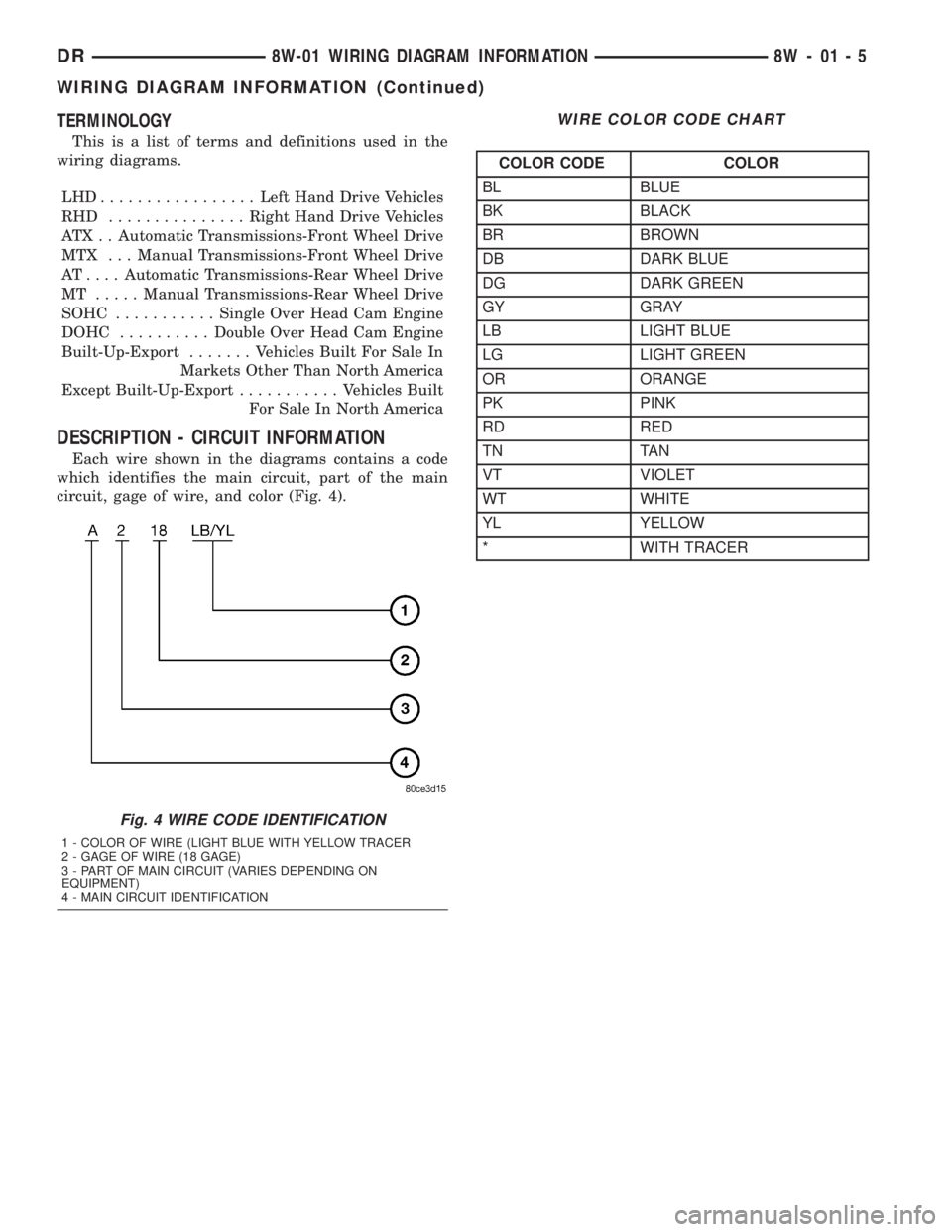
Each wire shown in the diagrams contains a code
which identifies the main circuit, part of the main
circuit, gage of wire, and color (Fig. 4).
WIRE COLOR CODE CHART
COLOR CODE COLOR
BL BLUE
BK BLACK
BR BROWN
DB DARK BLUE
DG DARK GREEN
GY GRAY
LB LIGHT BLUE
LG LIGHT GREEN
OR ORANGE
PK PINK
RD RED
TN TAN
VT VIOLET
WT WHITE
YL YELLOW
* WITH TRACER
Fig. 4 WIRE CODE IDENTIFICATION
1 - COLOR OF WIRE (LIGHT BLUE WITH YELLOW TRACER
2 - GAGE OF WIRE (18 GAGE)
3 - PART OF MAIN CIRCUIT (VARIES DEPENDING ON
EQUIPMENT)
4 - MAIN CIRCUIT IDENTIFICATION
DR8W-01 WIRING DIAGRAM INFORMATION 8W - 01 - 5
WIRING DIAGRAM INFORMATION (Continued)
Page 1074 of 2895
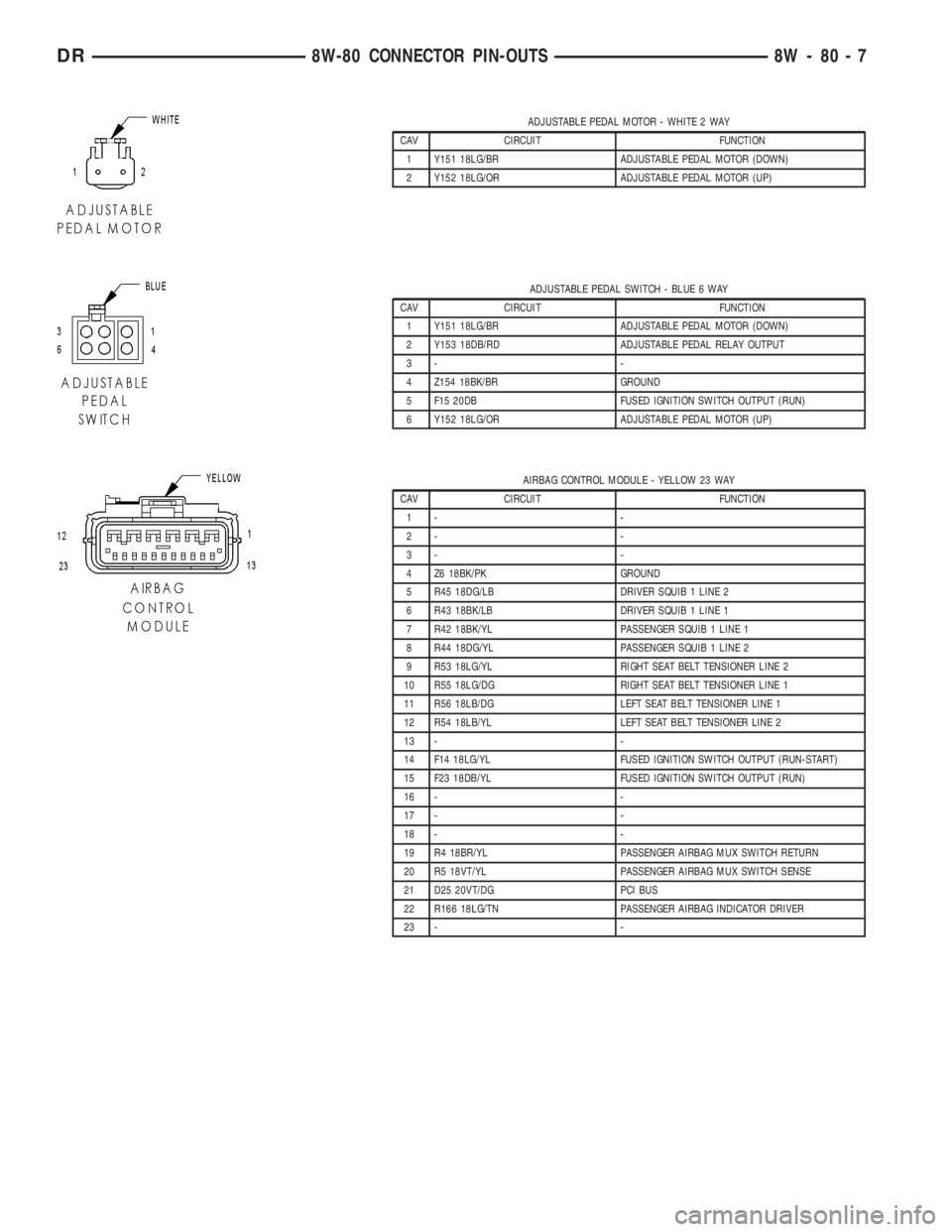
ADJUSTABLE PEDAL MOTOR - WHITE 2 WAY
CAV CIRCUIT FUNCTION
1 Y151 18LG/BR ADJUSTABLE PEDAL MOTOR (DOWN)
2 Y152 18LG/OR ADJUSTABLE PEDAL MOTOR (UP)
ADJUSTABLE PEDAL SWITCH - BLUE 6 WAY
CAV CIRCUIT FUNCTION
1 Y151 18LG/BR ADJUSTABLE PEDAL MOTOR (DOWN)
2 Y153 18DB/RD ADJUSTABLE PEDAL RELAY OUTPUT
3- -
4 Z154 18BK/BR GROUND
5 F15 20DB FUSED IGNITION SWITCH OUTPUT (RUN)
6 Y152 18LG/OR ADJUSTABLE PEDAL MOTOR (UP)
AIRBAG CONTROL MODULE - YELLOW 23 WAY
CAV CIRCUIT FUNCTION
1- -
2- -
3- -
4 Z6 18BK/PK GROUND
5 R45 18DG/LB DRIVER SQUIB 1 LINE 2
6 R43 18BK/LB DRIVER SQUIB 1 LINE 1
7 R42 18BK/YL PASSENGER SQUIB 1 LINE 1
8 R44 18DG/YL PASSENGER SQUIB 1 LINE 2
9 R53 18LG/YL RIGHT SEAT BELT TENSIONER LINE 2
10 R55 18LG/DG RIGHT SEAT BELT TENSIONER LINE 1
11 R56 18LB/DG LEFT SEAT BELT TENSIONER LINE 1
12 R54 18LB/YL LEFT SEAT BELT TENSIONER LINE 2
13 - -
14 F14 18LG/YL FUSED IGNITION SWITCH OUTPUT (RUN-START)
15 F23 18DB/YL FUSED IGNITION SWITCH OUTPUT (RUN)
16 - -
17 - -
18 - -
19 R4 18BR/YL PASSENGER AIRBAG MUX SWITCH RETURN
20 R5 18VT/YL PASSENGER AIRBAG MUX SWITCH SENSE
21 D25 20VT/DG PCI BUS
22 R166 18LG/TN PASSENGER AIRBAG INDICATOR DRIVER
23 - -
DR8W-80 CONNECTOR PIN-OUTS 8W - 80 - 7
Page 1119 of 2895
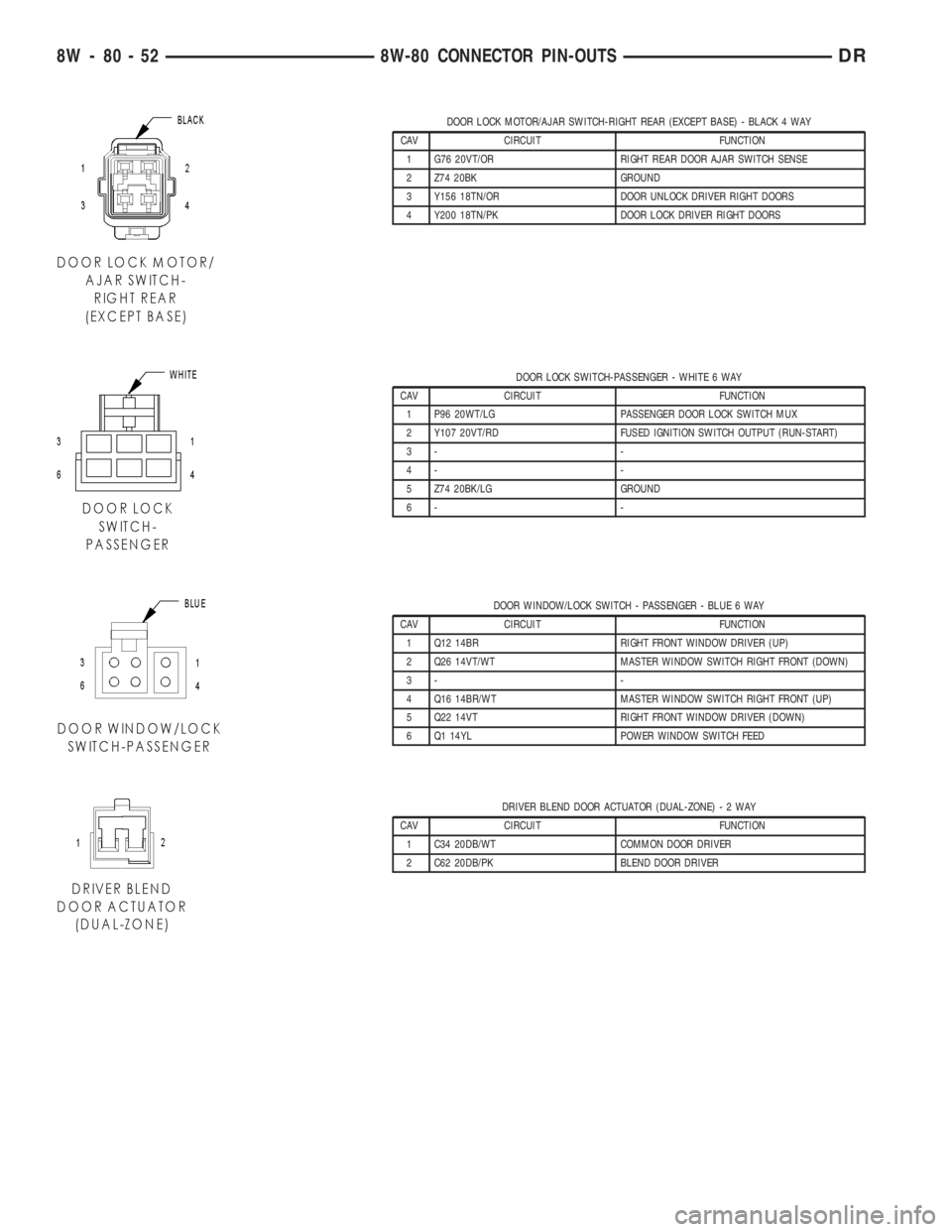
DOOR LOCK MOTOR/AJAR SWITCH-RIGHT REAR (EXCEPT BASE) - BLACK 4 WAY
CAV CIRCUIT FUNCTION
1 G76 20VT/OR RIGHT REAR DOOR AJAR SWITCH SENSE
2 Z74 20BK GROUND
3 Y156 18TN/OR DOOR UNLOCK DRIVER RIGHT DOORS
4 Y200 18TN/PK DOOR LOCK DRIVER RIGHT DOORS
DOOR LOCK SWITCH-PASSENGER - WHITE 6 WAY
CAV CIRCUIT FUNCTION
1 P96 20WT/LG PASSENGER DOOR LOCK SWITCH MUX
2 Y107 20VT/RD FUSED IGNITION SWITCH OUTPUT (RUN-START)
3- -
4- -
5 Z74 20BK/LG GROUND
6- -
DOOR WINDOW/LOCK SWITCH - PASSENGER - BLUE 6 WAY
CAV CIRCUIT FUNCTION
1 Q12 14BR RIGHT FRONT WINDOW DRIVER (UP)
2 Q26 14VT/WT MASTER WINDOW SWITCH RIGHT FRONT (DOWN)
3- -
4 Q16 14BR/WT MASTER WINDOW SWITCH RIGHT FRONT (UP)
5 Q22 14VT RIGHT FRONT WINDOW DRIVER (DOWN)
6 Q1 14YL POWER WINDOW SWITCH FEED
DRIVER BLEND DOOR ACTUATOR (DUAL-ZONE)-2WAY
CAV CIRCUIT FUNCTION
1 C34 20DB/WT COMMON DOOR DRIVER
2 C62 20DB/PK BLEND DOOR DRIVER
8W - 80 - 52 8W-80 CONNECTOR PIN-OUTSDR
Page 1120 of 2895
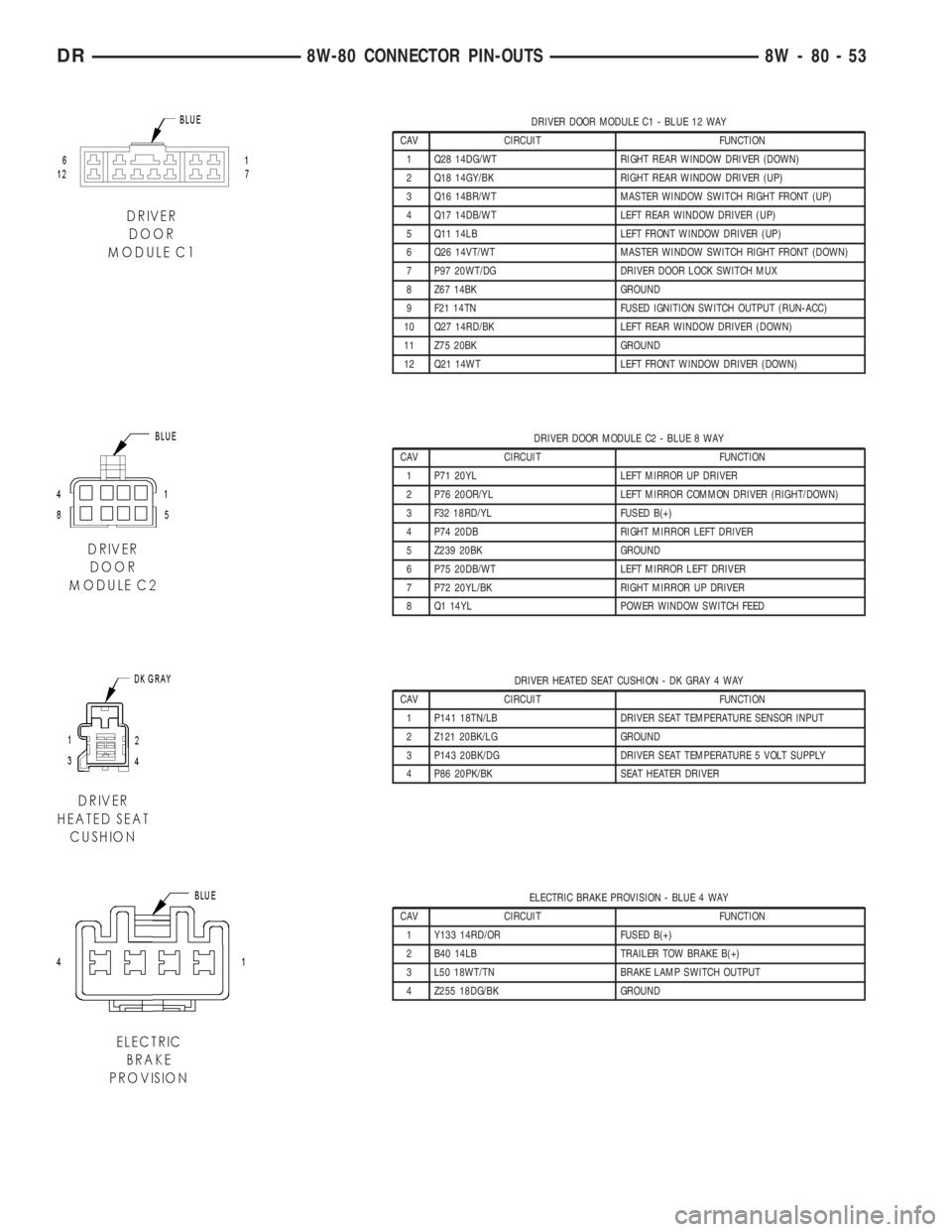
DRIVER DOOR MODULE C1 - BLUE 12 WAY
CAV CIRCUIT FUNCTION
1 Q28 14DG/WT RIGHT REAR WINDOW DRIVER (DOWN)
2 Q18 14GY/BK RIGHT REAR WINDOW DRIVER (UP)
3 Q16 14BR/WT MASTER WINDOW SWITCH RIGHT FRONT (UP)
4 Q17 14DB/WT LEFT REAR WINDOW DRIVER (UP)
5 Q11 14LB LEFT FRONT WINDOW DRIVER (UP)
6 Q26 14VT/WT MASTER WINDOW SWITCH RIGHT FRONT (DOWN)
7 P97 20WT/DG DRIVER DOOR LOCK SWITCH MUX
8 Z67 14BK GROUND
9 F21 14TN FUSED IGNITION SWITCH OUTPUT (RUN-ACC)
10 Q27 14RD/BK LEFT REAR WINDOW DRIVER (DOWN)
11 Z75 20BK GROUND
12 Q21 14WT LEFT FRONT WINDOW DRIVER (DOWN)
DRIVER DOOR MODULE C2 - BLUE 8 WAY
CAV CIRCUIT FUNCTION
1 P71 20YL LEFT MIRROR UP DRIVER
2 P76 20OR/YL LEFT MIRROR COMMON DRIVER (RIGHT/DOWN)
3 F32 18RD/YL FUSED B(+)
4 P74 20DB RIGHT MIRROR LEFT DRIVER
5 Z239 20BK GROUND
6 P75 20DB/WT LEFT MIRROR LEFT DRIVER
7 P72 20YL/BK RIGHT MIRROR UP DRIVER
8 Q1 14YL POWER WINDOW SWITCH FEED
DRIVER HEATED SEAT CUSHION - DK GRAY 4 WAY
CAV CIRCUIT FUNCTION
1 P141 18TN/LB DRIVER SEAT TEMPERATURE SENSOR INPUT
2 Z121 20BK/LG GROUND
3 P143 20BK/DG DRIVER SEAT TEMPERATURE 5 VOLT SUPPLY
4 P86 20PK/BK SEAT HEATER DRIVER
ELECTRIC BRAKE PROVISION - BLUE 4 WAY
CAV CIRCUIT FUNCTION
1 Y133 14RD/OR FUSED B(+)
2 B40 14LB TRAILER TOW BRAKE B(+)
3 L50 18WT/TN BRAKE LAMP SWITCH OUTPUT
4 Z255 18DG/BK GROUND
DR8W-80 CONNECTOR PIN-OUTS 8W - 80 - 53