Page 524 of 1184
4B –4 MASTER CYLINDER
DAEWOO M-150 BL2
REPAIR INSTRUCTIONS
ON–VEHICLE SERVICE
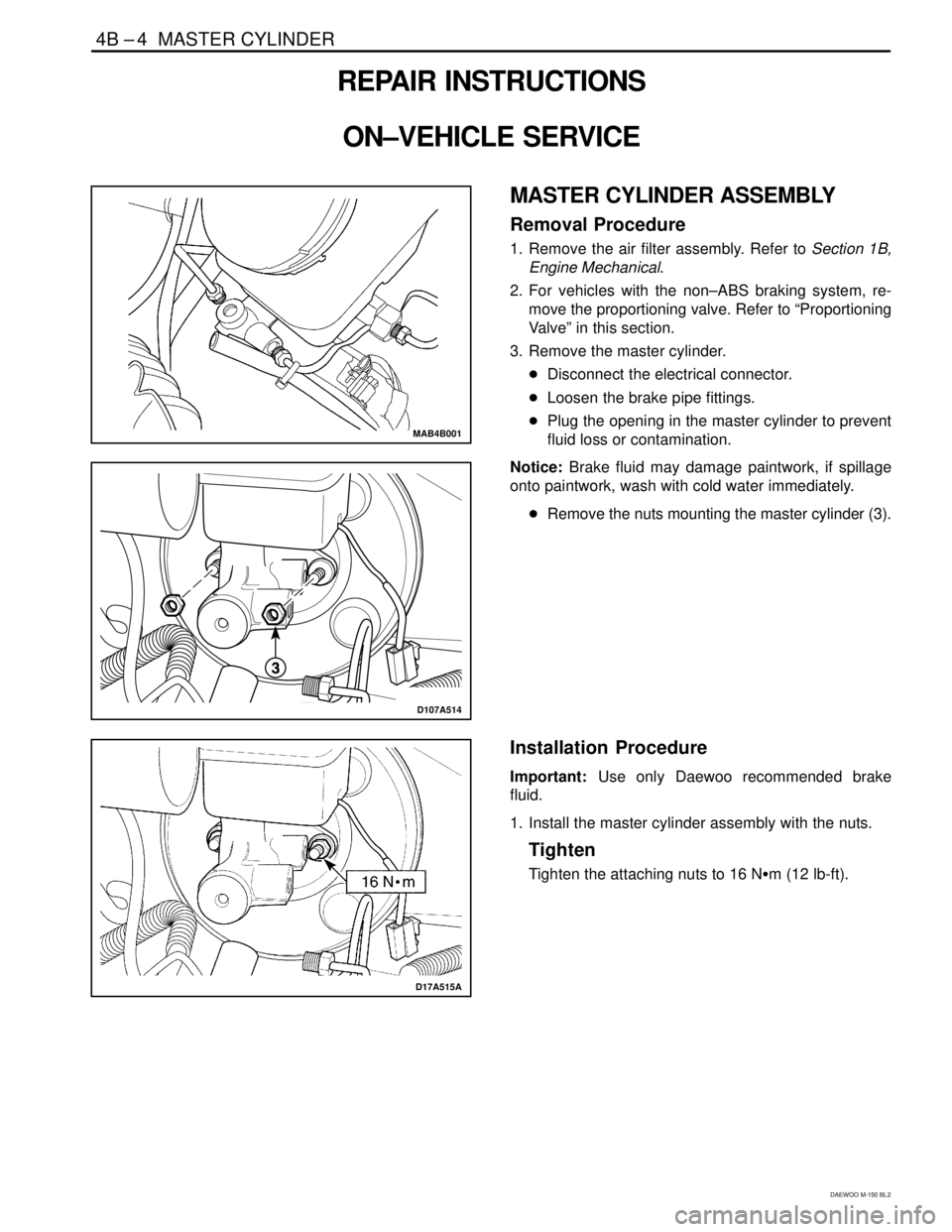
MAB4B001
D107A514
MASTER CYLINDER ASSEMBLY
Removal Procedure
1. Remove the air filter assembly. Refer to Section 1B,
Engine Mechanical.
2. For vehicles with the non–ABS braking system, re-
move the proportioning valve. Refer to “Proportioning
Valve” in this section.
3. Remove the master cylinder.
�Disconnect the electrical connector.
�Loosen the brake pipe fittings.
�Plug the opening in the master cylinder to prevent
fluid loss or contamination.
Notice: Brake fluid may damage paintwork, if spillage
onto paintwork, wash with cold water immediately.
�Remove the nuts mounting the master cylinder (3).
D17A515A
Installation Procedure
Important: Use only Daewoo recommended brake
fluid.
1. Install the master cylinder assembly with the nuts.
Tighten
Tighten the attaching nuts to 16 N�m (12 lb-ft).
Page 525 of 1184

MASTER CYLINDER 4B–5
DAEWOO M-150 BL2
MAB4B002
2. Install the brake pipe fittings to the master cylinder.
Tighten
Tighten the fittings to 16 N�m (12 lb-ft).
3. Connect the electrical connector.
4. For vehicles with the non–ABS braking system, install
the proportioning valve. Refer to “Proportioning
Valve” in this section.
5. Install the air filter assembly. Refer to Section 1B, En-
gine Mechanical.
6. Bleed the brake system. Refer to Section 4A, Hy-
draulic Brakes.
D17A517A
BRAKE FLUID RESERVOIR
Removal Procedure
1. Remove the fluid level switch connector. Refer to
“Brake Fluid Level Switch” in this section.
2. Remove the reservoir.
�Drain the brake fluid.
�Remove the screw (1).
�Remove the fluid reservoir using a flathead screw-
driver (2).
Notice: Do not force one side strongly to prevent dam-
age of reservoir when removing the reservoir.
D17A518A
Installation Procedure
Important: Use only Daewoo recommended brake fluid.
1. Install the reservoir with the screw.
Tighten
Tighten the screw to 4 N�m (35 lb-ft).
2. Install the fluid level switch connector. Refer to “Brake
Fluid Level Switch” in this section.
3. Add brake fluid.
4. Bleed the brake system. Refer to Section 4A, Hy-
draulic Brakes.
MAB4B003
PROPORTIONING VALVE (FOR
VEHICLE WITH THE NON–ABS
BRAKING SYSTEM)
1. Remove the proportioning valve.
�Loosen the brake pipe fittings–to–proportioning
valve (1).
�Remove the proportioning valve (2).
�Plug the opening in the proportioning valve and
brake pipe fitting to prevent fluid loss or contamina-
tion.
Page 622 of 1184
4G–6 PARKING BRAKE
DAEWOO M-150 BL2
D107D508
PARKING BRAKE CABLE
Removal Procedure
1. Remove the parking brake lever. Refer to “Parking
Brake Lever” in this section.
2. Remove the parking brake cable.
�Remove the cable pulley (1).
�Loosen the adjustment nuts (2).
�Remove the strengthener (3).
D107D509
�Remove the grommet (4).
D107D510
3. Remove the rear brake drum assembly. Refer to Sec-
tion 2D, Rear Suspension.
4. Disconnect the parking brake cable from the rear
brake drum assembly.
�Remove the clip from the brake plate (1).
�Disconnect the parking brake cable from the trailing
shoe (2). Refer to Section 4E, Rear Drum Brake.
D107D511
5. Remove the parking brake cable.
�Remove the clamp bolts fastening the brake cable
(RH Rear Brake Side) (1).
�Remove the fuel filter. Refer to Section 1F, Engine
Controls.
Page 623 of 1184
PARKING BRAKE 4G–7
DAEWOO M-150 BL2
D107D512
�Remove the clamp bolts fastening the brake cable
(LH Rear Brake Side) (2).
D17D513A
D17D514A
Installation Procedure
1. Install the fuel filter.
2. Install the parking brake cable with the clamp bolts.
Tighten
Tighten the parking brake cable clamp bolts to 10 N�m
(89 lb-in) (1, 2).
D17D515A
3. Connect the parking brake cable to the rear brake
drum assembly. Refer to Section 4E, Rear Drum
Brake.
4. Install the rear brake drum assembly. Refer to Sec-
tion 2D, Rear Suspension.
5. Install the grommet and the strengthener.
6. Install the cable pulley with the adjustment nuts.
Tighten
Tighten the adjustment nuts to 10 N�m (89 lb-in) (3).
7. Install the parking brake lever. Refer to “Parking Brake
Lever” in this section.
Page 796 of 1184

7B–14 MANUAL CONTROL HEATING, VENTILATION, AND AIR CONDITIONING SYSTEM
DAEWOO M-150 BL2
MAINTAINING CHEMICAL STABILITY
IN THE REFRIGERATION SYSTEM
The efficient operation and life of the air conditioning
system is dependent upon the chemical stability of the
refrigeration system. When foreign materials, such as
dirt, air, or moisture, contaminate the refrigeration sys-
tem, they will change the stability of the refrigerant and
the PAG compressor oil. They will also affect the pres-
sure-temperature relationship, reduce efficient opera-
tion, and can possibly cause interior corrosion and
abnormal wear of moving parts.
Observe the following practices to ensure chemical sta-
bility in the system:
�Wipe away dirt or oil at and near any connection be-
fore opening that connection. This will reduce the
chance of dirt entering the system.
�Cap, plug, or tape both sides of a connection as soon
as possible after opening the connection. This will
prevent the entry of dirt, foreign material, and mois-
ture.
�Keep all tools clean and dry, including the manifold
gauge set and all replacement parts.
�Use a clean and dry transfer device and container to
add PAG refrigerant oil. This will ensure that the oil
remains as moisture-free as possible. Refer to “Dis-
charging, Adding Oil, Evacuating and Charging Pro-
cedures for A/C System” in this section.
�Have everything you need ready to allow you to per-
form all operations quickly when opening an A/C sys-
tem. Do not leave the A/C system open any longer
than necessary.
�Evacuate and recharge any A/C system that has
been opened. Refer to “Discharging, Adding Oil, Eva-
cuating and Charging Procedures for A/C System” in
this section for the instructions to perform this proce-
dure properly.
All service parts are dehydrated and sealed before ship-
ping. They should remain sealed until just before making
connections. All the parts should be at room tempera-
ture before uncapping. This prevents condensation of
moisture from the air from entering the system. Reseal
all parts as soon as possible if the caps have been re-
moved but the connections cannot be made promptly.
DISCHARGING, ADDING OIL,
EVACUATING, AND CHARGING
PROCEDURES FOR A/C SYSTEMS
Caution: Use only refillable refrigerant tanks that
are authorized for the charging station being used.
The use of other tanks may cause personal injury or
void the warranty. Refer to the manufacturer’s in-
structions for the charging station.Caution: To avoid personal injury, always wear
goggles and gloves when performing work that in-
volves opening the refrigeration system.
A charging station discharges, evacuates, and re-
charges an air conditioning system with one hook-up.
Filtering during the recovery cycle together with filtering
during the evacuation cycle ensures a supply of clean,
dry refrigerant for A/C system charging.
Notice:
�Never use the R-134a charging station on a system
charged with R-12. The refrigerants and the oils are
not compatible and must never be mixed in even the
smallest amount. Mixing refrigerant residue will dam-
age the equipment.
�Never use adapters which convert from one size fit-
ting to another. This will allow contamination which
may cause system failure.
Charging Station Setup and Maintenance
Refer to the manufacturer’s instructions for all initial set-
up procedures and all maintenance procedures. There
are many charging stations available. All perform the
various tasks required to discharge the system and re-
cover refrigerant, evacuate the system, add a measured
amount of oil, and recharge an air conditioning system
with a measured amount of refrigerant.
Control Panel Functions
A charging station will have controls and indicators to al-
low the operator to control and monitor the operation in
progress. Refer to the manufacturer’s instructions for
details. These can be expected to include:
1. Main Power Switch: The main power switch supplies
electrical power to the control panel.
2. Display: The display shows the time programmed for
vacuum and the weight of the refrigerant pro-
grammed for recharging. Refer to the manufacturer’s
instructions for detailed programming information.
3. Low Side Manifold Gauge: This gauge shows the
system’s low side pressure.
4. High Side Manifold Gauge: This gauge shows the
system’s high side pressure.
5. Controls: This will contain the controls that control
various operating functions.
6. Low Side Valve: This valve connects the low side of
the A/C system to the unit.
7. Moisture Indicator: This indicator shows if the refrig-
erant is wet or dry.
8. High Side Valve: This valve connects the high side of
the A/C system to the unit.