Page 806 of 1184

7B -- 24 MANUAL CONTROL HEATING, VENTILATION, AND AIR CONDITIONING SYSTEM
DAEWOO M-150 BL2
D18B522A
D18B523B
D18B524A
Installation Procedure
Important:Discard the removed O--rings.
1. Install the high pressure pipe lines with the bolts, the
nuts, and the fittings.
Tighten
DTighten the bolt securing the high pressure pipe
line to the compressor to 23 NSm (17 lb-ft) (1).
DTighten the fitting securing the high pressure pipe
line to the condenser pipe line to 23 NSm (17 lb-ft)
(2).
DTighten the fitting securing the high pressure pipe
line to the receiver dryer to 14 NSm (10.5 lb-ft) (3).
DTighten the bracket nut to 5 NSm (44 lb-in) (4).
DTighten the receiver dryer flange nuts to 14 NSm
(10.5 lb-ft) (5).
DTighten the nut securing the high pressure pipe line
to the evaporator to 14 NSm (10.5 lb-ft) (6).
DTighten the bracket nut to 5 NSm (44 lb-in) (7).
2. Install the purge control valve. Refer toSection 1F,
Engine controls.
3. Evacuate and recharge the system. Refer to “Dis-
charging, Adding Oil, Evaculating, and Charging Pro-
cedures for A/C System” in this section.
4. Install the front bumper fascia. Refer toSection 9O,
Bumpers and Fascias.
5. Connect the negative battery cable.
D18B525B
Page 807 of 1184
MANUAL CONTROL HEATING, VENTILATION, AND AIR CONDITIONING SYSTEM 7B -- 25
DAEWOO M-150 BL2
D108B526
A/C LOW PRESSURE PIPE LINE
(Left -- Hand Drive Shown, Right -- Hand
Drive Similar)
Removal Procedure
1. Disconnect the negative battery cable.
2. Discharge and recover the refrigerant. Refer to “Dis-
charging, Adding Oil, Evacuating, and Charging Pro-
cedures for A/C System” in this section.
3. Remove the A/C low pressure pipe line.
DRemove the bolt securing the A/C low pressure
pipe line at the compressor (1).
D18B527A
DRemove the bracket nut from shut bar (2).
D18B528A
DRemove the purge control valve. Refer toSection
1F, Engine Controls.
DLoosen the nut securing the A/C low pressure pipe
line at the evaporator (3).
D18B529B
Installation Procedure
Important:Discard the removed O--rings.
1. Install the A/C low pressure pipe line.
Tighten
DTighten the nut securing the A/C low pressure pipe
line at the evaporator to 14 NSm (10.5 lb-ft) (1).
Page 808 of 1184
7B -- 26 MANUAL CONTROL HEATING, VENTILATION, AND AIR CONDITIONING SYSTEM
DAEWOO M-150 BL2
D18B530B
D18B531A
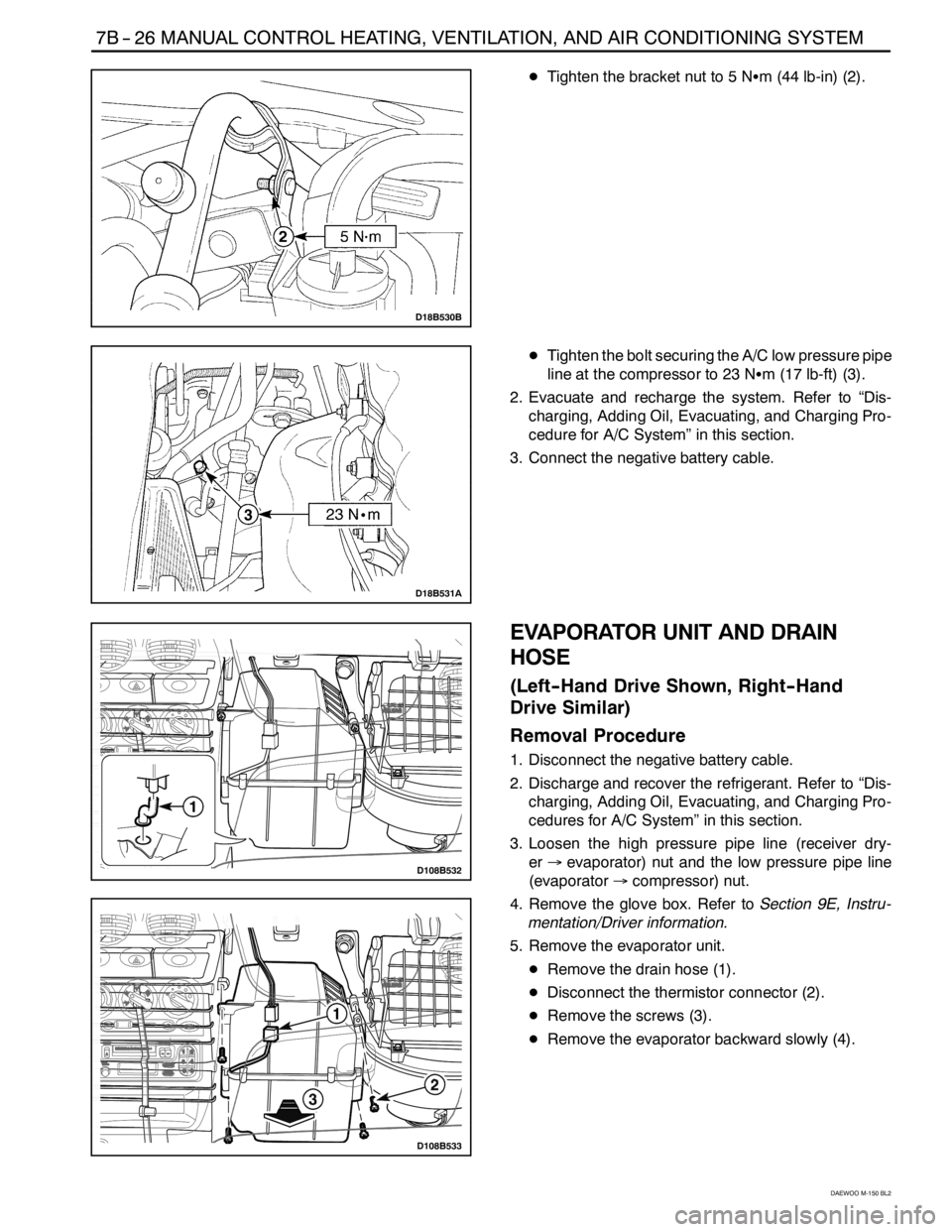
DTighten the bracket nut to 5 NSm (44 lb-in) (2).
DTighten the bolt securing the A/C low pressure pipe
line at the compressor to 23 NSm (17 lb-ft) (3).
2. Evacuate and recharge the system. Refer to “Dis-
charging, Adding Oil, Evacuating, and Charging Pro-
cedure for A/C System” in this section.
3. Connect the negative battery cable.
D108B532
D108B533
EVAPORATOR UNIT AND DRAIN
HOSE
(Left -- Hand Drive Shown, Right -- Hand
Drive Similar)
Removal Procedure
1. Disconnect the negative battery cable.
2. Discharge and recover the refrigerant. Refer to “Dis-
charging, Adding Oil, Evacuating, and Charging Pro-
cedures for A/C System” in this section.
3. Loosen the high pressure pipe line (receiver dry-
er→evaporator) nut and the low pressure pipe line
(evaporator→compressor) nut.
4. Remove the glove box. Refer toSection 9E, Instru-
mentation/Driver information.
5. Remove the evaporator unit.
DRemove the drain hose (1).
DDisconnect the thermistor connector (2).
DRemove the screws (3).
DRemove the evaporator backward slowly (4).
Page 809 of 1184
MANUAL CONTROL HEATING, VENTILATION, AND AIR CONDITIONING SYSTEM 7B -- 27
DAEWOO M-150 BL2
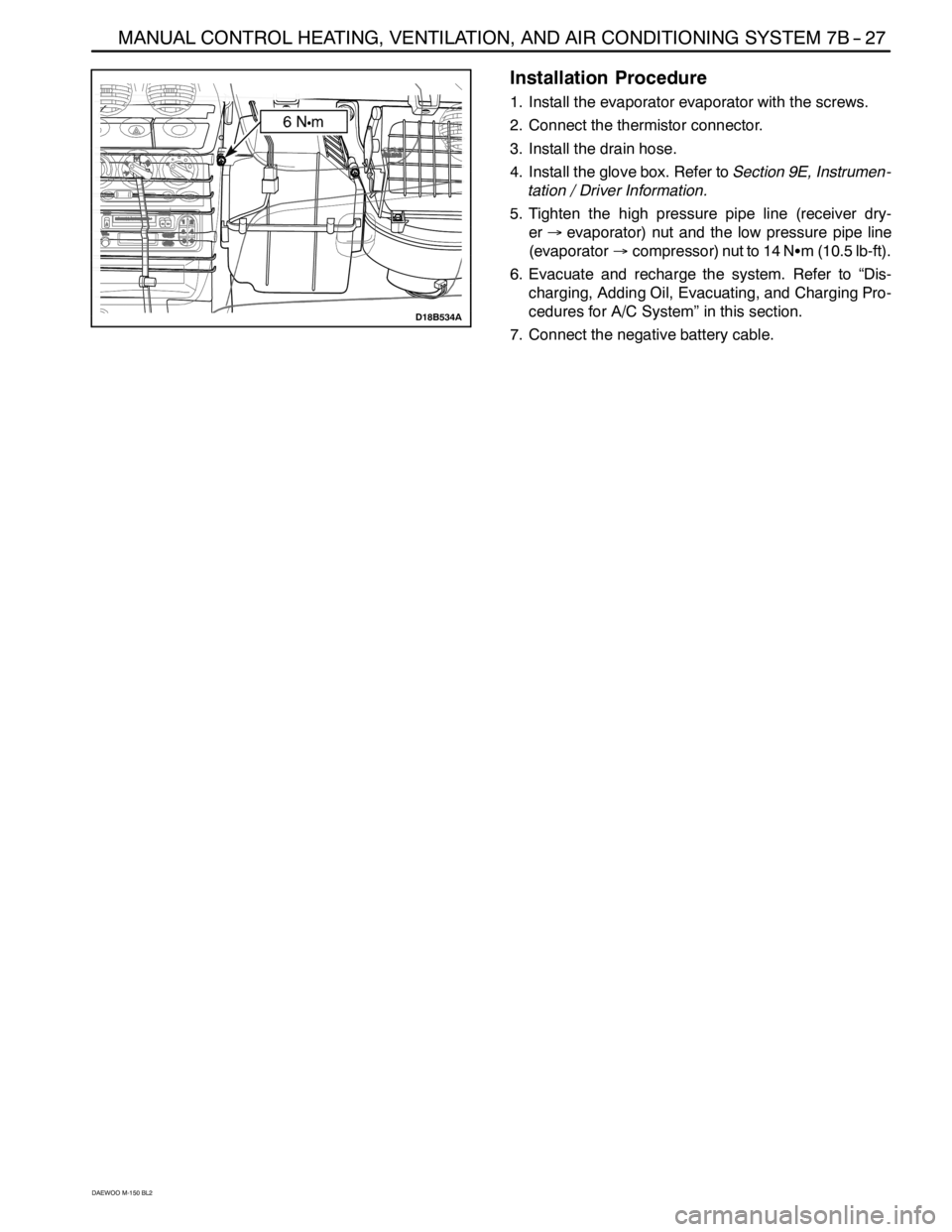
D18B534A
Installation Procedure
1. Install the evaporator evaporator with the screws.
2. Connect the thermistor connector.
3. Install the drain hose.
4. Install the glove box. Refer toSection 9E, Instrumen-
tation / Driver Information.
5. Tighten the high pressure pipe line (receiver dry-
er→evaporator) nut and the low pressure pipe line
(evaporator→compressor) nut to 14 NSm (10.5 lb-ft).
6. Evacuate and recharge the system. Refer to “Dis-
charging, Adding Oil, Evacuating, and Charging Pro-
cedures for A/C System” in this section.
7. Connect the negative battery cable.
Page 1053 of 1184

DAEWOO M-150 BL2
SECTION 9K
SQUEAKS AND RATTLES
TABLE OF CONTENTS
Diagnostic Information and Procedures 9K-1. . . . .
Squeak and Rattle Diagnosis 9K-1. . . . . . . . . . . . . . . Repair Instructions 9K-3. . . . . . . . . . . . . . . . . . . . . . . . .
On-Vehicle Service 9K-3. . . . . . . . . . . . . . . . . . . . . . . . . .
Squeak and Rattle Repair 9K-3. . . . . . . . . . . . . . . . . .
DIAGNOSTIC INFORMATION AND PROCEDURES
SQUEAK AND RATTLE DIAGNOSIS
ConditionProbable CauseCorrection
Rattle Coming From the
Side Rail�Improperly connected brake
lines.�Tap lightly on the brake lines and listen for a
rattle.
�Install plastic tie straps to secure the brake
lines tightly together.
Rattle Under Vehicle at
Higher RPM�The heat shield contacts with
the underbody.�Raise the vehicle and perform a visual
inspection.
�Bend the heat shield slightly to gain
clearance from the underbody.
Squeak From the Front
of the Vehicle in Cold
Weather�Poor front stabilizer shaft
insulators taping.�While the vehicle is cold, perform a test drive
and achieve full front suspension travel by
driving through a dip in the road.
�Remove the insulators and wrap teflon tape
around the stabilizer shaft. Reinstall the
insulators over the tape.
Thump From Rear of
Vehicle on Bumps�Improperly secured spare tire in
the rear compartment.�Open the rear compartment and perform a
visual inspection of the spare tire and the
tools.
�Tightly secure the spare tire and all tools.
�Perform a road test to verify that the noise is
eliminated.
Glass Knock Coming
From the Rear of the
Vehicle When Driving
Over Bumps�An out-of-adjustment hatchback
latch.�Test drive the vehicle in order to verify this
condition.
�Loosen the latch nuts and adjust the latch
downward.
Rattle Coming From
Door�The door lock solenoid is loose.�Remove the door trim panel and check if the
solenoid is loose.
�Tighten the solenoid bolts.
�Rattling electrical connectors
inside the door trim panel.�Tap on the trim panel and listen for a rattle.
�Remove the trim panel and wrap foam
padding around the connectors as required.
Squeak When
Operating Doors�A lack of lubrication of the door
hinge pins.�Operate the doors and listen for squeaks.
�Lubricate the door hinge pins with light oil
and coat with lithium grease.
�A lack of lubrication of the door
hold open link arm.�Lubricate the door hold open link arm with
light oil and coat with lithium grease.