Page 239 of 386
5-14
Single Drive Rear Axle
Disconnect the propshaft at the rear axle. Secure the
propshaft to the frame or crossmember.
Tandem Drive Rear Axles
(Forward Axle Off the Ground)
Raise the front of the vehicle until the forward tandem
axle wheels are off the ground. Remove the rearward
propshaft.Tandem Drive Rear Axle (Both Axles on the Ground
Due to Type of Suspension or Attached Load)
Disconnect the propshaft at the forward tandem axle.
Secure the propshaft to the frame or crossmember.
If there is damage or suspected damage to the axle(s),
remove all axle shafts. Cover the hub openings to
prevent the loss of lubricant or entry of dirt or
foreign objects.
After Towing
1. Block the rear wheels and install axle and propshafts.
2. Check for proper phasing of universal joints.
3. Apply the emergency brake system before
disconnecting from the towing vehicle.
Page 240 of 386

5-15 Towing Your Vehicle From the Front
(All Wheels On the Ground)
Your vehicle may be towed on all wheels provided the
steering is working. Remember that the power brakes
and power steering will not have power assist. Vehicles
with air brakes will not have brakes. There must be a
tow bar installed between the towing vehicle and the
disabled vehicle.
Before Towing
Block the wheels of the disabled vehicle. On vehicles
with air brakes, release the emergency brake system by
compressing the brake chamber springs as outlined in
this section. (This is to prevent the possibility of the
emergency brake being applied during towing.)
On vehicles with hydraulic brakes, release the parking
brake fully by moving the lever to the fully
-released
position.
Disconnect the propshaft at the rear axle (forward axle
on tandem axle models). Secure the propshaft to the
frame or crossmember.
If there is damage or suspected damage to the axle(s),
remove the axle shafts. Cover the hub openings to
prevent the loss of lubricant or entry of dirt or
foreign objects.After Towing
1. Block the rear wheels and install axle and propshafts.
2. Check for proper phasing of universal joints.
3. Apply the parking brake system before
disconnecting from the towing vehicle.
4. Check and fill with oil as required.
Towing Your Vehicle From the Rear
Before Towing
Secure the steering wheel to maintain a straight
-ahead
position. Make certain that the front axle is not loaded
above the front axle Gross Axle Weight Rating (GAWR)
as indicated on the vehicle's Gross Vehicle Weight
Rating (GVWR) label. See ªGross Vehicle Weight
Rating (GVWR)º in the index for more information.
After Towing
Block the rear wheels and release the steering. Apply the
parking brake system before disconnecting from the
towing vehicle.
Refer to the transmission shift label for additional
information.
Page 241 of 386
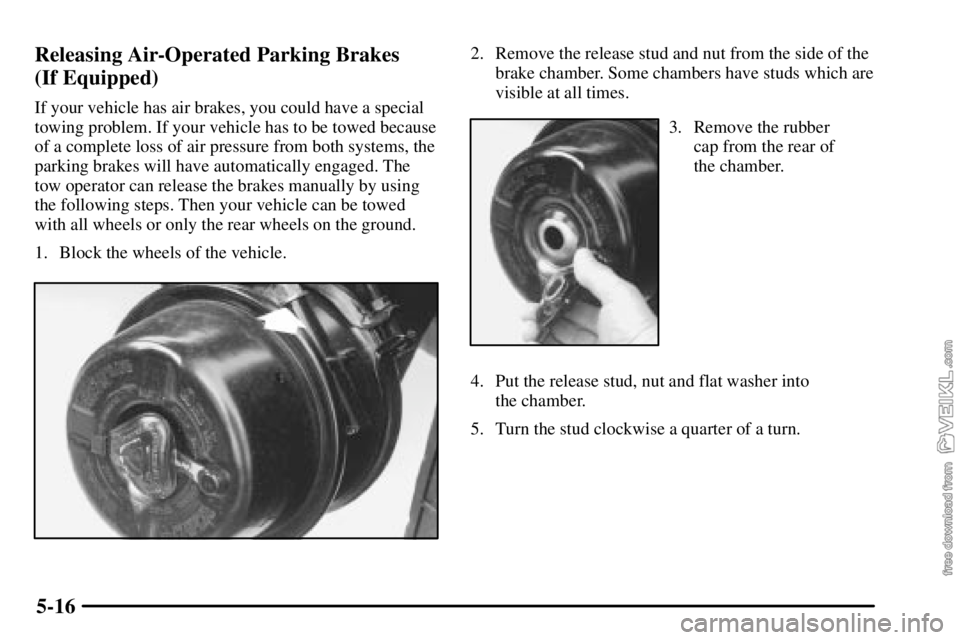
5-16 Releasing Air-Operated Parking Brakes
(If Equipped)
If your vehicle has air brakes, you could have a special
towing problem. If your vehicle has to be towed because
of a complete loss of air pressure from both systems, the
parking brakes will have automatically engaged. The
tow operator can release the brakes manually by using
the following steps. Then your vehicle can be towed
with all wheels or only the rear wheels on the ground.
1. Block the wheels of the vehicle.
2. Remove the release stud and nut from the side of the
brake chamber. Some chambers have studs which are
visible at all times.
3. Remove the rubber
cap from the rear of
the chamber.
4. Put the release stud, nut and flat washer into
the chamber.
5. Turn the stud clockwise a quarter of a turn.
Page 251 of 386

5-26
Engine Fan Noise
Your vehicle has a clutched engine cooling fan. When
the clutch is engaged, the fan spins faster to provide
more air to cool the engine. In most everyday driving
conditions, the clutch is not fully engaged. This
improves fuel economy and reduces fan noise. Under
heavy vehicle loading, trailer towing and/or high outside
temperatures, the fan speed increases when the clutch
engages. So you may hear an increase in fan noise.
This is normal and should not be mistaken as the
transmission slipping or making extra shifts. It is merely
the cooling system functioning properly. The fan will
slow down when additional cooling is not required and
the clutch disengages.
You may also hear this fan noise when you start the
engine. It will go away as the fan clutch disengages.
If a Tire Goes Flat
It's unusual for a tire to ªblow outº while you're driving,
especially if you maintain your tires properly. If air goes
out of a tire, it's much more likely to leak out slowly.
But if you should ever have a ªblowout,º here are a few
tips about what to expect and what to do:
If a front tire fails, the flat tire will create a drag that
pulls the vehicle toward that side. Take your foot off the
accelerator pedal and grip the steering wheel firmly.
Steer to maintain lane position, and then gently brake to
a stop well out of the traffic lane.
A rear blowout, particularly on a curve, acts much like a
skid and may require the same correction you'd use in a
skid. In any rear blowout, remove your foot from the
accelerator pedal. Get the vehicle under control by
steering the way you want the vehicle to go. It may be
very bumpy and noisy, but you can still steer. Gently
brake to a stop
-- well off the road if possible.
If a tire goes flat, avoid further tire and wheel damage
by driving slowly to a level place and turn on your
hazard warning flashers. The next part tells you what
to do.
Page 253 of 386
5-28
If You're Stuck: In Sand, Mud, Ice
or Snow
In order to free your vehicle when it is stuck, you will
need to spin the wheels, but you don't want to spin your
wheels too fast. The method known as ªrockingº can
help you get out when you're stuck, but you must
use caution.
CAUTION:
If you let your tires spin at high speed, they can
explode, and you or others could be injured. And,
the transmission or other parts of the vehicle can
overheat. That could cause an engine
compartment fire or other damage. When you're
stuck, spin the wheels as little as possible. Don't
spin the wheels above 35 mph (55 km/h) as shown
on the speedometer.
NOTICE:
Spinning your wheels can destroy parts of your
vehicle as well as the tires. If you spin the wheels
too fast while shifting your transmission back
and forth, you can destroy your transmission.
Rocking Your Vehicle To Get It Out
First, turn your steering wheel left and right. That will
clear the area around your front wheels. If your vehicle
has traction control, you should turn your traction
control system off. See ªTraction Control Systemº in the
Index. Then shift back and forth between REVERSE (R)
and a forward gear (or with a manual transmission,
between FIRST (1) or SECOND (2) and
REVERSE (R)), spinning the wheels as little as
possible. Release the accelerator pedal while you shift,
and press lightly on the accelerator pedal when the
transmission is in gear. By slowly spinning your wheels
in the forward and reverse directions, you will cause a
rocking motion that may free your vehicle. If that
doesn't get you out after a few tries, you may need to be
towed out. If you do need to be towed out, see ªTowing
Your Vehicleº in the Index.
Page 254 of 386
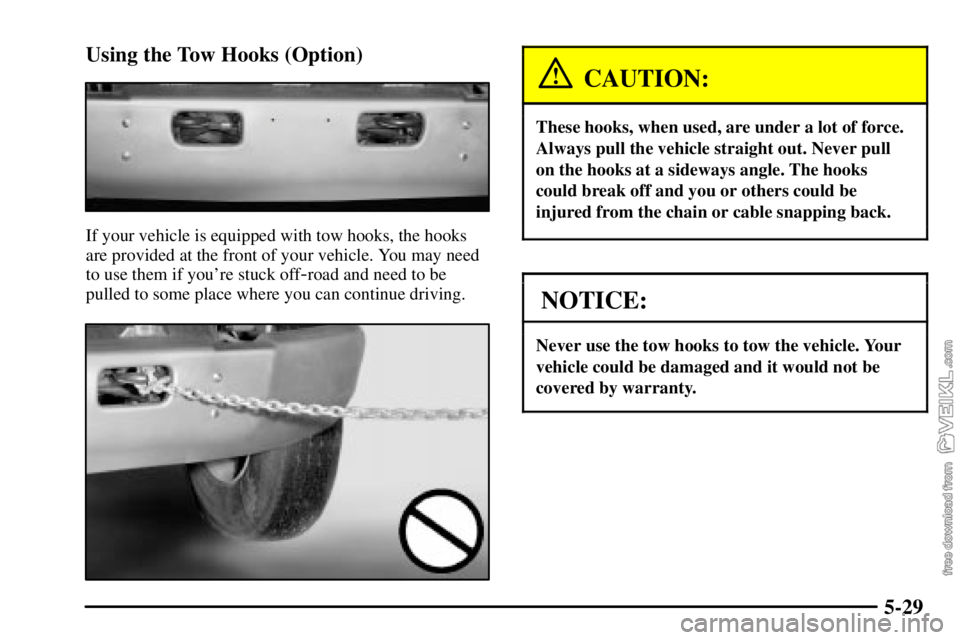
5-29 Using the Tow Hooks (Option)
If your vehicle is equipped with tow hooks, the hooks
are provided at the front of your vehicle. You may need
to use them if you're stuck off
-road and need to be
pulled to some place where you can continue driving.
CAUTION:
These hooks, when used, are under a lot of force.
Always pull the vehicle straight out. Never pull
on the hooks at a sideways angle. The hooks
could break off and you or others could be
injured from the chain or cable snapping back.
NOTICE:
Never use the tow hooks to tow the vehicle. Your
vehicle could be damaged and it would not be
covered by warranty.
Page 276 of 386
6-22 Checking Engine Oil
It's a good idea to check your engine oil every time you
get fuel. In order to get an accurate reading, the oil must
be warm and the vehicle must be on level ground.
The engine oil dipstick
is located in the engine
compartment on the
driver's side of the vehicle.
Turn off the engine and give the oil several minutes to
drain back into the oil pan. If you don't, the oil dipstick
might not show the actual level.Pull out the dipstick and clean it with a paper towel or
cloth, then push it back in all the way. Remove it again,
keeping the tip down, and check the level.
Page 281 of 386
6-27
Engine Oil (Caterpillar�
Diesel Engines)
See your Caterpillar� Operation & Maintenance Manual
for information on oil quality and viscosities as well as
the temperature range chart.
Engine Oil (DURAMAX� Diesel)
Checking Engine Oil
It's a good idea to check your engine oil level every time
you get fuel.
The engine oil dipstick is
located in the engine
compartment on the driver's
side of the vehicle.
In order to get an accurate
reading, the oil must be
warm (at normal operating
temperature) and the vehicle
must be on level ground.Turn off the engine and give the oil at least five minutes
to drain back into the oil pan. With a cool engine, allow
30 minutes. If you don't, the oil dipstick might not show
the actual level.
Pull out the dipstick and clean it with a paper towel or a
cloth, then push it back in all the way. Remove it again,
keeping the tip down.