Page 307 of 386
6-53
Windshield Wiper Blade
Replacement
Windshield wiper blades should be inspected at least
twice a year for wear or cracking. See ªWiper Blade
Checkº in the Index for more information.
Replacement blades come in different types and are
removed in different ways.
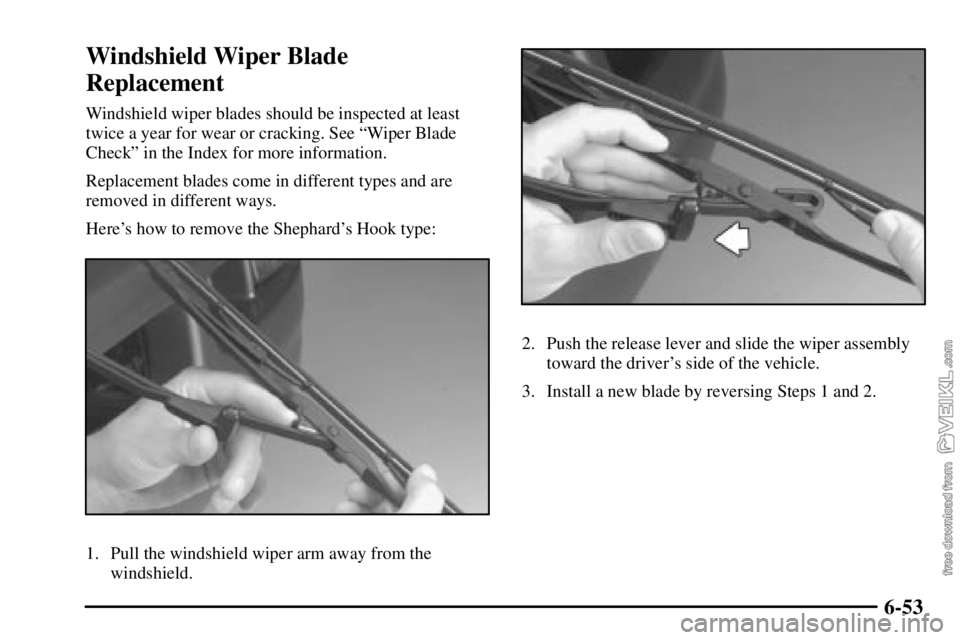
Here's how to remove the Shephard's Hook type:
1. Pull the windshield wiper arm away from the
windshield.
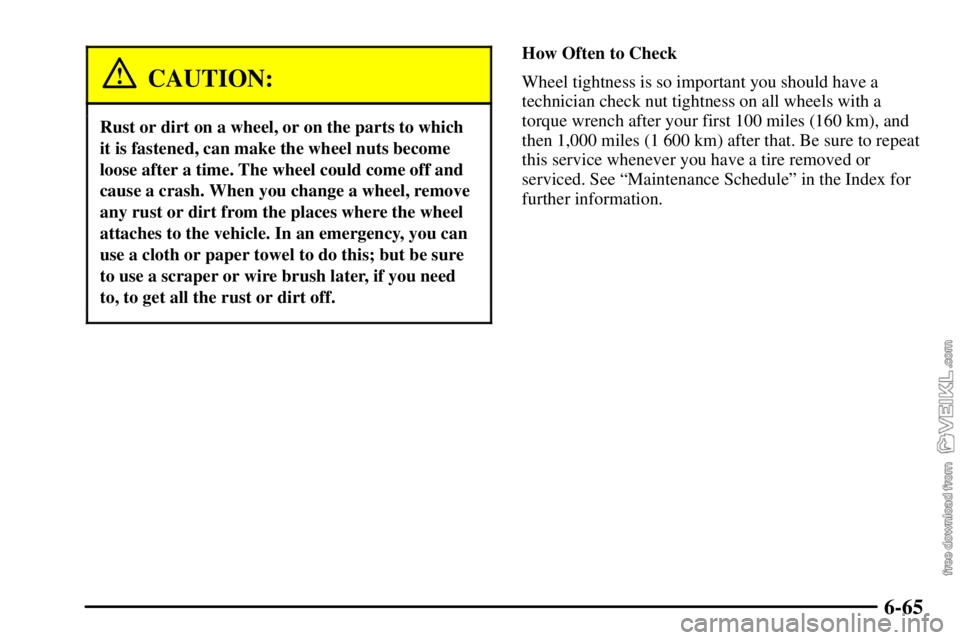
2. Push the release lever and slide the wiper assembly
toward the driver's side of the vehicle.
3. Install a new blade by reversing Steps 1 and 2.
Page 319 of 386
6-65
CAUTION:
Rust or dirt on a wheel, or on the parts to which
it is fastened, can make the wheel nuts become
loose after a time. The wheel could come off and
cause a crash. When you change a wheel, remove
any rust or dirt from the places where the wheel
attaches to the vehicle. In an emergency, you can
use a cloth or paper towel to do this; but be sure
to use a scraper or wire brush later, if you need
to, to get all the rust or dirt off.
How Often to Check
Wheel tightness is so important you should have a
technician check nut tightness on all wheels with a
torque wrench after your first 100 miles (160 km), and
then 1,000 miles (1 600 km) after that. Be sure to repeat
this service whenever you have a tire removed or
serviced. See ªMaintenance Scheduleº in the Index for
further information.
Page 322 of 386

6-68
Don't use any of these unless this manual says you can.
In many uses, these will damage your vehicle:
�Alcohol
�Laundry Soap
�Bleach
�Reducing Agents
Cleaning the Inside of Your Vehicle
Use a vacuum cleaner often to get rid of dust and loose
dirt. Wipe vinyl, leather, plastic and painted surfaces
with a clean, damp cloth.
Cleaning of Fabric/Carpet
Your dealer has cleaners for the cleaning of fabric and
carpet. They will clean normal spots and stains very
well. You can get GM
-approved cleaning products from
your dealer. See ªAppearance Care and Materialsº in
the Index.
Here are some cleaning tips:
�Always read the instructions on the cleaner label.
�Clean up stains as soon as you can
-- before they set.�Carefully scrape off any excess stain.
�Use a clean cloth or sponge, and change to a clean
area often. A soft brush may be used if stains are
stubborn.
�If a ring forms on fabric after spot cleaning, clean the
entire area immediately or it will set.
Using Cleaner on Fabric
1. Vacuum and brush the area to remove any loose dirt.
2. Always clean a whole trim panel or section. Mask
surrounding trim along stitch or welt lines.
3. Follow the directions on the container label.
4. Apply cleaner with a clean sponge. Don't saturate
the material and don't rub it roughly.
5. As soon as you've cleaned the section, use a sponge
to remove any excess cleaner.
6. Wipe cleaned area with a clean, water
-dampened
towel or cloth.
7. Wipe with a clean cloth and let dry.
Page 325 of 386

6-71
Cleaning the Outside of the
Windshield and Wiper Blades
If the windshield is not clear after using the windshield
washer, or if the wiper blade chatters when running,
wax, sap or other material may be on the blade or
windshield.
Clean the outside of the windshield with a full
-strength
glass cleaning liquid. The windshield is clean if beads
do not form when you rinse it with water.
Grime from the windshield will stick to the wiper blades
and affect their performance. Clean the blade by wiping
vigorously with a cloth soaked in full
-strength
windshield washer solvent. Then rinse the blade
with water.
Check the wiper blades and clean them as necessary;
replace blades that look worn.
Weatherstrips
Silicone grease on weatherstrips will make them
last longer, seal better, and not stick or squeak.
Apply silicone grease with a clean cloth at least
every six months. During very cold, damp weather
more frequent application may be required. See
ªRecommended Fluids and Lubricantsº in the Index.
Cleaning the Outside of Your Vehicle
The paint finish on your vehicle provides beauty, depth
of color, gloss retention and durability.
Washing Your Vehicle
The best way to preserve your vehicle's finish is to
keep it clean by washing it often with lukewarm or
cold water.
Don't wash your vehicle in the direct rays of the sun.
Use a vehicle washing soap. Don't use strong soaps or
chemical detergents. Be sure to rinse the vehicle well,
removing all soap residue completely. You can get
GM
-approved cleaning products from your dealer.
See ªAppearance Care and Materialsº in the Index.
Don't use cleaning agents that are petroleum based, or
that contain acid or abrasives. All cleaning agents
should be flushed promptly and not allowed to dry on
the surface, or they could stain. Dry the finish with a
soft, clean chamois or an all
-cotton towel to avoid
surface scratches and water spotting.
High pressure vehicle washes may cause water to enter
your vehicle.
Page 327 of 386
6-73
Cleaning Aluminum or
Chrome
-Plated Wheels (If Equipped)
Keep your wheels clean using a soft clean cloth with
mild soap and water. Rinse with clean water. After
rinsing thoroughly, dry with a soft clean towel. A wax
may then be applied.
The surface of these wheels is similar to the painted
surface of your vehicle. Don't use strong soaps,
chemicals, abrasive polishes, abrasive cleaners, cleaners
with acid or abrasive cleaning brushes on them because
you could damage the surface. Do not use chrome polish
on aluminum wheels.
Use chrome polish only on chrome
-plated wheels, but
avoid any painted surface of the wheel, and buff off
immediately after application.
Don't take your vehicle through an automatic vehicle
wash that has silicon carbide tire cleaning brushes.
These brushes can also damage the surface of
these wheels.
Cleaning Tires
To clean your tires, use a stiff brush with a tire cleaner.
NOTICE:
When applying a tire dressing always take care to
wipe off any overspray or splash from all painted
surfaces on the body or wheels of the vehicle.
Petroleum
-based products may damage the paint
finish and tires.
Sheet Metal Damage
If your vehicle is damaged and requires sheet metal
repair or replacement, make sure the body repair shop
applies anti
-corrosion material to the parts repaired or
replaced to restore corrosion protection.
Original manufacturer replacement parts will provide
the corrosion protection while maintaining the warranty.
Page 384 of 386

8-4
Roadside Assistance Program
GM Medium Duty Truck's Roadside Assistance
provides stranded owners with towing service for
disabled vehicles.
This service combines the efforts of trained telephone
representatives with a network of GM Medium Duty
Truck's dealer services.
Just dial Medium Duty Truck Roadside Assistance at
1
-800-TO-CHEVY (1-800-862-4389) to reach a
qualified representative who can assist you in a repair or
arrange a tow. Other recommended services can also be
arranged for situations such as retrieving locked
-in keys,
changing a tire or delivering gasoline, at a charge to the
owner. We also provide dealer information at no charge
such as location of the nearest authorized medium duty
GM Truck dealer and their hours of operation.
Roadside Assistance is available 24 hours a day,
7 days a week, 365 days a year, including weekends
and holidays. Should you have any questions about
Roadside Assistance, call the GM Medium Duty Truck
Roadside Assistance Center or contact your dealer.
Reporting Safety Defects to the
United States Government
If you believe that your vehicle has a defect which
could cause a crash or could cause injury or death,
you should immediately inform the National Highway
Traffic Safety Administration (NHTSA), in addition to
notifying General Motors.
If NHTSA receives similar complaints, it may open an
investigation, and if it finds that a safety defect exists in
a group of vehicles, it may order a recall and remedy
campaign. However, NHTSA cannot become involved
in individual problems between you, your dealer or
General Motors.
To contact NHTSA, you may either call the Auto Safety
Hotline toll
-free at 1-800-424-9393 (or 366-0123 in the
Washington, D.C. area) or write to:
NHTSA, U.S. Department of Transportation
Washington, D.C. 20590
You can also obtain other information about motor
vehicle safety from the hotline.
Page 385 of 386
8-5
Reporting Safety Defects to the
Canadian Government
If you live in Canada, and you believe that your vehicle
has a safety defect, you should immediately notify
Transport Canada, in addition to notifying General
Motors of Canada Limited. You may write to:
Transport Canada
330 Sparks Street
Tower C
Ottawa, Ontario K1A 0N5
Reporting Safety Defects to
General Motors
In addition to notifying NHTSA (or Transport Canada)
in a situation like this, we certainly hope you'll notify us.
Please call us at 1
-800-TO-CHEVY (1-800-862-4389),
or write:
GM Medium Duty Truck
Customer Assistance Center
P.O. Box 44947
Detroit, MI 48244
In Canada, please call us at 1
-800-263-3777 (English)
or 1
-800-263-7854 (French). Or, write:
General Motors of Canada Limited
Customer Communication Centre, 163-005
1908 Colonel Sam Drive
Oshawa, Ontario L1H 8P7