Page 67 of 386
1-60
CAUTION:
A child in a rear-facing child restraint can be
seriously injured or killed if the right front
passenger's air bag inflates. This is because the
back of the rear
-facing child restraint would be
very close to the inflating air bag. Be sure to turn
off the air bag before using a rear
-facing child
restraint in the right front seat position. If a
forward
-facing child restraint is suitable for your
child, always move the passenger seat as far back
as it will go.
CAUTION:
If the air bag readiness light ever comes on when
you have turned off the air bag, it means that
something may be wrong with the air bag system.
The right front passenger's air bag could inflate
even though the switch is off. If this ever
happens, don't let anyone whom the national
government has identified as a member of a
passenger air bag risk group sit in the right front
passenger's position (for example, don't secure a
rear
-facing child restraint in the right front
passenger's seat) until you have your vehicle
serviced. See ªAir Bag Off Switchº in the Index
for more on this, including important safety
information.
Page 68 of 386
1-61
You'll be using the lap-shoulder belt. See the earlier part
about the top strap if the child restraint has one. Be sure
to follow the instructions that came with the child
restraint. Secure the child in the child restraint when and
as the instructions say.
1. If your vehicle has a right front passenger's air bag
and you are using a rear
-facing child restraint in this
seat, make sure the air bag is turned off. See ªAir
Bag Off Switchº in the Index. If your vehicle has a
right front passenger's air bag and your child
restraint is forward
-facing, always move the seat as
far back as it will go before securing it in this seat.
See ªSeatsº in the Index.
2. Put the restraint on the seat.
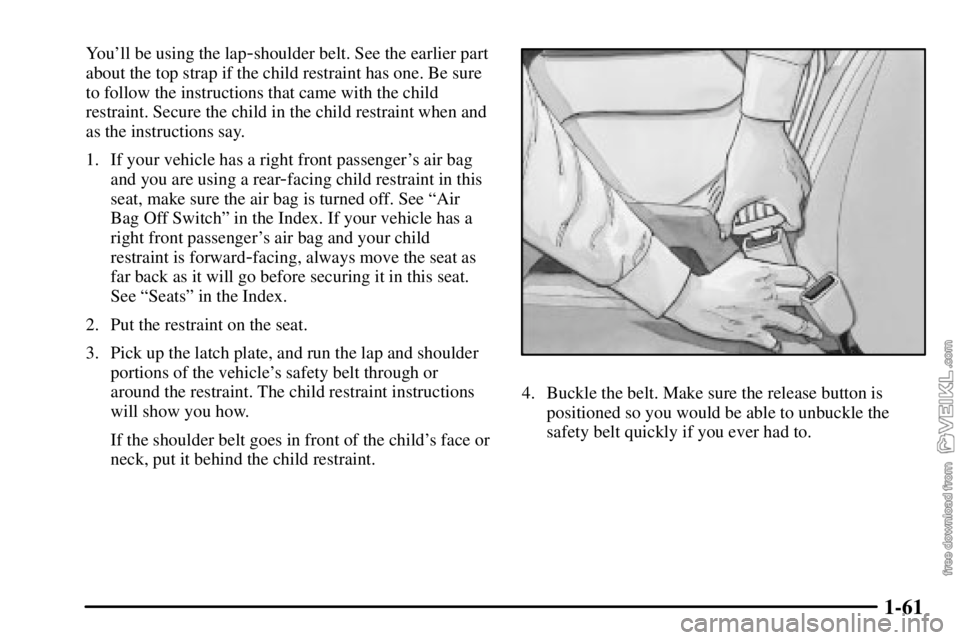
3. Pick up the latch plate, and run the lap and shoulder
portions of the vehicle's safety belt through or
around the restraint. The child restraint instructions
will show you how.
If the shoulder belt goes in front of the child's face or
neck, put it behind the child restraint.
4. Buckle the belt. Make sure the release button is
positioned so you would be able to unbuckle the
safety belt quickly if you ever had to.
Page 69 of 386
1-62
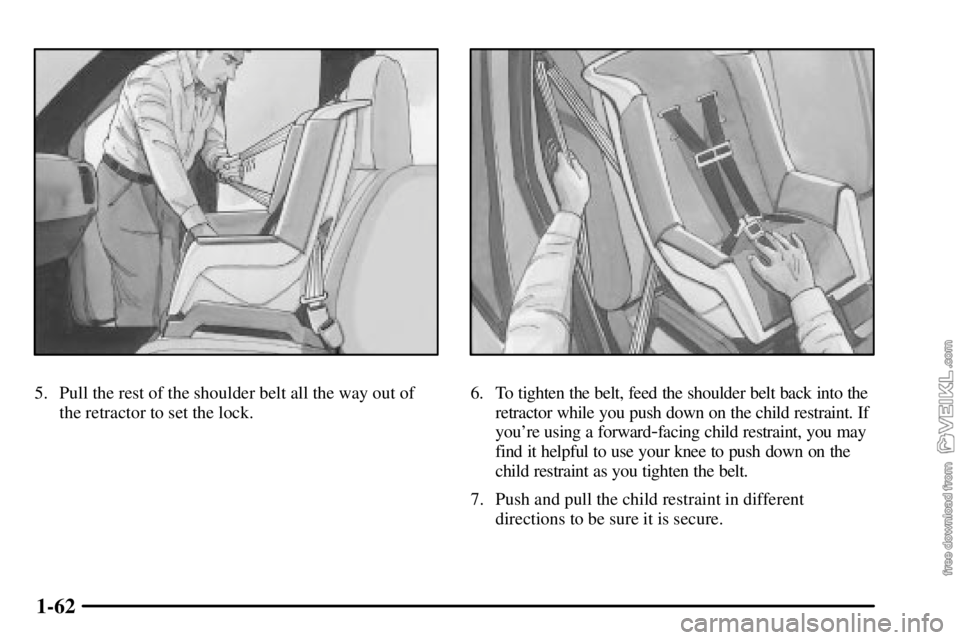
5. Pull the rest of the shoulder belt all the way out of
the retractor to set the lock.6. To tighten the belt, feed the shoulder belt back into the
retractor while you push down on the child restraint. If
you're using a forward
-facing child restraint, you may
find it helpful to use your knee to push down on the
child restraint as you tighten the belt.
7. Push and pull the child restraint in different
directions to be sure it is secure.
Page 86 of 386
2-11
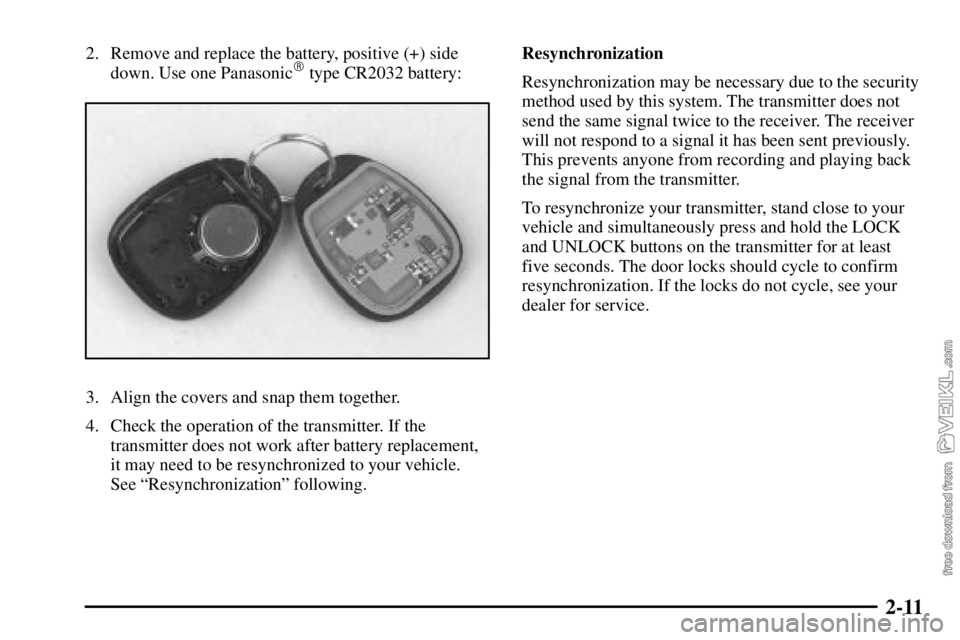
2. Remove and replace the battery, positive (+) side
down. Use one Panasonic� type CR2032 battery:
3. Align the covers and snap them together.
4. Check the operation of the transmitter. If the
transmitter does not work after battery replacement,
it may need to be resynchronized to your vehicle.
See ªResynchronizationº following.Resynchronization
Resynchronization may be necessary due to the security
method used by this system. The transmitter does not
send the same signal twice to the receiver. The receiver
will not respond to a signal it has been sent previously.
This prevents anyone from recording and playing back
the signal from the transmitter.
To resynchronize your transmitter, stand close to your
vehicle and simultaneously press and hold the LOCK
and UNLOCK buttons on the transmitter for at least
five seconds. The door locks should cycle to confirm
resynchronization. If the locks do not cycle, see your
dealer for service.
Page 152 of 386
2-77
CAUTION:
If the right front passenger's air bag is turned off
for a person who isn't in a risk group identified
by the national government, that person won't
have the extra protection of an air bag. In a
crash, the air bag wouldn't be able to inflate and
help protect the person sitting there. Don't turn
off the passenger's air bag unless the person
sitting there is in a risk group. See ªAir Bag Off
Switchº in the Index for more on this, including
important safety information.
CAUTION:
If the air bag readiness light ever comes on when
you have turned off the air bag, it means that
something may be wrong with the air bag system.
The right front passenger's air bag could inflate
even though the switch is off.
If this ever happens, don't let anyone whom the
national government has identified as a member
of a passenger air bag risk group sit in the right
front passenger's position (for example, don't
secure a rear
-facing child restraint in the right
front passenger's seat) until you have your
vehicle serviced.
Page 219 of 386
4-26
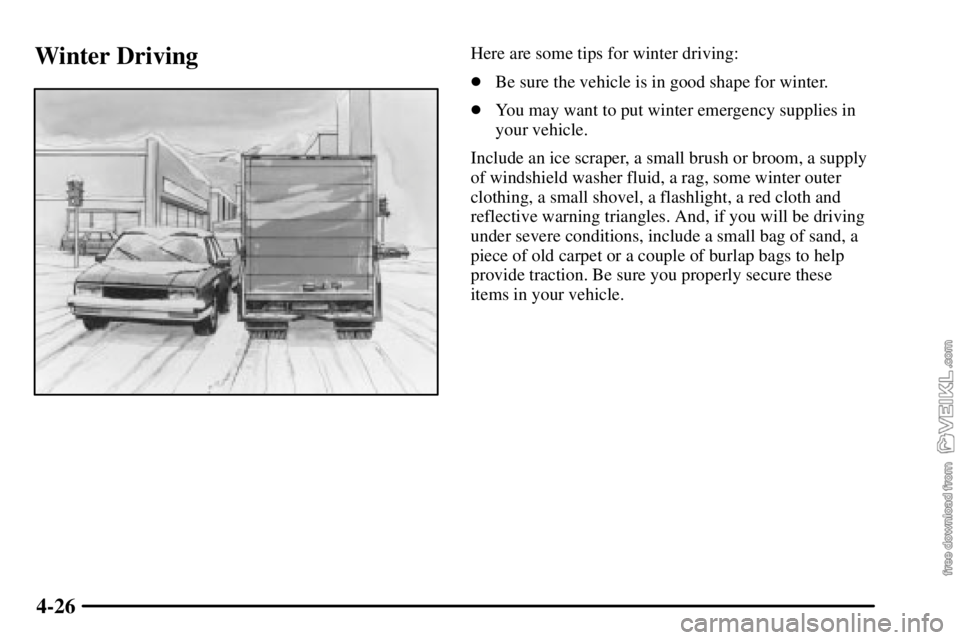
Winter DrivingHere are some tips for winter driving:
�Be sure the vehicle is in good shape for winter.
�You may want to put winter emergency supplies in
your vehicle.
Include an ice scraper, a small brush or broom, a supply
of windshield washer fluid, a rag, some winter outer
clothing, a small shovel, a flashlight, a red cloth and
reflective warning triangles. And, if you will be driving
under severe conditions, include a small bag of sand, a
piece of old carpet or a couple of burlap bags to help
provide traction. Be sure you properly secure these
items in your vehicle.
Page 225 of 386
4-32
If you put things inside your vehicle -- like suitcases,
tools, packages or anything else
-- they will go as fast as
the vehicle goes. If you have to stop or turn quickly, or
if there is a crash, they'll keep going.
CAUTION:
Things you put inside your vehicle can strike
and injure people in a sudden stop or turn, or in
a crash.
�Put things in the cargo area of your vehicle.
Try to spread the weight evenly.
�Never stack heavier things, like suitcases,
inside the vehicle so that some of them are
above the tops of the seats.
�Don't leave an unsecured child restraint in
your vehicle.
�When you carry something inside the
vehicle, secure it whenever you can.
�Don't leave a seat folded down unless you
need to.
Power Take-Off (PTO) Switch
(If Equipped)
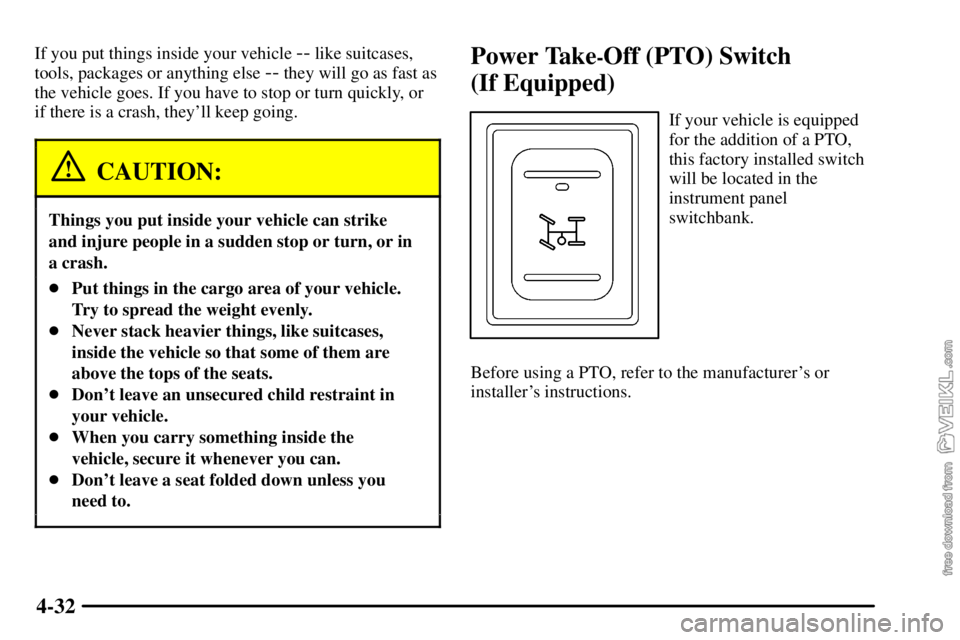
If your vehicle is equipped
for the addition of a PTO,
this factory installed switch
will be located in the
instrument panel
switchbank.
Before using a PTO, refer to the manufacturer's or
installer's instructions.
Page 235 of 386
5-10
Towing Your Vehicle
CAUTION:
To help avoid serious personal injury to you
or others:
�Never let passengers ride in a vehicle that is
being towed.
�Never tow faster than safe or posted speeds.
�Never tow with damaged parts not fully
secured.
�Never get under your vehicle after it has
been lifted by the tow truck.
�Always secure the vehicle on each side with
separate safety chains when towing it.
�Working on air brakes without first using
the release studs to compress the springs
can lead to injury. Never work on the air
brakes chambers without first using the
release studs to compress the brake springs.
CAUTION: (Continued)
CAUTION: (Continued)
�When the brake springs are manually
compressed, you will have no brakes.
Release your air
-operated parking brakes
manually only to tow the vehicle. Never
drive the vehicle with the brakes released.
Consult your dealer or a professional towing service if
you need to have your vehicle towed. They can provide
the right equipment and know
-how to tow it without
damage. See ªRoadside Assistanceº in the Index.
Before you do anything, turn on the hazard warning
flashers (if they have not been damaged).
When you call, tell the towing service:
�That your vehicle has rear
-wheel drive.
�The make, model and year of your vehicle.
�Whether you can still move the shift lever.
�If there was an accident, what was damaged.
When the towing service arrives, let the tow operator
know that this manual contains towing instructions.
The operator may want to see them.