Page 106 of 386
2-31
The accelerator and clutch pedals must be released in
order for the exhaust brake to engage. The exhaust brake
will not function when the cruise control feature is
active, and will automatically shut off when the
anti
-lock brake system is active.
CAUTION:
Be careful when using the exhaust brake or you
could lock the wheels and lose control of the
vehicle. Operators not familiar with an exhaust
brake should not use this brake on slippery
surfaces before learning to use it on dry surfaces.
If the vehicle's wheels begin to lock when using
the exhaust brake on slippery surfaces, switch the
exhaust brake off immediately. The exhaust
brake will turn off if the anti
-lock brake system
is activated.
Tw o-Speed Rear Axle Electric Shift
Control (If Equipped)
If your vehicle is equipped with this feature, you'll find
a label on the headliner above the windshield or in
another place near the driver that shows how to use it.
Be sure to follow the directions carefully.
Use the following directions based on the type of shift
control you have.
Manual Transmission
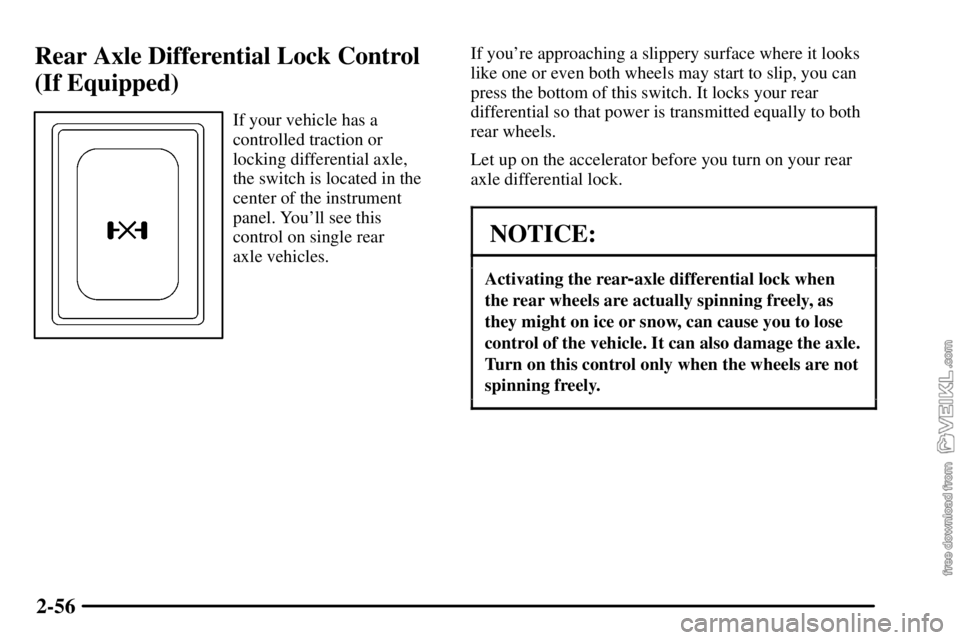
The rear axle shift control
switch for a manual
transmission is located
on the shift lever.
When the switch is up, the rear axle is in the high range.
Push the switch down to change to low range.
Page 122 of 386
2-47
CAUTION:
It can be dangerous to get out of your vehicle
without the parking brake firmly set. Your
vehicle can roll. If you've left the engine running,
the vehicle can move suddenly. You or others
could be injured. To be sure your vehicle won't
move, even when you're on fairly level ground,
always set your parking brake.
Follow the proper steps to be sure your vehicle
won't move.
Horn
Sound the horn by pushing the center of the steering
wheel. If you have the optional air horn, it is controlled
by a cord that you'll find up above and to the left of
the driver. The harder you pull on the cord, the louder
the air horn will sound. The air horn works only after
your air brake system pressure gets up to about
115 psi (790 kPa). The air horn will work properly
unless the the air brake system pressure drops
below 60 psi (415 kPa).
Page 123 of 386
2-48
Tilt Wheel (If Equipped)
A tilt wheel allows you to adjust the steering wheel
before you drive. You can raise it to the highest level
to give your legs more room when you exit and enter
the vehicle.
The lever that allows you to tilt the steering wheel is
located on the left side of the steering column.
To tilt the wheel, hold the wheel and pull the lever. Then
move the wheel to a comfortable position and release
the lever to lock the wheel in place.
Turn Signal/Multifunction Lever
The lever located on the left side of the steering column
includes the following:
�Turn and Lane
-Change Signals
�Headlamp High/Low
-Beam Changer
�Windshield Wipers
�Windshield Washer
�Cruise Control (Option)
Page 127 of 386
2-52
With cruise control, you can maintain a speed of about
30 mph (48 km/h) or more without keeping your foot on
the accelerator. Cruise control does not work at speeds
below about 30 mph (48 km/h).
If you have an automatic transmission and you apply
your brakes, the cruise control will shut off.
If you have a manual transmission and you apply your
brakes or push the clutch pedal, the cruise control will
shut off.
CAUTION:
�Cruise control can be dangerous where you
can't drive safely at a steady speed. So,
don't use your cruise control on winding
roads or in heavy traffic.
�Cruise control can be dangerous on
slippery roads. On such roads, fast changes
in tire traction can cause needless wheel
spinning, and you could lose control. Don't
use cruise control on slippery roads.
Setting Cruise Control
CAUTION:
If you leave your cruise control switch on when
you're not using cruise, you might hit a button
and go into cruise when you don't want to. You
could be startled and even lose control. Keep the
cruise control switch off until you want to use
cruise control.
1. Move the cruise control switch to on.
2. Get up to the speed you want.
3. Press in the set button at the end of the lever and
release it.
4. Take your foot off the accelerator pedal.
The accelerator pedal will not go down.
Page 130 of 386
2-55
Inter-Axle Differential Lock Control
(If Equipped)
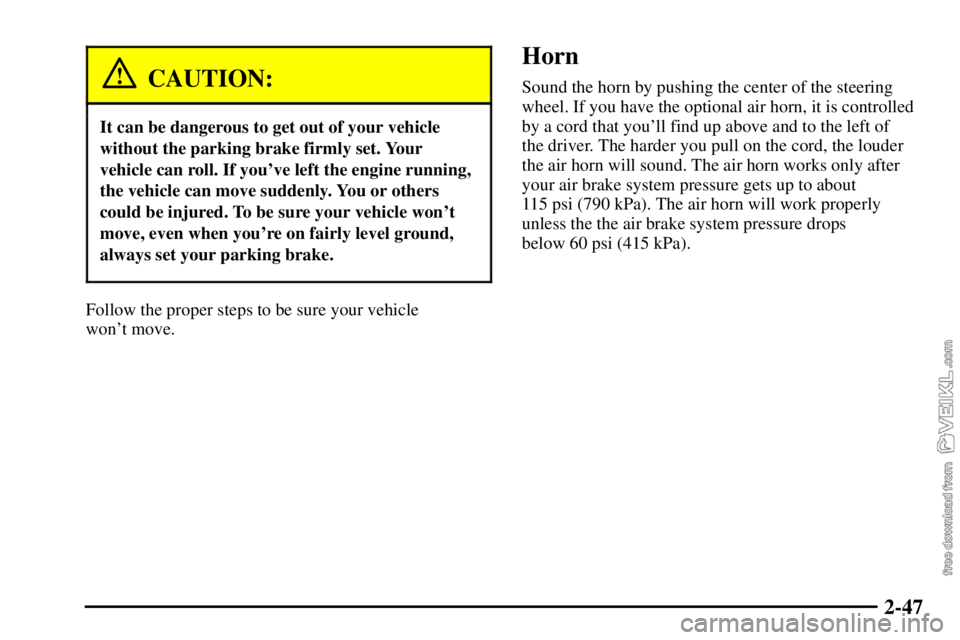
If your vehicle has this
feature, the switch is located
in the center of the
instrument panel.
If you're approaching a slippery surface where it looks
like one or even all of the wheels may start to slip, you
can press the bottom of this switch. It locks your rear
differentials so that power is transmitted equally to both
rear axles.Let up on the accelerator before you turn on your
inter
-axle differential lock. When you turn on this
control, the diff lock indicator on the center of the
instrument panel will light.
NOTICE:
Activating the inter-axle differential lock when
the rear wheels are actually spinning freely, as
they might on ice or snow, can cause you to lose
control of the vehicle. It can also damage the
axles. Turn on this control only when the wheels
are not spinning freely.
Page 131 of 386
2-56
Rear Axle Differential Lock Control
(If Equipped)
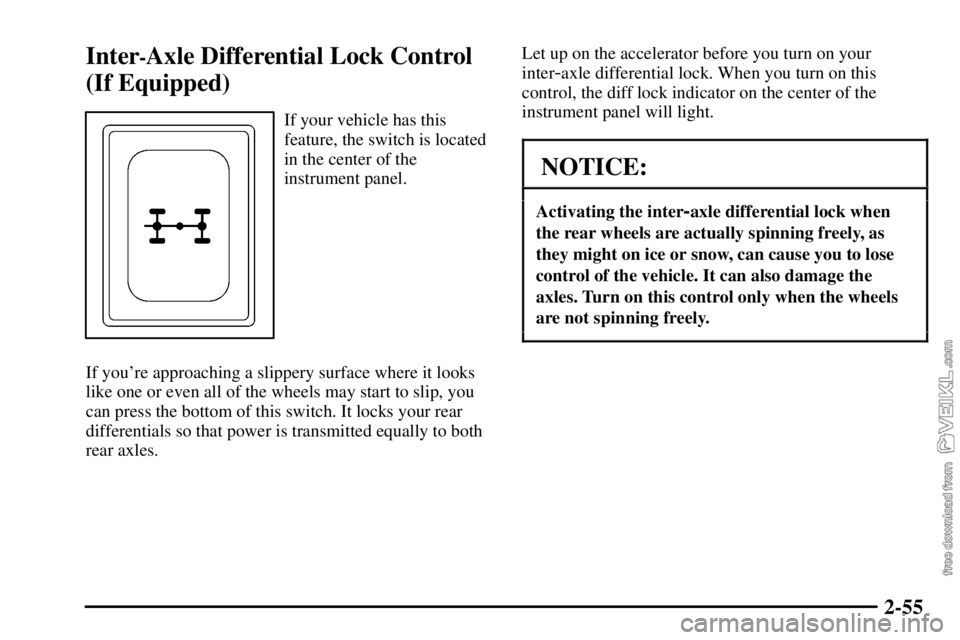
If your vehicle has a
controlled traction or
locking differential axle,
the switch is located in the
center of the instrument
panel. You'll see this
control on single rear
axle vehicles.If you're approaching a slippery surface where it looks
like one or even both wheels may start to slip, you can
press the bottom of this switch. It locks your rear
differential so that power is transmitted equally to both
rear wheels.
Let up on the accelerator before you turn on your rear
axle differential lock.
NOTICE:
Activating the rear-axle differential lock when
the rear wheels are actually spinning freely, as
they might on ice or snow, can cause you to lose
control of the vehicle. It can also damage the axle.
Turn on this control only when the wheels are not
spinning freely.
Page 135 of 386

2-60
Interior Lamps
Instrument Panel Brightness Control
This feature controls the brightness of the instrument
panel lights.
The thumbwheel for this feature is located to the right of
the exterior lamp control.
Turn the thumbwheel up to brighten the lights. When the
thumbwheel is moved to the first position, the radio
display and transmission selection display will go to full
intensity. The instrument panel cluster will also be dimly
lit. Moving the thumbwheel up to the next position will
activate the interior dome lamps.
Dome Lamps
The dome lamps will come on when you open a door.
You can also turn the dome lamps on by moving the
thumbwheel, located to the right of the exterior lamp
control, all the way up to the second position. In this
position, the dome lamps will remain on whether a door
is open or closed.
You can use the dome override button to set the dome
lamps to automatically come on when a door is open, or
to remain off.
The dome override button is located below the exterior
lamp control.
If the dome override button is pushed in, the dome
lamps will not come on. Use this feature when you want
to leave your door(s) open for an extended period of
time and do not want to run the battery down.
If the dome override button is in the out position, the
interior lamps will work as usual.
Page 175 of 386
3-6 Rear Heater (If Equipped)
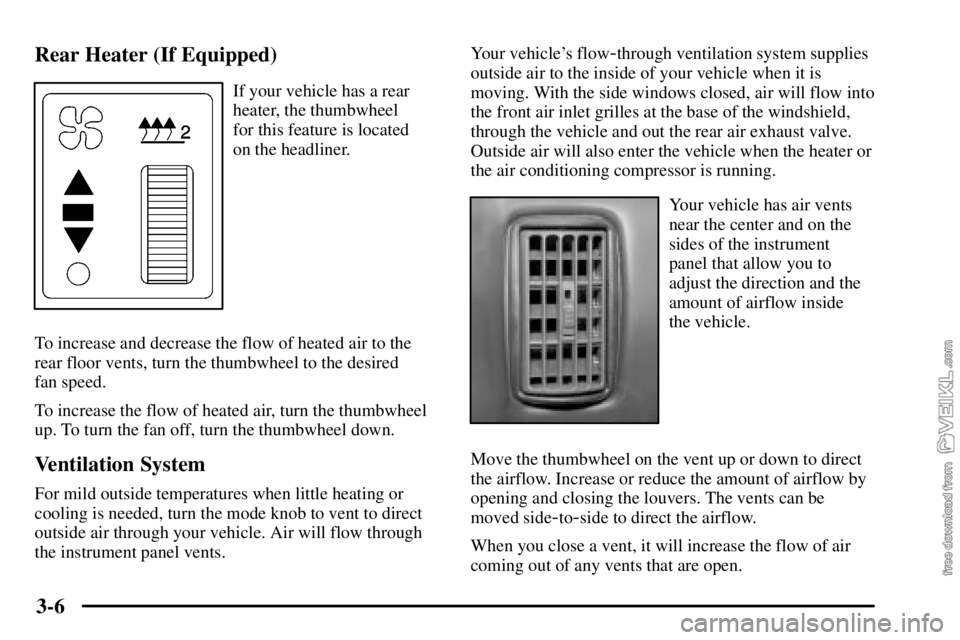
If your vehicle has a rear
heater, the thumbwheel
for this feature is located
on the headliner.
To increase and decrease the flow of heated air to the
rear floor vents, turn the thumbwheel to the desired
fan speed.
To increase the flow of heated air, turn the thumbwheel
up. To turn the fan off, turn the thumbwheel down.
Ventilation System
For mild outside temperatures when little heating or
cooling is needed, turn the mode knob to vent to direct
outside air through your vehicle. Air will flow through
the instrument panel vents.Your vehicle's flow
-through ventilation system supplies
outside air to the inside of your vehicle when it is
moving. With the side windows closed, air will flow into
the front air inlet grilles at the base of the windshield,
through the vehicle and out the rear air exhaust valve.
Outside air will also enter the vehicle when the heater or
the air conditioning compressor is running.
Your vehicle has air vents
near the center and on the
sides of the instrument
panel that allow you to
adjust the direction and the
amount of airflow inside
the vehicle.
Move the thumbwheel on the vent up or down to direct
the airflow. Increase or reduce the amount of airflow by
opening and closing the louvers. The vents can be
moved side
-to-side to direct the airflow.
When you close a vent, it will increase the flow of air
coming out of any vents that are open.