Page 252 of 386
5-27
Changing a Flat Tire
Your truck, when new, did not include tire changing
equipment or a place to store a tire in the vehicle.
Few drivers of these vehicles have the necessary
equipment aboard to be able to change a flat tire safely.
For example, you would need a truck jack that can lift
several thousand pounds and a torque wrench that can
generate several hundred foot
-pounds (Newton-meters)
of twisting force.
CAUTION:
If you try to put air back into a tire that has run
flat, or even a tire that was quite low on air, the
tire can have a sudden air
-out. This could cause
you to lose control of the vehicle and have a
serious crash. Don't refill a flat or very low tire
with air without first having the tire taken off the
wheel and checked for damage.
So if you're stopped somewhere by a flat or damaged
tire or wheel, you should get expert help. See ªRoadside
Assistanceº in the Index.
CAUTION:
Your vehicle, when new, did not include tire
changing equipment or a place to store a tire in
the vehicle. Special tools and procedures are
required if a tire needs to be serviced. If these
tools and procedures aren't used, you or others
could be injured or killed while trying to change
or service a truck tire.
Page 253 of 386
5-28
If You're Stuck: In Sand, Mud, Ice
or Snow
In order to free your vehicle when it is stuck, you will
need to spin the wheels, but you don't want to spin your
wheels too fast. The method known as ªrockingº can
help you get out when you're stuck, but you must
use caution.
CAUTION:
If you let your tires spin at high speed, they can
explode, and you or others could be injured. And,
the transmission or other parts of the vehicle can
overheat. That could cause an engine
compartment fire or other damage. When you're
stuck, spin the wheels as little as possible. Don't
spin the wheels above 35 mph (55 km/h) as shown
on the speedometer.
NOTICE:
Spinning your wheels can destroy parts of your
vehicle as well as the tires. If you spin the wheels
too fast while shifting your transmission back
and forth, you can destroy your transmission.
Rocking Your Vehicle To Get It Out
First, turn your steering wheel left and right. That will
clear the area around your front wheels. If your vehicle
has traction control, you should turn your traction
control system off. See ªTraction Control Systemº in the
Index. Then shift back and forth between REVERSE (R)
and a forward gear (or with a manual transmission,
between FIRST (1) or SECOND (2) and
REVERSE (R)), spinning the wheels as little as
possible. Release the accelerator pedal while you shift,
and press lightly on the accelerator pedal when the
transmission is in gear. By slowly spinning your wheels
in the forward and reverse directions, you will cause a
rocking motion that may free your vehicle. If that
doesn't get you out after a few tries, you may need to be
towed out. If you do need to be towed out, see ªTowing
Your Vehicleº in the Index.
Page 272 of 386
6-18
Checking Things Under the Hood
CAUTION:
Things that burn can get on hot engine parts and
start a fire. These include liquids like fuel, oil,
coolant, brake fluid, windshield washer and other
fluids, and plastic or rubber. You or others could
be burned. Be careful not to drop or spill things
that will burn onto a hot engine.
Hood Latches
To tilt the hood forward, pull back and up on each of the
hood latches, located above the wheel wells on both
sides of the vehicle.
Page 298 of 386
6-44 Four-Wheel Disc Brakes (Hydraulic Only)
Your vehicle has four-wheel disc brakes.
Some driving conditions or climates may cause a brake
squeal when the brakes are first applied or lightly
applied. This does not mean something is wrong with
your brakes.
Brake linings should always be replaced as complete
axle sets.
Four-Wheel and Six-Wheel Drum Brakes
(Air Only)
The brake drums should be removed and inspected each
time the tires are removed for rotation or changing.
When you have the front brakes replaced, have the rear
brakes inspected, too.
Brake linings should always be replaced as complete
axle sets.
Page 303 of 386
6-49
ITEM NO. ITEM REMARKS
1
Brake Camshaft �One fitting each (apply sparingly).
2 Steering Column Slip Joint* One fitting.
3 Steering Drag Link Ends One fitting at each end.
4 Pivot Points and Hinges Apply chassis lubricant
5 Pivot Points and Hinges Apply chassis lubricant.
6
Slack Adjuster �One fitting.
7 Brake Cam Roller Pins at
interface of pin and shoe �Apply engine oil.
8 Front Steering Knuckles
One fitting each side, lower bushing (hand
-operated
grease gun only). Hand
-pack upper bearing.
9 Front Wheel Bearings
Hand
-pack or lubricate.
10 Steering Tie Rod Ends One fitting each end.
11 Spring Slip Pads*
(Multi
-Leaf Only)Apply chassis lubricant.
Page 304 of 386
6-50
ITEM NO. ITEM REMARKS
12 Clutch Release Bearing* Cup or fitting.
13 Battery Terminal
(except ªSTº type)Keep coated with petroleum jelly.
14 Transmission Fill to level of filler plug.
15 Propshaft Slip Joints Lubricate with GM Part No. 1051344
Wheel Bearing Lubricant.
16 Parking Brake Clevis Pins$ Apply chassis lubricant.
17 Parking Brake Lever Pivot*$ Apply chassis lubricant.
18 Clutch Release Cross Shaft,
Master Cylinder$Apply chassis lubricant, Fill to 1/4, (6 mm) below opening.
19 Release Bearing,
Clutch Cross ShaftTwo fittings, Apply chassis lubricant
20 Clutch Release Fork Two fittings.
* Applies to some vehicles.
� Applies to air brakes only.
� Refer to Allison Transmission Operator's Manual.
$ Applies to hydraulic brakes only.
Page 305 of 386
6-51
Tandem Axle Models
ITEM
NO. ITEM REMARKS
1 Brake Camshafts One fitting each.
2
Propshaft U
-JointOne fitting each joint.
Lubricate with
GM Part No. 1051344,
Wheel Bearing Lubricant.
4 Brake Shoe
Roller PinsApply engine oil at pin
to shoe joint only.
5 Rear Spring Pin One fitting each side.
6 Rear Axles Fill to level of filler plug.
Page 311 of 386
6-57 Front Wheel Bearings with Oil-Filled Hubs
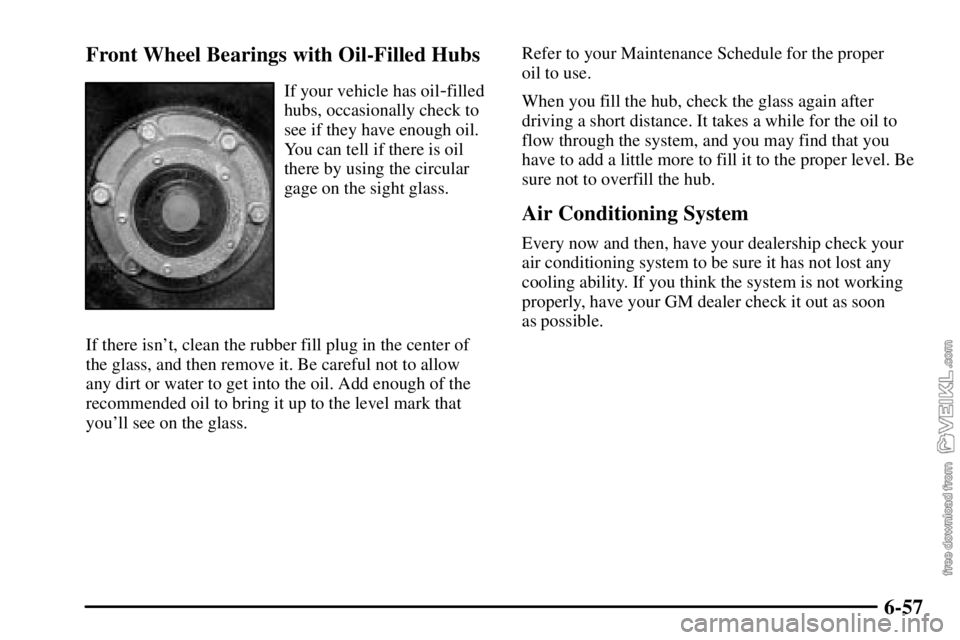
If your vehicle has oil-filled
hubs, occasionally check to
see if they have enough oil.
You can tell if there is oil
there by using the circular
gage on the sight glass.
If there isn't, clean the rubber fill plug in the center of
the glass, and then remove it. Be careful not to allow
any dirt or water to get into the oil. Add enough of the
recommended oil to bring it up to the level mark that
you'll see on the glass.Refer to your Maintenance Schedule for the proper
oil to use.
When you fill the hub, check the glass again after
driving a short distance. It takes a while for the oil to
flow through the system, and you may find that you
have to add a little more to fill it to the proper level. Be
sure not to overfill the hub.
Air Conditioning System
Every now and then, have your dealership check your
air conditioning system to be sure it has not lost any
cooling ability. If you think the system is not working
properly, have your GM dealer check it out as soon
as possible.