2003 CHEVROLET ASTRO towing
[x] Cancel search: towingPage 132 of 386

If a bulb is burned out, replace it to help avoid an
accident.
If the arrows don’t go on at all when you signal
a turn, check for burned-out bulbs and a blown fuse.
See
Fuses and Circuit Breakers on page 5-93.
If you have a trailer towing option with added wiring
for the trailer lamps, a different turn signal flasher
is used. With this flasher installed, the signal indicator
will flash even
if a turn signal bulb is burned out.
Check the front and rear turn signal lamps regularly
to make sure they are working.
Turn Signal On Chime
If your turn signal is left on for more than 3/4 of a mile
(1.2 km), a chime will sound at each flash of the
turn signal. To turn
off the chime, move the turn signal
lever to the center position.
Headlamp High/Low-Beam Changer
To change the headlamps from low beam to high or
high to low, pull the multifunction lever all the way
toward you. Then release it.
When the high beams are
on, this indicator light located on the instrument
panel cluster also will
be on.
Flash-to-Pass
This feature lets you use your high-beam headlamps to
signal a driver in front of you that you want to pass.
It works even
if your headlamps are in automatic.
To use it, pull the turn signal lever toward you, but not
so far that you hear a click.
If your headlamps are in automatic or on low beam,
your high-beam headlamps will turn on. They’ll stay
on
as long as you hold the lever toward you and the
high-beam indicator located on the cluster comes on.
Release the lever to return to normal operation.
3-7
Page 154 of 386
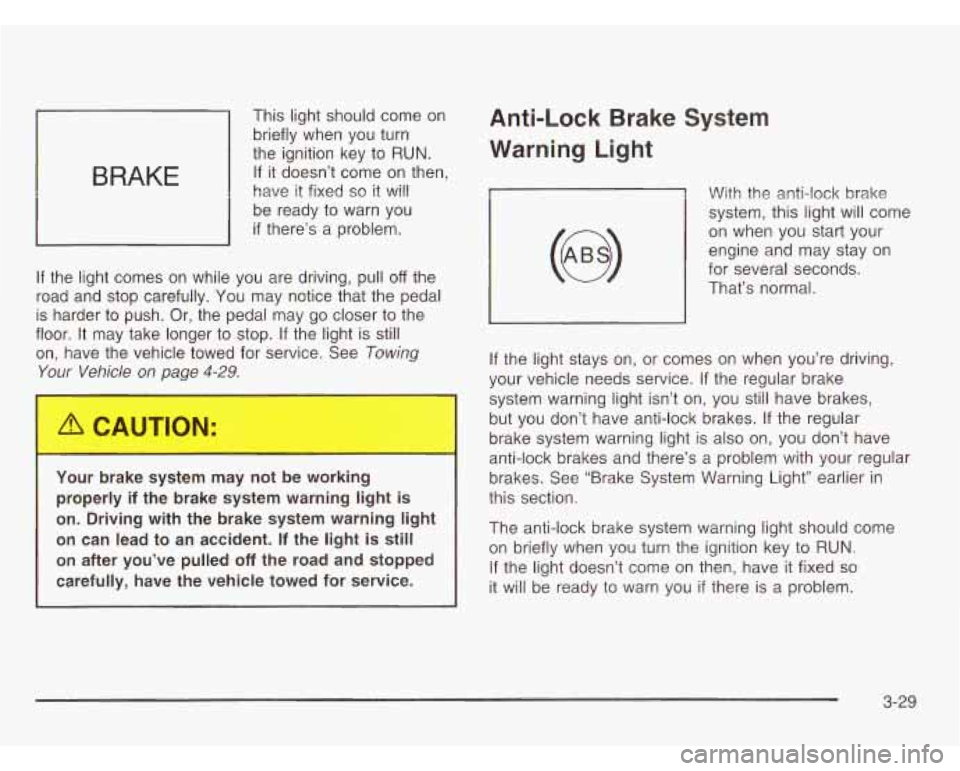
BRAKE
This light should come on
briefly when you turn
the ignition key to
RUN.
If it doesn’t come on then,
have it fixed
so it will
be ready to warn you
if there’s a problem.
If the light comes on while you are driving, pull
off the
road and stop carefully. You may notice that the pedal
is harder to push. Or, the pedal may
go closer to the
floor. It may take longer to stop. If the light is still
on, have the vehicle towed for service. See
Towing
Your Vehicle on page 4-29.
I
You- -)rake system may not be working
properly
if the brake system warning light is
on. Driving with the brake system warning light
on can lead to an accident. If the light is still
on after you’ve pulled off the road and stopped
carefully, have the vehicle towed for service.
Anti-Lock Brake System
Warning light
With the anti-lock brake
system, this light will come
on when you start your
engine and may stay on
for several seconds.
That’s normal.
If the light stays on, or comes on when you’re driving,
your vehicle needs service. If the regular brake
system warning light isn’t on, you still have brakes,
but you don’t have anti-lock brakes. If the regular
brake system warning light is also on, you don’t have
anti-lock brakes and there’s a problem with your regular
brakes. See “Brake System Warning Light” earlier in
this section.
The anti-lock brake system warning light should come
on briefly when you turn the ignition key to
RUN.
If the light doesn’t come on then, have it fixed so
it will be ready to warn you if there is a problem.
3-29
Page 157 of 386
If the Light Is Flashing
The following may prevent more serious damage to
your vehicle:
Reducing vehicle speed.
Avoiding hard accelerations.
Avoiding steep uphill grades.
If you are towing a trailer, reduce the amount of
cargo being hauled as soon as it is possible.
If the light stops flashing and remains on steady,
see
“If the Light Is On Steady” following.
If the light continues to flash, when it is safe to do so,
stop the vehicle. Find a safe place to park your vehicle.
Turn the key off, wait at least
10 seconds and restart
the engine.
If the light remains on steady, see “If the
Light
Is On Steady” following. If the light is still flashing,
follow the previous steps, and drive the vehicle to
your dealer or qualified service center for service.
If the Light Is On Steady
You may be able to correct the emission system
malfunction by considering the following:
Did you recently put fuel into your vehicle?
If so, reinstall the fuel cap, making sure to fully
install the cap. See
Filling Your Tank on page 5-8.
The diagnostic system can determine if the fuel cap has
been left off or improperly installed. A loose or missing
fuel cap will allow fuel to evaporate into the atmosphere.
A few driving trips with the cap properly installed
should turn the light off.
Did you just drive through a deep puddle of water?
If
so, your electrical system may be wet. The condition
will usually be corrected when the electrical system
dries out.
A few driving trips should turn the light off.
Have you recently changed brands of fuel?
If
so, be sure to fuel your vehicle with quality fuel.
See
Gasoline Octane on page 5-5. Poor fuel quality
will cause your engine not to run as efficiently as
designed. You may notice this as stalling after start-up,
stalling when you put the vehicle into gear, misfiring,
hesitation on acceleration or stumbling on acceleration.
(These conditions may go away once the engine is
warmed up.) This will be detected by the system and
cause the light to turn on.
3-32
Page 161 of 386

Tow/HauI Mode Liaht
TOW / HAUL
J
This light should come on
when the tow/haul mode
has been selected.
For more information, see “Tow/Haul Mode” in
Towing a
Trailer on page 4-31.
Check Gages Warning Light
CHECK
GAGES
The CHECK GAGES light
will come on briefly when
you are starting the engine.
Fuel Gage
I
UNLEADED
United States Canada
The
fuel gage tells you approximately how much fuel
you have remaining when the ignition is on.
When the gage first indicates empty, you still have a
little fuel left, but you should get more fuel as soon
as possible.
If the light comes on and stays on while you are driving,
check your coolant temperature and engine oil
pressure gages to see
if they are in the warning zones.
3-36
Page 176 of 386
Section 4 Driving Your Vehicle
Your Driving. the Road. and Your Vehicle .......... 4-2
Defensive Driving
........................................... 4.2
Braking
......................................................... 4-6
Steering
........................................................ 4-9
Off-Road Recovery
....................................... 4-11
Passing
....................................................... 4-12
Loss of Control ............................................. 4-13
Driving at Night
............................................ 4-14
Driving in Rain and on Wet Roads
.................. 4-16
Drunken Driving
............................................. 4-3
Control of a Vehicle
........................................ 4-6
City Driving
.................................................. 4-19 Freeway
Driving
........................................... 4.20
Before Leaving
on a Long Trip ....................... 4.21
Highway Hypnosis ........................................ 4.22
Hill and Mountain Roads
................................ 4-22
Winter Driving
.............................................. 4-24
If You Are Stuck: In Sand, Mud,
Ice or Snow
..... 4.28
Towing ..... 4.29
Towing Your Vehicle
.................................. 4.29
Recreational Vehicle Towing
........................... 4.29
Loading Your Vehicle
.................................... 4.29
Towing
a Trailer ........................................... 4.31
..............................
..............................................
4- 1
Page 203 of 386
If You Are Stuck: In Sand, Mud,
Ice or Snow
In order to free your vehicle when it is stuck, you will
need to spin the wheels, but you don’t want to spin your
wheels too fast. The method known as “rocking” can
help you get out when you’re stuck, but you must
use caution.
If you let your tires spin at high speed, they
can explode, and you or others could be
injured. And, the transmission or other parts of
the vehicle can overheat. That could cause an
engine compartment fire or other damage.
When you’re stuck, spin the wheels as little as
possible. Don’t spin the wheels above
25 mph
(55 km/h) as shown on the speedometer.
Notice: Spinning your wheels can destroy parts of
your vehicle as well as the tires. If you spin the
wheels too fast while shifting your transmission
back and forth, you can destroy your transmission.
For information about using tire chains on your
vehicle, see
Tire Chains on page 5-70.
Rocking Your Vehicle To Get It Out
First, turn your steering wheel left and right. That will
clear the area around your front wheels. Then shift back
and forth between
REVERSE (R) and a forward gear,
spinning the wheels as little as possible. Release
the accelerator pedal while you shift, and press lightly
on the accelerator pedal when the transmission is
in gear. By slowly spinning your wheels in the forward
and reverse directions, you will cause a rocking
motion that may free your vehicle. If that doesn’t get
you out after a few tries, you may need to be towed out.
If you do need to be towed out, see “Towing Your
Vehicle” following.
4-28
Page 204 of 386
Towing Loading Your Vehicle
Towing
Your Vehicle
Consult your dealer or a professional towing service if
you need to have your disabled vehicle towed.
See
Roadside Assistance Program on page 7-6.
If you want to tow your vehicle behind another vehicle
for recreational purposes (such as behind a motorhome),
see “Recreational Vehicle Towing” following.
Recreational Vehicle Towing
Recreational vehicle towing means towing your vehicle
behind another vehicle
- such as behind a motorhome.
The two most common types
of recreational vehicle
towing are known as “dinghy towing” (towing your vehicle
with all four wheels on the ground) and “dolly towing”
(towing your vehicle with two wheels on the ground and
two wheels up on a device known as a “dolly”).
Your vehicle was not designed to be towed with any
of
its wheels on the ground. If your vehicle must be
towed, see
Towing Your Vehicle on page 4-29.
Notice: Towing an all-wheel-drive vehicle with all
four wheels on the ground, or even with only two
of
its wheels on the ground, will damage drivetrain
components. Don’t tow an all-wheel-drive vehicle
if
any of its wheels will be on the ground.
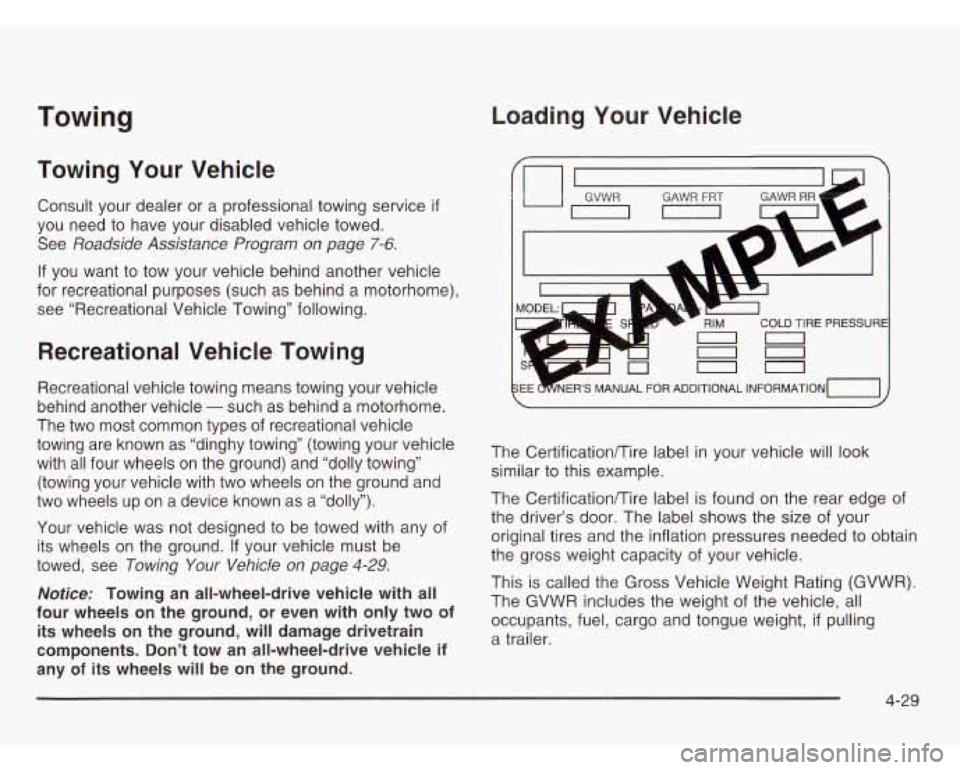
1 I GWVR GAWR FRT GAWR RR 1
COLD TIRE PRESSURI
DO nn
NERS MANUAL FOR ADDITIONAL INFORMATION^ I
The Certificationflire label in your vehicle will look
similar to this example.
The Certificationflire label is found on the rear edge of
the driver’s door. The label shows the size
of your
original tires and the inflation pressures needed to obtain
the gross weight capacity of your vehicle.
This is called the Gross Vehicle Weight Rating (GVWR).
The GVWR includes the weight of the vehicle, all
occupants, fuel, cargo and tongue weight,
if pulling
a trailer.
4-29
Page 206 of 386
Payload
The Payload Capacity is shown on the CertificationiTire
label. This is the maximum load capacity that your
vehicle can carry. Be sure to include the weight of the
people inside as part of your load.
If you added any
accessories or equipment after your vehicle left
the factory, remember to subtract the weight of these
things from the payload. Your dealer can help you
with this.
Towing a Trailer
Trailering Package
There is a load rating which includes the weight of the
vehicle and the trailer it tows. This rating is called
the Gross Combination Weight Rating (GCWR).
When
you weigh your trailer, be sure to include the
weight of everything you put in it. And, remember
to figure the weight of the people inside the vehicle
as part of your load.
Add-on Equipment
When you carry removable items, you may need to put
a limit on how many people you carry inside your
vehicle. Be sure to weigh your vehicle before you buy
and install the new equipment. If
)“J don’t use the correct equipment and
drive properly, you can lose control when you pull a trailer. For example, if the trailer
is too
heavy, the brakes may not work well
- or
even at all. You and your passengers could be
seriously injured. Pull a trailer only if you have
followed all the steps in this section.
Ask your
dealer for advice and information about towing
a trailer with your vehicle.
Notice: Pulling a trailer improperly can damage
your vehicle and result in costly repairs not covered by your warranty.
To pull a trailer correctly, follow
the advice
in this part, and see your dealer for
important information about towing a trailer with
your vehicle. Additional rear axle maintenance is required for a vehicle used to tow a trailer. See
“Scheduled Maintenance Services”
in the Index.
To identify what the vehicle trailering capacity is for your
vehicle, you should read the information in “Weight of
the Trailer” that appears later in this section.
4-3 1