Page 267 of 408
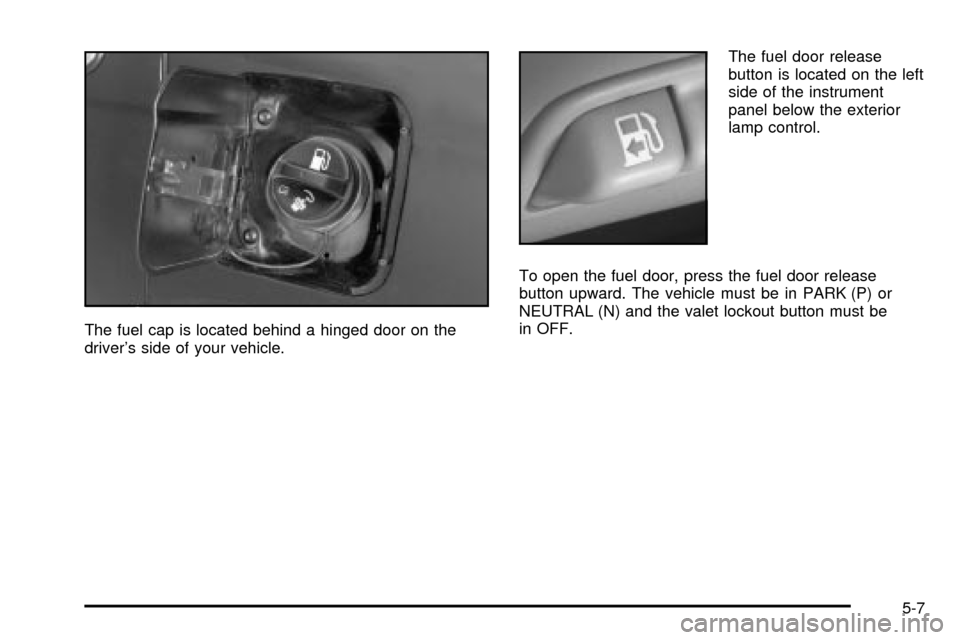
The fuel cap is located behind a hinged door on the
driver's side of your vehicle.The fuel door release
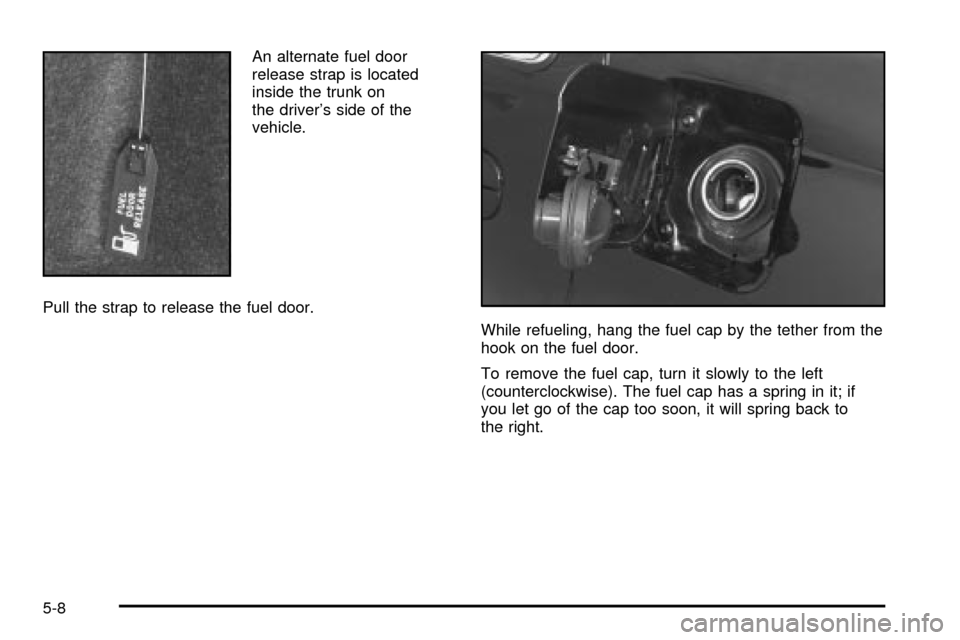
button is located on the left
side of the instrument
panel below the exterior
lamp control.
To open the fuel door, press the fuel door release
button upward. The vehicle must be in PARK (P) or
NEUTRAL (N) and the valet lockout button must be
in OFF.
5-7
Page 268 of 408
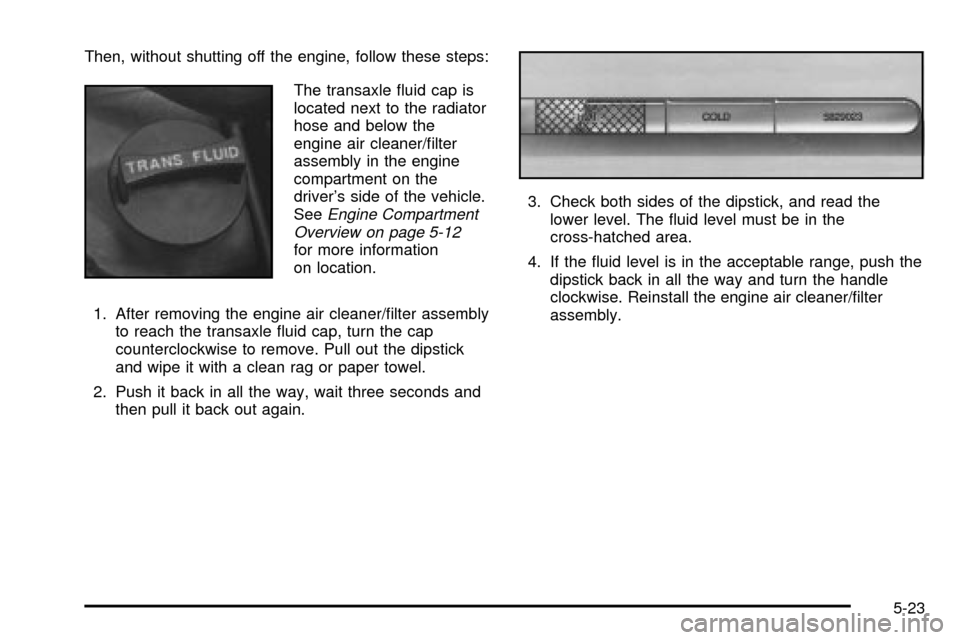
An alternate fuel door
release strap is located
inside the trunk on
the driver's side of the
vehicle.
Pull the strap to release the fuel door.
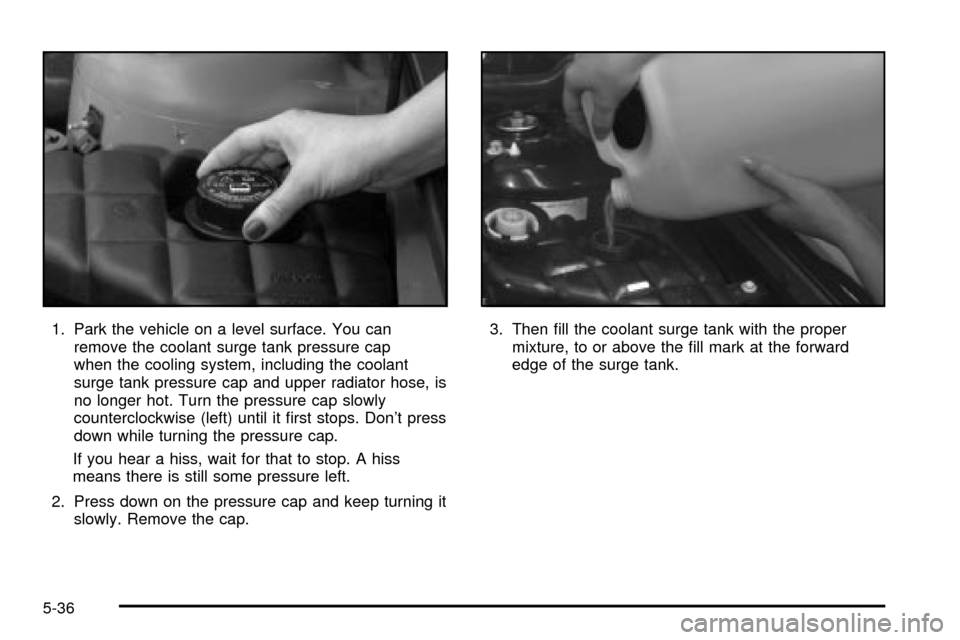
While refueling, hang the fuel cap by the tether from the
hook on the fuel door.
To remove the fuel cap, turn it slowly to the left
(counterclockwise). The fuel cap has a spring in it; if
you let go of the cap too soon, it will spring back to
the right.
5-8
Page 269 of 408

{CAUTION:
If you get fuel on yourself and then something
ignites it, you could be badly burned. Fuel can
spray out on you if you open the fuel cap too
quickly. This spray can happen if your tank is
nearly full, and is more likely in hot weather.
Open the fuel cap slowly and wait for any
ªhissº noise to stop. Then unscrew the cap all
the way.
Be careful not to spill fuel. Clean fuel from painted
surfaces as soon as possible. See
Cleaning the Outside
of Your Vehicle on page 5-86.When you put the fuel cap back on, turn it to the right
(clockwise) until you hear a clicking sound. Make
sure you fully install the cap. The diagnostic system can
determine if the fuel cap has been left off or improperly
installed. This would allow fuel to evaporate into the
atmosphere. See
Malfunction Indicator Lamp on
page 3-47.
The CHECK GAS CAP message in the Driver
Information Center (DIC) will come on if the fuel cap is
not properly reinstalled.
Notice:If you need a new fuel cap, be sure to get
the right type. Your dealer can get one for you.
If you get the wrong type, it may not ®t properly.
This may cause your malfunction indicator lamp to
light and may damage your fuel tank and emissions
system. See ªMalfunction Indicator Lampº in the
Index.
5-9
Page 273 of 408

A. Windshield Washer Fluid Reservoir. SeeWindshield
Washer Fluid on page 5-39.
B. Underhood Fuse Block. See ªUnderhood Fuse
Blockº
Fuses and Circuit Breakers on page 5-93.
C. Power Steering Fluid Reservoir. See
Power Steering
Fluid on page 5-38.
D. Engine Oil Fill Location. See
Engine Oil on
page 5-13.
E. Engine Oil Dipstick. See
Engine Oil on page 5-13.
F. Brake Master Cylinder Reservoir. See
Brakes
on page 5-40.
G. Transaxle Fluid Cap and Dipstick. See
Automatic
Transaxle Fluid on page 5-21.
H. Engine Air Cleaner/Filter. See
Engine Air
Cleaner/Filter on page 5-19.
I. Engine Coolant Surge Tank and Pressure Cap. See
Coolant Surge Tank Pressure Cap on page 5-28andCooling System on page 5-31.
Engine Oil
If the CHECK OIL LEVEL message appears on the
instrument cluster, it means you need to check
your engine oil level right away. For more information,
see ªCHECK OIL LEVELº under
DIC Warnings and
Messages on page 3-56.
You should check your engine oil level regularly; this is
an added reminder.
5-13
Page 275 of 408
When to Add Engine Oil
If the oil is at or below the cross-hatched area at the tip
of the dipstick, then you'll need to add at least one
quart of oil. But you must use the right kind. This part
explains what kind of oil to use. For engine oil crankcase
capacity, see
Capacities and Speci®cations on
page 5-100.
Notice:Don't add too much oil. If your engine has
so much oil that the oil level gets above the
cross-hatched area that shows the proper operating
range, your engine could be damaged.The engine oil ®ll cap is
located behind the radiator
on the passenger's side
of the vehicle. For
more information on
location, see
Engine
Compartment Overview on
page 5-12
.
Turn the cap counterclockwise to remove it.
Be sure to ®ll it enough to put the level somewhere in
the proper operating range in the cross-hatched
area. Push the dipstick all the way back in when you're
through.
5-15
Page 283 of 408
Then, without shutting off the engine, follow these steps:
The transaxle ¯uid cap is
located next to the radiator
hose and below the
engine air cleaner/®lter
assembly in the engine
compartment on the
driver's side of the vehicle.
See
Engine Compartment
Overview on page 5-12
for more information
on location.
1. After removing the engine air cleaner/®lter assembly
to reach the transaxle ¯uid cap, turn the cap
counterclockwise to remove. Pull out the dipstick
and wipe it with a clean rag or paper towel.
2. Push it back in all the way, wait three seconds and
then pull it back out again.3. Check both sides of the dipstick, and read the
lower level. The ¯uid level must be in the
cross-hatched area.
4. If the ¯uid level is in the acceptable range, push the
dipstick back in all the way and turn the handle
clockwise. Reinstall the engine air cleaner/®lter
assembly.
5-23
Page 284 of 408

How to Add Fluid
Refer to the Maintenance Schedule to determine what
kind of transaxle ¯uid to use. SeePart D:
Recommended Fluids and Lubricants on page 6-15.
If the ¯uid level is low, add only enough of the proper
¯uid to bring the level into the cross-hatched area on the
dipstick.
1. Pull out the dipstick.
2. Using a long-neck funnel, add enough ¯uid at the
dipstick hole to bring it to the proper level.
It doesn't take much ¯uid, generally less than one
pint (0.5 L). Don't over®ll.
Notice:We recommend you use only ¯uid labeled
DEXRONž±III, because ¯uid with that label is
made especially for your automatic transaxle.
Damage caused by ¯uid other than DEXRON
ž±III is
not covered by your new vehicle warranty.
3. After adding ¯uid, recheck the ¯uid level as
described under
How to Check.
4. When the correct ¯uid level is obtained, push the
dipstick back in all the way and turn the handle
clockwise. Reinstall the engine air cleaner/®lter
assembly.
How to Reset the Transaxle Fluid
Change Indicator
Once the transaxle ¯uid has been changed, the
transaxle ¯uid change indicator must be reset. Use the
following steps to reset the indicator:
1. Press the INFO button on the Driver Information
Center (DIC) until TRANS FLUID LIFE is displayed.
2. Press and hold the INFO RESET button until 100%
is displayed.
The indicator is now reset. The percentage of transaxle
¯uid life remaining may be checked at any time by
pressing the INFO button several times until the TRANS
FLUID LIFE message appears.
5-24
Page 296 of 408
1. Park the vehicle on a level surface. You can
remove the coolant surge tank pressure cap
when the cooling system, including the coolant
surge tank pressure cap and upper radiator hose, is
no longer hot. Turn the pressure cap slowly
counterclockwise (left) until it ®rst stops. Don't press
down while turning the pressure cap.
If you hear a hiss, wait for that to stop. A hiss
means there is still some pressure left.
2. Press down on the pressure cap and keep turning it
slowly. Remove the cap.3. Then ®ll the coolant surge tank with the proper
mixture, to or above the ®ll mark at the forward
edge of the surge tank.
5-36