Page 298 of 408
Power Steering Fluid
The power steering ¯uid reservoir is located next to the
underhood fuse block on the passenger's side of the
vehicle. See
Engine Compartment Overview on
page 5-12for more information on location.
When to Check Power Steering Fluid
It is not necessary to regularly check power steering ¯uid
unless you suspect there is a leak in the system or
you hear an unusual noise. A ¯uid loss in this system
could indicate a problem. Have the system inspected
and repaired.
How to Check Power Steering Fluid
Turn the key off, let the engine compartment cool down,
wipe the cap and the top of the reservoir clean, then
unscrew the cap and wipe the dipstick with a clean rag.
Replace the cap and completely tighten it. Then
remove the cap again and look at the ¯uid level on the
dipstick.
The level should be at the FULL COLD mark. If
necessary, add only enough ¯uid to bring the level up to
the mark.
What to Use
To determine what kind of ¯uid to use, seePart D:
Recommended Fluids and Lubricants on page 6-15.
Always use the proper ¯uid. Failure to use the proper
¯uid can cause leaks and damage hoses and seals.
5-38
Page 299 of 408

Windshield Washer Fluid
What to Use
When you need windshield washer ¯uid, be sure to read
the manufacturer's instructions before use. If you will
be operating your vehicle in an area where the
temperature may fall below freezing, use a ¯uid that has
sufficient protection against freezing.
Adding Washer Fluid
When your vehicle's windshield washer ¯uid level
becomes low, a CHECK WASHER FLUID message will
appear on the Driver Information Center (DIC). You
will need to add ¯uid soon.
The windshield washer
¯uid reservoir is located
next to the underhood fuse
block on the passenger's
side of the vehicle.
See
Engine Compartment Overview on page 5-12for
reservoir location.
Open the cap with the washer symbol on it. Add washer
¯uid until the tank is full.
Notice:
·When using concentrated washer ¯uid,
follow the manufacturer's instructions for
adding water.
·Don't mix water with ready-to-use washer ¯uid.
Water can cause the solution to freeze and
damage your washer ¯uid tank and other parts
of the washer system. Also, water doesn't
clean as well as washer ¯uid.
·Fill your washer ¯uid tank only three-quarters
full when it's very cold. This allows for
expansion if freezing occurs, which could
damage the tank if it is completely full.
·Don't use engine coolant (antifreeze) in your
windshield washer. It can damage your
washer system and paint.
5-39
Page 306 of 408
4. Open the hoods and locate the positive (+) and
negative (-) terminal locations on the other
vehicle. Your vehicle has a remote (+) jump starting
terminal and a remote negative (-) jump starting
terminal. You should always use these remote
terminals instead of the terminals on the battery.
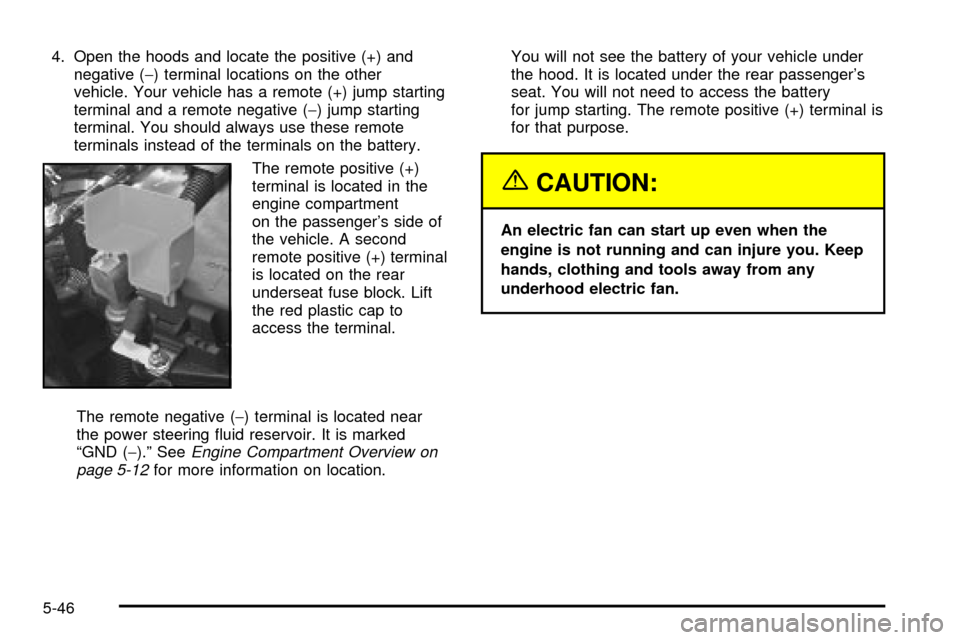
The remote positive (+)
terminal is located in the
engine compartment
on the passenger's side of
the vehicle. A second
remote positive (+) terminal
is located on the rear
underseat fuse block. Lift
the red plastic cap to
access the terminal.
The remote negative (-) terminal is located near
the power steering ¯uid reservoir. It is marked
ªGND (-).º See
Engine Compartment Overview on
page 5-12for more information on location.You will not see the battery of your vehicle under
the hood. It is located under the rear passenger's
seat. You will not need to access the battery
for jump starting. The remote positive (+) terminal is
for that purpose.
{CAUTION:
An electric fan can start up even when the
engine is not running and can injure you. Keep
hands, clothing and tools away from any
underhood electric fan.
5-46
Page 317 of 408
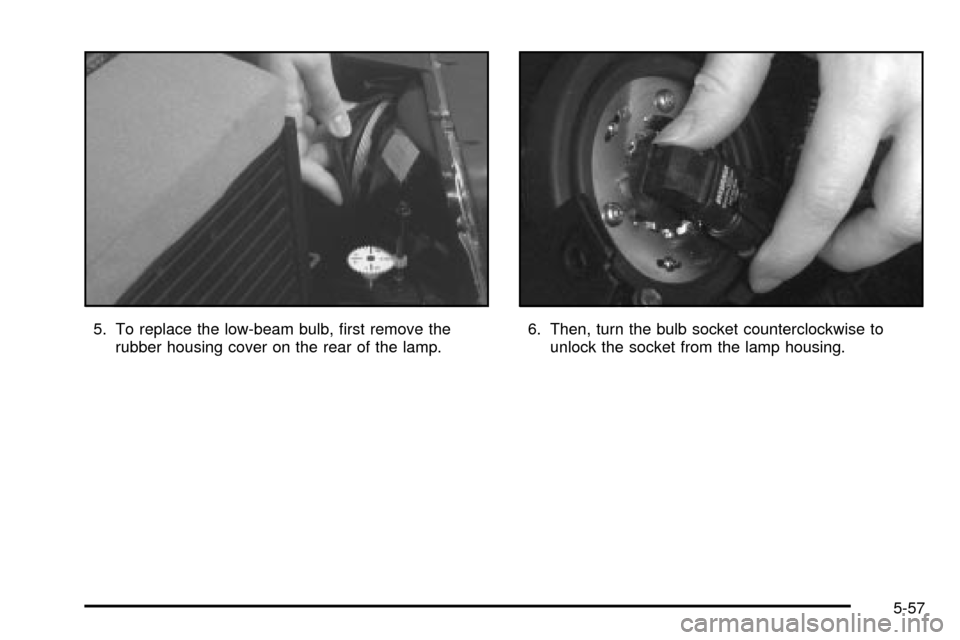
5. To replace the low-beam bulb, ®rst remove the
rubber housing cover on the rear of the lamp.6. Then, turn the bulb socket counterclockwise to
unlock the socket from the lamp housing.
5-57
Page 319 of 408
9. After reinstalling the bulb and socket, reinstall the
rubber cover. Make sure it fully covers the
headlamp socket.
10. To replace the high-beam bulb, turn the bulb socket
counterclockwise to unlock the socket from the
lamp housing. Follow the instructions in
Step 6 through 8 to install the new bulb.
11. Reinstall the upper ®ller panel by inserting the
grommets, along with the screws, back into
the holes.Front Turn Signal Lamps
1. The turn signal lamps are located on the outboard
side of the headlamps. To access, remove the
headlamp. See Steps 1, 2, 3, and 10 under
Headlamps on page 5-56.
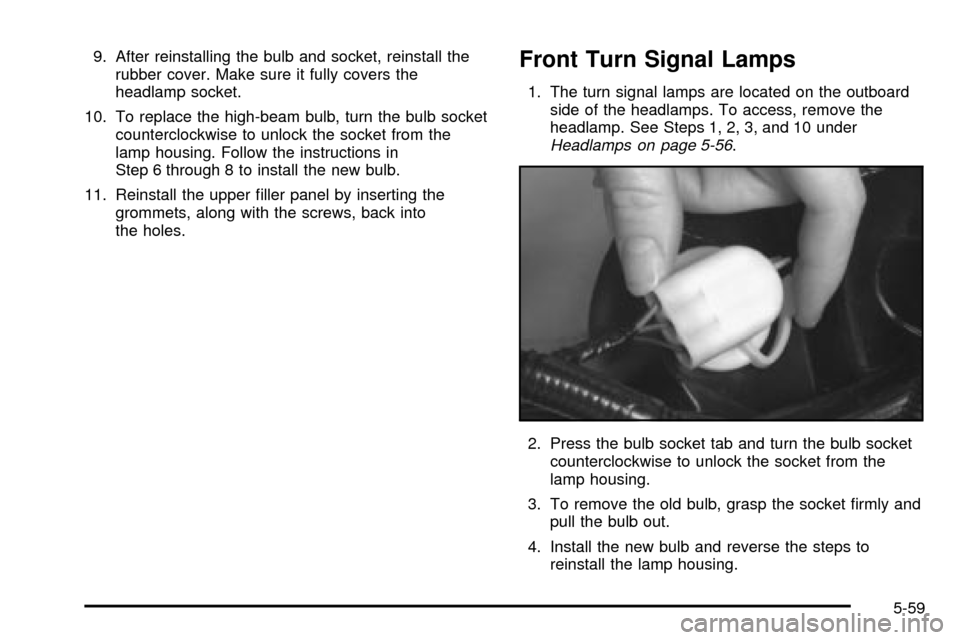
2. Press the bulb socket tab and turn the bulb socket
counterclockwise to unlock the socket from the
lamp housing.
3. To remove the old bulb, grasp the socket ®rmly and
pull the bulb out.
4. Install the new bulb and reverse the steps to
reinstall the lamp housing.
5-59
Page 321 of 408
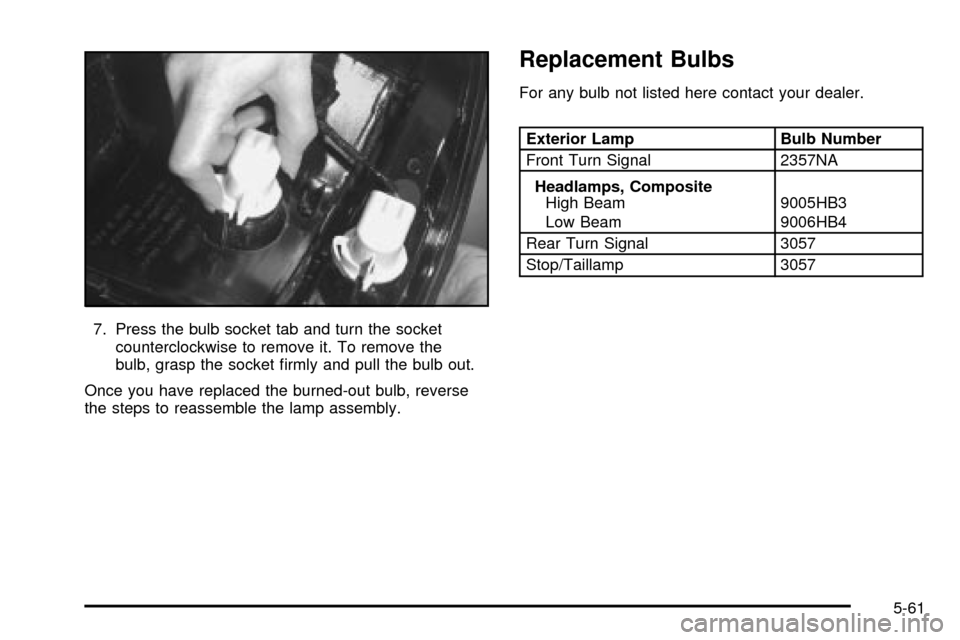
7. Press the bulb socket tab and turn the socket
counterclockwise to remove it. To remove the
bulb, grasp the socket ®rmly and pull the bulb out.
Once you have replaced the burned-out bulb, reverse
the steps to reassemble the lamp assembly.
Replacement Bulbs
For any bulb not listed here contact your dealer.
Exterior Lamp Bulb Number
Front Turn Signal 2357NA
Headlamps, Composite
High Beam
Low Beam9005HB3
9006HB4
Rear Turn Signal 3057
Stop/Taillamp 3057
5-61
Page 322 of 408
Windshield Wiper Blade
Replacement
Windshield wiper blades should be inspected at least
twice a year for wear or cracking. SeeWiper Blade
CheckunderAt Least Twice a Year on page 6-10for
more information.
It's a good idea to clean or replace the wiper blade
assembly on a regular basis or when worn. For proper
windshield wiper blade length and type, see
Normal
Maintenance Replacement Parts on page 5-101.To replace the wiper blade assembly do the following:
1. Lift the wiper up from the windshield and set into the
vertically-locked position.
2. Press the tab that holds the wiper blade to the arm.
3. Slide the blade down and off the arm.
4. Slide in the new blade and snap into place.
5-62
Page 334 of 408
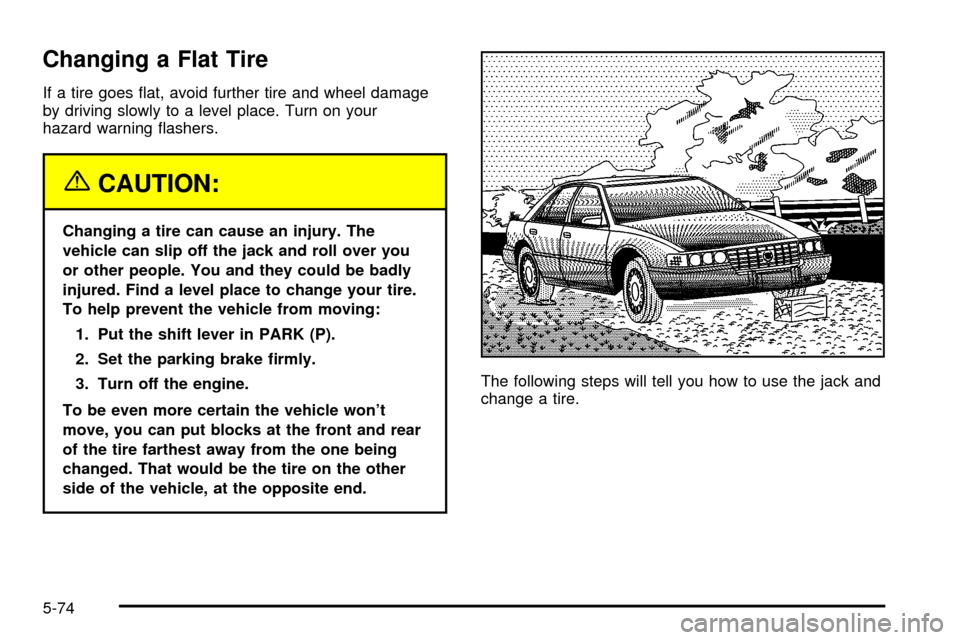
Changing a Flat Tire
If a tire goes ¯at, avoid further tire and wheel damage
by driving slowly to a level place. Turn on your
hazard warning ¯ashers.
{CAUTION:
Changing a tire can cause an injury. The
vehicle can slip off the jack and roll over you
or other people. You and they could be badly
injured. Find a level place to change your tire.
To help prevent the vehicle from moving:
1. Put the shift lever in PARK (P).
2. Set the parking brake ®rmly.
3. Turn off the engine.
To be even more certain the vehicle won't
move, you can put blocks at the front and rear
of the tire farthest away from the one being
changed. That would be the tire on the other
side of the vehicle, at the opposite end.The following steps will tell you how to use the jack and
change a tire.
5-74