2003 BMW M5 SEDAN service
[x] Cancel search: servicePage 109 of 155
109n
OverviewControlsMaintenanceRepairsDataIndex
Information for your safetyThe factory-approved radial tires are
matched to the vehicle and have been
selected to provide optimum safety and
driving comfort on your vehicle.
It is not merely the tire's service life,
but also driving comfort and Ð above
all else Ð driving safety that depend on
the condition of the tires and the main-
tenance of the specified tire inflation
pressure.
Incorrect inflation pressures are
a frequent cause of tire problems
and flat tires. Tire pressure also has a
major effect on your BMW's handling
response. Check tire inflation pressures
on a regular basis (refer to page 22), at
least every two weeks and before every
long trip. If you fail to observe these
precautions, incorrect tire pressures
can cause driving instability and tire
damage, ultimately resulting in an
accident.<
Tire tread Ð tire damageInspect your tires frequently for tread
wear, signs of damage and for foreign
objects lodged in the tread. Check the
tread depth.
The tread depth should not drop
below 0.12 in (3 mm), even though, for
example the legally specified minimum
tread depth in Europe is only 0.063 in
(1.6 mm). Below a tread depth of
0.12 in (3 mm) there is an increased risk
of hydroplaning, even at relatively mod-
erate speeds and with only small
amounts of water on the road.
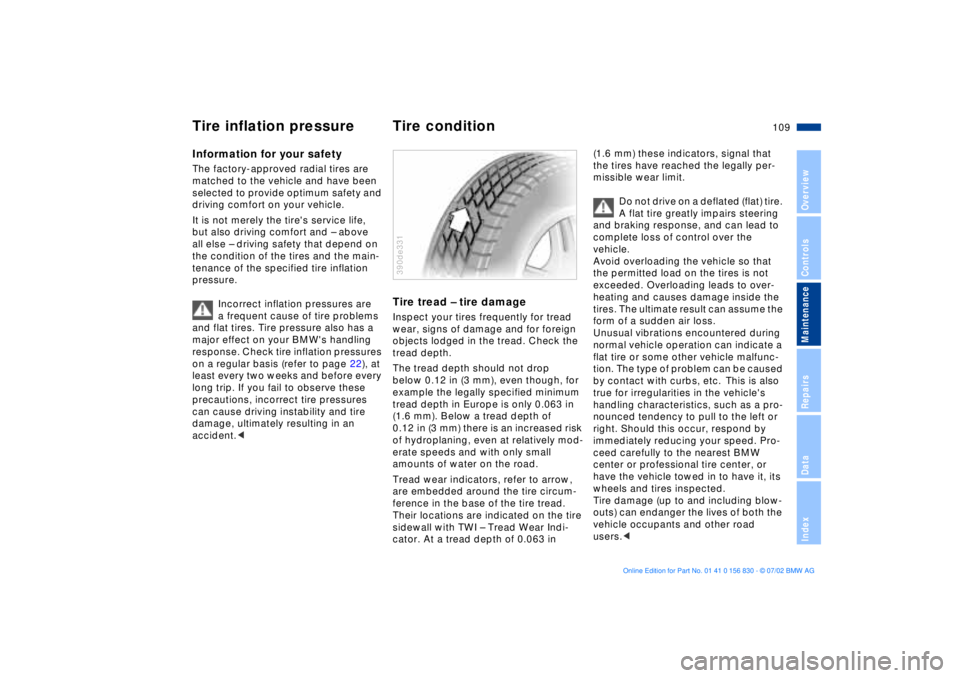
Tread wear indicators, refer to arrow,
are embedded around the tire circum-
ference in the base of the tire tread.
Their locations are indicated on the tire
sidewall with TWI Ð Tread Wear Indi-
cator. At a tread depth of 0.063 in 390de331
(1.6 mm) these indicators, signal that
the tires have reached the legally per-
missible wear limit.
Do not drive on a deflated (flat) tire.
A flat tire greatly impairs steering
and braking response, and can lead to
complete loss of control over the
vehicle.
Avoid overloading the vehicle so that
the permitted load on the tires is not
exceeded. Overloading leads to over-
heating and causes damage inside the
tires. The ultimate result can assume the
form of a sudden air loss.
Unusual vibrations encountered during
normal vehicle operation can indicate a
flat tire or some other vehicle malfunc-
tion. The type of problem can be caused
by contact with curbs, etc. This is also
true for irregularities in the vehicle's
handling characteristics, such as a pro-
nounced tendency to pull to the left or
right. Should this occur, respond by
immediately reducing your speed. Pro-
ceed carefully to the nearest BMW
center or professional tire center, or
have the vehicle towed in to have it, its
wheels and tires inspected.
Tire damage (up to and including blow-
outs) can endanger the lives of both the
vehicle occupants and other road
users.<
Tire inflation pressure Tire condition
Page 110 of 155

110n
Tire replacementTo maintain good handling and vehicle
response, use only tires of a single
tread configuration from a single manu-
facturer. BMW tests wheel and tire
combinations and approves them.DOT Quality GradesTreadwear
Traction AA A B C
Temperature A B C
All passenger car tires must con-
form to Federal Safety Require-
ments in addition to these grades.
when tested under controlled condi-
tions on a specified government test
course.
For example, a tire graded 150 would
wear one and one-half (1g) times as
well on the government course as a tire
graded 100. The relative performance
of tires depends upon the actual condi-
tions of their use, however, and may
depart significantly from the norm due
to variations in driving habits, service
practices and differences in road char-
acteristics and climate.
TractionThe traction grades, from highest to
lowest, are AA, A, B and C.
Those grades represent the tire's ability
to stop on wet pavement as measured
under controlled conditions on speci-
fied government test surfaces of
asphalt and concrete. A tire marked C
may have poor traction performance.
The traction grade assigned to
this tire is based on straight-
ahead braking traction tests, and does
not include acceleration, cornering,
hydroplaning, or peak traction charac-
teristics.
tire's resistance to the generation of
heat and its ability to dissipate heat
when tested under controlled condi-
tions on a specified indoor laboratory
test wheel.
Sustained high temperature can cause
the material of the tire to degenerate
and reduce tire life, and excessive tem-
perature can lead to a sudden flat tire.
The grade C corresponds to a level of
performance which all passenger car
tires must meet under the Federal
Motor Car Safety Standard No. 109.
Grades B and A represent higher levels
of performance on the laboratory test
wheel than the minimum required by
law.
The temperature grade for this tire
is established for a tire that is
properly inflated and not overloaded.
Excessive speed, underinflation, or
excessive loading, either separately or
in combination, can cause heat buildup
and possible tire failure.
tread shoulder and maximum section
width. For example:
Treadwear 200
Traction AA
Temperature A
Page 111 of 155

111n
OverviewControlsMaintenanceRepairsDataIndex
Tire replacement Wheel and tire combinations
Do not use retreaded tires, since
driving safety may be impaired.
This is due to the possible variations in
casing structures and, in some cases,
to their extreme age, which can lead to
a decrease in their durability.<
Tire ageThe date on which the tire was manu-
factured is indicated by the code on the
sidewall:
DOT ... 3401 indicates that the tire was
manufactured in week 34 of the year
2001.
Although tires may have a theoretical
service life of up to 10 years, BMW
strongly recommends that you replace
all tires after an absolute maximum of
6 years.
The right choice
Never mount wheels and tires that
have not been specifically
approved by BMW for use on your par-
ticular model. Although other wheels
and tires may theoretically have the
same dimensions, variations in factors
such as manufacturing tolerances can
result in contact between tire and body-
work, ultimately leading to serious acci-
dents. If non-approved wheels and tires
are used, BMW cannot evaluate their
suitability, and therefore cannot be held
liable for driving safety.<
BMW has tested certain tires for each
tire size, rated them according to road
safety and approved them. Your BMW
center can inform you which tires have
been tested in this way. Observe pos-
sible national guidelines, e.g. regarding
entry into vehicle documents.
Because various systems on your
vehicle, such as ABS, DSC and
the Flat Tire Monitor, rely on the correct
combination of tires and wheels for
optimal operation, their operation may
be adversely affected if other tires and/
or wheels are mounted .
You should therefore ensure that tires
from a single manufacturer with the
same tread pattern are mounted at all
four wheels. After installing a spare tire
in response to a flat tire you should
always ensure that a tire of the original
specifications is remounted as soon as
possible.<
The use of rims and wheel bolts
that do not meet the specifica-
tions of the original factory-installed
equipment will affect the safe operation
of your vehicle and may cause an acci-
dent and personal injury.
Never mix tires of different design, such
as steel-belted radials with radial bias-
belted or bias-ply tires, etc. Mixing tire
types will adversely affect roadholding and can lead to loss of vehicle control.
possible. Protect the tires against con-
tact with oil, grease and fuel.
Page 112 of 155

112n
Special characteristics of winter tires Snow chains
*
Choosing the right tireBMW recommends winter tires (M+S
radial tires) for driving in adverse winter
road conditions. While "all-season"
tires (M+S designation) provide better
winter traction than summer tires with
the load ratings H, V, W, Y and ZR, they
generally do not achieve the perfor-
mance of winter tires.
In the interests of safe tracking and
steering response, install radial tires
made by the same manufacturer and
with the same tread configuration on all
four wheels if you elect to mount winter
tires.
Never exceed the maximum speed
approved for your speciÞc winter
tires.
Unprofessional attempts by laymen to
service tires can lead to damage and
accidents.
Have this work performed by skilled
professionals only. Any BMW center
has the required technical knowledge
and the proper equipment and will be
happy to assist you.<
Tire condition, tire inflation
pressureWhen the tread wears to a depth of less
than 0.16 in (4 mm) there is a substan-
tial reduction in the tire's ability to pro-
vide adequate traction under winter
driving conditions. To ensure continued
safety, tires with this amount of tread
wear should always be replaced.
Comply with the specified tire inflation
pressures Ð and be sure to have the
wheel and tire assemblies balanced
every time you change the wheels/tires.The use of BMW narrow-link snow
chains on winter tires is approved only
in pairs and only on the rear wheels.
Comply with all manufacturer's safety
precautions when mounting the chains.
Do not exceed a speed of 30 mph
(50 km/h) while driving with mounted
snow chains.
It is not possible to mount snow
chains with 18-inch wheels and
tires.<
Page 113 of 155
113n
OverviewControlsMaintenanceRepairsDataIndex
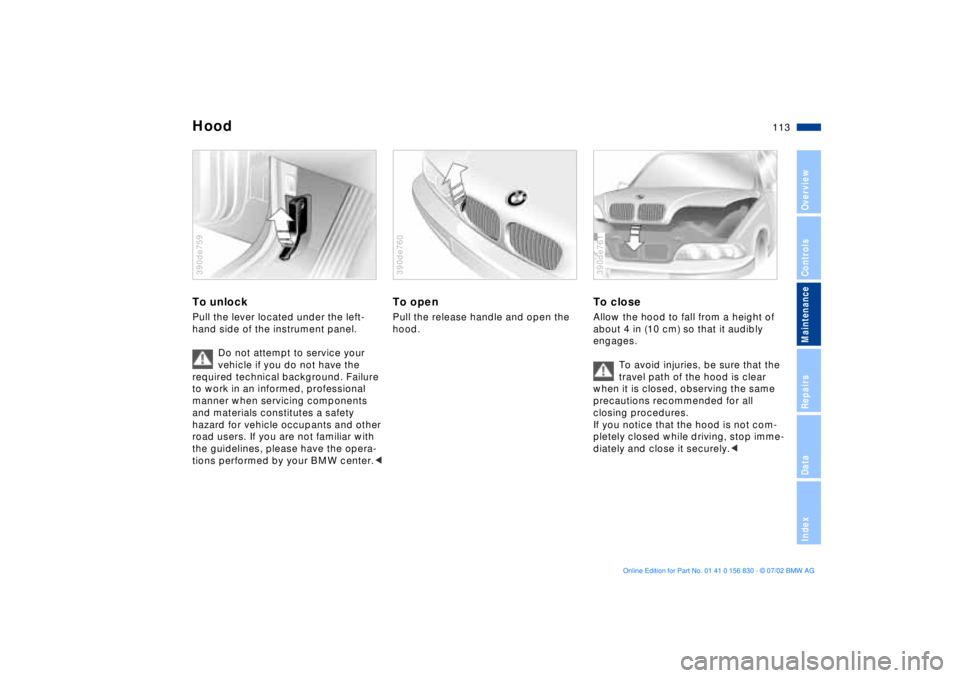
To unlockPull the lever located under the left-
hand side of the instrument panel.
Do not attempt to service your
vehicle if you do not have the
required technical background. Failure
to work in an informed, professional
manner when servicing components
and materials constitutes a safety
hazard for vehicle occupants and other
road users. If you are not familiar with
the guidelines, please have the opera-
tions performed by your BMW center.<390de759
To openPull the release handle and open the
hood. 390de760
To closeAllow the hood to fall from a height of
about 4 in (10 cm) so that it audibly
engages.
To avoid injuries, be sure that the
travel path of the hood is clear
when it is closed, observing the same
precautions recommended for all
closing procedures.
If you notice that the hood is not com-
pletely closed while driving, stop imme-
diately and close it securely.<390de761
Hood
Page 117 of 155

117n
OverviewControlsMaintenanceRepairsDataIndex
Engine oil CoolantSpecified engine oils The quality of the engine oil is
extremely important for the function
and service life of an engine. Based on
extensive testing, BMW approves only
certain grades of engine oil.
Use only approved "BMW High Perfor-
mance Synthetic Oil."
If you are unable to obtain "BMW High
Performance Synthetic Oil," you can
add small amounts of synthetic oil in
between oil changes. Only use oils with
the API SH specification or higher.
Ask your BMW center for details
concerning the specific "BMW
High Performance Synthetic Oil" or
"special oils" which have been
approved.<
You can also call BMW of North
America at 1-800-831-1117 or visit this
website: www.bmwusa.com to obtain
this information.
Viscosity ratings Viscosity is the oil flow rating as estab-
lished in SAE classes.
The selection of the correct SAE class
depends on the climatic conditions in
the area where you typically drive your
BMW.
Approved oils are in SAE classes
5W-40 and 5W-30.<
These oils may be used for driving in all
ambient temperatures.
Do not add coolant to the cooling
system when the engine is hot.
If you attempt to do so, escaping
coolant can cause scalds. To avoid the
possibility of secondary damage, never
use anything other than factory-
approved, nitrite and amino-free
extended-duty antifreeze with corrosion
inhibitor. Your BMW center is familiar
with these specifications.
Antifreeze and anti-corrosion agents
are hazardous to health. You should
always store them in their original con-
tainers and in a location which is out of
reach of children. For this reason, do
not spill antifreeze with corrosion inhib-
itor on hot engine parts. It could ignite
and cause burns.<
Page 118 of 155
118n
Coolant Brake fluidChecking coolant level and
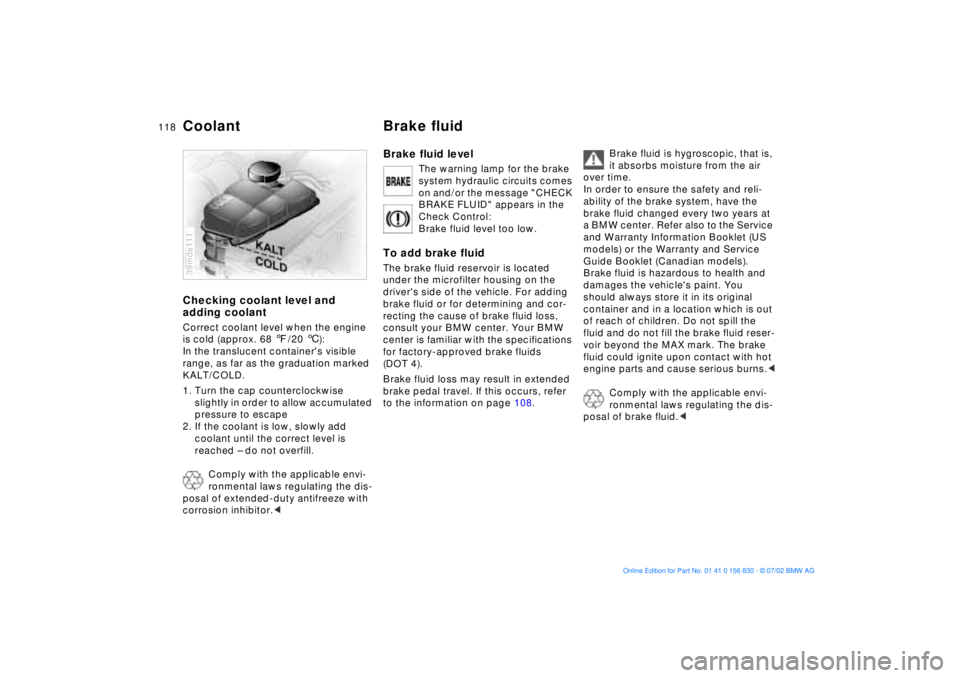
adding coolantCorrect coolant level when the engine
is cold (approx. 68 7/20 6):
In the translucent container's visible
range, as far as the graduation marked
KALT/COLD.
1. Turn the cap counterclockwise
slightly in order to allow accumulated
pressure to escape
2. If the coolant is low, slowly add
coolant until the correct level is
reached Ð do not overfill.
Comply with the applicable envi-
ronmental laws regulating the dis-
posal of extended-duty antifreeze with
corrosion inhibitor.<39mde111
Brake fluid level
The warning lamp for the brake
system hydraulic circuits comes
on and/or the message "CHECK
BRAKE FLUID" appears in the
Check Control:
Brake fluid level too low.
To add brake fluidThe brake fluid reservoir is located
under the microfilter housing on the
driver's side of the vehicle. For adding
brake fluid or for determining and cor-
recting the cause of brake fluid loss,
consult your BMW center. Your BMW
center is familiar with the specifications
for factory-approved brake fluids
(DOT 4).
Brake fluid loss may result in extended
brake pedal travel. If this occurs, refer
to the information on page 108.
Brake fluid is hygroscopic, that is,
it absorbs moisture from the air
over time.
In order to ensure the safety and reli-
ability of the brake system, have the
brake fluid changed every two years at
a BMW center. Refer also to the Service
and Warranty Information Booklet (US
models) or the Warranty and Service
Guide Booklet (Canadian models).
Brake fluid is hazardous to health and
damages the vehicle's paint. You
should always store it in its original
container and in a location which is out
of reach of children. Do not spill the
fluid and do not fill the brake fluid reser-
voir beyond the MAX mark. The brake
fluid could ignite upon contact with hot
engine parts and cause serious burns.<
Comply with the applicable envi-
ronmental laws regulating the dis-
posal of brake fluid.<
Page 119 of 155
119n
OverviewControlsMaintenanceRepairsDataIndex
The BMW Maintenance System has
been designed as a reliable means of
providing maximum driving and oper-
ating safety Ð and as cost-effectively as
possible for you.
Please keep in mind that regular main-
tenance is not only necessary for the
safety of your vehicle, but also plays a
significant role in maintaining its resale
value. 380us008
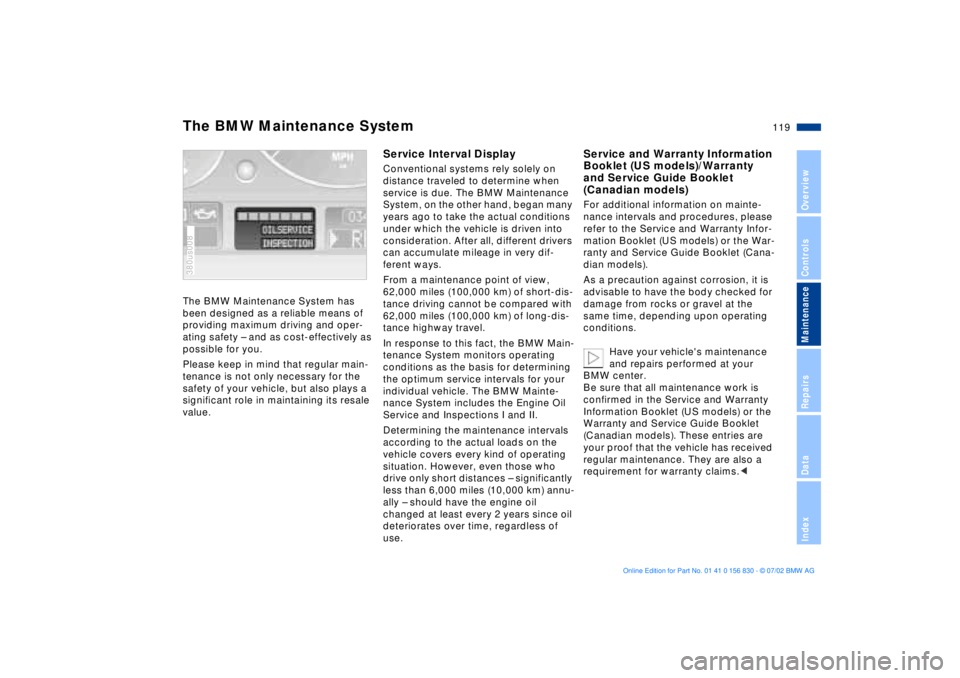
Service Interval DisplayConventional systems rely solely on
distance traveled to determine when
service is due. The BMW Maintenance
System, on the other hand, began many
years ago to take the actual conditions
under which the vehicle is driven into
consideration. After all, different drivers
can accumulate mileage in very dif-
ferent ways.
From a maintenance point of view,
62,000 miles (100,000 km) of short-dis-
tance driving cannot be compared with
62,000 miles (100,000 km) of long-dis-
tance highway travel.
In response to this fact, the BMW Main-
tenance System monitors operating
conditions as the basis for determining
the optimum service intervals for your
individual vehicle. The BMW Mainte-
nance System includes the Engine Oil
Service and Inspections I and II.
Determining the maintenance intervals
according to the actual loads on the
vehicle covers every kind of operating
situation. However, even those who
drive only short distances Ð significantly
less than 6,000 miles (10,000 km) annu-
ally Ð should have the engine oil
changed at least every 2 years since oil
deteriorates over time, regardless of
use.
Service and Warranty Information
Booklet (US models)/Warranty
and Service Guide Booklet
(Canadian models)For additional information on mainte-
nance intervals and procedures, please
refer to the Service and Warranty Infor-
mation Booklet (US models) or the War-
ranty and Service Guide Booklet (Cana-
dian models).
As a precaution against corrosion, it is
advisable to have the body checked for
damage from rocks or gravel at the
same time, depending upon operating
conditions.
Have your vehicle's maintenance
and repairs performed at your
BMW center.
Be sure that all maintenance work is
confirmed in the Service and Warranty
Information Booklet (US models) or the
Warranty and Service Guide Booklet
(Canadian models). These entries are
your proof that the vehicle has received
regular maintenance. They are also a
requirement for warranty claims.<
The BMW Maintenance System