2003 BMW M5 SEDAN service
[x] Cancel search: servicePage 17 of 155
17n
OverviewControlsMaintenanceRepairsDataIndex
Indicator and warning lamps
Red: an important reminder
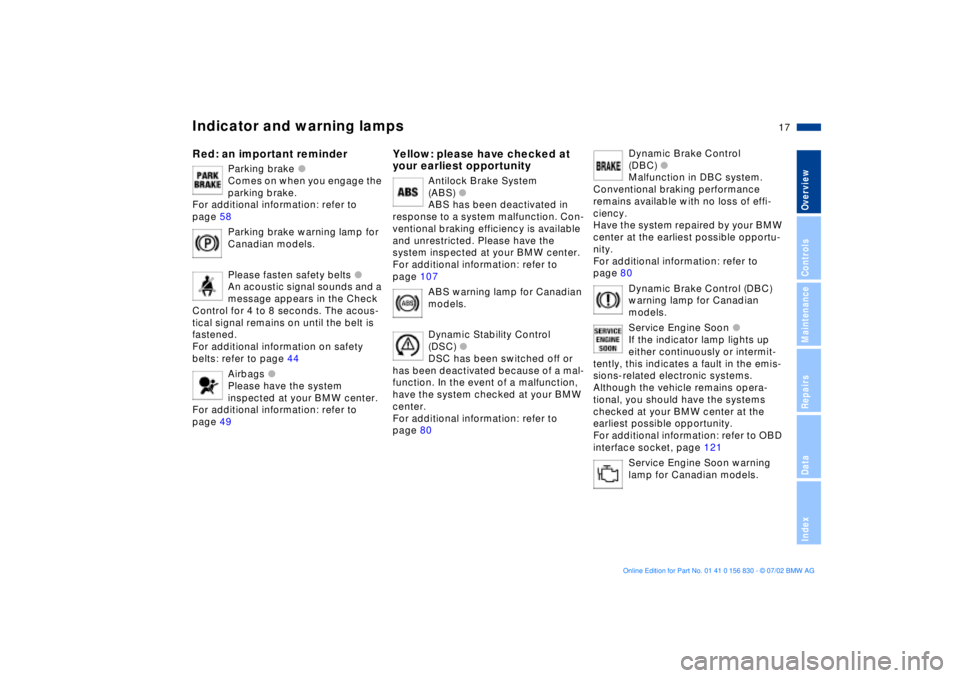
Parking brake
l
Comes on when you engage the
parking brake.
For additional information: refer to
page 58
Parking brake warning lamp for
Canadian models.
Please fasten safety belts
l
An acoustic signal sounds and a
message appears in the Check
Control for 4 to 8 seconds. The acous-
tical signal remains on until the belt is
fastened.
For additional information on safety
belts: refer to page 44
Airbags
l
Please have the system
inspected at your BMW center.
For additional information: refer to
page 49
Yellow: please have checked at
your earliest opportunity
Antilock Brake System
(ABS)
l
ABS has been deactivated in
response to a system malfunction. Con-
ventional braking efficiency is available
and unrestricted. Please have the
system inspected at your BMW center.
For additional information: refer to
page 107
ABS warning lamp for Canadian
models.
Dynamic Stability Control
(DSC)
l
DSC has been switched off or
has been deactivated because of a mal-
function. In the event of a malfunction,
have the system checked at your BMW
center.
For additional information: refer to
page 80
Dynamic Brake Control
(DBC)
l
Malfunction in DBC system.
Conventional braking performance
remains available with no loss of effi-
ciency.
Have the system repaired by your BMW
center at the earliest possible opportu-
nity.
For additional information: refer to
page 80
Dynamic Brake Control (DBC)
warning lamp for Canadian
models.
Service Engine Soon
l
If the indicator lamp lights up
either continuously or intermit-
tently, this indicates a fault in the emis-
sions-related electronic systems.
Although the vehicle remains opera-
tional, you should have the systems
checked at your BMW center at the
earliest possible opportunity.
For additional information: refer to OBD
interface socket, page 121
Service Engine Soon warning
lamp for Canadian models.
Page 20 of 155
20n
Warning triangle
*
First-aid kit
*
Refueling
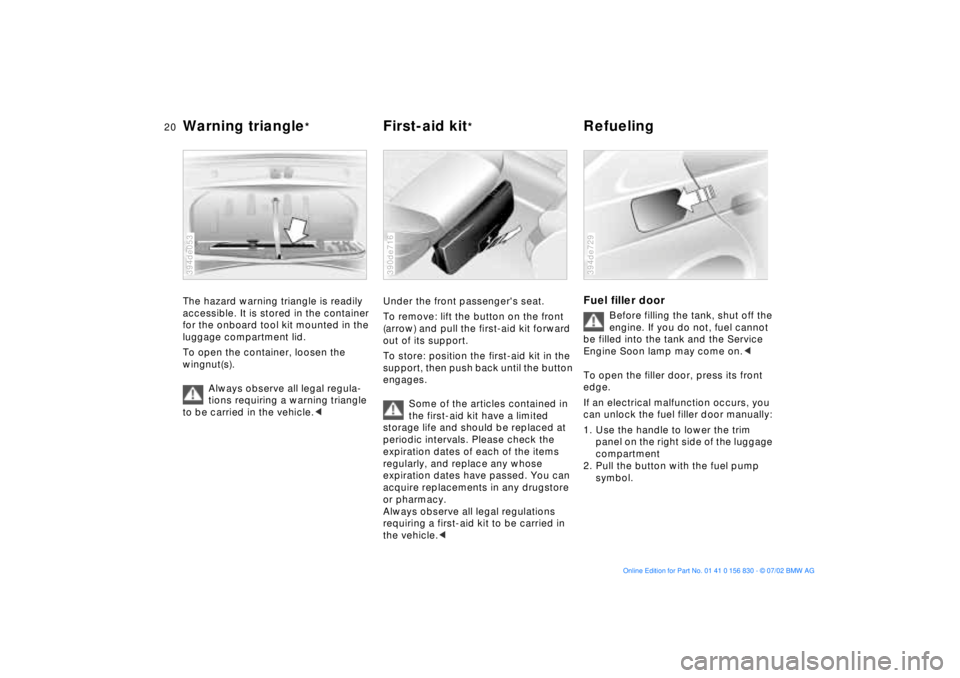
The hazard warning triangle is readily
accessible. It is stored in the container
for the onboard tool kit mounted in the
luggage compartment lid.
To open the container, loosen the
wingnut(s).
Always observe all legal regula-
tions requiring a warning triangle
to be carried in the vehicle.
<
394de053
Under the front passenger's seat.
To remove: lift the button on the front
(arrow) and pull the first-aid kit forward
out of its support.
To store: position the first-aid kit in the
support, then push back until the button
engages.
Some of the articles contained in
the first-aid kit have a limited
storage life and should be replaced at
periodic intervals. Please check the
expiration dates of each of the items
regularly, and replace any whose
expiration dates have passed. You can
acquire replacements in any drugstore
or pharmacy.
Always observe all legal regulations
requiring a first-aid kit to be carried in
the vehicle.< 390de716
Fuel filler door
Before filling the tank, shut off the
engine. If you do not, fuel cannot
be filled into the tank and the Service
Engine Soon lamp may come on.<
To open the filler door, press its front
edge.
If an electrical malfunction occurs, you
can unlock the fuel filler door manually:
1. Use the handle to lower the trim
panel on the right side of the luggage
compartment
2. Pull the button with the fuel pump
symbol.
394de729
Page 21 of 155
21n
OverviewControlsMaintenanceRepairsDataIndex
Refueling
Always observe all safety notices
posted at the service station when
refueling. Never carry spare fuel con-
tainers in your vehicle. Whether empty
or full, these containers can leak, cause
an explosion, or lead to fire in the event
of a collision.<
Simple and environmentally
friendly
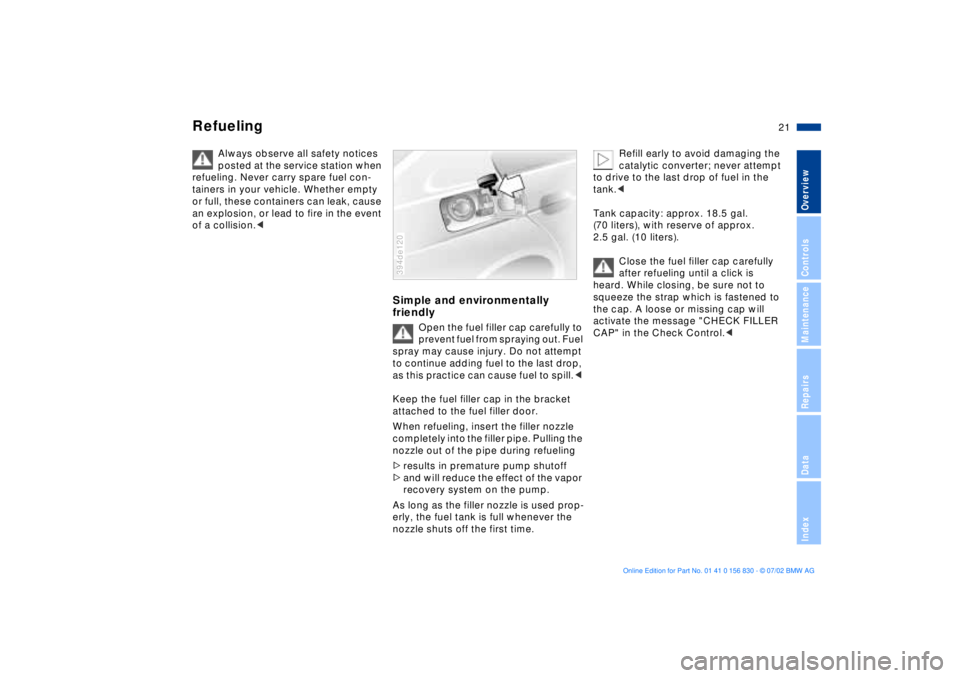
Open the fuel filler cap carefully to
prevent fuel from spraying out. Fuel
spray may cause injury. Do not attempt
to continue adding fuel to the last drop,
as this practice can cause fuel to spill.<
Keep the fuel filler cap in the bracket
attached to the fuel filler door.
When refueling, insert the filler nozzle
completely into the filler pipe. Pulling the
nozzle out of the pipe during refueling
>results in premature pump shutoff
>and will reduce the effect of the vapor
recovery system on the pump.
As long as the filler nozzle is used prop-
erly, the fuel tank is full whenever the
nozzle shuts off the first time.
394de120
Refill early to avoid damaging the
catalytic converter; never attempt
to drive to the last drop of fuel in the
tank.<
Tank capacity: approx. 18.5 gal.
(70 liters), with reserve of approx.
2.5 gal. (10 liters).
Close the fuel filler cap carefully
after refueling until a click is
heard. While closing, be sure not to
squeeze the strap which is fastened to
the cap. A loose or missing cap will
activate the message "CHECK FILLER
CAP" in the Check Control.<
Page 25 of 155
25n
OverviewControlsMaintenanceRepairsDataIndex
Overview
Controls and features
Operation, maintenance
Owner service procedures
Index Technical data
Page 49 of 155
49n
OverviewControlsMaintenanceRepairsDataIndex
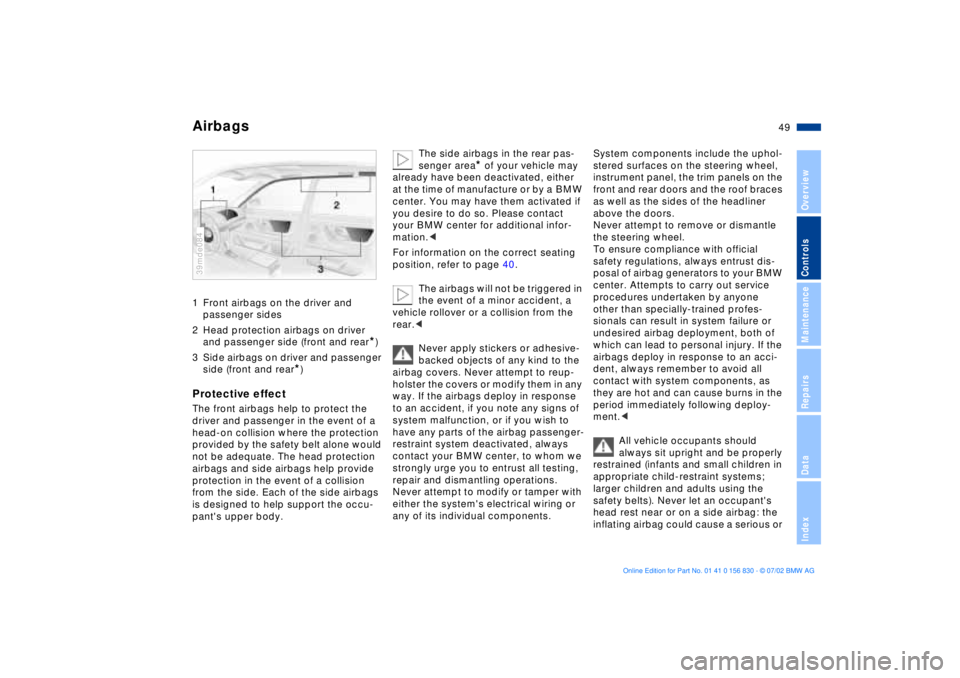
Airbags1 Front airbags on the driver and
passenger sides
2 Head protection airbags on driver
and passenger side (front and rear
*)
3 Side airbags on driver and passenger
side (front and rear
*)
Protective effectThe front airbags help to protect the
driver and passenger in the event of a
head-on collision where the protection
provided by the safety belt alone would
not be adequate. The head protection
airbags and side airbags help provide
protection in the event of a collision
from the side. Each of the side airbags
is designed to help support the occu-
pant's upper body.39mde084
The side airbags in the rear pas-
senger area
* of your vehicle may
already have been deactivated, either
at the time of manufacture or by a BMW
center. You may have them activated if
you desire to do so. Please contact
your BMW center for additional infor-
mation.<
For information on the correct seating
position, refer to page 40.
The airbags will not be triggered in
the event of a minor accident, a
vehicle rollover or a collision from the
rear.<
Never apply stickers or adhesive-
backed objects of any kind to the
airbag covers. Never attempt to reup-
holster the covers or modify them in any
way. If the airbags deploy in response
to an accident, if you note any signs of
system malfunction, or if you wish to
have any parts of the airbag passenger-
restraint system deactivated, always
contact your BMW center, to whom we
strongly urge you to entrust all testing,
repair and dismantling operations.
Never attempt to modify or tamper with
either the system's electrical wiring or
any of its individual components.
System components include the uphol-
stered surfaces on the steering wheel,
instrument panel, the trim panels on the
front and rear doors and the roof braces
as well as the sides of the headliner
above the doors.
Never attempt to remove or dismantle
the steering wheel.
To ensure compliance with official
safety regulations, always entrust dis-
posal of airbag generators to your BMW
center. Attempts to carry out service
procedures undertaken by anyone
other than specially-trained profes-
sionals can result in system failure or
undesired airbag deployment, both of
which can lead to personal injury. If the
airbags deploy in response to an acci-
dent, always remember to avoid all
contact with system components, as
they are hot and can cause burns in the
period immediately following deploy-
ment.<
All vehicle occupants should
always sit upright and be properly
restrained (infants and small children in
appropriate child-restraint systems;
larger children and adults using the
safety belts). Never let an occupant's
head rest near or on a side airbag: the
inflating airbag could cause a serious or
Page 65 of 155

65n
OverviewControlsMaintenanceRepairsDataIndex
Coolant temperature gauge Service Interval Display BlueThe engine is still cold. Drive at mod-
erate engine and vehicle speeds.RedAccompanied by the warning,
"COOLANT TEMPERATURE" in the
Check Control: the engine is over-
heated. Shut off the engine immediately
and allow it to cool down.
To check coolant level, refer to
page 118.Between the blue and red zonesNormal operating range. The needle
may rise as far as the edge of the red
sector in normal operation. 39mde026
Green lampsThe number of illuminated lamps
decreases as the time for your next
maintenance visit approaches.Yellow lampThis field appears together with
OILSERVICE or INSPECTION.
Maintenance is due. Please contact
your BMW center for an appointment. Red lampThe maintenance deadline has been
passed.380us008
Page 105 of 155
105n
OverviewControlsMaintenanceRepairsDataIndex
Overview
Controls and features
Operation, maintenance
Owner service procedures
Index Technical data
Mainte-
Page 106 of 155
106n
To ensure that your vehicle provides
maximum economy throughout a long
service life, we request that you
observe the following.
Your BMW M5 is a masterpiece of
superlative technology. To ensure
that you derive maximum satisfaction
from its extensive array of advanced
features while simultaneously creating
the basis for many years of driving plea-
sure, we urge you to observe the fol-
lowing precautions during the initial
period of operation.<
Engine and differentialUp to 1,200 miles (2,000 km):
Drive at varying engine speeds and
road speeds, but do not exceed
5,500 rpm or 105 mph (170 km/h)
during this period.
Comply with all official speed limits.
Do not depress the accelerator pedal to
the full-throttle position.
Following the Break-in inspection at
1,200 miles (2,000 km), you can gradu-
ally increase engine or road speeds.
You should also comply with these
break-in procedures if the engine or dif-
ferential is replaced later in the course
of the vehicle service life.
TiresOwing to technical factors associated
with their manufacture, tires do not
achieve their full traction potential until
an initial break-in period has elapsed.
Thus drive with extra care during the
initial 200 miles (300 km).
Comply with all official speed limits.
When the vehicle is operated on
wet or slushy roads, a wedge of
water may from between the tire and
the road surface. This phenomenon is
referred to as aquaplaning, or hydro-
planing, and can lead to partial or com-
plete loss of traction, vehicle control
and braking effectiveness. Reduce your
speed on wet roads.<
Brake systemApproximately 300 miles (500 km) must
elapse before the brake pads and
rotors achieve the optimal pad-surface
and wear patterns required for trouble-
free operation and long service life later
on.
To break-in the separate parking brake
drums, apply the parking brake lightly
when coasting to a standstill (at a traffic
signal, for instance), provided that
traffic conditions allow you to do so. To
avoid corrosion, repeat this procedure
from time to time.
The brake lamps do not come on
when the parking brake is applied.
Vacuum for the brake system servo unit
on your BMW is available only when the
engine is running. When you move the
vehicle with the engine shut off Ð when
towing, for instance Ð substantially
higher levels of pedal force will be
required to brake the vehicle.
(500 km). Engage the gears carefully
during the break-in period.
Break-in procedures