49
SeatsWhen adjusting your seat, always
observe the following precautions
Never try to adjust your seat while
operating the vehicle. The seat
could respond with an unexpected
movement, and the ensuing loss of
vehicle control could lead to an acci-
dent. Never ride with the backrest
reclined to an extreme horizontal angle
– important for front passengers to
remember. Keep the backrest relatively
upright to minimize the risk of sliding
under the safety belt and sustaining
injury in an accident.
With the wind deflector in place: never
push the front seats all the way back to
avoid damaging the wind deflector.<
Adjusting the seats>Power seat adjustment, refer to
page 49
>Head restraint, refer to page 50
>Entering the rear, refer to page 51.
Power seat adjustmentSeat adjustment1Tilt angle
2Forward/backward adjustment
3Height
4Backrest angle
You can manually adjust the thigh sup-
port.
Thigh support Pull the lever and adjust the position of
the cushion for thigh support as
desired.
OverviewControlsMaintenanceRepairsDataIndex
handbook.book Page 49 Tuesday, July 30, 2002 9:28 AM
50
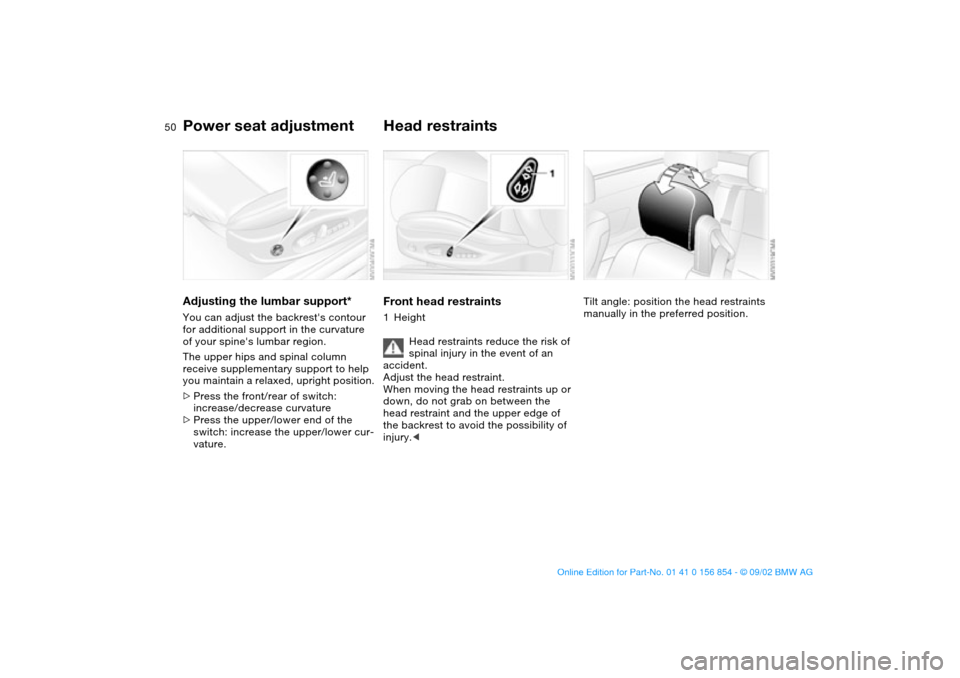
Adjusting the lumbar support*You can adjust the backrest's contour
for additional support in the curvature
of your spine's lumbar region.
The upper hips and spinal column
receive supplementary support to help
you maintain a relaxed, upright position.
>Press the front/rear of switch:
increase/decrease curvature
>Press the upper/lower end of the
switch: increase the upper/lower cur-
vature.
Head restraintsFront head restraints1Height
Head restraints reduce the risk of
spinal injury in the event of an
accident.
Adjust the head restraint.
When moving the head restraints up or
down, do not grab on between the
head restraint and the upper edge of
the backrest to avoid the possibility of
injury.<
Tilt angle: position the head restraints
manually in the preferred position.
Power seat adjustment
handbook.book Page 50 Tuesday, July 30, 2002 9:28 AM