2003 BMW 540I SEDAN brake light
[x] Cancel search: brake lightPage 132 of 187
132n
Break-in proceduresTo ensure that your vehicle provides
maximum economy throughout a long
service life, we request that you
observe the following suggestions.Engine and differentialUp to 1,200 miles (2,000 km):
Drive at varying engine speeds and
road speeds, but do not exceed
4,500 rpm and the following road
speeds during this initial period:
BMW 525i, 530i: 100 mph (160 km/h)
BMW 540i: 106 mph (170 km/h).
Comply with all official speed limits.
Refrain from using full throttle and avoid
pressing the accelerator beyond the
kickdown point.
Once you have driven 1,200 miles
(2,000 km), engine and vehicle speeds
can gradually be increased.
You should also comply with these
break-in procedures if the engine or dif-
ferential is replaced later in the course
of the vehicle service life.
TiresOwing to technical factors associated
with their manufacture, tires do not
achieve their full traction potential until
an initial break-in period has elapsed.
For this reason, you should drive with
extra care during the initial 200 miles
(300 km).
Comply with all official speed limits.
When the vehicle is operated on
wet or slushy roads, a wedge of
water may form between the tire and
the road surface. This phenomenon is
referred to as aquaplaning or hydro-
planing, and can lead to partial or com-
plete loss of traction, vehicle control
and braking effectiveness. Reduce your
speed on wet roads.<
Brake systemApprox. 300 miles (500 km) must
elapse before the brake pads and
rotors achieve the optimal pad-surface
and wear patterns required for trouble-
free operation and long service life later
on.
To break-in the separate parking brake
drums, apply the parking brake lightly
when coasting to a standstill (at a traffic
signal, for instance), provided that
traffic conditions allow you to do so.
To avoid corrosion, repeat this proce-
dure from time to time.
The brake lamps do not come on
when the parking brake is applied.
Vacuum for the brake system servo unit
on your BMW is available only when the
engine is running. When you move the
vehicle with the engine switched off Ð
when towing, for instance Ð substan-
tially higher levels of pedal force will be
required to brake the vehicle.< ClutchThe clutch will also begin to function
optimally after about 300 miles
(500 km). Engage the gears carefully
during the break-in period.
Page 133 of 187
133n
OverviewControlsMaintenanceRepairsDataIndex
Driving notes Antilock Brake System
Brakes:
Do not drive with your foot resting
on the brake pedal. Even light but con-
sistent pedal pressure can lead to high
temperatures, brake wear and possibly
even brake failure.
Hydroplaning:
When driving on wet or slushy roads,
reduce vehicle speed. If you do not, a
wedge of water may form between the
tires and the road surface. This phe-
nomenon is referred to as aquaplaning
or hydroplaning. It is characterized by a
partial or complete loss of contact
between the tires and the road surface.
The ultimate results are loss of steering
and braking control.
Driving through water:
When there is water on the roads, do
not drive in it if it is deeper than
1 ft (30 cm), and even then, only at
walking speed, otherwise the vehicle
can sustain damage to the engine, the
electrical systems and the transmission.
Rear parcel tray:
Do not place heavy or hard objects on
the rear parcel tray. These objects
could endanger vehicle occupants
during heavy brake applications or eva-
sive maneuvers.
Clothes hooks:
Hang items of clothing from the hooks
so that they will not obstruct the driver's
vision. Do not hang heavy objects on
the hooks. If you do so, they could
cause personal injury during braking or
evasive maneuvers.<
The conceptThe Antilock Brake System (ABS) keeps
the wheels from locking during braking,
thereby enhancing active driving safety.
With ABS, the shortest possible braking
distances are achieved under most
conditions (on straight-aways and in
curves, on asphalt, ice, wet road sur-
faces, etc.).Braking with ABSIf you are in a situation that requires full
braking, you will exploit the full benefits
of the ABS system if you apply max-
imum pedal pressure ("panic stop").
Pulsation at the brake pedal combined
with sounds from the hydraulic circuits
indicates to the driver that ABS is in its
active mode.
Page 134 of 187
134n
Brake systemBrake fluid level If the brake fluid level is too low and
brake pedal travel has become notice-
ably longer, there may be a defect in
one of the two brake system's hydraulic
circuits.
Proceed to the nearest BMW
center. Higher brake application
pressure may be necessary under these
conditions, and the vehicle may exhibit
a slight tendency to pull to one side
when the brakes are applied. Braking
distances may also be longer. Please
remember to adapt your driving style
accordingly.<
Disc brakesLimited vehicle use, extended periods
with the vehicle parked or in storage,
and operating conditions in which
braking is restricted to gentle, low-
pressure applications will all increase
the tendency for corrosion to form on
the rotors; this is often accompanied by
a simultaneous accumulation of con-
tamination on the brake pads. The pads
must exert a certain minimal level of
pressure against the rotors for the disc
brakes' inherent self-cleaning effect to
remain effective; the pressure available
under the above conditions may not
provide adequate cleansing.
If the brake rotors are corroded, they
will tend to respond to braking with a
pulsating effect that even extended
brake applications will fail to cure.
When driving in heavy rain and on wet
roads it is a good idea to apply light
pressure to the brake pedal every few
miles. Monitor traffic conditions to
ensure that this maneuver does not
pose a hazard to you or to other road
users. The heat generated in this pro-
cess helps dry the pads and rotors to
ensure that your brake system will
respond with undiminished efficiency
when you need it.When descending steep hills and
extended grades, downshift to a gear
that will allow you to continue safely
with only a minimal amount of braking.
By minimizing the loads placed on the
brake system, this strategy helps
ensure that optimal brake system
response will remain available at all
times.
Do not coast with the clutch
depressed or with the transmission
or selector lever in Neutral. Do not coast
with the engine switched off. The engine
provides no braking effect when the
clutch is depressed and there is no
power-assist for braking or steering
when the engine is not running.
Never allow floor mats, carpets or any
other objects to protrude into the area
around the accelerator, clutch and brake
pedals and obstruct their movement.<
Brake pads
For your own safety: use only
brake pads that BMW has
approved for your particular vehicle
model. BMW cannot evaluate non-
approved brake pads to determine if
they are suited for use, and therefore
cannot ensure the operating safety of
the vehicle if they are installed.<
Page 166 of 187
166n
Towing the vehicle
The towed vehicle should always
be the lighter of the two vehicles.
If this is not the case, it is no longer
possible to control vehicle response.<
Tow-startingIt is not possible to start the engine of
vehicles equipped with an automatic
transmission by towing or pushing.
For instructions on jump-starting: refer
to page 164.
Never attempt to use your vehicle to
push another vehicle, since damage to
the energy-absorbing bumpers could
result.
Towing a vehicle with automatic
transmission1. Place the selector lever in position N
2. Towing speed:
Max. 45 mph (70 km/h)
3. Towing distance:
Max. 95 miles (150 km)
4. Leave the ignition key in position 1 to
ensure that the brake lamps, turn
signal indicators, horn and wind-
shield wipers remain operative, and
to prevent the steering lock from
engaging
5. Switch on the hazard warning
flashers (observe official regulations).
Find some means of identifying the
vehicle in tow, for instance, place a sign
or warning triangle in the rear window.
Make sure that the ignition key
remains in position 1 even when
the electrical system has failed to pre-
vent the steering lock from engaging.
The steering and brakes are without
power-assist when the engine is off.
This means that increased effort is
required for steering and braking.<
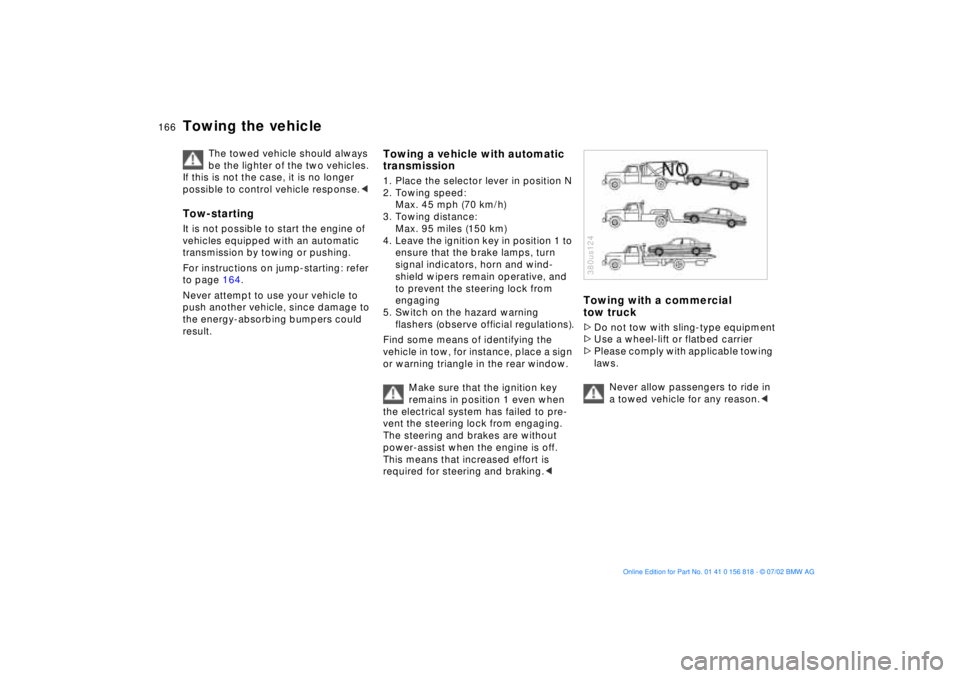
Towing with a commercial
tow truck>Do not tow with sling-type equipment
>Use a wheel-lift or flatbed carrier
>Please comply with applicable towing
laws.
Never allow passengers to ride in
a towed vehicle for any reason.< 380us124
Page 179 of 187
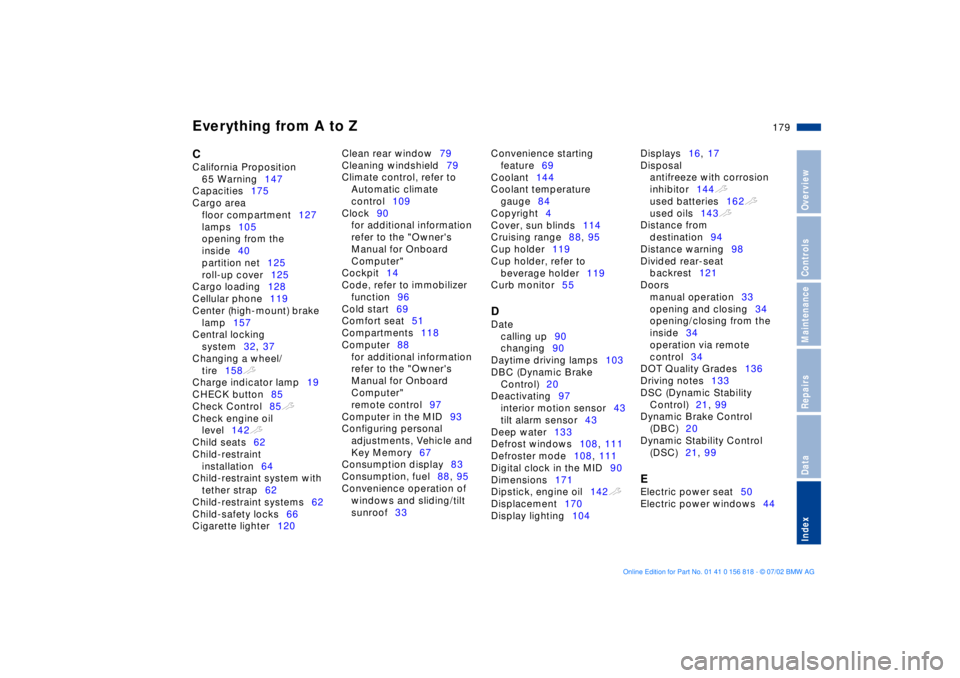
Everything from A to Z
179n
OverviewControlsMaintenanceRepairsDataIndex
C
California Proposition
65 Warning147
Capacities175
Cargo area
floor compartment127
lamps105
opening from the
inside40
partition net125
roll-up cover125
Cargo loading128
Cellular phone119
Center (high-mount) brake
lamp157
Central locking
system32, 37
Changing a wheel/
tire158t
Charge indicator lamp19
CHECK button85
Check Control85t
Check engine oil
level142t
Child seats62
Child-restraint
installation64
Child-restraint system with
tether strap62
Child-restraint systems62
Child-safety locks66
Cigarette lighter120 Clean rear window79
Cleaning windshield79
Climate control, refer to
Automatic climate
control109
Clock90
for additional information
refer to the "Owner's
Manual for Onboard
Computer"
Cockpit14
Code, refer to immobilizer
function96
Cold start69
Comfort seat51
Compartments118
Computer88
for additional information
refer to the "Owner's
Manual for Onboard
Computer"
remote control97
Computer in the MID93
Configuring personal
adjustments, Vehicle and
Key Memory67
Consumption display83
Consumption, fuel88, 95
Convenience operation of
windows and sliding/tilt
sunroof33 Convenience starting
feature69
Coolant144
Coolant temperature
gauge84
Copyright4
Cover, sun blinds114
Cruising range88, 95
Cup holder119
Cup holder, refer to
beverage holder119
Curb monitor55
D
Date
calling up90
changing90
Daytime driving lamps103
DBC (Dynamic Brake
Control)20
Deactivating97
interior motion sensor43
tilt alarm sensor43
Deep water133
Defrost windows108, 111
Defroster mode108, 111
Digital clock in the MID90
Dimensions171
Dipstick, engine oil142t
Displacement170
Display lighting104 Displays16, 17
Disposal
antifreeze with corrosion
inhibitor144t
used batteries162t
used oils143t
Distance from
destination94
Distance warning98
Divided rear-seat
backrest121
Doors
manual operation33
opening and closing34
opening/closing from the
inside34
operation via remote
control34
DOT Quality Grades136
Driving notes133
DSC (Dynamic Stability
Control)21, 99
Dynamic Brake Control
(DBC)20
Dynamic Stability Control
(DSC)21, 99
E
Electric power seat50
Electric power windows44
Page 180 of 187
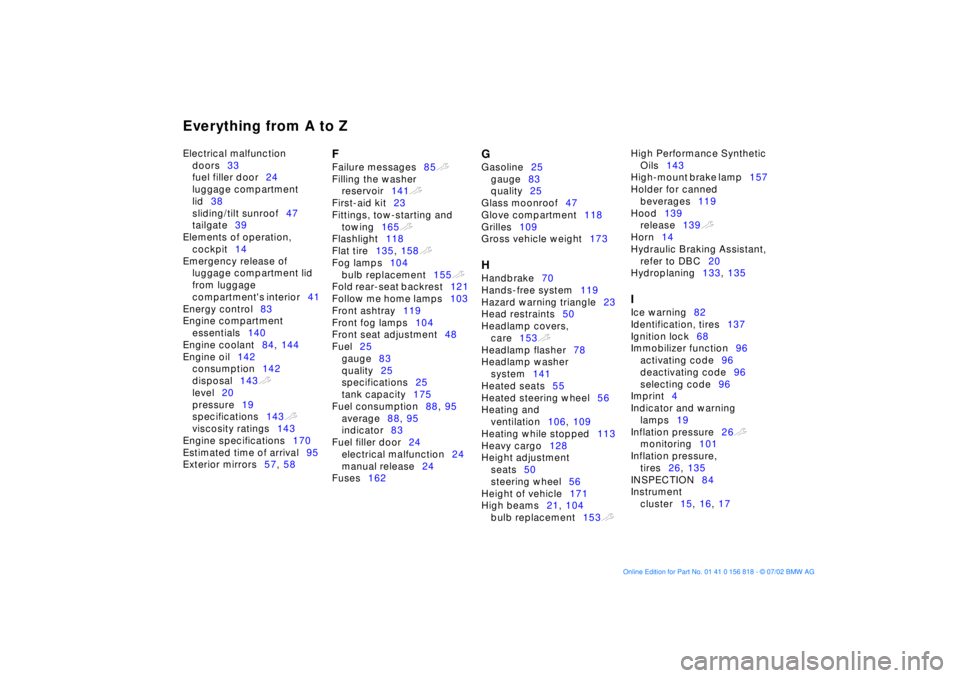
Everything from A to ZElectrical malfunction
doors33
fuel filler door24
luggage compartment
lid38
sliding/tilt sunroof47
tailgate39
Elements of operation,
cockpit14
Emergency release of
luggage compartment lid
from luggage
compartment's interior41
Energy control83
Engine compartment
essentials140
Engine coolant84, 144
Engine oil142
consumption142
disposal143t
level20
pressure19
specifications143t
viscosity ratings143
Engine specifications170
Estimated time of arrival95
Exterior mirrors57, 58
F
Failure messages85t
Filling the washer
reservoir141t
First-aid kit23
Fittings, tow-starting and
towing165t
Flashlight118
Flat tire135, 158t
Fog lamps104
bulb replacement155t
Fold rear-seat backrest121
Follow me home lamps103
Front ashtray119
Front fog lamps104
Front seat adjustment48
Fuel25
gauge83
quality25
specifications25
tank capacity175
Fuel consumption88, 95
average88, 95
indicator83
Fuel filler door24
electrical malfunction24
manual release24
Fuses162
G
Gasoline25
gauge83
quality25
Glass moonroof47
Glove compartment118
Grilles109
Gross vehicle weight173 H
Handbrake70
Hands-free system119
Hazard warning triangle23
Head restraints50
Headlamp covers,
care153t
Headlamp flasher78
Headlamp washer
system141
Heated seats55
Heated steering wheel56
Heating and
ventilation106, 109
Heating while stopped113
Heavy cargo128
Height adjustment
seats50
steering wheel56
Height of vehicle171
High beams21, 104
bulb replacement153t High Performance Synthetic
Oils143
High-mount brake lamp157
Holder for canned
beverages119
Hood139
release139t
Horn14
Hydraulic Braking Assistant,
refer to DBC20
Hydroplaning133, 135
I
Ice warning82
Identification, tires137
Ignition lock68
Immobilizer function96
activating code96
deactivating code96
selecting code96
Imprint4
Indicator and warning
lamps19
Inflation pressure26t
monitoring101
Inflation pressure,
tires26, 135
INSPECTION84
Instrument
cluster15, 16, 17
Page 182 of 187
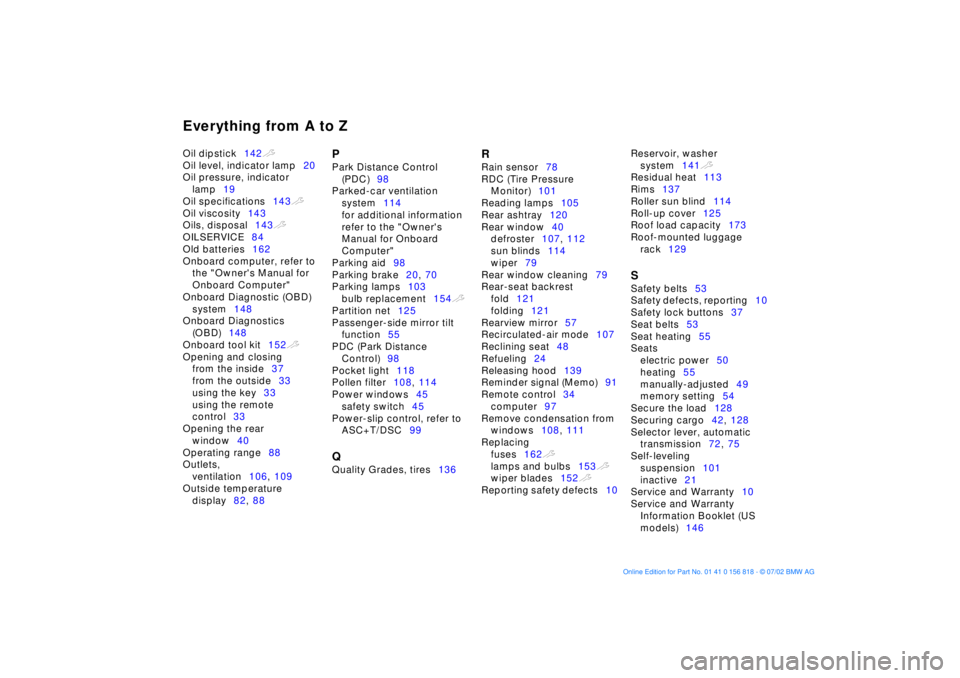
Everything from A to ZOil dipstick142t
Oil level, indicator lamp20
Oil pressure, indicator
lamp19
Oil specifications143t
Oil viscosity143
Oils, disposal143t
OILSERVICE84
Old batteries162
Onboard computer, refer to
the "Owner's Manual for
Onboard Computer"
Onboard Diagnostic (OBD)
system148
Onboard Diagnostics
(OBD)148
Onboard tool kit152t
Opening and closing
from the inside37
from the outside33
using the key33
using the remote
control33
Opening the rear
window40
Operating range88
Outlets,
ventilation106, 109
Outside temperature
display82, 88
P
Park Distance Control
(PDC)98
Parked-car ventilation
system114
for additional information
refer to the "Owner's
Manual for Onboard
Computer"
Parking aid98
Parking brake20, 70
Parking lamps103
bulb replacement154t
Partition net125
Passenger-side mirror tilt
function55
PDC (Park Distance
Control)98
Pocket light118
Pollen filter108, 114
Power windows45
safety switch45
Power-slip control, refer to
ASC+T/DSC99 Q
Quality Grades, tires136
R
Rain sensor78
RDC (Tire Pressure
Monitor)101
Reading lamps105
Rear ashtray120
Rear window40
defroster107, 112
sun blinds114
wiper79
Rear window cleaning79
Rear-seat backrest
fold121
folding121
Rearview mirror57
Recirculated-air mode107
Reclining seat48
Refueling24
Releasing hood139
Reminder signal (Memo)91
Remote control34
computer97
Remove condensation from
windows108, 111
Replacing
fuses162t
lamps and bulbs153t
wiper blades152t
Reporting safety defects10 Reservoir, washer
system141t
Residual heat113
Rims137
Roller sun blind114
Roll-up cover125
Roof load capacity173
Roof-mounted luggage
rack129
S
Safety belts53
Safety defects, reporting10
Safety lock buttons37
Seat belts53
Seat heating55
Seats
electric power50
heating55
manually-adjusted49
memory setting54
Secure the load128
Securing cargo42, 128
Selector lever, automatic
transmission72, 75
Self-leveling
suspension101
inactive21
Service and Warranty10
Service and Warranty
Information Booklet (US
models)146