164n
Do not use spray starter fluids to start
the engine.
When your battery is discharged you
can used two jumper cables to start
your vehicle with power from the bat-
tery in a second vehicle. You can also
use the same method to help start
another vehicle. Always use jumper
cables with fully insulated handles on
the terminal clamps.
Do not touch high-voltage wiring
and cables on a running engine.
Contact with components carrying high
voltage can be harmful or fatal. Care-
fully observe the following instructions
to avoid personal injury and/or damage
to one or both vehicles.<
1. Ensure that the battery in the sup-
port vehicle is also rated at
12 volts. This information is pro-
vided on the top of the battery
casing
2. Do not disconnect your battery from
your vehicle's electrical system.
Switch off all electrical accessories
in both vehicles
3. Make absolutely certain that there
is no contact between the body-
work of the two vehicles Ð short cir-
cuit hazard
4. Start the engine on the support
vehicle and allow it to run
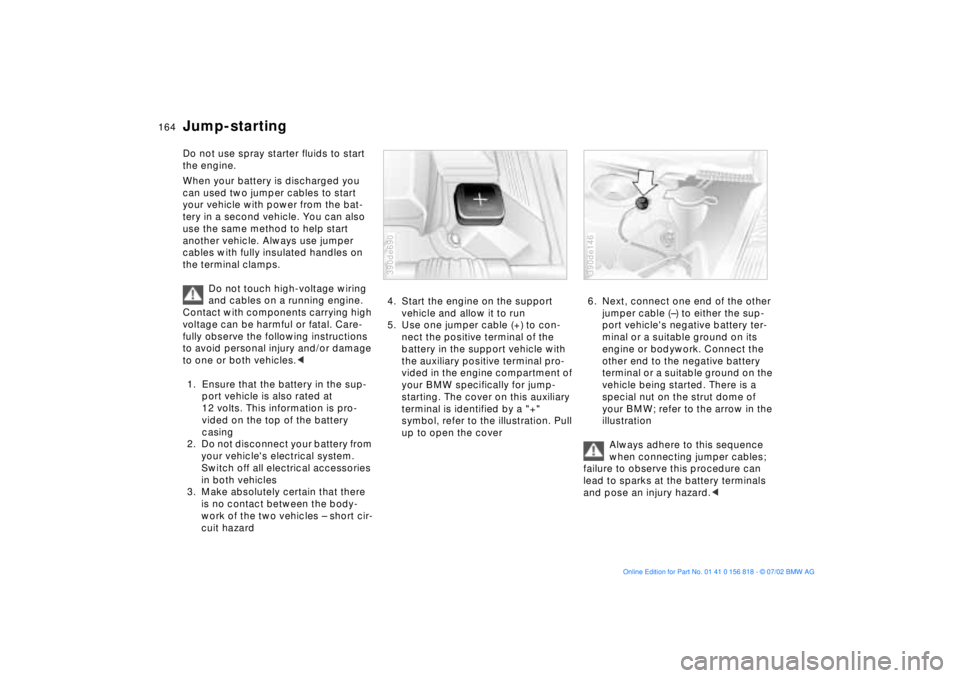
5. Use one jumper cable (+) to con-
nect the positive terminal of the
battery in the support vehicle with
the auxiliary positive terminal pro-
vided in the engine compartment of
your BMW specifically for jump-
starting. The cover on this auxiliary
terminal is identified by a "+"
symbol, refer to the illustration. Pull
up to open the cover390de690
6. Next, connect one end of the other
jumper cable (Ð) to either the sup-
port vehicle's negative battery ter-
minal or a suitable ground on its
engine or bodywork. Connect the
other end to the negative battery
terminal or a suitable ground on the
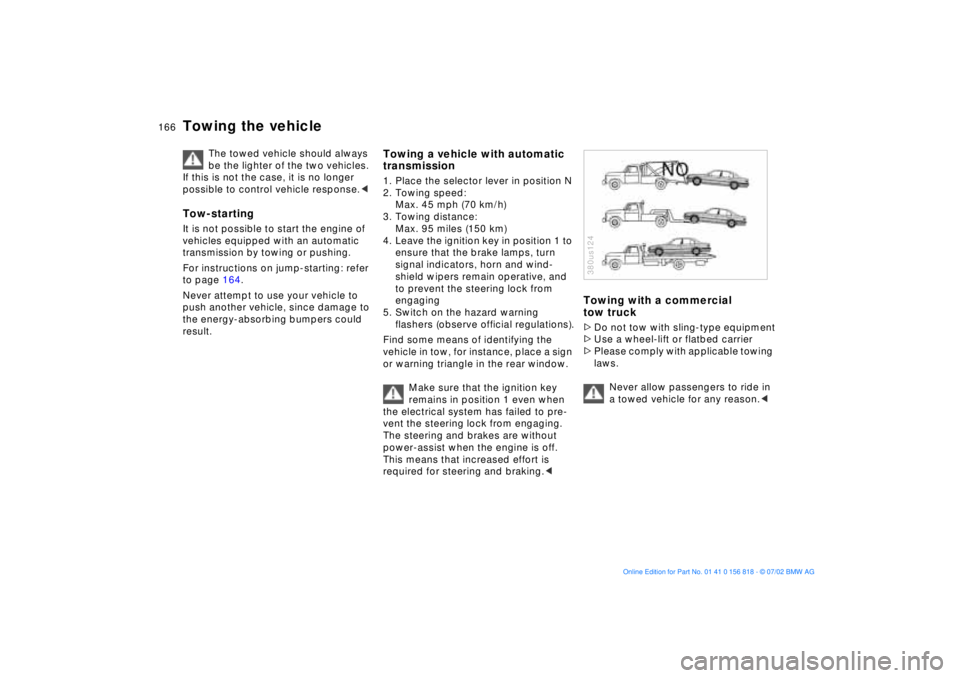
vehicle being started. There is a
special nut on the strut dome of
your BMW; refer to the arrow in the
illustration
Always adhere to this sequence
when connecting jumper cables;
failure to observe this procedure can
lead to sparks at the battery terminals
and pose an injury hazard.< 390de146
Jump-starting
166n
Towing the vehicle
The towed vehicle should always
be the lighter of the two vehicles.
If this is not the case, it is no longer
possible to control vehicle response.<
Tow-startingIt is not possible to start the engine of
vehicles equipped with an automatic
transmission by towing or pushing.
For instructions on jump-starting: refer
to page 164.
Never attempt to use your vehicle to
push another vehicle, since damage to
the energy-absorbing bumpers could
result.
Towing a vehicle with automatic
transmission1. Place the selector lever in position N
2. Towing speed:
Max. 45 mph (70 km/h)
3. Towing distance:
Max. 95 miles (150 km)
4. Leave the ignition key in position 1 to
ensure that the brake lamps, turn
signal indicators, horn and wind-
shield wipers remain operative, and
to prevent the steering lock from
engaging
5. Switch on the hazard warning
flashers (observe official regulations).
Find some means of identifying the
vehicle in tow, for instance, place a sign
or warning triangle in the rear window.
Make sure that the ignition key
remains in position 1 even when
the electrical system has failed to pre-
vent the steering lock from engaging.
The steering and brakes are without
power-assist when the engine is off.
This means that increased effort is
required for steering and braking.<
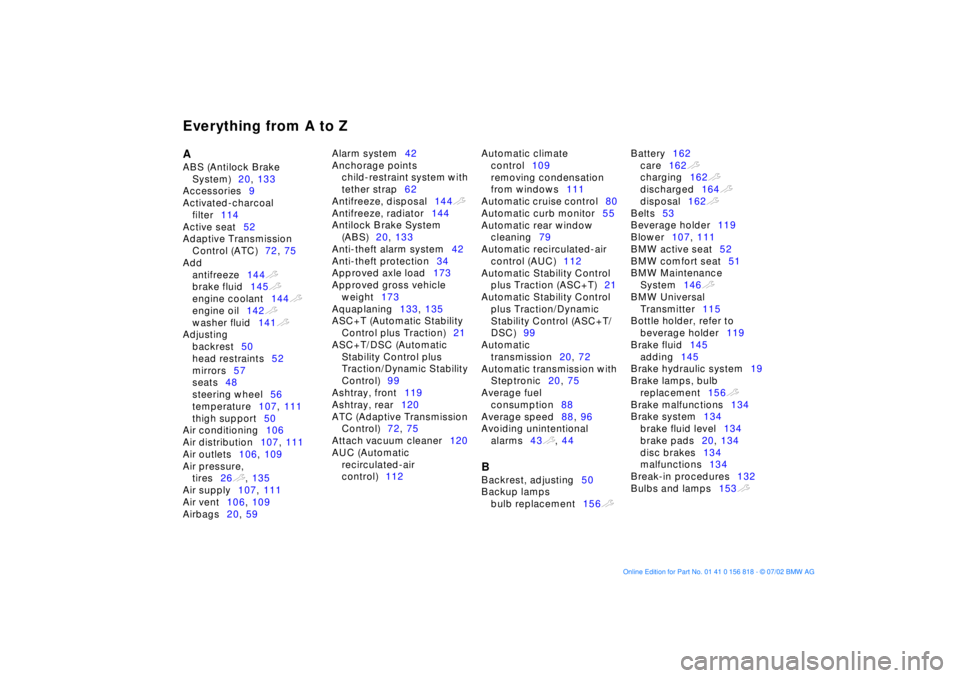
Towing with a commercial
tow truck>Do not tow with sling-type equipment
>Use a wheel-lift or flatbed carrier
>Please comply with applicable towing
laws.
Never allow passengers to ride in
a towed vehicle for any reason.< 380us124
Everything from A to ZA
ABS (Antilock Brake
System)20, 133
Accessories9
Activated-charcoal
filter114
Active seat52
Adaptive Transmission
Control (ATC)72, 75
Add
antifreeze144t
brake fluid145t
engine coolant144t
engine oil142t
washer fluid141t
Adjusting
backrest50
head restraints52
mirrors57
seats48
steering wheel56
temperature107, 111
thigh support50
Air conditioning106
Air distribution107, 111
Air outlets106, 109
Air pressure,
tires26t, 135
Air supply107, 111
Air vent106, 109
Airbags20, 59 Alarm system42
Anchorage points
child-restraint system with
tether strap62
Antifreeze, disposal144t
Antifreeze, radiator144
Antilock Brake System
(ABS)20, 133
Anti-theft alarm system42
Anti-theft protection34
Approved axle load173
Approved gross vehicle
weight173
Aquaplaning133, 135
ASC+T (Automatic Stability
Control plus Traction)21
ASC+T/DSC (Automatic
Stability Control plus
Traction/Dynamic Stability
Control)99
Ashtray, front119
Ashtray, rear120
ATC (Adaptive Transmission
Control)72, 75
Attach vacuum cleaner120
AUC (Automatic
recirculated-air
control)112 Automatic climate
control109
removing condensation
from windows111
Automatic cruise control80
Automatic curb monitor55
Automatic rear window
cleaning79
Automatic recirculated-air
control (AUC)112
Automatic Stability Control
plus Traction (ASC+T)21
Automatic Stability Control
plus Traction/Dynamic
Stability Control (ASC+T/
DSC)99
Automatic
transmission20, 72
Automatic transmission with
Steptronic20, 75
Average fuel
consumption88
Average speed88, 96
Avoiding unintentional
alarms43t, 44
B
Backrest, adjusting50
Backup lamps
bulb replacement156t Battery162
care162t
charging162t
discharged164t
disposal162t
Belts53
Beverage holder119
Blower107, 111
BMW active seat52
BMW comfort seat51
BMW Maintenance
System146t
BMW Universal
Transmitter115
Bottle holder, refer to
beverage holder119
Brake fluid145
adding145
Brake hydraulic system19
Brake lamps, bulb
replacement156t
Brake malfunctions134
Brake system134
brake fluid level134
brake pads20, 134
disc brakes134
malfunctions134
Break-in procedures132
Bulbs and lamps153t