Page 145 of 1690
A79301
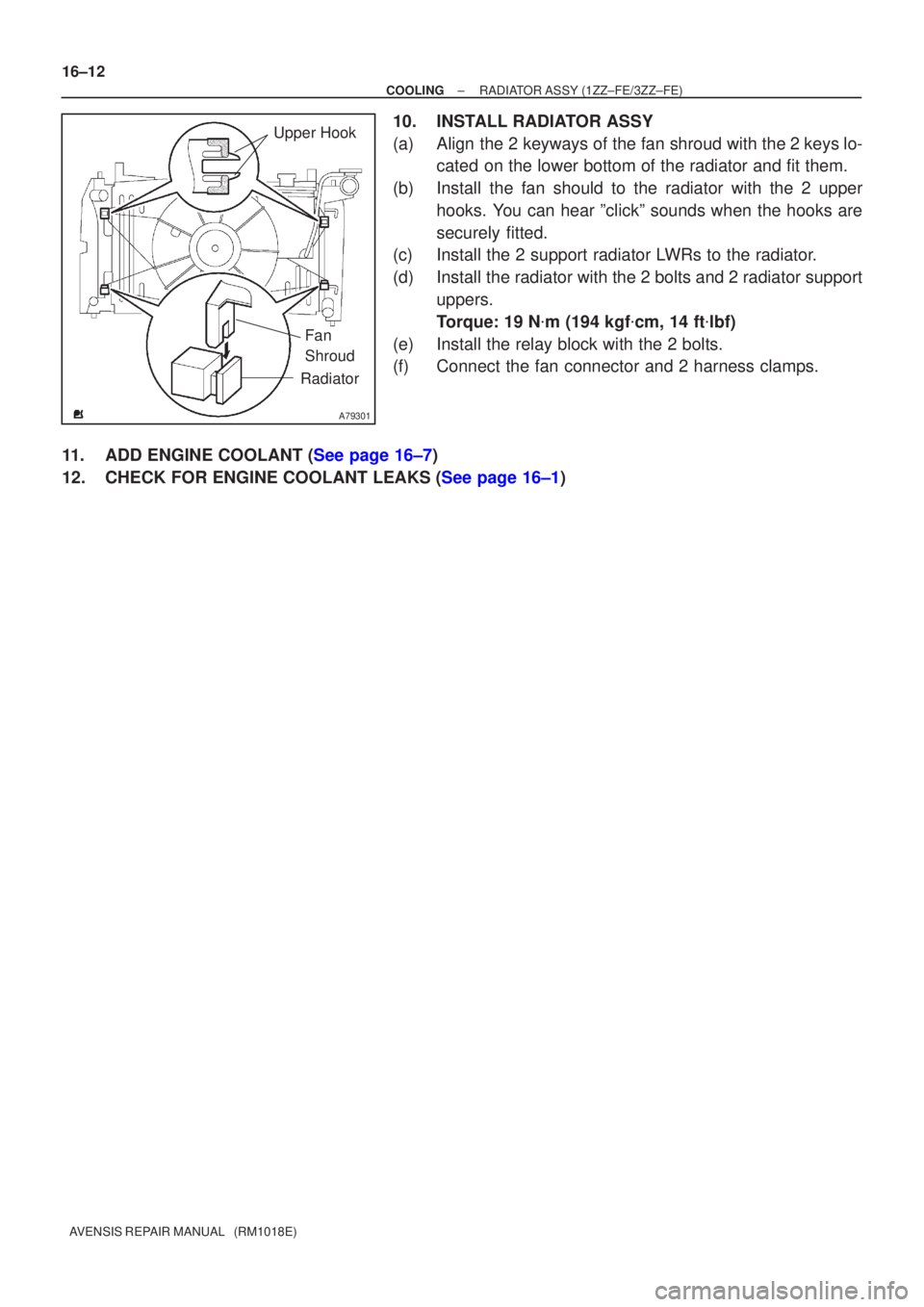
Upper Hook
Fan
Shroud
Radiator
16±12
±
COOLING RADIATOR ASSY(1ZZ±FE/3ZZ±FE)
AVENSIS REPAIR MANUAL (RM1018E)
10.INSTALL RADIATOR ASSY
(a)Align the 2 keyways of the fan shroud with the 2 keys lo- cated on the lower bottom of the radiator and fit them.
(b)Install the fan should to the radiator with the 2 upper hooks. You can hear ºclickº sounds when the hooks are
securely fitted.
(c)Install the 2 support radiator LWRs to the radiator.
(d)Install the radiator with the 2 bolts and 2 radiator support
uppers.
Torque: 19 N �m (194 kgf �cm, 14 ft �lbf)
(e)Install the relay block with the 2 bolts.
(f)Connect the fan connector and 2 harness clamps.
11.ADD ENGINE COOLANT (See page 16±7)
12.CHECK FOR ENGINE COOLANT LEAKS (See page 16±1)
Page 146 of 1690
160N1±01
A78433
± COOLINGCOOLING SYSTEM (1AZ±FE)
16±13
AVENSIS REPAIR MANUAL (RM1018E)
COOLING SYSTEM (1AZ±FE)
ON±VEHICLE INSPECTION
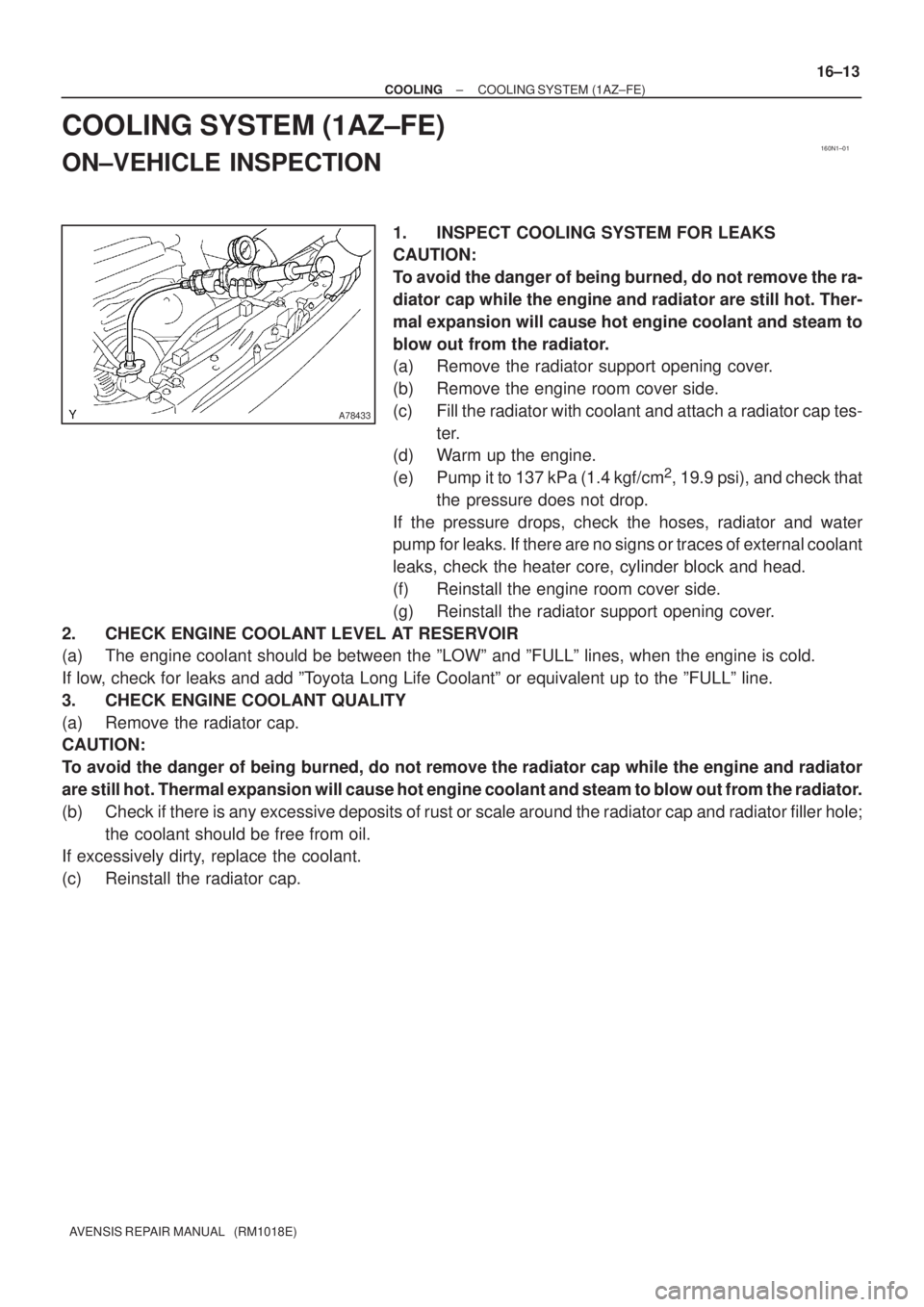
1. INSPECT COOLING SYSTEM FOR LEAKS
CAUTION:
To avoid the danger of being burned, do not remove the ra-
diator cap while the engine and radiator are still hot. Ther-
mal expansion will cause hot engine coolant and steam to
blow out from the radiator.
(a) Remove the radiator support opening cover.
(b) Remove the engine room cover side.
(c) Fill the radiator with coolant and attach a radiator cap tes-
ter.
(d) Warm up the engine.
(e) Pump it to 137 kPa (1.4 kgf/cm
2, 19.9 psi), and check that
the pressure does not drop.
If the pressure drops, check the hoses, radiator and water
pump for leaks. If there are no signs or traces of external coolant
leaks, check the heater core, cylinder block and head.
(f) Reinstall the engine room cover side.
(g) Reinstall the radiator support opening cover.
2. CHECK ENGINE COOLANT LEVEL AT RESERVOIR
(a) The engine coolant should be between the ºLOWº and ºFULLº lines, when the engine is cold.
If low, check for leaks and add ºToyota Long Life Coolantº or equivalent up to the ºFULLº line.
3. CHECK ENGINE COOLANT QUALITY
(a) Remove the radiator cap.
CAUTION:
To avoid the danger of being burned, do not remove the radiator cap while the engine and radiator
are still hot. Thermal expansion will cause hot engine coolant and steam to blow out from the radiator.
(b) Check if there is any excessive deposits of rust or scale around the radiator cap and radiator filler hole;
the coolant should be free from oil.
If excessively dirty, replace the coolant.
(c) Reinstall the radiator cap.
Page 148 of 1690
160N2±01
P13560
P00436
10mm
A51911
± COOLINGCOOLING SYSTEM (1AZ±FE)
16±15
AVENSIS REPAIR MANUAL (RM1018E)
INSPECTION
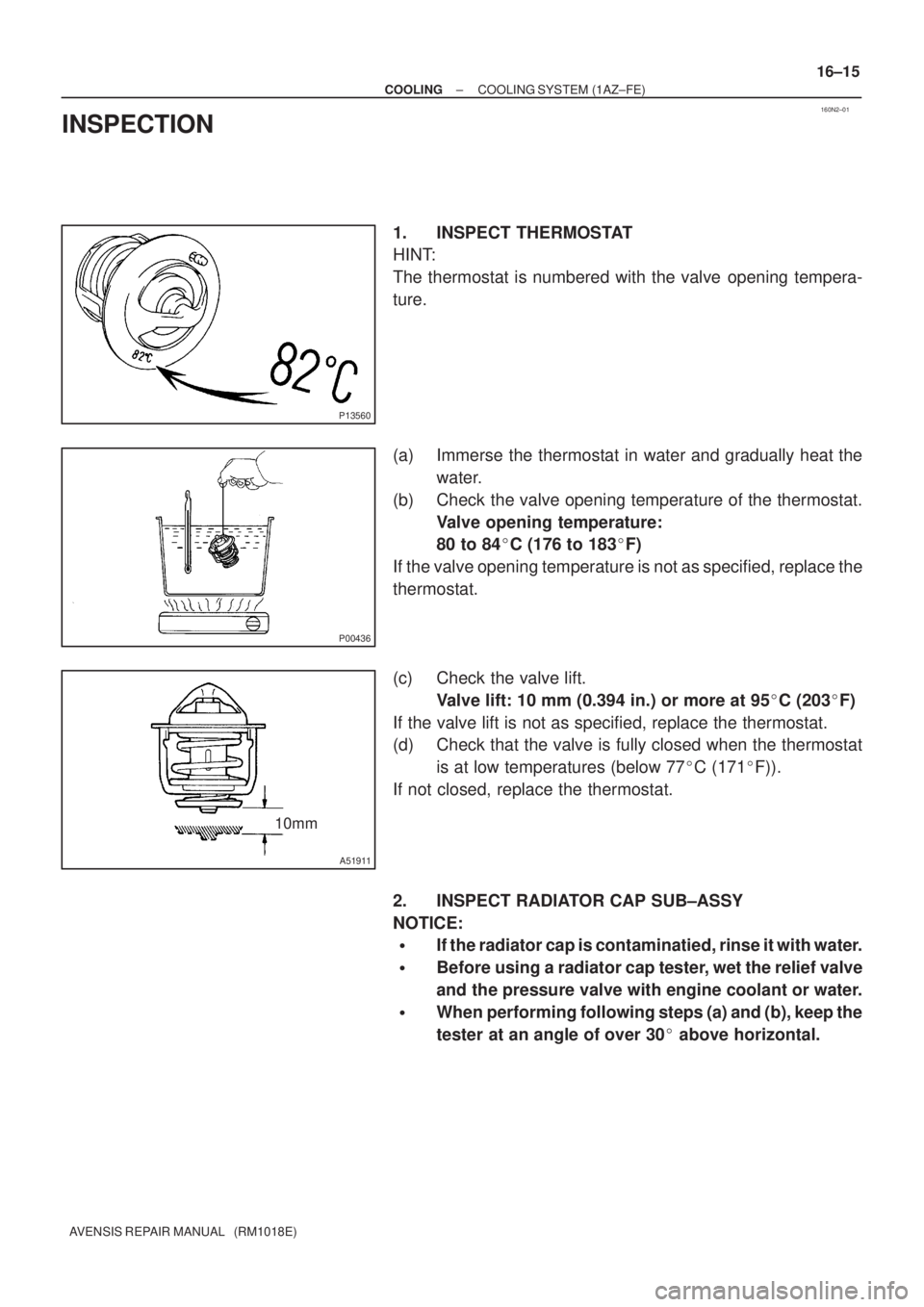
1. INSPECT THERMOSTAT
HINT:
The thermostat is numbered with the valve opening tempera-
ture.
(a) Immerse the thermostat in water and gradually heat the
water.
(b) Check the valve opening temperature of the thermostat.
Valve opening temperature:
80 to 84�C (176 to 183�F)
If the valve opening temperature is not as specified, replace the
thermostat.
(c) Check the valve lift.
Valve lift: 10 mm (0.394 in.) or more at 95�C (203�F)
If the valve lift is not as specified, replace the thermostat.
(d) Check that the valve is fully closed when the thermostat
is at low temperatures (below 77�C (171�F)).
If not closed, replace the thermostat.
2. INSPECT RADIATOR CAP SUB±ASSY
NOTICE:
�If the radiator cap is contaminatied, rinse it with water.
�Before using a radiator cap tester, wet the relief valve
and the pressure valve with engine coolant or water.
�When performing following steps (a) and (b), keep the
tester at an angle of over 30� above horizontal.
Page 150 of 1690
160MY±01
A78433
± COOLINGCOOLING SYSTEM (1AZ±FSE)
16±25
AVENSIS REPAIR MANUAL (RM1018E)
COOLING SYSTEM (1AZ±FSE)
ON±VEHICLE INSPECTION
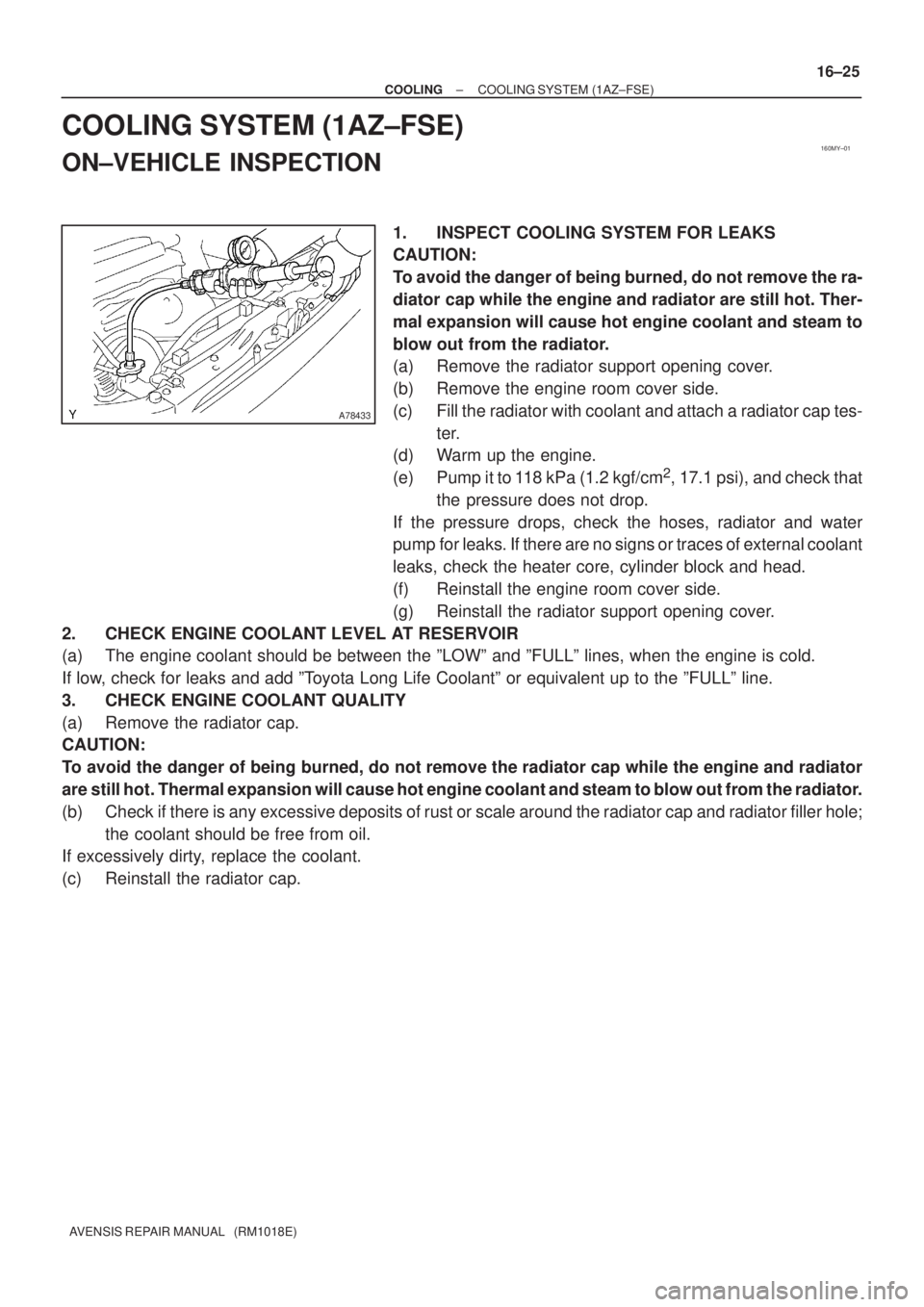
1. INSPECT COOLING SYSTEM FOR LEAKS
CAUTION:
To avoid the danger of being burned, do not remove the ra-
diator cap while the engine and radiator are still hot. Ther-
mal expansion will cause hot engine coolant and steam to
blow out from the radiator.
(a) Remove the radiator support opening cover.
(b) Remove the engine room cover side.
(c) Fill the radiator with coolant and attach a radiator cap tes-
ter.
(d) Warm up the engine.
(e) Pump it to 118 kPa (1.2 kgf/cm
2, 17.1 psi), and check that
the pressure does not drop.
If the pressure drops, check the hoses, radiator and water
pump for leaks. If there are no signs or traces of external coolant
leaks, check the heater core, cylinder block and head.
(f) Reinstall the engine room cover side.
(g) Reinstall the radiator support opening cover.
2. CHECK ENGINE COOLANT LEVEL AT RESERVOIR
(a) The engine coolant should be between the ºLOWº and ºFULLº lines, when the engine is cold.
If low, check for leaks and add ºToyota Long Life Coolantº or equivalent up to the ºFULLº line.
3. CHECK ENGINE COOLANT QUALITY
(a) Remove the radiator cap.
CAUTION:
To avoid the danger of being burned, do not remove the radiator cap while the engine and radiator
are still hot. Thermal expansion will cause hot engine coolant and steam to blow out from the radiator.
(b) Check if there is any excessive deposits of rust or scale around the radiator cap and radiator filler hole;
the coolant should be free from oil.
If excessively dirty, replace the coolant.
(c) Reinstall the radiator cap.
Page 152 of 1690
160MZ±01
P35001
P00436
10mm
A51911
± COOLINGCOOLING SYSTEM (1AZ±FSE)
16±27
AVENSIS REPAIR MANUAL (RM1018E)
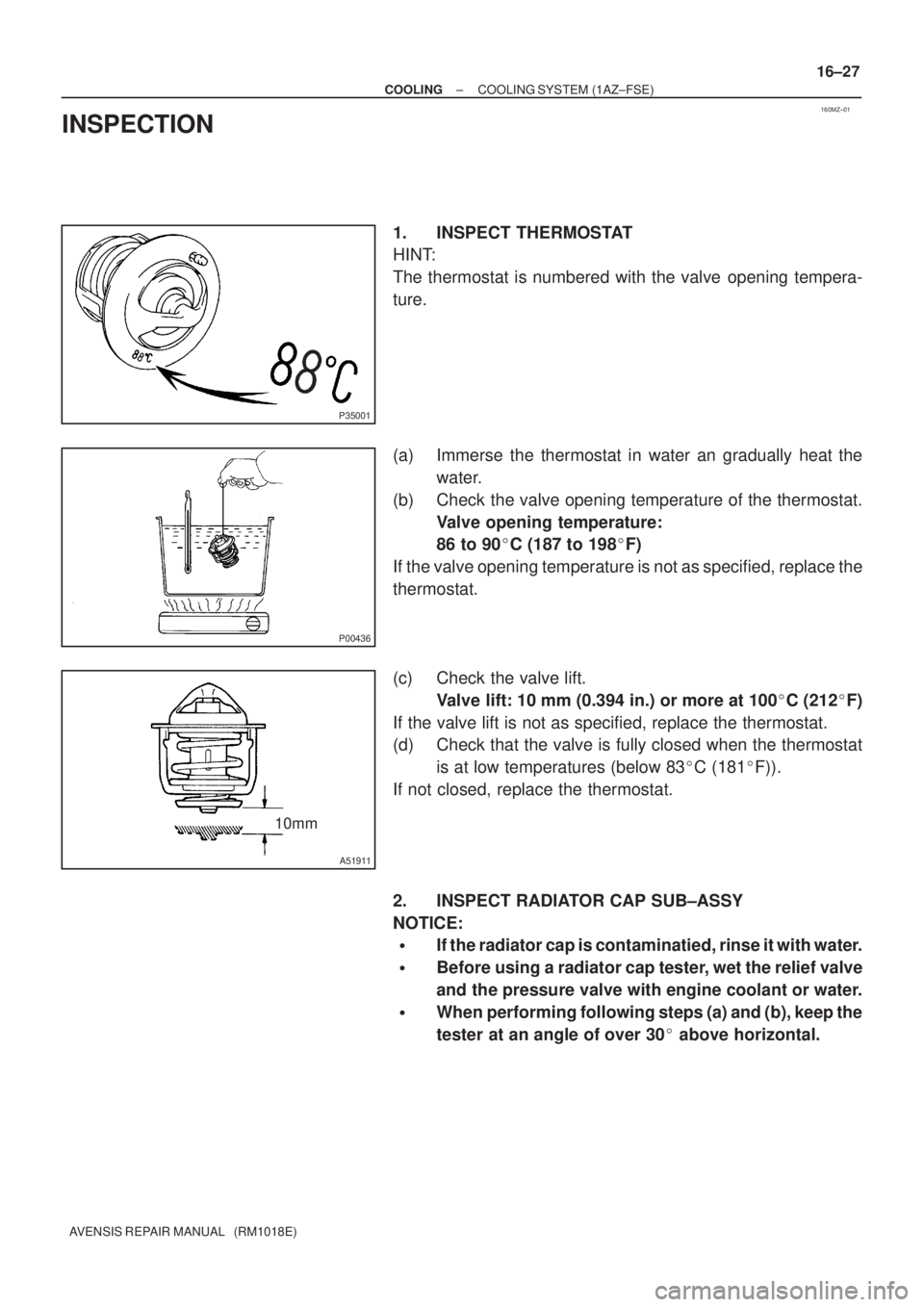
INSPECTION
1. INSPECT THERMOSTAT
HINT:
The thermostat is numbered with the valve opening tempera-
ture.
(a) Immerse the thermostat in water an gradually heat the
water.
(b) Check the valve opening temperature of the thermostat.
Valve opening temperature:
86 to 90�C (187 to 198�F)
If the valve opening temperature is not as specified, replace the
thermostat.
(c) Check the valve lift.
Valve lift: 10 mm (0.394 in.) or more at 100�C (212�F)
If the valve lift is not as specified, replace the thermostat.
(d) Check that the valve is fully closed when the thermostat
is at low temperatures (below 83�C (181�F)).
If not closed, replace the thermostat.
2. INSPECT RADIATOR CAP SUB±ASSY
NOTICE:
�If the radiator cap is contaminatied, rinse it with water.
�Before using a radiator cap tester, wet the relief valve
and the pressure valve with engine coolant or water.
�When performing following steps (a) and (b), keep the
tester at an angle of over 30� above horizontal.
Page 154 of 1690
160N6±01
A78434
Radiator Cap Tester
± COOLINGCOOLING SYSTEM (1CD±FTV)
16±37
AVENSIS REPAIR MANUAL (RM1018E)
COOLING SYSTEM (1CD±FTV)
ON±VEHICLE INSPECTION
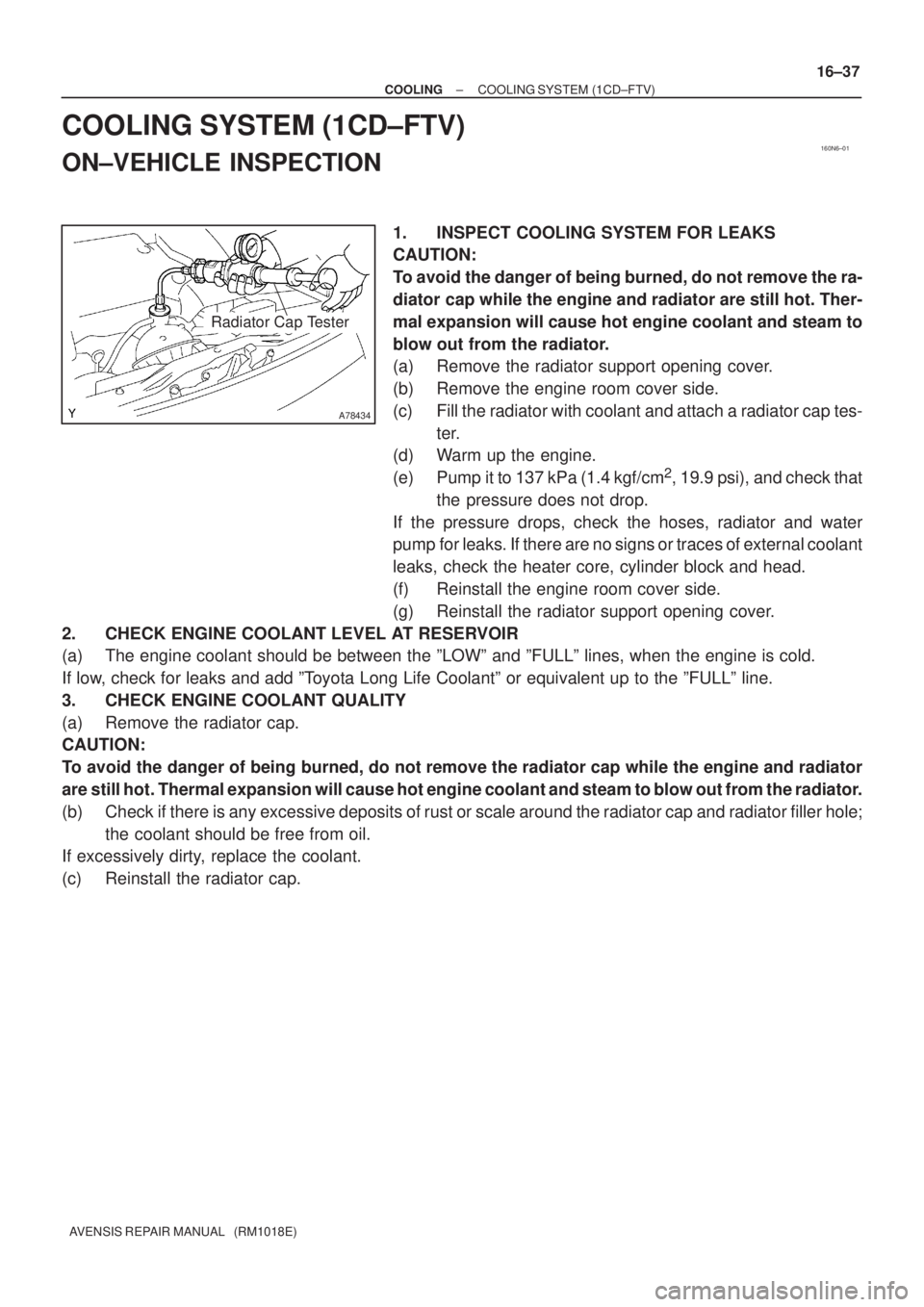
1. INSPECT COOLING SYSTEM FOR LEAKS
CAUTION:
To avoid the danger of being burned, do not remove the ra-
diator cap while the engine and radiator are still hot. Ther-
mal expansion will cause hot engine coolant and steam to
blow out from the radiator.
(a) Remove the radiator support opening cover.
(b) Remove the engine room cover side.
(c) Fill the radiator with coolant and attach a radiator cap tes-
ter.
(d) Warm up the engine.
(e) Pump it to 137 kPa (1.4 kgf/cm
2, 19.9 psi), and check that
the pressure does not drop.
If the pressure drops, check the hoses, radiator and water
pump for leaks. If there are no signs or traces of external coolant
leaks, check the heater core, cylinder block and head.
(f) Reinstall the engine room cover side.
(g) Reinstall the radiator support opening cover.
2. CHECK ENGINE COOLANT LEVEL AT RESERVOIR
(a) The engine coolant should be between the ºLOWº and ºFULLº lines, when the engine is cold.
If low, check for leaks and add ºToyota Long Life Coolantº or equivalent up to the ºFULLº line.
3. CHECK ENGINE COOLANT QUALITY
(a) Remove the radiator cap.
CAUTION:
To avoid the danger of being burned, do not remove the radiator cap while the engine and radiator
are still hot. Thermal expansion will cause hot engine coolant and steam to blow out from the radiator.
(b) Check if there is any excessive deposits of rust or scale around the radiator cap and radiator filler hole;
the coolant should be free from oil.
If excessively dirty, replace the coolant.
(c) Reinstall the radiator cap.
Page 156 of 1690
160N7±01
B08008
CO0929
B08007
8.5mm
± COOLINGCOOLING SYSTEM (1CD±FTV)
16±39
AVENSIS REPAIR MANUAL (RM1018E)
INSPECTION
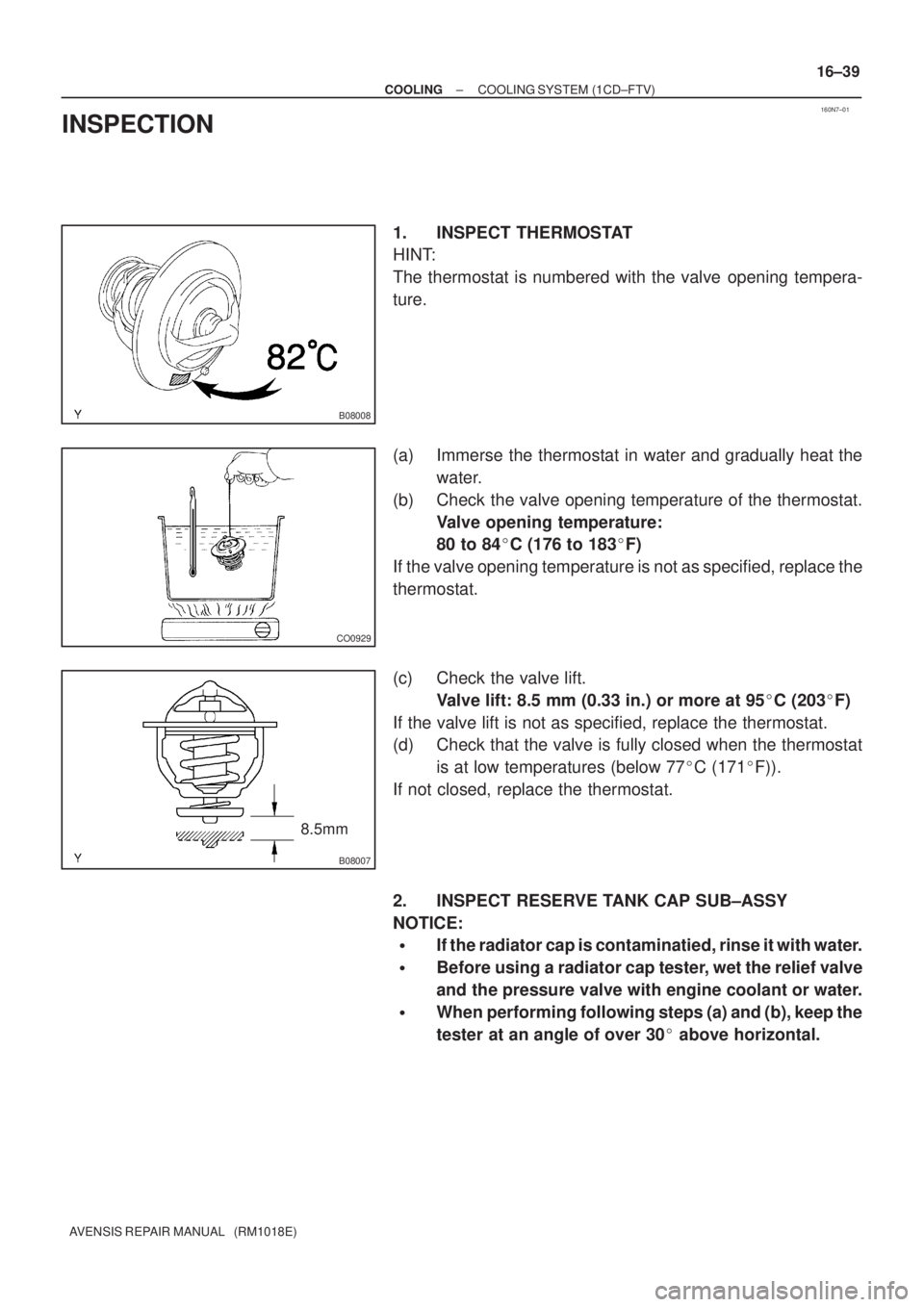
1. INSPECT THERMOSTAT
HINT:
The thermostat is numbered with the valve opening tempera-
ture.
(a) Immerse the thermostat in water and gradually heat the
water.
(b) Check the valve opening temperature of the thermostat.
Valve opening temperature:
80 to 84�C (176 to 183�F)
If the valve opening temperature is not as specified, replace the
thermostat.
(c) Check the valve lift.
Valve lift: 8.5 mm (0.33 in.) or more at 95�C (203�F)
If the valve lift is not as specified, replace the thermostat.
(d) Check that the valve is fully closed when the thermostat
is at low temperatures (below 77�C (171�F)).
If not closed, replace the thermostat.
2. INSPECT RESERVE TANK CAP SUB±ASSY
NOTICE:
�If the radiator cap is contaminatied, rinse it with water.
�Before using a radiator cap tester, wet the relief valve
and the pressure valve with engine coolant or water.
�When performing following steps (a) and (b), keep the
tester at an angle of over 30� above horizontal.
Page 158 of 1690
160N4±01
A79037
± COOLINGCOOLING SYSTEM (1ZZ±FE/3ZZ±FE)
16±1
AVENSIS REPAIR MANUAL (RM1018E)
COOLING SYSTEM (1ZZ±FE/3ZZ±FE)
ON±VEHICLE INSPECTION
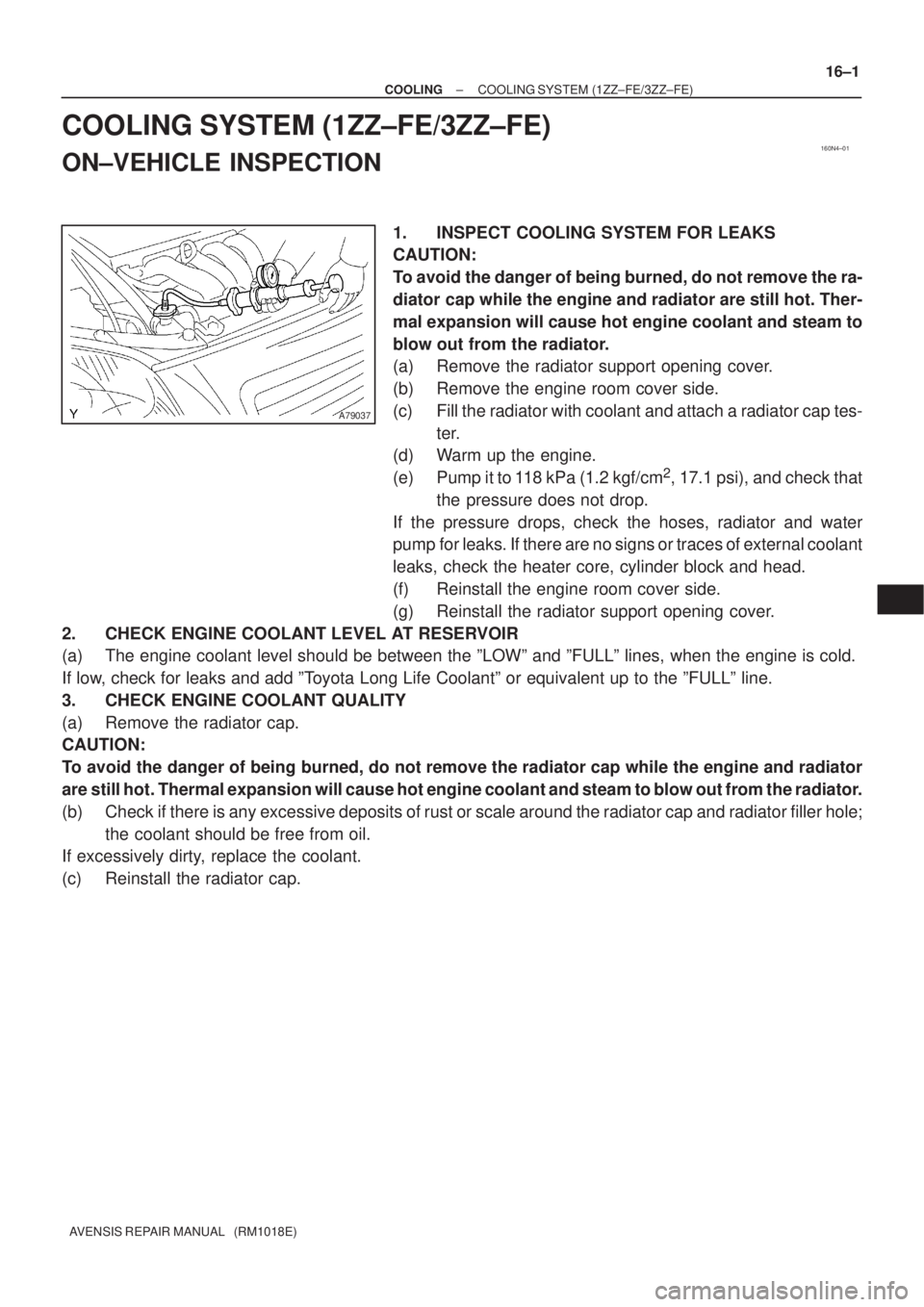
1. INSPECT COOLING SYSTEM FOR LEAKS
CAUTION:
To avoid the danger of being burned, do not remove the ra-
diator cap while the engine and radiator are still hot. Ther-
mal expansion will cause hot engine coolant and steam to
blow out from the radiator.
(a) Remove the radiator support opening cover.
(b) Remove the engine room cover side.
(c) Fill the radiator with coolant and attach a radiator cap tes-
ter.
(d) Warm up the engine.
(e) Pump it to 118 kPa (1.2 kgf/cm
2, 17.1 psi), and check that
the pressure does not drop.
If the pressure drops, check the hoses, radiator and water
pump for leaks. If there are no signs or traces of external coolant
leaks, check the heater core, cylinder block and head.
(f) Reinstall the engine room cover side.
(g) Reinstall the radiator support opening cover.
2. CHECK ENGINE COOLANT LEVEL AT RESERVOIR
(a) The engine coolant level should be between the ºLOWº and ºFULLº lines, when the engine is cold.
If low, check for leaks and add ºToyota Long Life Coolantº or equivalent up to the ºFULLº line.
3. CHECK ENGINE COOLANT QUALITY
(a) Remove the radiator cap.
CAUTION:
To avoid the danger of being burned, do not remove the radiator cap while the engine and radiator
are still hot. Thermal expansion will cause hot engine coolant and steam to blow out from the radiator.
(b) Check if there is any excessive deposits of rust or scale around the radiator cap and radiator filler hole;
the coolant should be free from oil.
If excessively dirty, replace the coolant.
(c) Reinstall the radiator cap.