2002 NISSAN TERRANO engine
[x] Cancel search: enginePage 52 of 1767
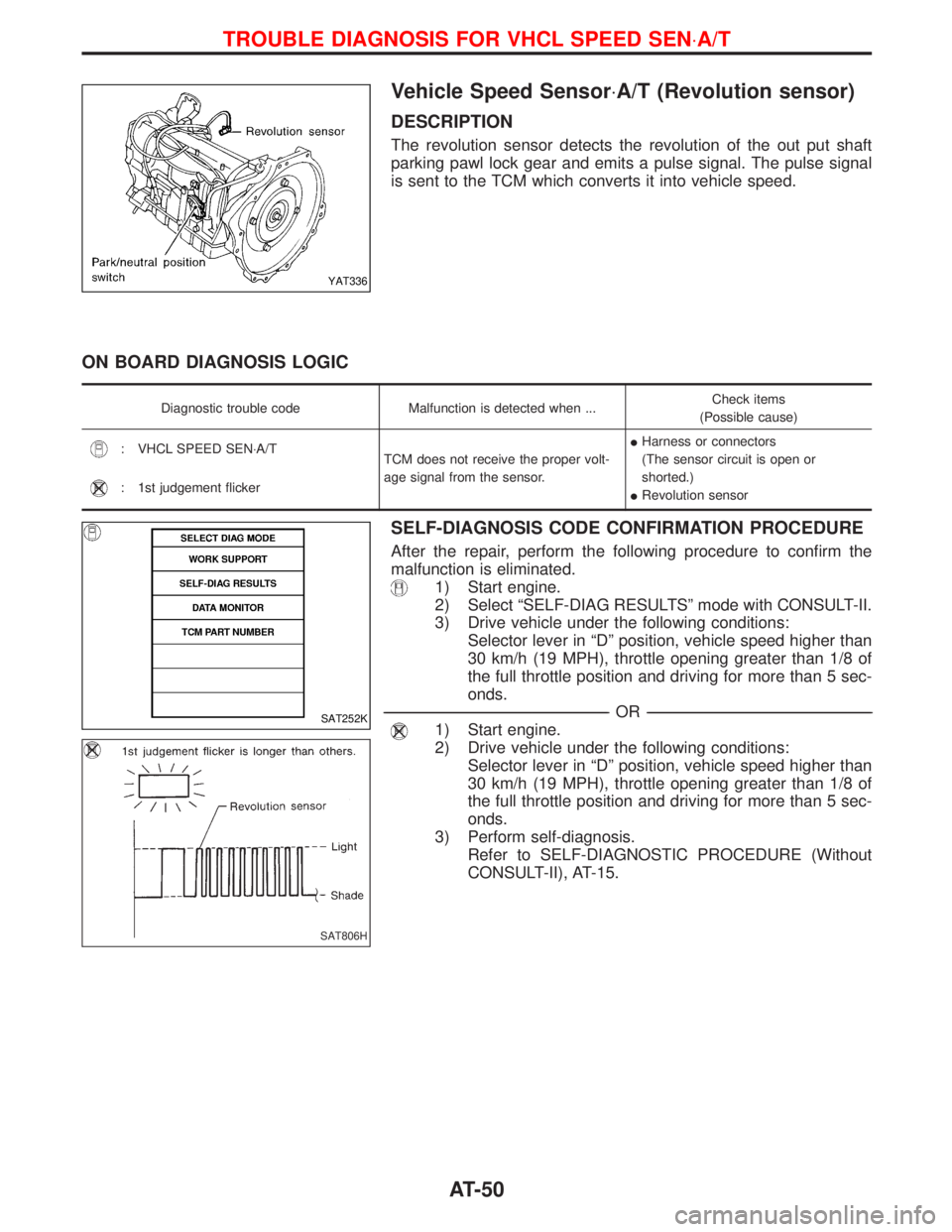
Vehicle Speed Sensor×A/T (Revolution sensor)
DESCRIPTION
The revolution sensor detects the revolution of the out put shaft
parking pawl lock gear and emits a pulse signal. The pulse signal
is sent to the TCM which converts it into vehicle speed.
ON BOARD DIAGNOSIS LOGIC
Diagnostic trouble code Malfunction is detected when ...Check items
(Possible cause)
: VHCL SPEED SEN×A/T
TCM does not receive the proper volt-
age signal from the sensor.IHarness or connectors
(The sensor circuit is open or
shorted.)
IRevolution sensor
: 1st judgement flicker
SELF-DIAGNOSIS CODE CONFIRMATION PROCEDURE
After the repair, perform the following procedure to confirm the
malfunction is eliminated.
1) Start engine.
2) Select ªSELF-DIAG RESULTSº mode with CONSULT-II.
3) Drive vehicle under the following conditions:
Selector lever in ªDº position, vehicle speed higher than
30 km/h (19 MPH), throttle opening greater than 1/8 of
the full throttle position and driving for more than 5 sec-
onds.
------------------------------------------------------------------------------------------------------------------------------------------------------------------------------------------------------------------------------------------------------------OR------------------------------------------------------------------------------------------------------------------------------------------------------------------------------------------------------------------------------------------------------------
1) Start engine.
2) Drive vehicle under the following conditions:
Selector lever in ªDº position, vehicle speed higher than
30 km/h (19 MPH), throttle opening greater than 1/8 of
the full throttle position and driving for more than 5 sec-
onds.
3) Perform self-diagnosis.
Refer to SELF-DIAGNOSTIC PROCEDURE (Without
CONSULT-II), AT-15.
YAT336
SAT252K
SAT806H
TROUBLE DIAGNOSIS FOR VHCL SPEED SEN×A/T
AT-50
Page 53 of 1767
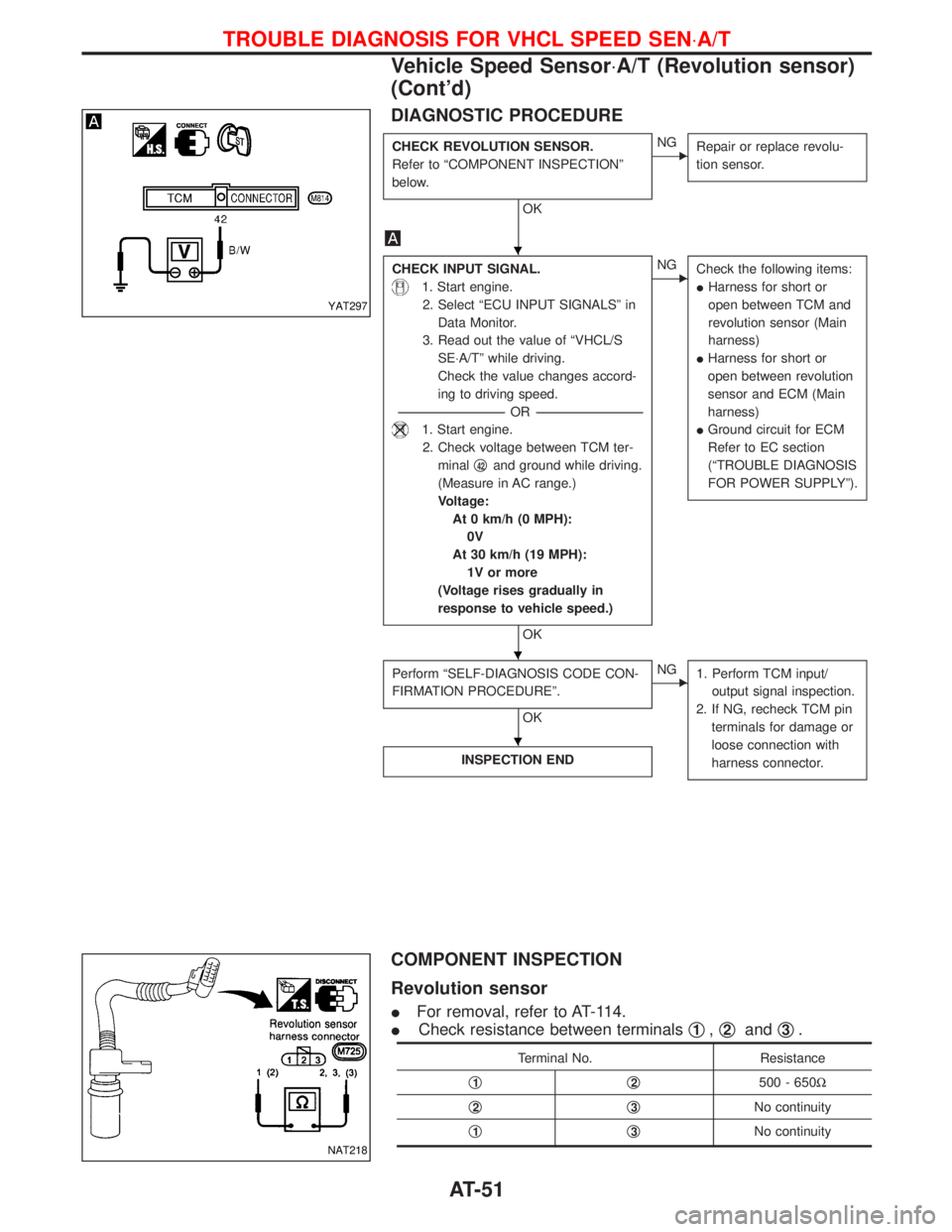
DIAGNOSTIC PROCEDURE
CHECK REVOLUTION SENSOR.
Refer to ªCOMPONENT INSPECTIONº
below.
OK
ENG
Repair or replace revolu-
tion sensor.
CHECK INPUT SIGNAL.
1. Start engine.
2. Select ªECU INPUT SIGNALSº in
Data Monitor.
3. Read out the value of ªVHCL/S
SE×A/Tº while driving.
Check the value changes accord-
ing to driving speed.
-----------------------------------------------------------------------------------------------------------------------OR -----------------------------------------------------------------------------------------------------------------------
1. Start engine.
2. Check voltage between TCM ter-
minalq
42and ground while driving.
(Measure in AC range.)
Voltage:
At 0 km/h (0 MPH):
0V
At 30 km/h (19 MPH):
1V or more
(Voltage rises gradually in
response to vehicle speed.)
OK
ENG
Check the following items:
IHarness for short or
open between TCM and
revolution sensor (Main
harness)
IHarness for short or
open between revolution
sensor and ECM (Main
harness)
IGround circuit for ECM
Refer to EC section
(ªTROUBLE DIAGNOSIS
FOR POWER SUPPLYº).
Perform ªSELF-DIAGNOSIS CODE CON-
FIRMATION PROCEDUREº.
OK
ENG
1. Perform TCM input/
output signal inspection.
2. If NG, recheck TCM pin
terminals for damage or
loose connection with
harness connector.
INSPECTION END
COMPONENT INSPECTION
Revolution sensor
IFor removal, refer to AT-114.
ICheck resistance between terminalsq
1,q2andq3.
Terminal No. Resistance
q
1q2500 - 650W
q
2q3No continuity
q
1q3No continuity
YAT297
NAT218
H
H
H
TROUBLE DIAGNOSIS FOR VHCL SPEED SEN×A/T
Vehicle Speed Sensor×A/T (Revolution sensor)
(Cont'd)
AT-51
Page 56 of 1767
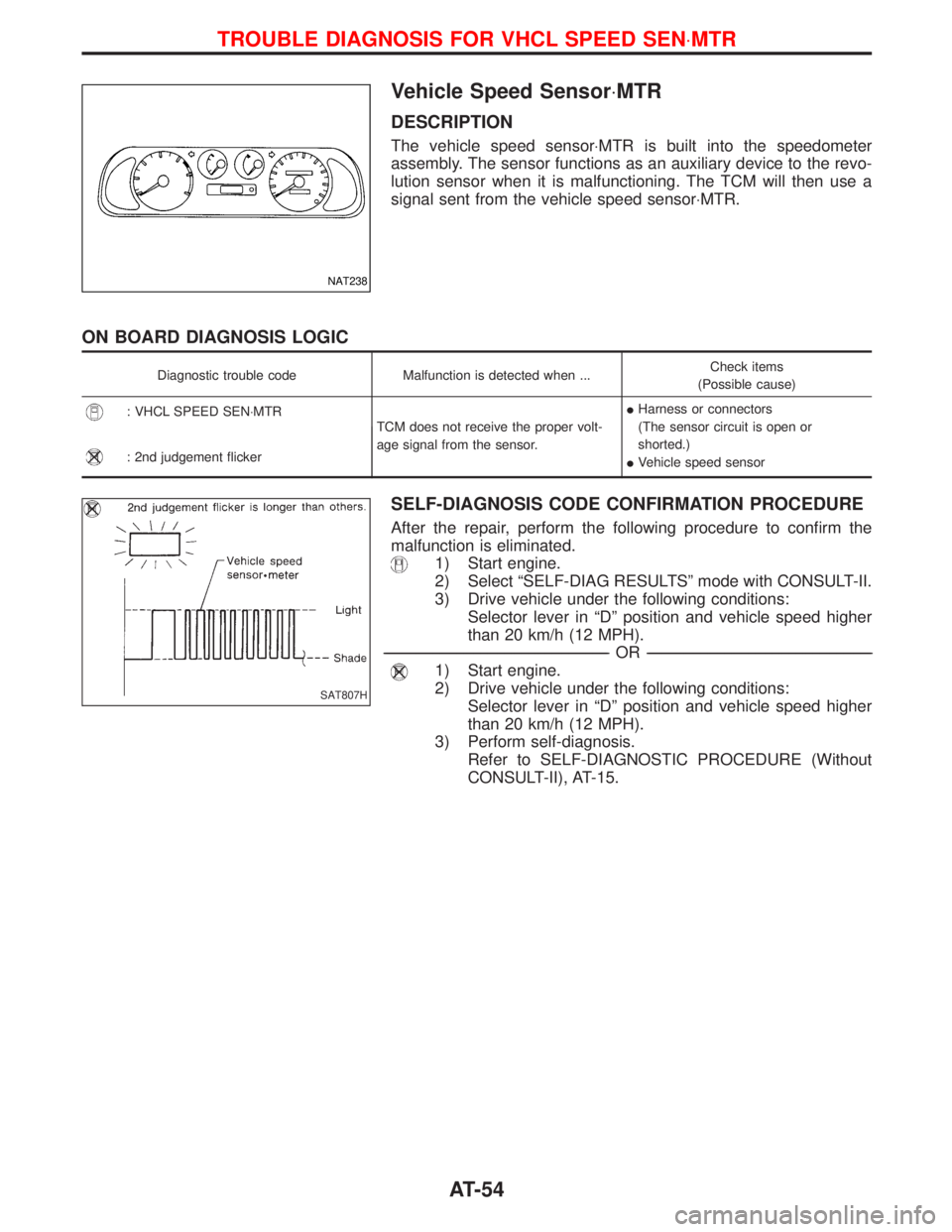
Vehicle Speed Sensor×MTR
DESCRIPTION
The vehicle speed sensor×MTR is built into the speedometer
assembly. The sensor functions as an auxiliary device to the revo-
lution sensor when it is malfunctioning. The TCM will then use a
signal sent from the vehicle speed sensor×MTR.
ON BOARD DIAGNOSIS LOGIC
Diagnostic trouble code Malfunction is detected when ...Check items
(Possible cause)
: VHCL SPEED SEN×MTR
TCM does not receive the proper volt-
age signal from the sensor.IHarness or connectors
(The sensor circuit is open or
shorted.)
IVehicle speed sensor
: 2nd judgement flicker
SELF-DIAGNOSIS CODE CONFIRMATION PROCEDURE
After the repair, perform the following procedure to confirm the
malfunction is eliminated.
1) Start engine.
2) Select ªSELF-DIAG RESULTSº mode with CONSULT-II.
3) Drive vehicle under the following conditions:
Selector lever in ªDº position and vehicle speed higher
than 20 km/h (12 MPH).
------------------------------------------------------------------------------------------------------------------------------------------------------------------------------------------------------------------------------------------------------------OR------------------------------------------------------------------------------------------------------------------------------------------------------------------------------------------------------------------------------------------------------------
1) Start engine.
2) Drive vehicle under the following conditions:
Selector lever in ªDº position and vehicle speed higher
than 20 km/h (12 MPH).
3) Perform self-diagnosis.
Refer to SELF-DIAGNOSTIC PROCEDURE (Without
CONSULT-II), AT-15.
NAT238
SAT807H
TROUBLE DIAGNOSIS FOR VHCL SPEED SEN×MTR
AT-54
Page 57 of 1767
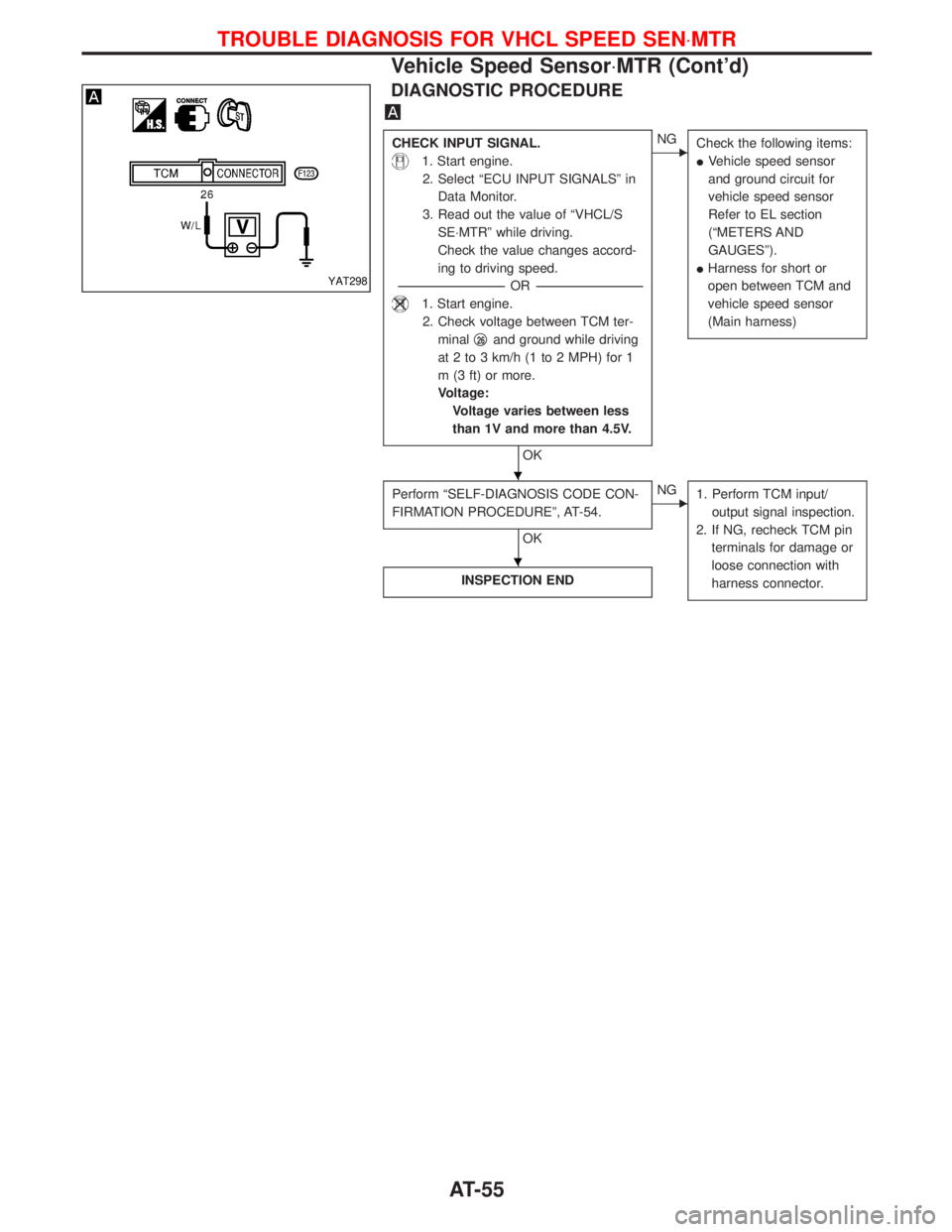
DIAGNOSTIC PROCEDURE
CHECK INPUT SIGNAL.
1. Start engine.
2. Select ªECU INPUT SIGNALSº in
Data Monitor.
3. Read out the value of ªVHCL/S
SE×MTRº while driving.
Check the value changes accord-
ing to driving speed.
-----------------------------------------------------------------------------------------------------------------------OR -----------------------------------------------------------------------------------------------------------------------
1. Start engine.
2. Check voltage between TCM ter-
minalq
26and ground while driving
at 2 to 3 km/h (1 to 2 MPH) for 1
m (3 ft) or more.
Voltage:
Voltage varies between less
than 1V and more than 4.5V.
OK
ENG
Check the following items:
IVehicle speed sensor
and ground circuit for
vehicle speed sensor
Refer to EL section
(ªMETERS AND
GAUGESº).
IHarness for short or
open between TCM and
vehicle speed sensor
(Main harness)
Perform ªSELF-DIAGNOSIS CODE CON-
FIRMATION PROCEDUREº, AT-54.
OK
ENG
1. Perform TCM input/
output signal inspection.
2. If NG, recheck TCM pin
terminals for damage or
loose connection with
harness connector.
INSPECTION END
YAT298
H
H
TROUBLE DIAGNOSIS FOR VHCL SPEED SEN×MTR
Vehicle Speed Sensor×MTR (Cont'd)
AT-55
Page 62 of 1767
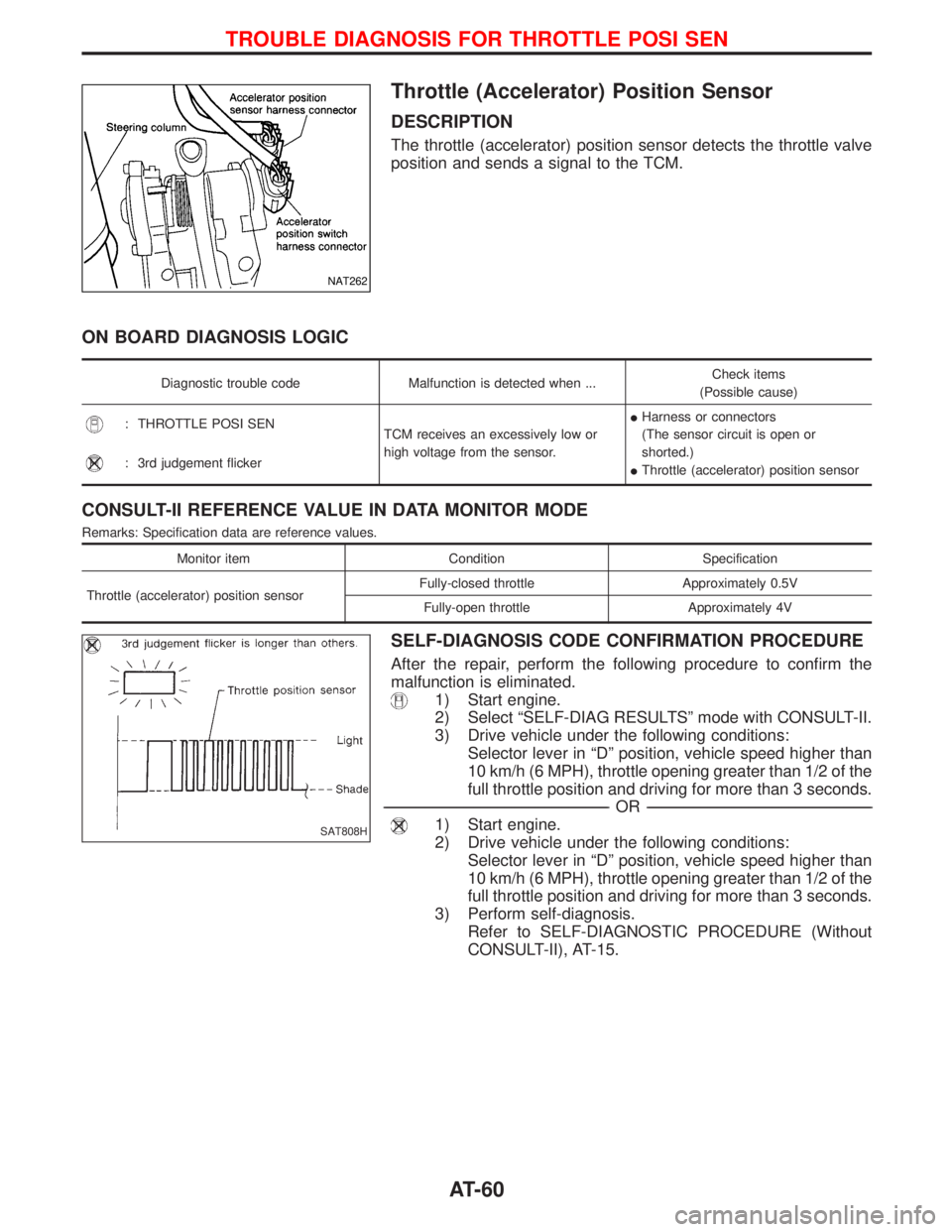
Throttle (Accelerator) Position Sensor
DESCRIPTION
The throttle (accelerator) position sensor detects the throttle valve
position and sends a signal to the TCM.
ON BOARD DIAGNOSIS LOGIC
Diagnostic trouble code Malfunction is detected when ...Check items
(Possible cause)
: THROTTLE POSI SEN
TCM receives an excessively low or
high voltage from the sensor.IHarness or connectors
(The sensor circuit is open or
shorted.)
IThrottle (accelerator) position sensor
: 3rd judgement flicker
CONSULT-II REFERENCE VALUE IN DATA MONITOR MODE
Remarks: Specification data are reference values.
Monitor item Condition Specification
Throttle (accelerator) position sensorFully-closed throttle Approximately 0.5V
Fully-open throttle Approximately 4V
SELF-DIAGNOSIS CODE CONFIRMATION PROCEDURE
After the repair, perform the following procedure to confirm the
malfunction is eliminated.
1) Start engine.
2) Select ªSELF-DIAG RESULTSº mode with CONSULT-II.
3) Drive vehicle under the following conditions:
Selector lever in ªDº position, vehicle speed higher than
10 km/h (6 MPH), throttle opening greater than 1/2 of the
full throttle position and driving for more than 3 seconds.
------------------------------------------------------------------------------------------------------------------------------------------------------------------------------------------------------------------------------------------------------------OR------------------------------------------------------------------------------------------------------------------------------------------------------------------------------------------------------------------------------------------------------------
1) Start engine.
2) Drive vehicle under the following conditions:
Selector lever in ªDº position, vehicle speed higher than
10 km/h (6 MPH), throttle opening greater than 1/2 of the
full throttle position and driving for more than 3 seconds.
3) Perform self-diagnosis.
Refer to SELF-DIAGNOSTIC PROCEDURE (Without
CONSULT-II), AT-15.
NAT262
SAT808H
TROUBLE DIAGNOSIS FOR THROTTLE POSI SEN
AT-60
Page 63 of 1767
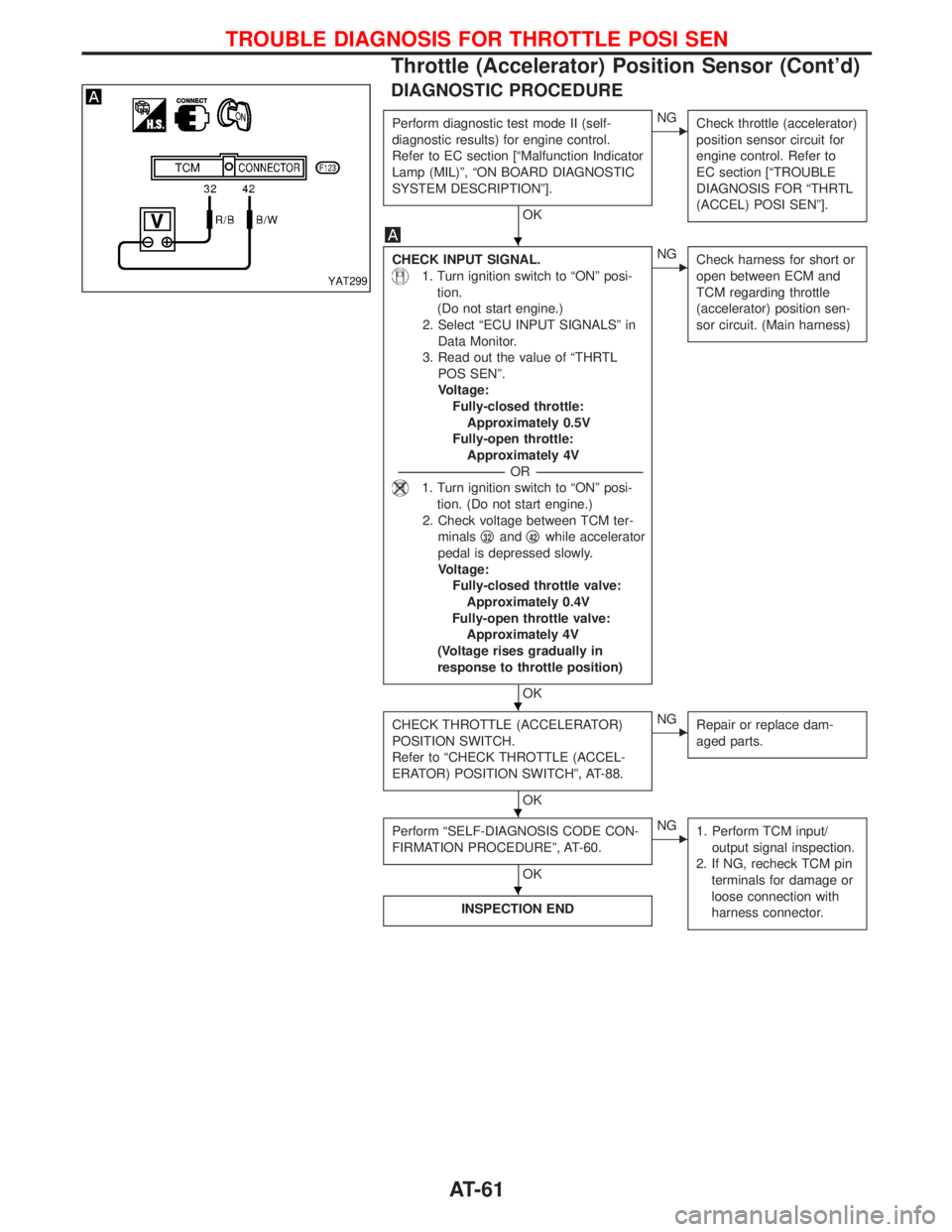
DIAGNOSTIC PROCEDURE
Perform diagnostic test mode II (self-
diagnostic results) for engine control.
Refer to EC section [ªMalfunction Indicator
Lamp (MIL)º, ªON BOARD DIAGNOSTIC
SYSTEM DESCRIPTIONº].
OK
ENG
Check throttle (accelerator)
position sensor circuit for
engine control. Refer to
EC section [ªTROUBLE
DIAGNOSIS FOR ªTHRTL
(ACCEL) POSI SENº].
CHECK INPUT SIGNAL.
1. Turn ignition switch to ªONº posi-
tion.
(Do not start engine.)
2. Select ªECU INPUT SIGNALSº in
Data Monitor.
3. Read out the value of ªTHRTL
POS SENº.
Voltage:
Fully-closed throttle:
Approximately 0.5V
Fully-open throttle:
Approximately 4V
-----------------------------------------------------------------------------------------------------------------------OR -----------------------------------------------------------------------------------------------------------------------
1. Turn ignition switch to ªONº posi-
tion. (Do not start engine.)
2. Check voltage between TCM ter-
minalsq
32andq42while accelerator
pedal is depressed slowly.
Voltage:
Fully-closed throttle valve:
Approximately 0.4V
Fully-open throttle valve:
Approximately 4V
(Voltage rises gradually in
response to throttle position)
OK
ENG
Check harness for short or
open between ECM and
TCM regarding throttle
(accelerator) position sen-
sor circuit. (Main harness)
CHECK THROTTLE (ACCELERATOR)
POSITION SWITCH.
Refer to ªCHECK THROTTLE (ACCEL-
ERATOR) POSITION SWITCHº, AT-88.
OK
ENG
Repair or replace dam-
aged parts.
Perform ªSELF-DIAGNOSIS CODE CON-
FIRMATION PROCEDUREº, AT-60.
OK
ENG
1. Perform TCM input/
output signal inspection.
2. If NG, recheck TCM pin
terminals for damage or
loose connection with
harness connector.
INSPECTION END
YAT299
H
H
H
H
TROUBLE DIAGNOSIS FOR THROTTLE POSI SEN
Throttle (Accelerator) Position Sensor (Cont'd)
AT-61
Page 65 of 1767
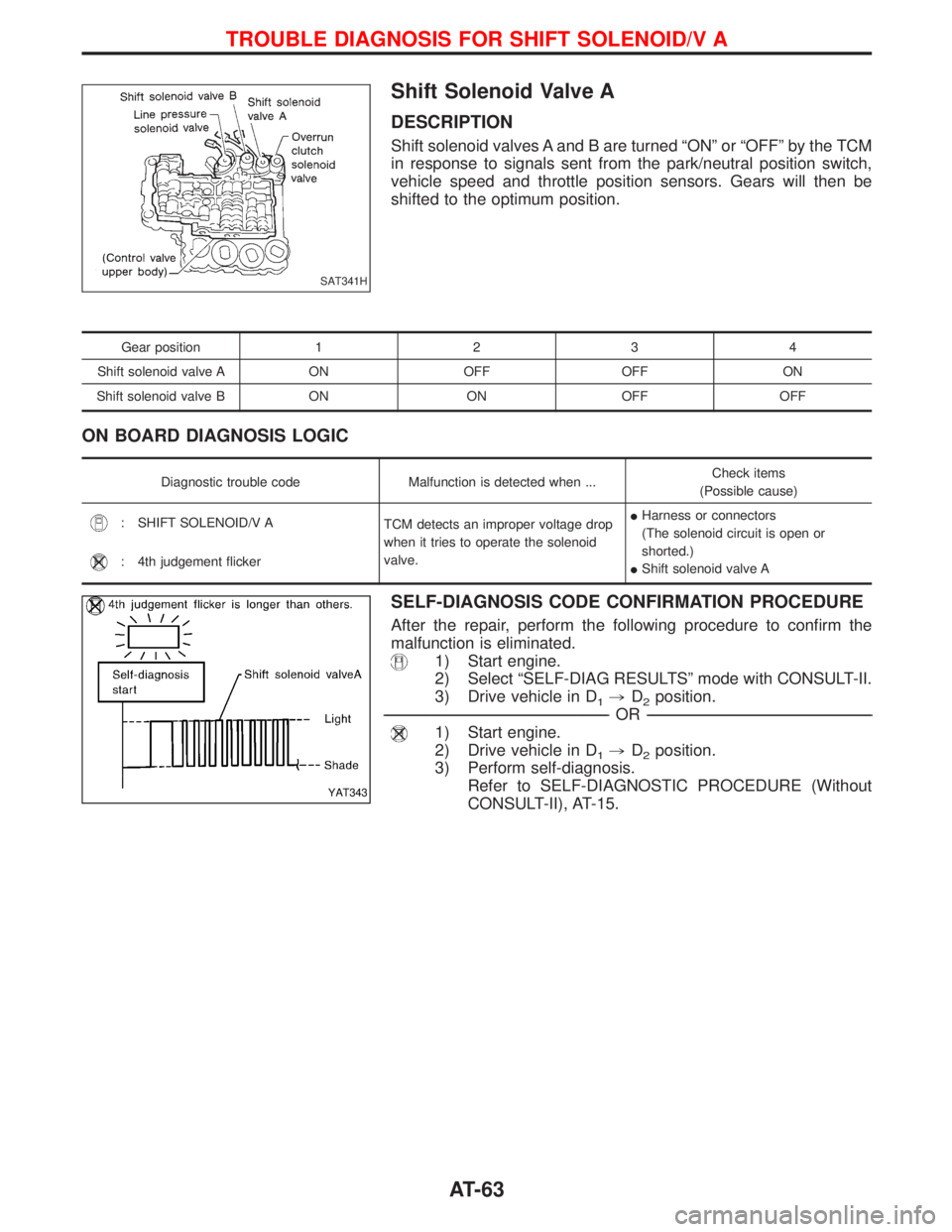
Shift Solenoid Valve A
DESCRIPTION
Shift solenoid valves A and B are turned ªONº or ªOFFº by the TCM
in response to signals sent from the park/neutral position switch,
vehicle speed and throttle position sensors. Gears will then be
shifted to the optimum position.
Gear position1234
Shift solenoid valve A ON OFF OFF ON
Shift solenoid valve B ON ON OFF OFF
ON BOARD DIAGNOSIS LOGIC
Diagnostic trouble code Malfunction is detected when ...Check items
(Possible cause)
: SHIFT SOLENOID/V A
TCM detects an improper voltage drop
when it tries to operate the solenoid
valve.IHarness or connectors
(The solenoid circuit is open or
shorted.)
IShift solenoid valve A
: 4th judgement flicker
SELF-DIAGNOSIS CODE CONFIRMATION PROCEDURE
After the repair, perform the following procedure to confirm the
malfunction is eliminated.
1) Start engine.
2) Select ªSELF-DIAG RESULTSº mode with CONSULT-II.
3) Drive vehicle in D
1,D2position.
------------------------------------------------------------------------------------------------------------------------------------------------------------------------------------------------------------------------------------------------------------OR------------------------------------------------------------------------------------------------------------------------------------------------------------------------------------------------------------------------------------------------------------
1) Start engine.
2) Drive vehicle in D
1,D2position.
3) Perform self-diagnosis.
Refer to SELF-DIAGNOSTIC PROCEDURE (Without
CONSULT-II), AT-15.
SAT341H
YAT343
TROUBLE DIAGNOSIS FOR SHIFT SOLENOID/V A
AT-63
Page 66 of 1767
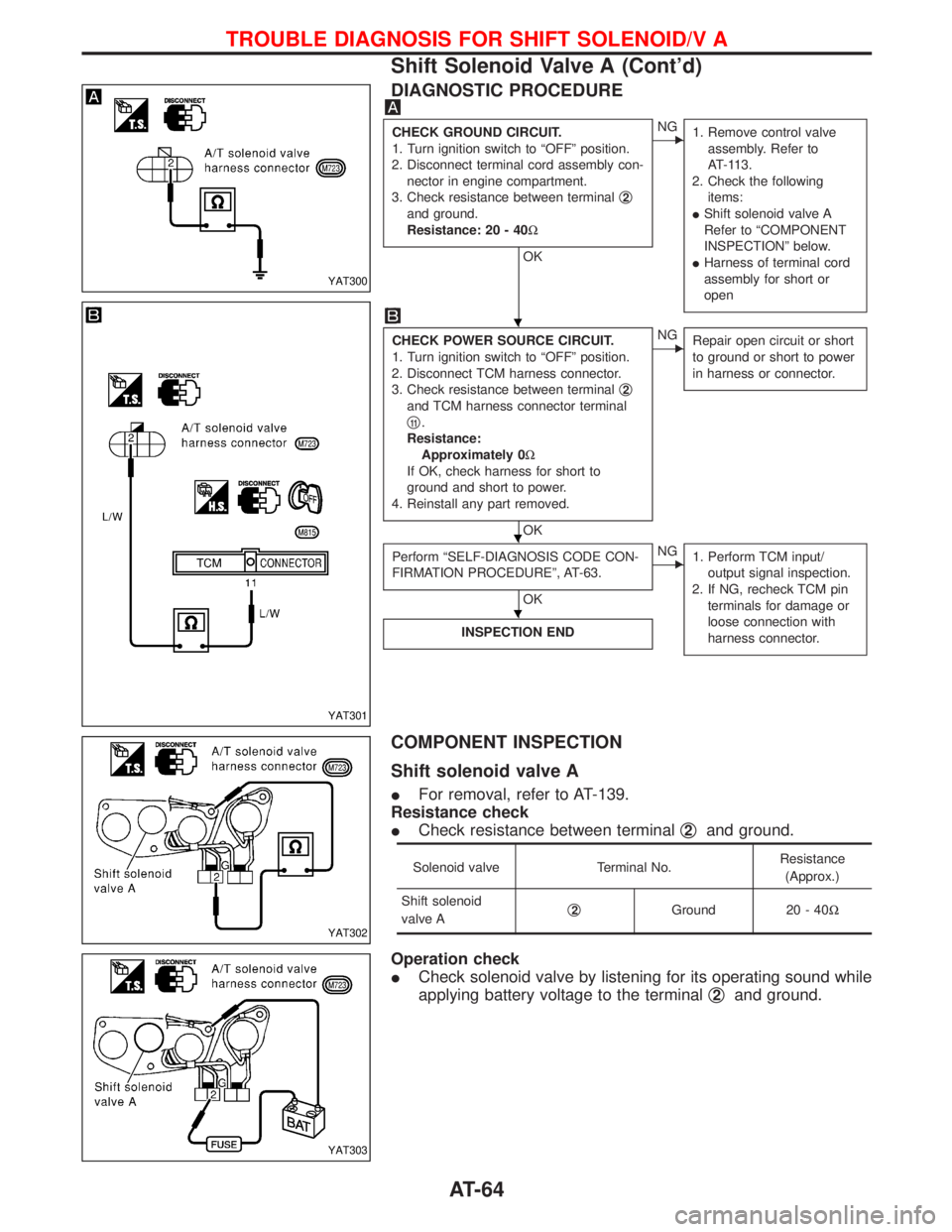
DIAGNOSTIC PROCEDURE
CHECK GROUND CIRCUIT.
1. Turn ignition switch to ªOFFº position.
2. Disconnect terminal cord assembly con-
nector in engine compartment.
3. Check resistance between terminalq
2
and ground.
Resistance: 20 - 40W
OK
ENG
1. Remove control valve
assembly. Refer to
AT-113.
2. Check the following
items:
IShift solenoid valve A
Refer to ªCOMPONENT
INSPECTIONº below.
IHarness of terminal cord
assembly for short or
open
CHECK POWER SOURCE CIRCUIT.
1. Turn ignition switch to ªOFFº position.
2. Disconnect TCM harness connector.
3. Check resistance between terminalq
2
and TCM harness connector terminal
q
11.
Resistance:
Approximately 0W
If OK, check harness for short to
ground and short to power.
4. Reinstall any part removed.
OK
ENG
Repair open circuit or short
to ground or short to power
in harness or connector.
Perform ªSELF-DIAGNOSIS CODE CON-
FIRMATION PROCEDUREº, AT-63.
OK
ENG
1. Perform TCM input/
output signal inspection.
2. If NG, recheck TCM pin
terminals for damage or
loose connection with
harness connector.
INSPECTION END
COMPONENT INSPECTION
Shift solenoid valve A
IFor removal, refer to AT-139.
Resistance check
ICheck resistance between terminalq
2and ground.
Solenoid valve Terminal No.Resistance
(Approx.)
Shift solenoid
valve Aq
2Ground 20 - 40W
Operation check
ICheck solenoid valve by listening for its operating sound while
applying battery voltage to the terminalq
2and ground.
YAT300
YAT301
YAT302
YAT303
H
H
H
TROUBLE DIAGNOSIS FOR SHIFT SOLENOID/V A
Shift Solenoid Valve A (Cont'd)
AT-64