Page 1121 of 1767
REMOVAL
1. Remove the following parts.
IDrain engine coolant. Refer to MA section, ªChanging Engine
Coolantº.
IRemove engine cover. Refer to the figure at left.
IRemove intercooler.
IRemove air hose (on throttle body side).
IRemove injection tube.
IRemove or relocate wires/harnesses and tubes/pipes.
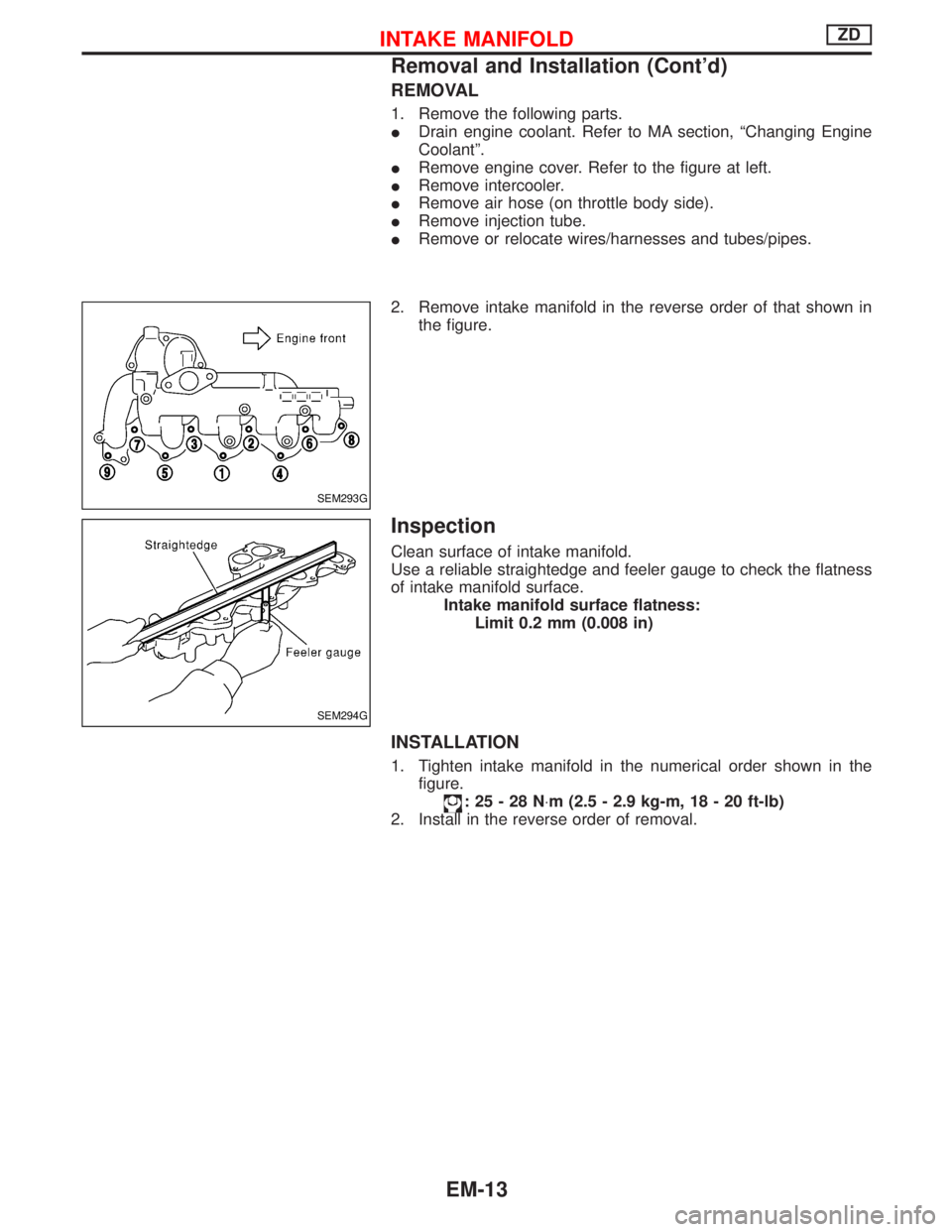
2. Remove intake manifold in the reverse order of that shown in
the figure.
Inspection
Clean surface of intake manifold.
Use a reliable straightedge and feeler gauge to check the flatness
of intake manifold surface.
Intake manifold surface flatness:
Limit 0.2 mm (0.008 in)
INSTALLATION
1. Tighten intake manifold in the numerical order shown in the
figure.
:25-28N×m (2.5 - 2.9 kg-m, 18 - 20 ft-lb)
2. Install in the reverse order of removal.
SEM293G
SEM294G
INTAKE MANIFOLDZD
Removal and Installation (Cont'd)
EM-13
Page 1122 of 1767
Removal and Installation
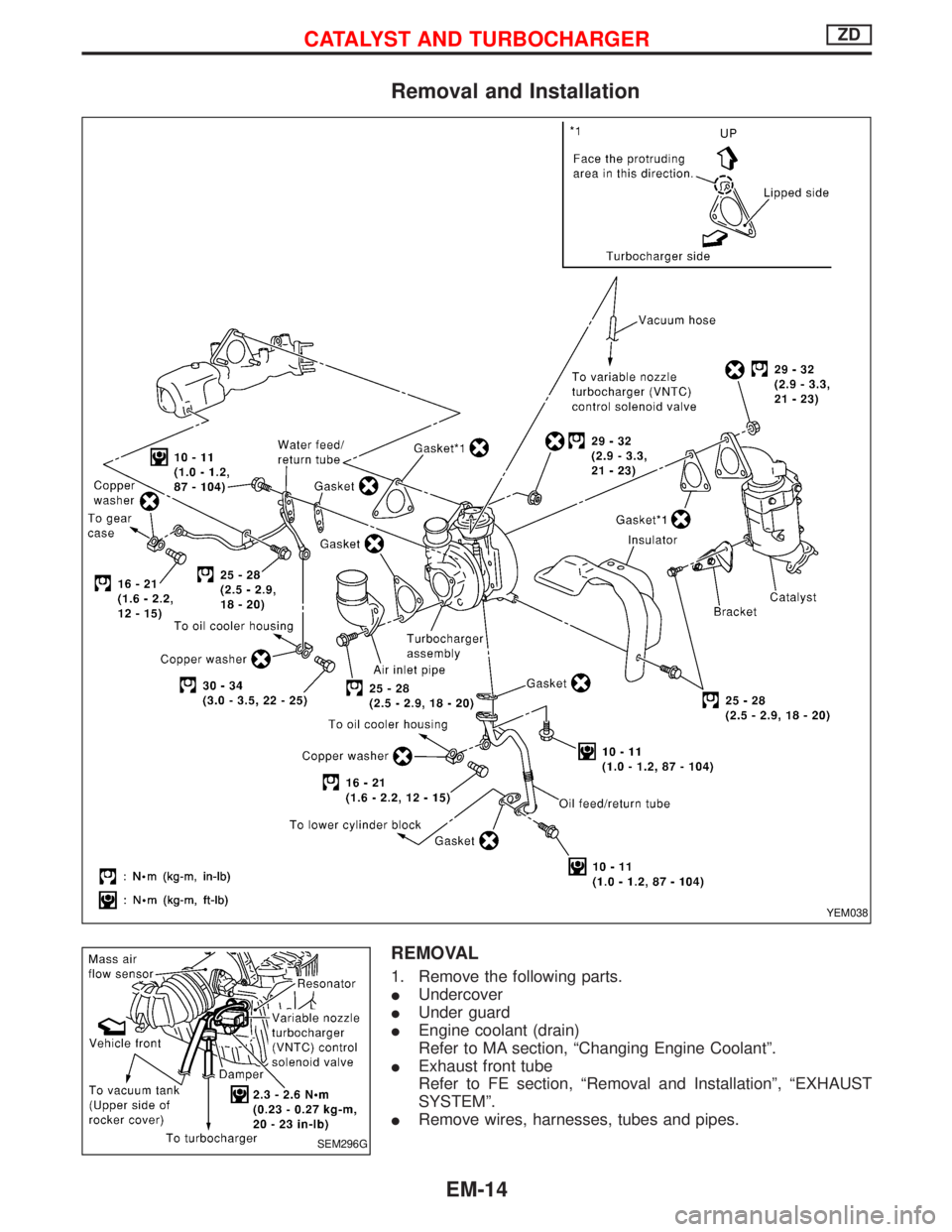
REMOVAL
1. Remove the following parts.
IUndercover
IUnder guard
IEngine coolant (drain)
Refer to MA section, ªChanging Engine Coolantº.
IExhaust front tube
Refer to FE section, ªRemoval and Installationº, ªEXHAUST
SYSTEMº.
IRemove wires, harnesses, tubes and pipes.
YEM038
SEM296G
CATALYST AND TURBOCHARGERZD
EM-14
Page 1125 of 1767
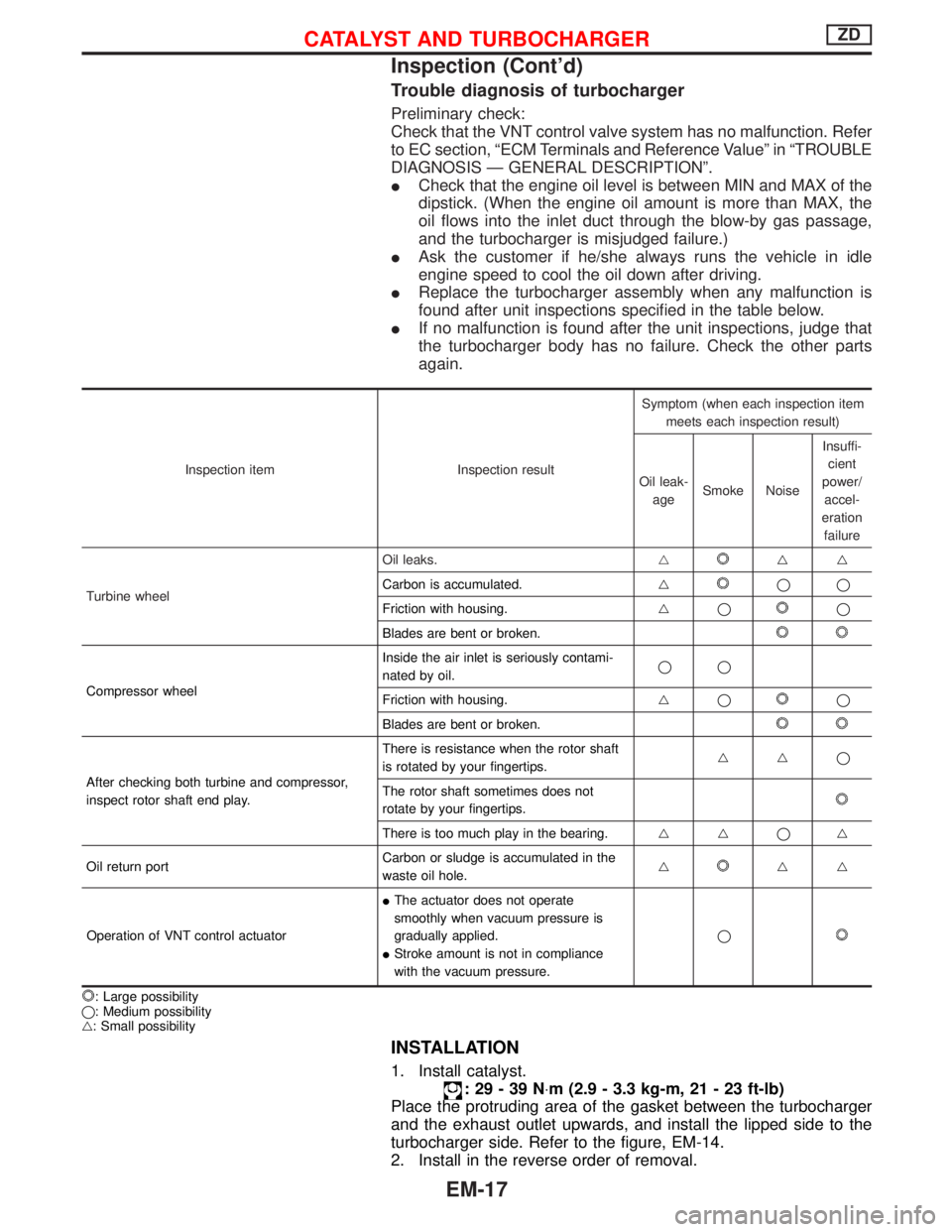
Trouble diagnosis of turbocharger
Preliminary check:
Check that the VNT control valve system has no malfunction. Refer
to EC section, ªECM Terminals and Reference Valueº in ªTROUBLE
DIAGNOSIS Ð GENERAL DESCRIPTIONº.
ICheck that the engine oil level is between MIN and MAX of the
dipstick. (When the engine oil amount is more than MAX, the
oil flows into the inlet duct through the blow-by gas passage,
and the turbocharger is misjudged failure.)
IAsk the customer if he/she always runs the vehicle in idle
engine speed to cool the oil down after driving.
IReplace the turbocharger assembly when any malfunction is
found after unit inspections specified in the table below.
IIf no malfunction is found after the unit inspections, judge that
the turbocharger body has no failure. Check the other parts
again.
Inspection item Inspection resultSymptom (when each inspection item
meets each inspection result)
Oil leak-
ageSmoke NoiseInsuffi-
cient
power/
accel-
eration
failure
Turbine wheelOil leaks.g
gg
Carbon is accumulated.g
qq
Friction with housing.gq
q
Blades are bent or broken.
Compressor wheelInside the air inlet is seriously contami-
nated by oil.qq
Friction with housing.gqq
Blades are bent or broken.
After checking both turbine and compressor,
inspect rotor shaft end play.There is resistance when the rotor shaft
is rotated by your fingertips.ggq
The rotor shaft sometimes does not
rotate by your fingertips.
There is too much play in the bearing.ggqg
Oil return portCarbon or sludge is accumulated in the
waste oil hole.g
gg
Operation of VNT control actuatorIThe actuator does not operate
smoothly when vacuum pressure is
gradually applied.
IStroke amount is not in compliance
with the vacuum pressure.q
: Large possibility
q: Medium possibility
g: Small possibility
INSTALLATION
1. Install catalyst.
:29-39N×m (2.9 - 3.3 kg-m, 21 - 23 ft-lb)
Place the protruding area of the gasket between the turbocharger
and the exhaust outlet upwards, and install the lipped side to the
turbocharger side. Refer to the figure, EM-14.
2. Install in the reverse order of removal.
CATALYST AND TURBOCHARGERZD
Inspection (Cont'd)
EM-17
Page 1128 of 1767
Removal and Installation
REMOVAL
1. Remove the following parts.
IEngine cover
IIntercooler
IAir inlet pipe
IThrottle body
IWires, harnesses, tubes and pipes
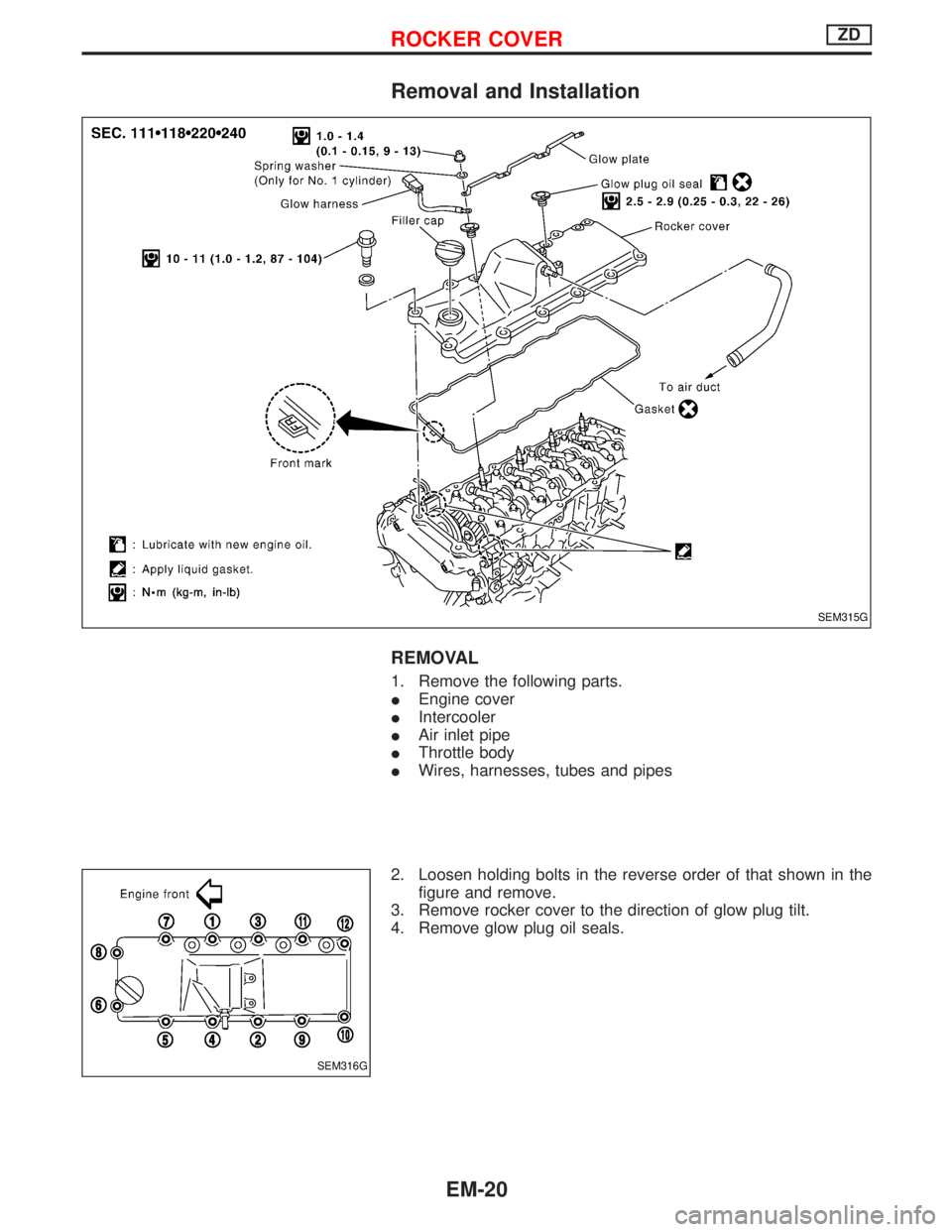
2. Loosen holding bolts in the reverse order of that shown in the
figure and remove.
3. Remove rocker cover to the direction of glow plug tilt.
4. Remove glow plug oil seals.
SEM315G
SEM316G
ROCKER COVERZD
EM-20
Page 1129 of 1767
INSTALLATION
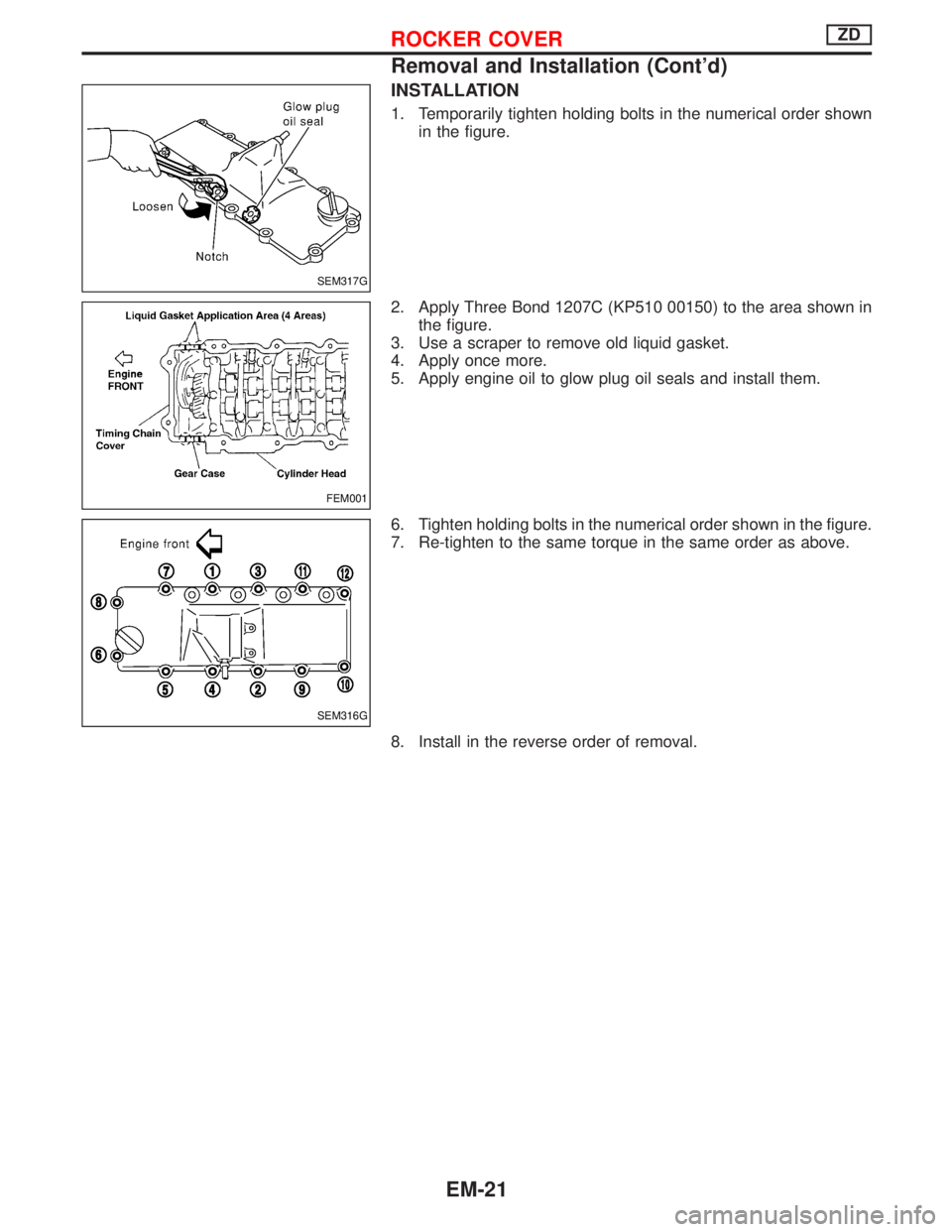
1. Temporarily tighten holding bolts in the numerical order shown
in the figure.
2. Apply Three Bond 1207C (KP510 00150) to the area shown in
the figure.
3. Use a scraper to remove old liquid gasket.
4. Apply once more.
5. Apply engine oil to glow plug oil seals and install them.
6. Tighten holding bolts in the numerical order shown in the figure.
7. Re-tighten to the same torque in the same order as above.
8. Install in the reverse order of removal.
SEM317G
FEM001
SEM316G
ROCKER COVERZD
Removal and Installation (Cont'd)
EM-21
Page 1130 of 1767
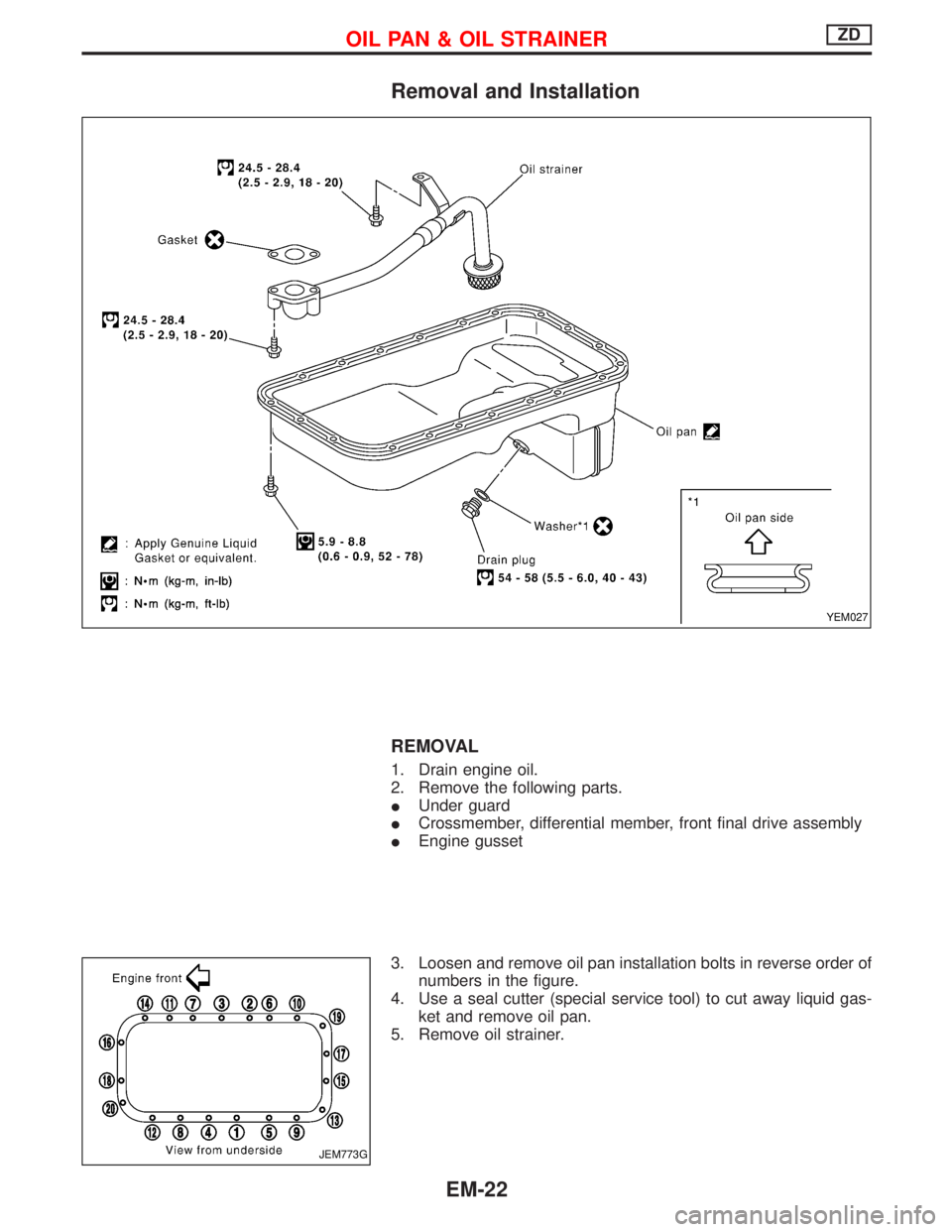
Removal and Installation
REMOVAL
1. Drain engine oil.
2. Remove the following parts.
IUnder guard
ICrossmember, differential member, front final drive assembly
IEngine gusset
3. Loosen and remove oil pan installation bolts in reverse order of
numbers in the figure.
4. Use a seal cutter (special service tool) to cut away liquid gas-
ket and remove oil pan.
5. Remove oil strainer.
YEM027
JEM773G
OIL PAN & OIL STRAINERZD
EM-22
Page 1132 of 1767
Removal and Installation
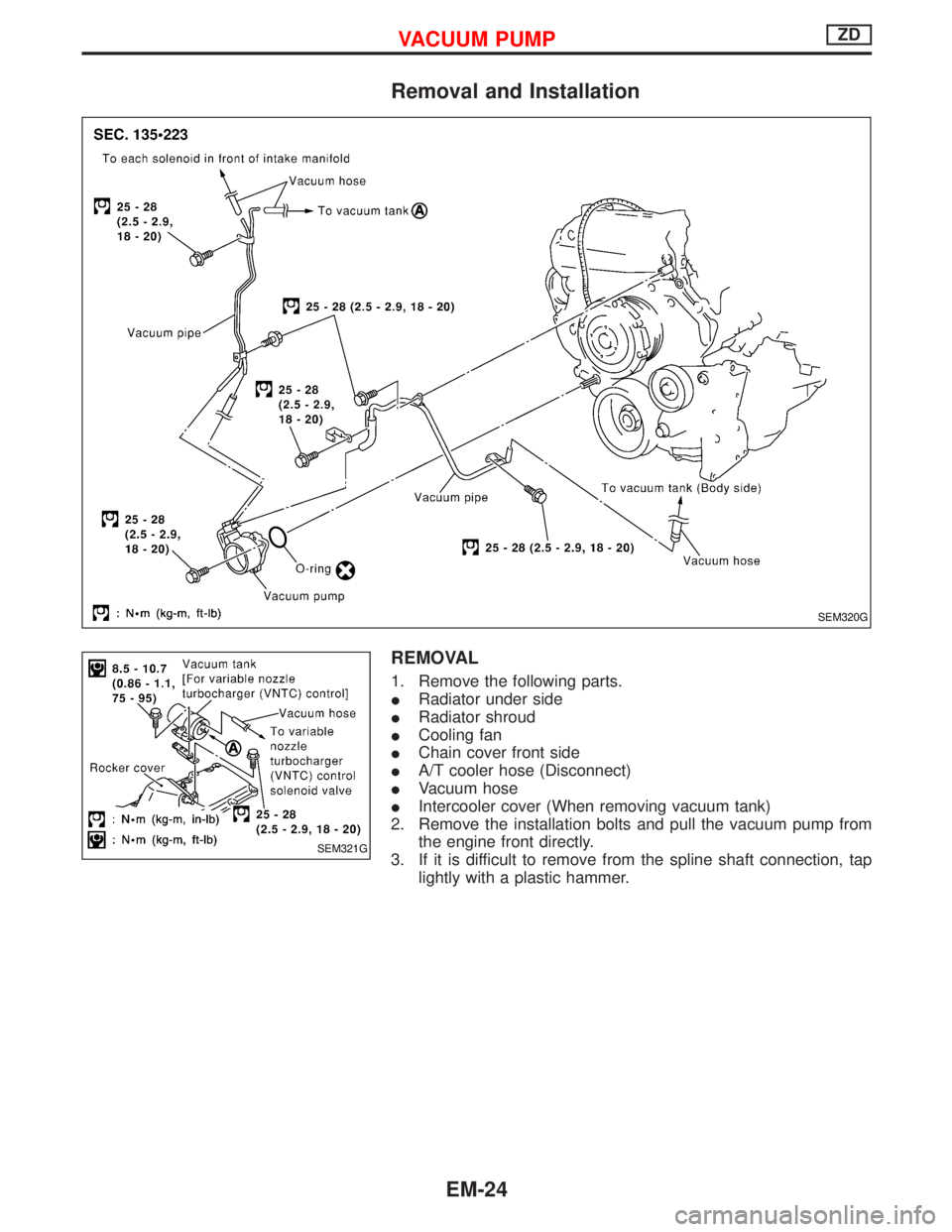
REMOVAL
1. Remove the following parts.
IRadiator under side
IRadiator shroud
ICooling fan
IChain cover front side
IA/T cooler hose (Disconnect)
IVacuum hose
IIntercooler cover (When removing vacuum tank)
2. Remove the installation bolts and pull the vacuum pump from
the engine front directly.
3. If it is difficult to remove from the spline shaft connection, tap
lightly with a plastic hammer.
SEM320G
SEM321G
VACUUM PUMPZD
EM-24
Page 1133 of 1767
INSPECTION
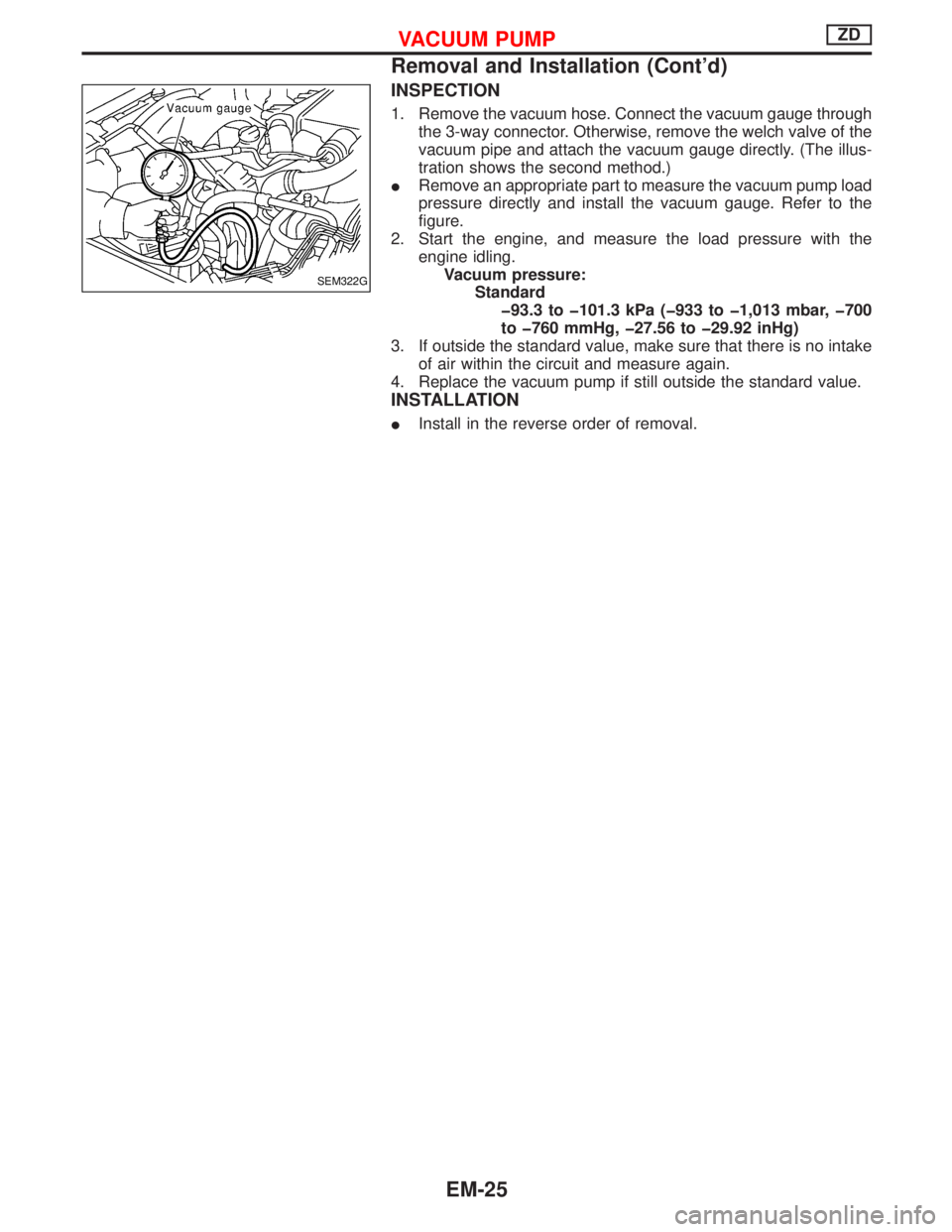
1. Remove the vacuum hose. Connect the vacuum gauge through
the 3-way connector. Otherwise, remove the welch valve of the
vacuum pipe and attach the vacuum gauge directly. (The illus-
tration shows the second method.)
IRemove an appropriate part to measure the vacuum pump load
pressure directly and install the vacuum gauge. Refer to the
figure.
2. Start the engine, and measure the load pressure with the
engine idling.
Vacuum pressure:
Standard
þ93.3 to þ101.3 kPa (þ933 to þ1,013 mbar, þ700
to þ760 mmHg, þ27.56 to þ29.92 inHg)
3. If outside the standard value, make sure that there is no intake
of air within the circuit and measure again.
4. Replace the vacuum pump if still outside the standard value.
INSTALLATION
IInstall in the reverse order of removal.
SEM322G
VACUUM PUMPZD
Removal and Installation (Cont'd)
EM-25