Page 630 of 1767
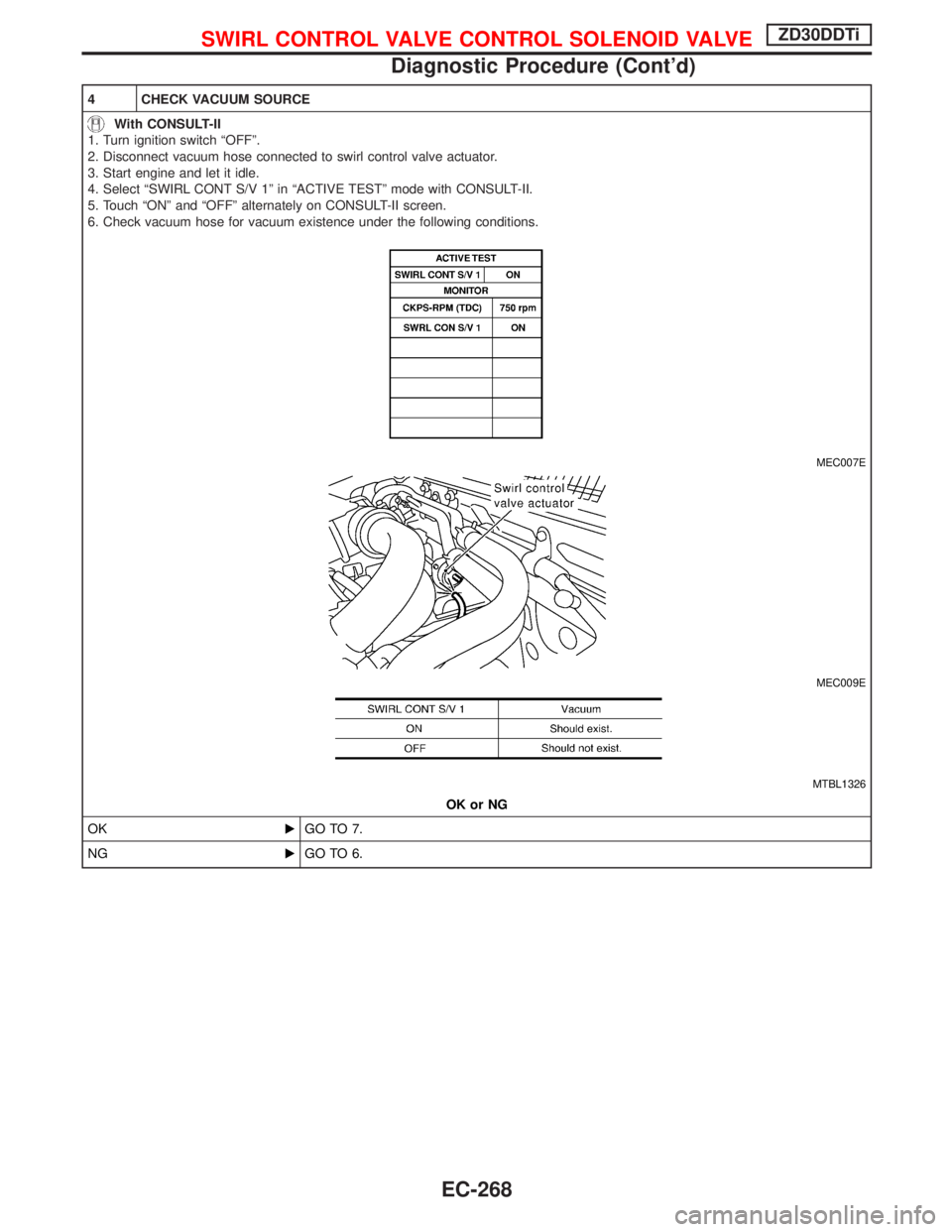
4 CHECK VACUUM SOURCE
With CONSULT-II
1. Turn ignition switch ªOFFº.
2. Disconnect vacuum hose connected to swirl control valve actuator.
3. Start engine and let it idle.
4. Select ªSWIRL CONT S/V 1º in ªACTIVE TESTº mode with CONSULT-II.
5. Touch ªONº and ªOFFº alternately on CONSULT-II screen.
6. Check vacuum hose for vacuum existence under the following conditions.
MEC007E
MEC009E
MTBL1326
OK or NG
OKEGO TO 7.
NGEGO TO 6.
SWIRL CONTROL VALVE CONTROL SOLENOID VALVEZD30DDTi
Diagnostic Procedure (Cont'd)
EC-268
Page 631 of 1767
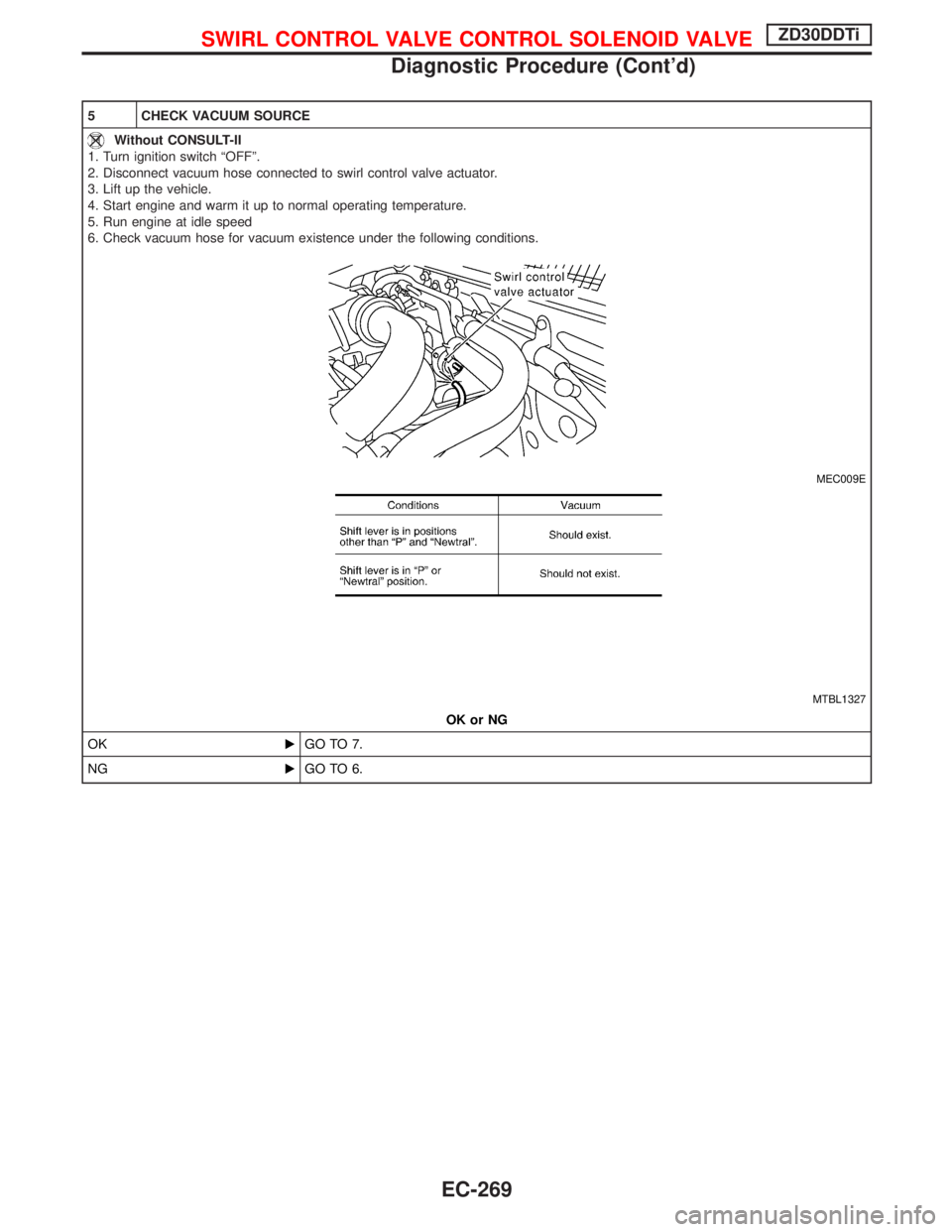
5 CHECK VACUUM SOURCE
Without CONSULT-II
1. Turn ignition switch ªOFFº.
2. Disconnect vacuum hose connected to swirl control valve actuator.
3. Lift up the vehicle.
4. Start engine and warm it up to normal operating temperature.
5. Run engine at idle speed
6. Check vacuum hose for vacuum existence under the following conditions.
MEC009E
MTBL1327
OK or NG
OKEGO TO 7.
NGEGO TO 6.
SWIRL CONTROL VALVE CONTROL SOLENOID VALVEZD30DDTi
Diagnostic Procedure (Cont'd)
EC-269
Page 635 of 1767
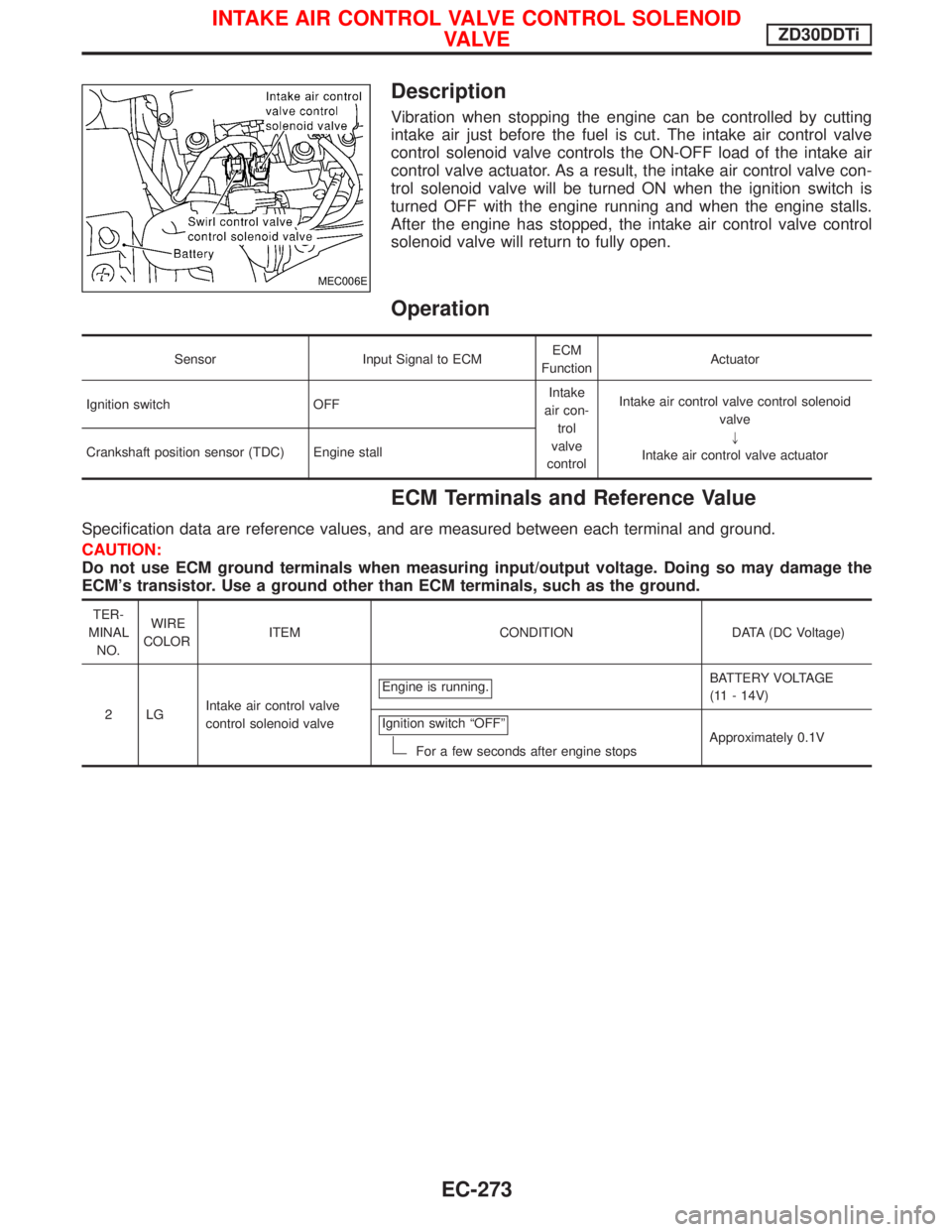
Description
Vibration when stopping the engine can be controlled by cutting
intake air just before the fuel is cut. The intake air control valve
control solenoid valve controls the ON-OFF load of the intake air
control valve actuator. As a result, the intake air control valve con-
trol solenoid valve will be turned ON when the ignition switch is
turned OFF with the engine running and when the engine stalls.
After the engine has stopped, the intake air control valve control
solenoid valve will return to fully open.
Operation
Sensor Input Signal to ECMECM
FunctionActuator
Ignition switch OFFIntake
air con-
trol
valve
controlIntake air control valve control solenoid
valve
"
Intake air control valve actuator Crankshaft position sensor (TDC) Engine stall
ECM Terminals and Reference Value
Specification data are reference values, and are measured between each terminal and ground.
CAUTION:
Do not use ECM ground terminals when measuring input/output voltage. Doing so may damage the
ECM's transistor. Use a ground other than ECM terminals, such as the ground.
TER-
MINAL
NO.WIRE
COLORITEM CONDITION DATA (DC Voltage)
2LGIntake air control valve
control solenoid valveEngine is running.
BATTERY VOLTAGE
(11 - 14V)
Ignition switch ªOFFº
For a few seconds after engine stopsApproximately 0.1V
MEC006E
INTAKE AIR CONTROL VALVE CONTROL SOLENOID
VA LV EZD30DDTi
EC-273
Page 637 of 1767
Diagnostic Procedure
1 CHECK OVERALL FUNCTION
1. Start engine and let it idle.
2. Make sure that intake air control valve actuator rod moves when turning ignition switch ªOFFº.
MEC011E
OK or NG
OKEINSPECTION END
NGEGO TO 2.
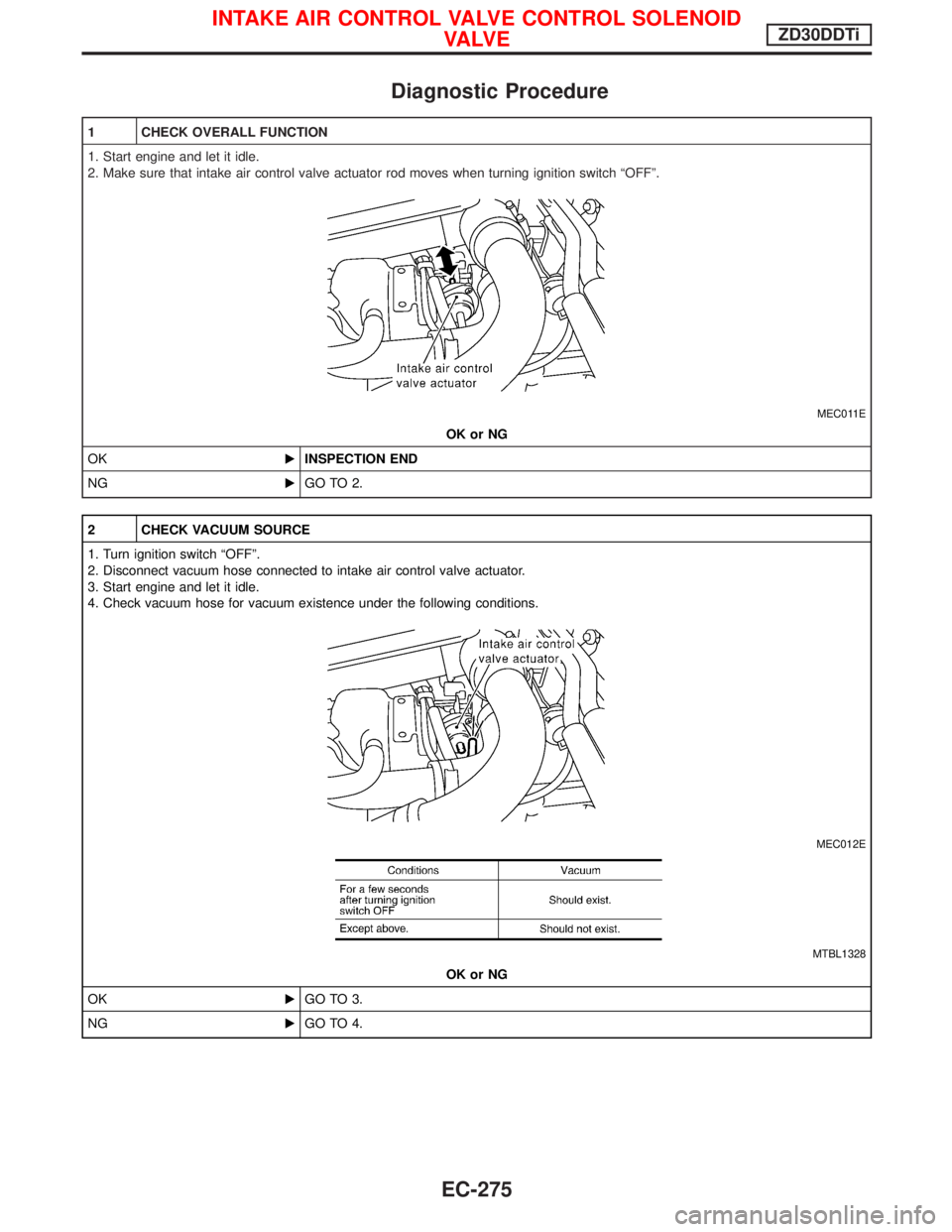
2 CHECK VACUUM SOURCE
1. Turn ignition switch ªOFFº.
2. Disconnect vacuum hose connected to intake air control valve actuator.
3. Start engine and let it idle.
4. Check vacuum hose for vacuum existence under the following conditions.
MEC012E
MTBL1328
OK or NG
OKEGO TO 3.
NGEGO TO 4.
INTAKE AIR CONTROL VALVE CONTROL SOLENOID
VA LV EZD30DDTi
EC-275
Page 643 of 1767
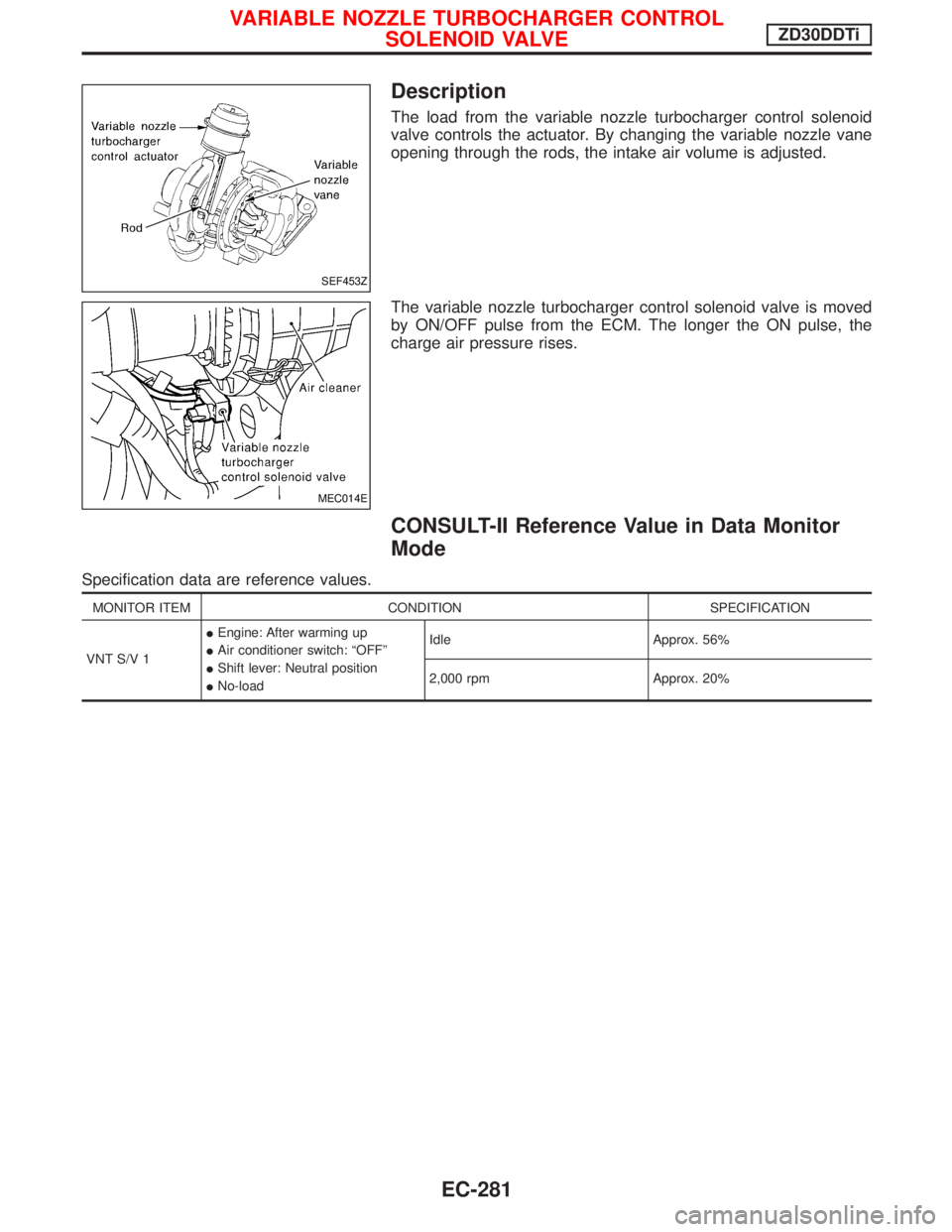
Description
The load from the variable nozzle turbocharger control solenoid
valve controls the actuator. By changing the variable nozzle vane
opening through the rods, the intake air volume is adjusted.
The variable nozzle turbocharger control solenoid valve is moved
by ON/OFF pulse from the ECM. The longer the ON pulse, the
charge air pressure rises.
CONSULT-II Reference Value in Data Monitor
Mode
Specification data are reference values.
MONITOR ITEM CONDITION SPECIFICATION
VNT S/V 1IEngine: After warming up
IAir conditioner switch: ªOFFº
IShift lever: Neutral position
INo-loadIdle Approx. 56%
2,000 rpm Approx. 20%
SEF453Z
MEC014E
VARIABLE NOZZLE TURBOCHARGER CONTROL
SOLENOID VALVEZD30DDTi
EC-281
Page 644 of 1767
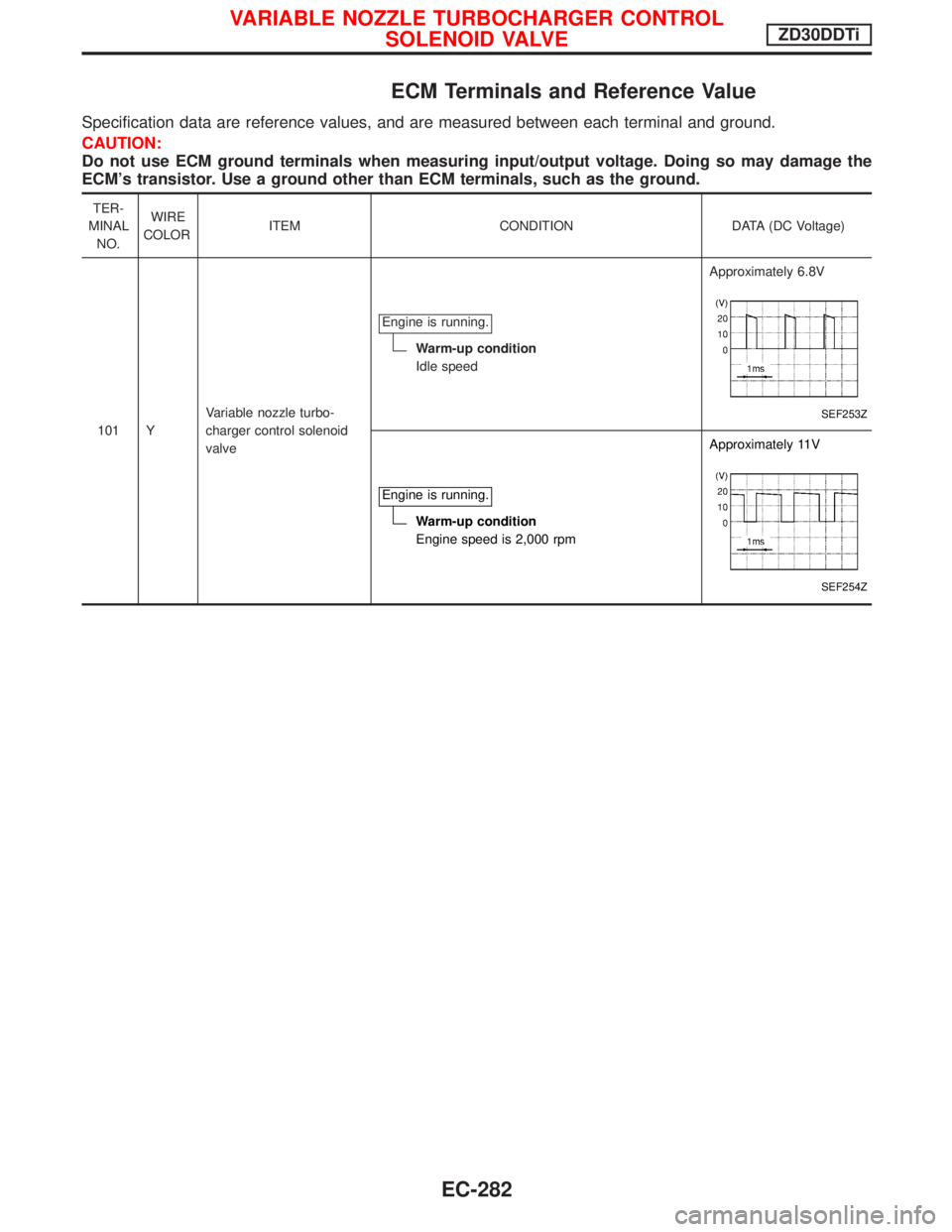
ECM Terminals and Reference Value
Specification data are reference values, and are measured between each terminal and ground.
CAUTION:
Do not use ECM ground terminals when measuring input/output voltage. Doing so may damage the
ECM's transistor. Use a ground other than ECM terminals, such as the ground.
TER-
MINAL
NO.WIRE
COLORITEM CONDITION DATA (DC Voltage)
101 YVariable nozzle turbo-
charger control solenoid
valveEngine is running.
Warm-up condition
Idle speedApproximately 6.8V
SEF253Z
Engine is running.
Warm-up condition
Engine speed is 2,000 rpmApproximately 11V
SEF254Z
VARIABLE NOZZLE TURBOCHARGER CONTROL
SOLENOID VALVEZD30DDTi
EC-282
Page 646 of 1767
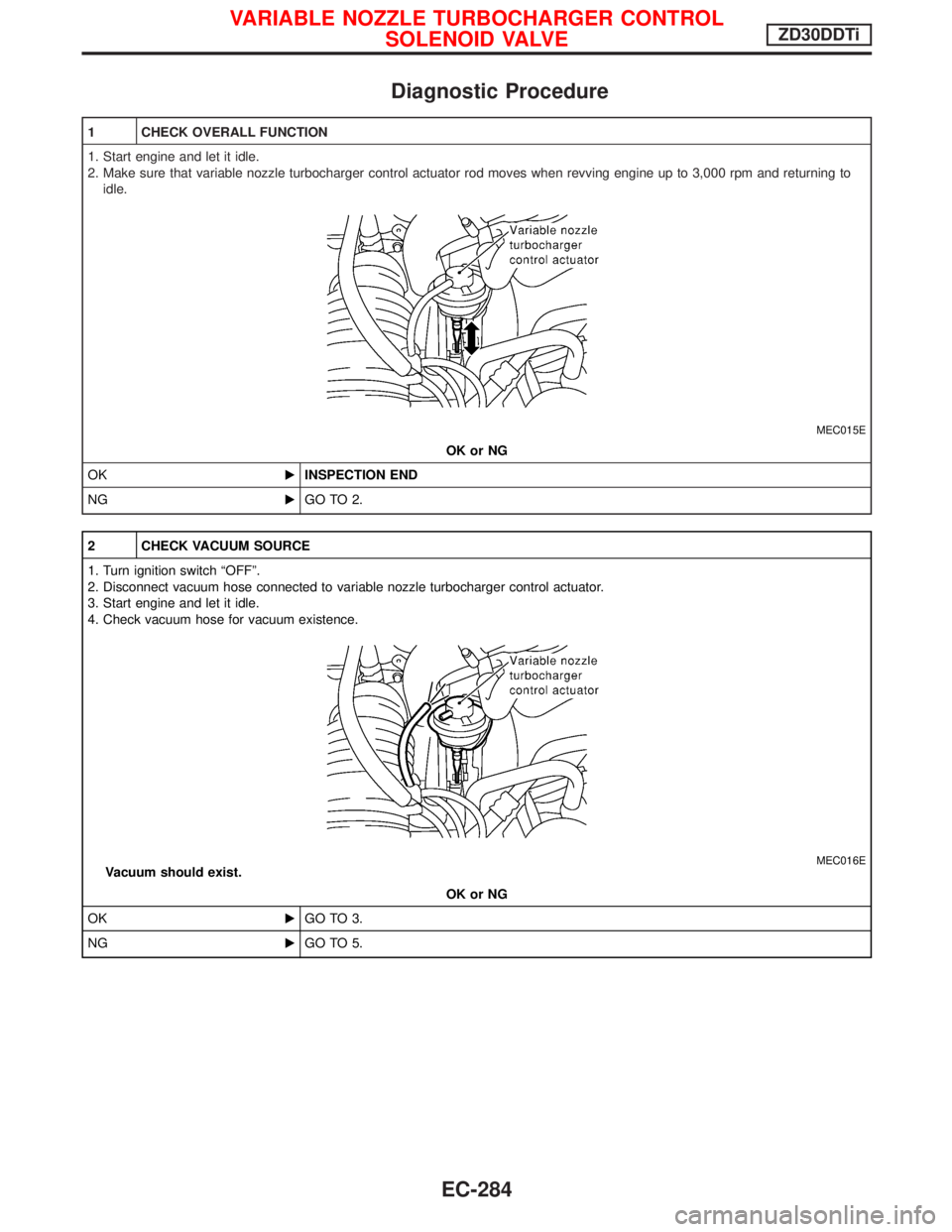
Diagnostic Procedure
1 CHECK OVERALL FUNCTION
1. Start engine and let it idle.
2. Make sure that variable nozzle turbocharger control actuator rod moves when revving engine up to 3,000 rpm and returning to
idle.
MEC015E
OK or NG
OKEINSPECTION END
NGEGO TO 2.
2 CHECK VACUUM SOURCE
1. Turn ignition switch ªOFFº.
2. Disconnect vacuum hose connected to variable nozzle turbocharger control actuator.
3. Start engine and let it idle.
4. Check vacuum hose for vacuum existence.
MEC016EVacuum should exist.
OK or NG
OKEGO TO 3.
NGEGO TO 5.
VARIABLE NOZZLE TURBOCHARGER CONTROL
SOLENOID VALVEZD30DDTi
EC-284
Page 654 of 1767
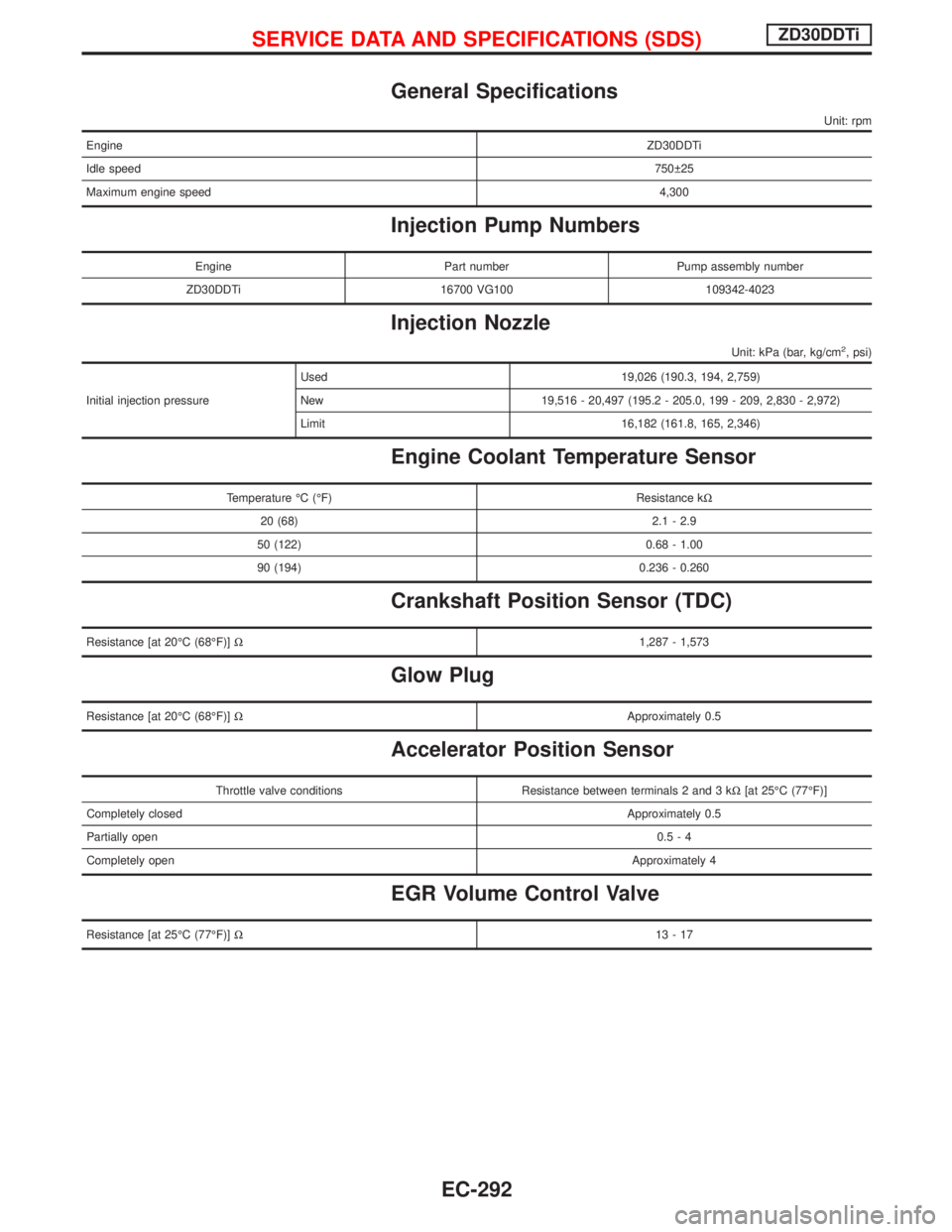
General Specifications
Unit: rpm
EngineZD30DDTi
Idle speed750 25
Maximum engine speed4,300
Injection Pump Numbers
Engine Part number Pump assembly number
ZD30DDTi 16700 VG100 109342-4023
Injection Nozzle
Unit: kPa (bar, kg/cm2, psi)
Initial injection pressureUsed 19,026 (190.3, 194, 2,759)
New 19,516 - 20,497 (195.2 - 205.0, 199 - 209, 2,830 - 2,972)
Limit 16,182 (161.8, 165, 2,346)
Engine Coolant Temperature Sensor
Temperature ÉC (ÉF) Resistance kW
20 (68) 2.1 - 2.9
50 (122) 0.68 - 1.00
90 (194) 0.236 - 0.260
Crankshaft Position Sensor (TDC)
Resistance [at 20ÉC (68ÉF)]W1,287 - 1,573
Glow Plug
Resistance [at 20ÉC (68ÉF)]WApproximately 0.5
Accelerator Position Sensor
Throttle valve conditions Resistance between terminals 2 and 3 kW[at 25ÉC (77ÉF)]
Completely closedApproximately 0.5
Partially open0.5-4
Completely openApproximately 4
EGR Volume Control Valve
Resistance [at 25ÉC (77ÉF)]W13-17
SERVICE DATA AND SPECIFICATIONS (SDS)ZD30DDTi
EC-292