2002 NISSAN PATHFINDER ECU
[x] Cancel search: ECUPage 224 of 288
washer. Securely tighten the drain plug with
a wrench. Do not use excessive force.
Drain plug tightening torque:
22 to 29 ft-lb (29 to 39 N×m)
7. Refill engine with recommended oil through
the oil filler opening, then install the oil filler
cap securely.
See ªCapacities and recommended
fuel/lubricantsº in the ª9. Technical and
consumer informationº section for drain and
refill capacity.
The drain and refill capacity depends on the
oil temperature and drain time. Use these
specifications for reference only. Always
use the dipstick to determine when the
proper amount of oil is in the engine.
8. Start the engine.
Check for leakage around the drain plug.
Correct as required.
9. Turn the engine off and wait more than 10
minutes. Check the oil level with the dip-
stick. Add engine oil if necessary.
WARNING
IProlonged and repeated contact withused engine oil may cause skin can-
cer.
ITry to avoid direct skin contact with
used oil. If skin contact is made, wash
thoroughly with soap or hand cleaner
as soon as possible.
IKeep used engine oil out of reach of
children.
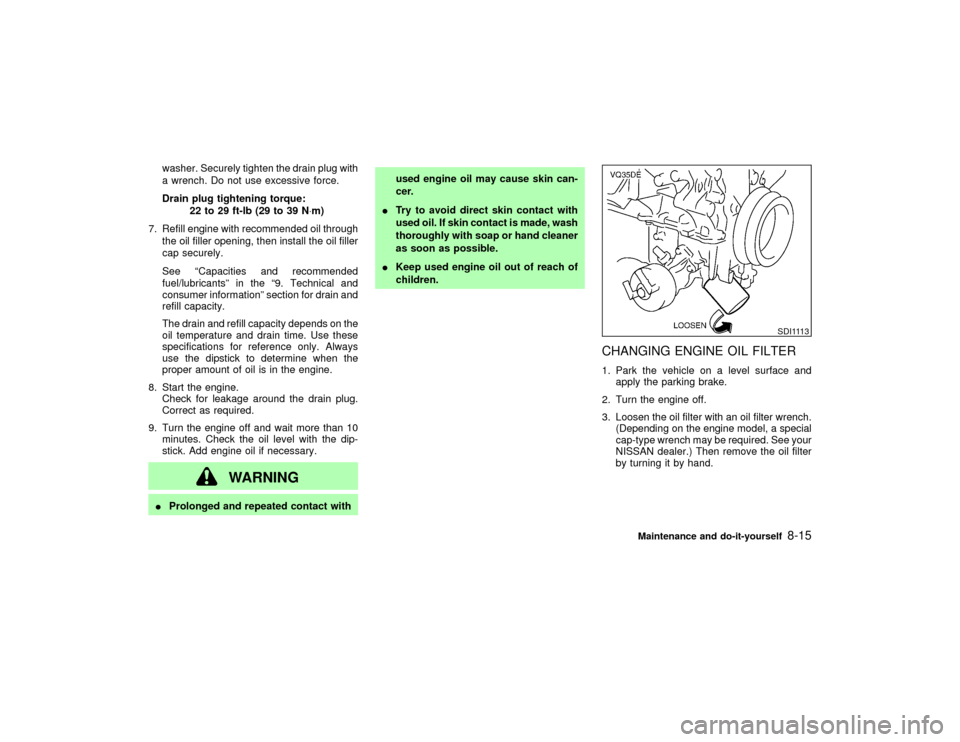
CHANGING ENGINE OIL FILTER1. Park the vehicle on a level surface and
apply the parking brake.
2. Turn the engine off.
3. Loosen the oil filter with an oil filter wrench.
(Depending on the engine model, a special
cap-type wrench may be required. See your
NISSAN dealer.) Then remove the oil filter
by turning it by hand.
SDI1113
Maintenance and do-it-yourself
8-15
Z
01.9.21/R50-D/V5
X
Page 230 of 288
IKeep the battery surface clean and dry. Any
corrosion should be washed off with a
solution of baking soda and water.
IMake certain the terminal connections are
clean and securely tightened.
IIf the vehicle is not to be used for 30 days or
longer, disconnect the (Ð) negative battery
terminal cable to prevent discharge.
WARNING
IDo not expose the battery to flames
or electrical sparks. Hydrogen gas
generated by battery action is explo-
sive. Do not allow battery fluid to
contact your skin, eyes, fabrics, or
painted surfaces. After touching a
battery or battery cap, do not touch or
rub your eyes. Thoroughly wash your
hands. If the acid contacts your eyes,
skin or clothing, immediately flush
with water for at least 15 minutes and
seek medical attention.
IWhen working on or near a battery,
always wear suitable eye protection
and remove all jewelry.IBattery posts, terminals and related
accessories contain lead and lead
compounds. Wash hands after han-
dling.
IKeep the battery out of the reach of
children.
IDo not operate the vehicle if the fluid
in the battery is low. Low battery fluid
can cause a higher load on the bat-
tery which can generate heat, reduce
battery life, and in some cases lead to
an explosion.
JUMP STARTINGIf jump starting is necessary, see ªJump start-
ingº in the ª6. In case of emergencyº section. If
the engine does not start by jump starting, the
battery may have to be replaced. Contact your
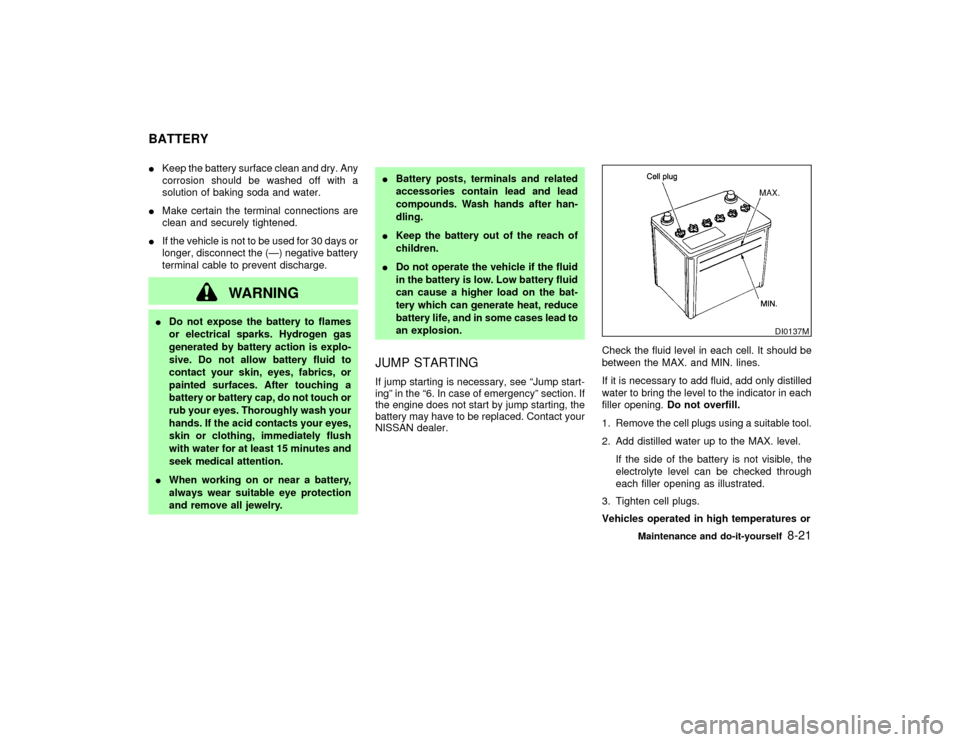
NISSAN dealer.Check the fluid level in each cell. It should be
between the MAX. and MIN. lines.
If it is necessary to add fluid, add only distilled
water to bring the level to the indicator in each
filler opening.Do not overfill.
1. Remove the cell plugs using a suitable tool.
2. Add distilled water up to the MAX. level.
If the side of the battery is not visible, the
electrolyte level can be checked through
each filler opening as illustrated.
3. Tighten cell plugs.
Vehicles operated in high temperatures or
DI0137M
BATTERY
Maintenance and do-it-yourself
8-21
Z
01.9.21/R50-D/V5
X
Page 232 of 288
REPLACING SPARK PLUGS
WARNING
Be sure the engine and ignition switch
are off and that the parking brake is
engaged securely.
CAUTION
Be sure to use the correct socket toremove the spark plugs. An incorrect
socket can cause damage the spark
plugs.
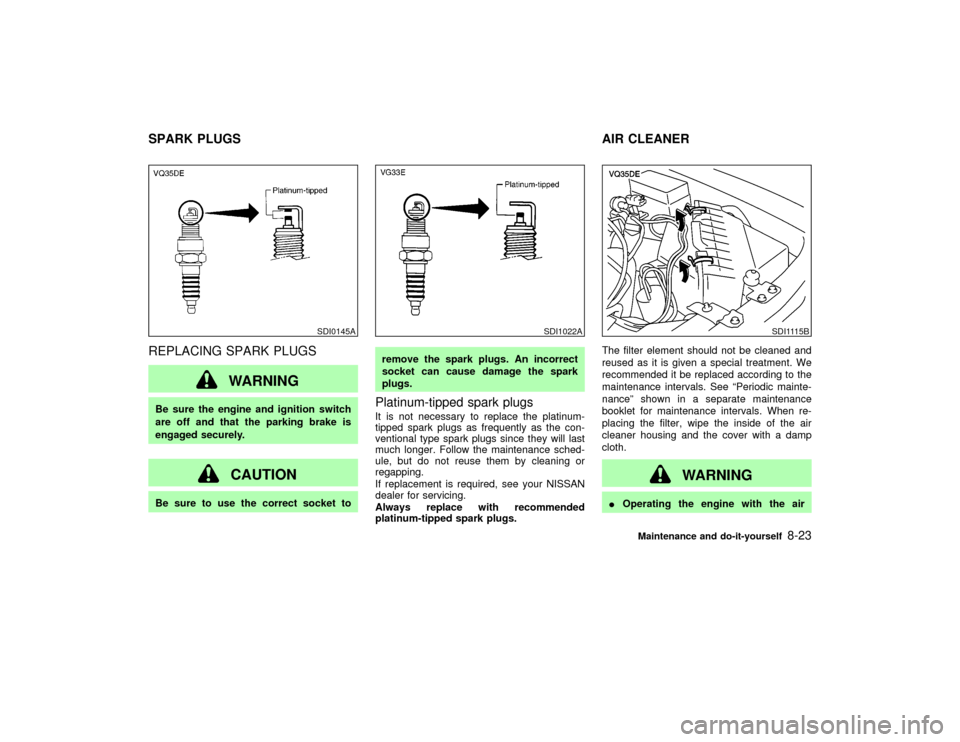
Platinum-tipped spark plugsIt is not necessary to replace the platinum-
tipped spark plugs as frequently as the con-
ventional type spark plugs since they will last
much longer. Follow the maintenance sched-
ule, but do not reuse them by cleaning or
regapping.
If replacement is required, see your NISSAN
dealer for servicing.
Always replace with recommended
platinum-tipped spark plugs.The filter element should not be cleaned and
reused as it is given a special treatment. We
recommended it be replaced according to the
maintenance intervals. See ªPeriodic mainte-
nanceº shown in a separate maintenance
booklet for maintenance intervals. When re-
placing the filter, wipe the inside of the air
cleaner housing and the cover with a damp
cloth.
WARNING
IOperating the engine with the air
SDI0145A
SDI1022A
SDI1115B
SPARK PLUGS AIR CLEANER
Maintenance and do-it-yourself
8-23
Z
01.9.21/R50-D/V5
X
Page 238 of 288

KEYFOB BATTERY
REPLACEMENTReplace the battery as follows:
1. Open the lid using a suitable tool.2. Replace the battery with a new one.
Recommended battery: Sanyo CR2025 or
equivalent
Make sure that theÅside faces the
bottom case.
3. Close the lid securely.
4. Push the keyfob button two or three times
to check its operation.
See your NISSAN dealer if you need any
assistance for replacement.
If the battery is removed for any reason
other than replacement, perform step 4
above.
IBe careful not to touch a circuit board
and a battery terminal.
IAn improperly disposed battery can
harm the environment. Always confirm
local regulations for battery disposal.
IThe keyfob is water-resistant; however,
if it does get wet, immediately wipe com-
pletely dry.
IWhen changing batteries, do not let dust
or oil get on the controller.
FCC Notice:
Changes or modifications not expresslyapproved by the manufacturer compliance
could void the user's authority to operate
the equipment.
This device complies with Part 15 of the
FCC Rules and RSS-210 of Industry
Canada.
Operation is subject to the following two
conditions: (1) This device may not cause
harmful interference, and (2) this device
must accept any interference received, in-
cluding interference that may cause undes-
ired operation of the device.
SPA1374
Maintenance and do-it-yourself
8-29
Z
01.9.21/R50-D/V5
X
Page 245 of 288

do not have the tire traction rating M&S on the
tire sidewall.
If you operate your vehicle in snowy or icy
conditions, NISSAN recommends the use of
SNOW or ALL SEASON tires on all four
wheels.Snow tiresIf snow tires are needed, it is necessary to
select tires equivalent in size and load rating to
the original equipment tires. If you do not, it
can adversely affect the safety and handling of
your vehicle.
Generally, snow tires will have lower speed
ratings than factory equipped tires and may
not match the potential maximum vehicle
speed. Never exceed the maximum speed
rating of the tire.
If you install snow tires on four wheel drive
models, they must also be the same size,
brand, construction and tread pattern on all
four wheels.
If you operate your vehicle in snowy or icy
conditions, NISSAN recommends the use of
SNOW or ALL SEASON tire on all four wheels.
For additional traction on icy roads, studded
tires may be used. However, some provinces
and states prohibit their use. Check local, stateand provincial laws before installing studded
tires. Skid and traction capabilities of studded
snow tires, on wet or dry surfaces, may be
poorer than that of non-studded snow tires.
TIRE CHAINSUse of tire chains is prohibited according to
location. Check the local laws before installing
tire chains. When installing tire chains, make
sure they are of proper size for the tires on
your vehicle and are installed according to the
chain manufacturer's suggestions.Use only
SAE class S chains.Other types may dam-
age your vehicle. Use chain tensioners when
recommended by the tire chain manufacturer
to ensure a tight fit. Loose end links of the tire
chain must be secured or removed to prevent
the possibility of whipping action damage to
the fenders or underbody. If possible, avoid
fully loading your vehicle when using tire
chains. In addition, drive at a reduced speed.
Otherwise, your vehicle may be damaged
and/or vehicle handling and performance may
be adversely affected.
Never install tire chains on TEMPORARY USE
ONLY spare tires.
Do not use tire chains on dry roads.
Tire chains must be installed only on the
rear wheels and not on the front wheels.Do not drive with tire chains on paved roads
which are clear of snow. Driving with chains in
such conditions can cause damage to the
various mechanisms of the vehicle due to
some overstress. When driving on clear paved
roads, be sure to change to 2WD.
8-36
Maintenance and do-it-yourself
Z
01.9.21/R50-D/V5
X
Page 252 of 288

9 Technical and consumer informationCapacities and recommended fuel/lubricants ........... 9-2
Fuel recommendation........................................... 9-4
Engine oil and oil filter recommendation .............. 9-6
Recommended SAE oil viscosity number ............ 9-7
Air conditioning system refrigerant and lubricant
recommendations ................................................. 9-8
Specifications ............................................................ 9-9
Engine .................................................................. 9-9
Wheels and tires ..................................................... 9-11
Dimensions and weights .................................... 9-11
When traveling or registering your vehicle in another
country..................................................................... 9-12
Vehicle identification ............................................... 9-12
Vehicle identification number (VIN) plate ........... 9-12
Vehicle identification number (Chassis
number) .............................................................. 9-12
Engine serial number ......................................... 9-13
F.M.V.S.S. certification label .............................. 9-13
Emission control information label ..................... 9-14
Tire placard ........................................................ 9-14Air conditioner specification label ....................... 9-14
Vehicle loading information ..................................... 9-15
Terms ................................................................. 9-15
Determining vehicle payload capacity ................ 9-15
Securing the load ............................................... 9-16
Loading tips ........................................................ 9-16
Payload weight capacity ..................................... 9-17
Measurement of weights .................................... 9-17
Towing a trailer ....................................................... 9-17
Maximum load limits ........................................... 9-17
Towing load/specification chart .......................... 9-19
Towing safety ..................................................... 9-19
Uniform tire quality grading ................................ 9-21
Emission control system warranty .......................... 9-22
Reporting safety defects (US only) ......................... 9-22
Readiness for inspection/maintenance (I/M) test
(US only) ................................................................. 9-23
Owner's Manual/Service Manual order
information............................................................... 9-25
In the event of a collision ................................... 9-25
Z
01.9.21/R50-D/V5
X
Page 267 of 288
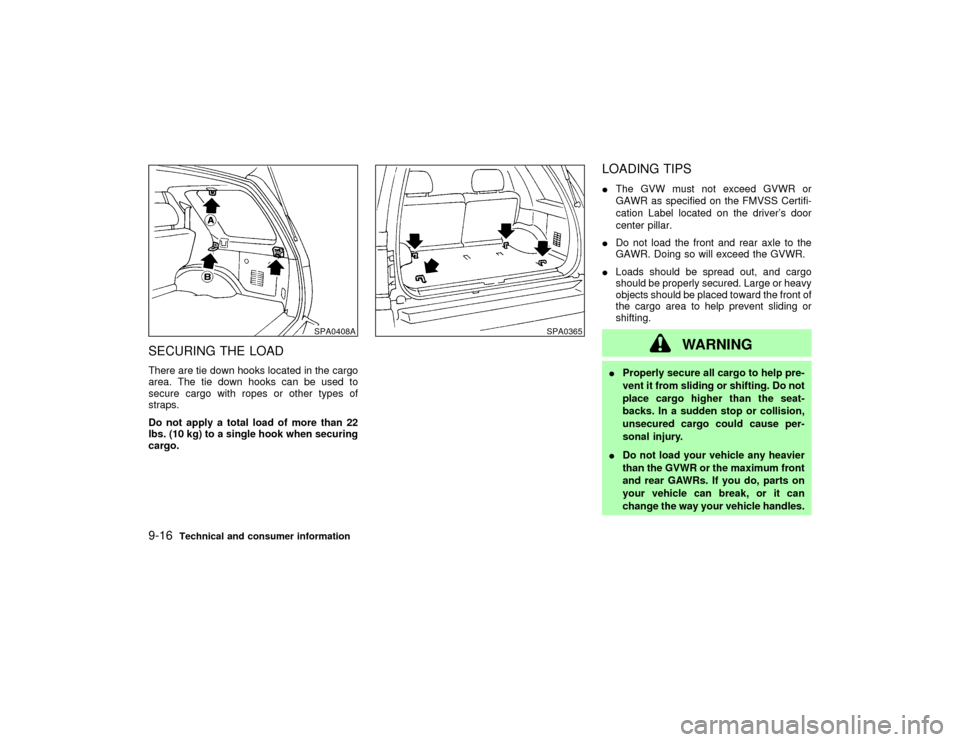
SECURING THE LOADThere are tie down hooks located in the cargo
area. The tie down hooks can be used to
secure cargo with ropes or other types of
straps.
Do not apply a total load of more than 22
lbs. (10 kg) to a single hook when securing
cargo.
LOADING TIPSIThe GVW must not exceed GVWR or
GAWR as specified on the FMVSS Certifi-
cation Label located on the driver's door
center pillar.
IDo not load the front and rear axle to the
GAWR. Doing so will exceed the GVWR.
ILoads should be spread out, and cargo
should be properly secured. Large or heavy
objects should be placed toward the front of
the cargo area to help prevent sliding or
shifting.
WARNING
IProperly secure all cargo to help pre-
vent it from sliding or shifting. Do not
place cargo higher than the seat-
backs. In a sudden stop or collision,
unsecured cargo could cause per-
sonal injury.
IDo not load your vehicle any heavier
than the GVWR or the maximum front
and rear GAWRs. If you do, parts on
your vehicle can break, or it can
change the way your vehicle handles.
SPA0408A
SPA0365
9-16
Technical and consumer information
Z
01.9.21/R50-D/V5
X
Page 268 of 288
This could result in loss of control
and cause personal injury.
PAYLOAD WEIGHT CAPACITYThe payload weight capacity is the maximum
total weight of passengers, optional equipment
(air conditioning, trailer hitch, etc.) and cargo
that your vehicle is designed to carry.
Before driving a loaded vehicle, confirm that
you do not exceed the Gross Vehicle Weight
Rating (GVWR) or the Gross Axle Weight
Rating (GAWR) for your vehicle. See ªVehicle
loading informationº earlier in this section for
details.
Also check tires for proper inflation pressures.
See the tire placard affixed to the glove box lid.
Payload Weight Capacity Unit: lb (kg)
VQ35DE
2WD 4WD
Automatic and
Manual Trans-
missionAutomatic and
Manual Trans-
mission
XE, SE, LE
US 980 (445) 970 (440)
Canada Ð 945 (430)
MEASUREMENT OF WEIGHTSSecure loose items to prevent weight shifts
that could affect the balance of your vehicle.
When the vehicle is loaded, drive to a scale
and weight the front and the rear wheels
separately to determine axle loads. Individual
axle loads should not exceed either of the
gross axle weight ratings (GAWR). The total of
the axle loads should not exceed the gross
vehicle weight rating (GVWR). These ratings
are given on the vehicle certification label that
is located on the driver's door lock pillar. If
weight ratings are exceeded, move or remove
items to bring all weights below the ratings.
CAUTION
Overloading can shorten the life of your
vehicle. Failures caused by overloading
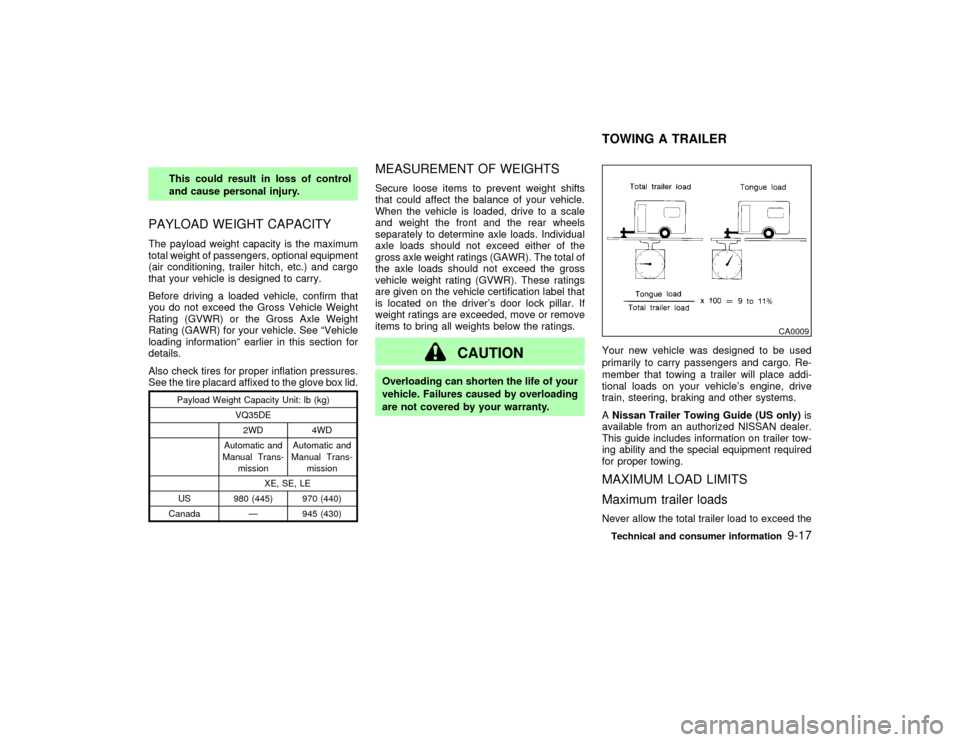
are not covered by your warranty.Your new vehicle was designed to be used
primarily to carry passengers and cargo. Re-
member that towing a trailer will place addi-
tional loads on your vehicle's engine, drive
train, steering, braking and other systems.
ANissan Trailer Towing Guide (US only)is
available from an authorized NISSAN dealer.
This guide includes information on trailer tow-
ing ability and the special equipment required
for proper towing.
MAXIMUM LOAD LIMITS
Maximum trailer loadsNever allow the total trailer load to exceed the
CA0009
TOWING A TRAILERTechnical and consumer information
9-17
Z
01.9.21/R50-D/V5
X