2002 NISSAN ALTIMA flat
[x] Cancel search: flatPage 27 of 249

When the ignition key is in the ON or START
position, the supplemental air bag warning
light illuminates for about 7 seconds and
then turns off. This means the system is
operational.
If any of the following conditions occur, the
supplemental front air bag, supplemental
side air bag and curtain air bag (if so
equipped) and pre-tensioner seat belt sys-
tems need servicing:
cThe supplemental air bag warning light
remains on after approximately 7 sec-
onds.
cThe supplemental air bag warning light
flashes intermittently.
cThe supplemental air bag warning light
does not come on at all.
Under these conditions, the supplemental
front air bag, supplemental side air bags
and curtain air bag (if so equipped) or
pre-tensioner seat belt systems may not
operate properly. It must be checked and
repaired. Take your vehicle to the nearest
authorized NISSAN dealer.WARNING
If the supplemental air bag warning
light is on, it could mean that the
supplemental front air bag, supplemen-
tal side air bag, curtain air bag systems
(if so equipped) and/or pre-tensioner
seat belt systems will not operate in an
accident.
Repair and replacement procedure
The supplemental front air bags, supple-
mental side air bags, curtain air bags and
pretensioner seat belts are designed to in-
flate on a one-time-only basis. As a re-
minder, unless it is damaged, the supple-
mental air bag light remains illuminated
after inflation has occurred. Repair and re-
placement of these supplemental air bag
systems should be done only by an autho-
rized NISSAN dealer.
When maintenance work is required on the
vehicle, the supplemental front air bags,
supplemental side air bags, pre-tensioner
seat belts and related parts should be
pointed out to the person conducting the
maintenance. The ignition key should al-
ways be in the LOCK position when working
under the hood or inside the vehicle.
WARNING
cOnce the supplemental front air bag,
supplemental side air bag or curtain
air bag has inflated, the air bag mod-
ule will not function again and must
be replaced. Additionally, if any of
the supplemental air bags inflate, the
pre-tensioner seat belts must also
be replaced. The air bag module and
pre-tensioner seat belt system
should be replaced by an authorized
NISSAN dealer. The air bag module
and pre-tensioner seat belt system
cannot be repaired.
cThe supplemental front air bag,
supplemental side air bag and cur-
tain air bag systems should be in-
spected by an authorized NISSAN
dealer if there is any damage to the
front end or side portion of the ve-
hicle.
cIf you need to dispose of a supple-
mental air bag, pre-tensioner seat
belt system or scrap the vehicle,
contact an authorized NISSAN
dealer. Correct supplemental air bag
and pre-tensioner seat belt system
1-20Seats, restraints and supplemental air bag systems
ZX
Page 36 of 249
accident. The child could be crushed
between the adult and parts of the
vehicle. Also, do not put the same
seat belt around both your child and
yourself.
cNever install a rear-facing child re-
straint in the front seat. An inflating
supplemental front air bag could se-
riously injure or kill your child. A
rear-facing child restraint must only
be used in the rear seat.
cNISSAN recommends that the child
restraint be installed in the rear seat.
According to accident statistics,
children are safer when properly re-
strained in the rear seat than in the
front seat.
cAn improperly installed child re-
straint could lead to serious injury or
death in an accident.
In general, child restraints are designed to
be installed with a lap belt or the lap portion
of a three-point type seat belt. In addition,
this vehicle is equipped with a universal
child restraint lower anchor system, referred
to as the LATCH (Lower Anchors andTether for Children) system. Some child
restraints include two rigid or webbing-
mounted attachments that can be con-
nected to these lower anchors. For details,
see the ``LATCH (Lower Anchors and
Tether for Children) system'' later in this
section.
Child restraints for infants and children of
various sizes are offered by several manu-
facturers. When selecting any child re-
straint, keep the following points in mind:
1) Choose only a restraint with a label cer-
tifying that it complies with Federal Motor
Vehicle Safety Standard 213 or Cana-
dian Motor Vehicle Safety Standard 213.
2) Check the child restraint in your vehicle
to be sure it is compatible with the vehi-
cle's seat and seat belt system.
3) If the child restraint is compatible with
your vehicle, place your child in the child
restraint and check the various adjust-
ments to be sure the child restraint is
compatible with your child. Always follow
all recommended procedures.
All U.S. states and provinces of Canada
require that infants and small children be
restrained in approved child restraints atall times while the vehicle is being
operated.
WARNING
cImproper use of a child restraint can
result in increased injuries for both
the infant or child and other occu-
pants in the vehicle.
cFollow all of the child restraint manu-
facturer's instructions for installa-
tion and use. When purchasing a
child restraint, be sure to select one
which will fit your child and vehicle.
It may not be possible to properly
install some types of child restraints
in your vehicle.
cIf the child restraint is not anchored
properly, the risk of a child being
injured in a collision or a sudden
stop greatly increases.
cAdjustable seatbacks should be po-
sitioned to fit the child restraint, but
as upright as possible.
cAfter attaching the child restraint,
test it before you place the child in it.
Tilt it from side to side. Try to tug it
Seats, restraints and supplemental air bag systems
1-29
ZX
Page 45 of 249
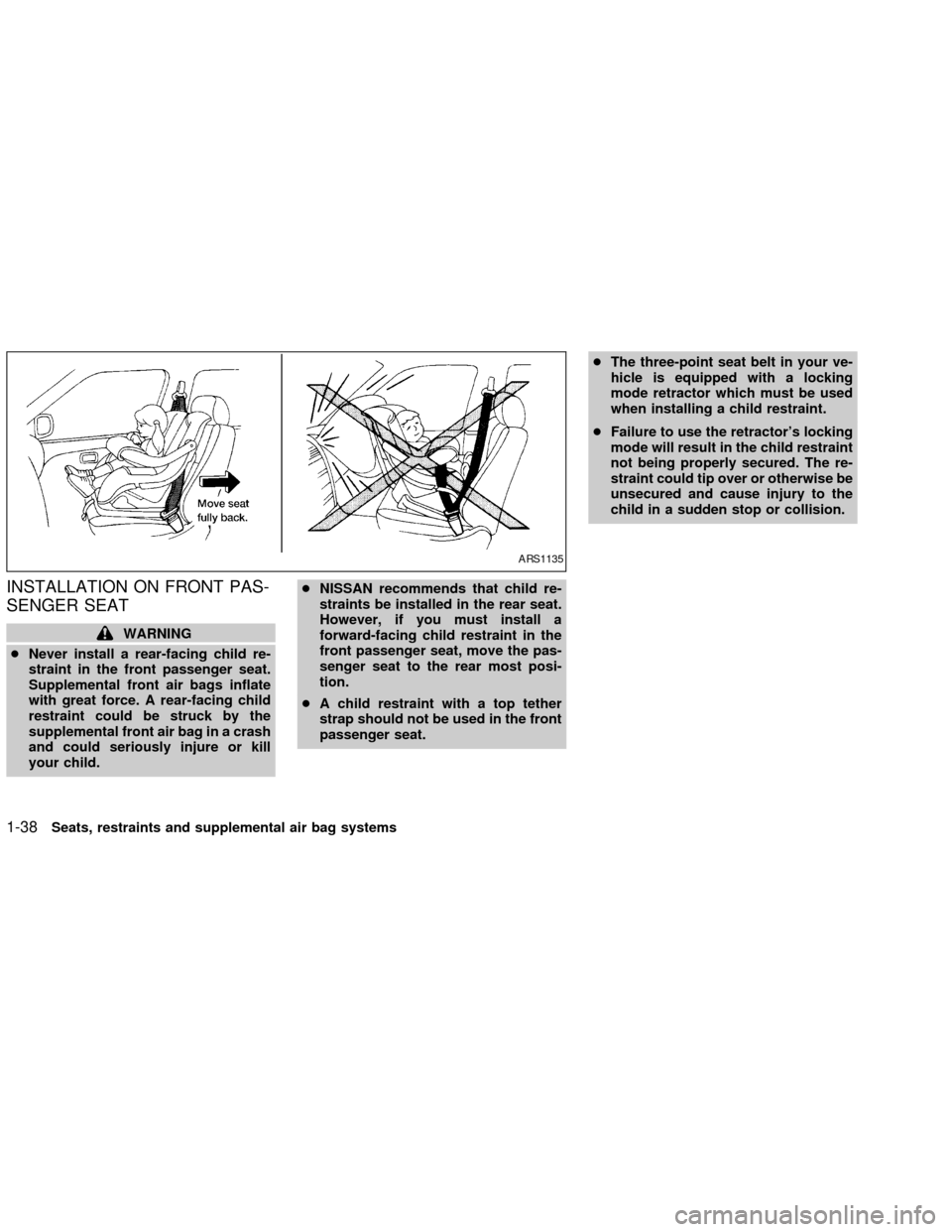
INSTALLATION ON FRONT PAS-
SENGER SEAT
WARNING
cNever install a rear-facing child re-
straint in the front passenger seat.
Supplemental front air bags inflate
with great force. A rear-facing child
restraint could be struck by the
supplemental front air bag in a crash
and could seriously injure or kill
your child.cNISSAN recommends that child re-
straints be installed in the rear seat.
However, if you must install a
forward-facing child restraint in the
front passenger seat, move the pas-
senger seat to the rear most posi-
tion.
cA child restraint with a top tether
strap should not be used in the front
passenger seat.cThe three-point seat belt in your ve-
hicle is equipped with a locking
mode retractor which must be used
when installing a child restraint.
cFailure to use the retractor's locking
mode will result in the child restraint
not being properly secured. The re-
straint could tip over or otherwise be
unsecured and cause injury to the
child in a sudden stop or collision.
ARS1135
1-38Seats, restraints and supplemental air bag systems
ZX
Page 101 of 249
TELESCOPIC OPERATION
Push the lever down and adjust the steering
wheel forward or backward to the desired
position.
Pull the lock lever up firmly to lock the
steering wheel in place.
WARNING
Do not adjust the steering wheel any
closer to you than is necessary for
proper steering operation and comfort.
The driver's air bag inflates with great
force. If you are unrestrained, leaning
forward, sitting sideways or out of po-
sition in any way, you are at greater risk
of injury or death in a crash. You may
also receive serious or fatal injuries
from the air bag if you are up against it
when it inflates. Always sit back
against the seatback and as far away as
practical from the steering wheel. Al-
ways use the seat belts.
CAUTION
Do not store the main sun visor before
storing the extension sun visor.VANITY MIRRORS
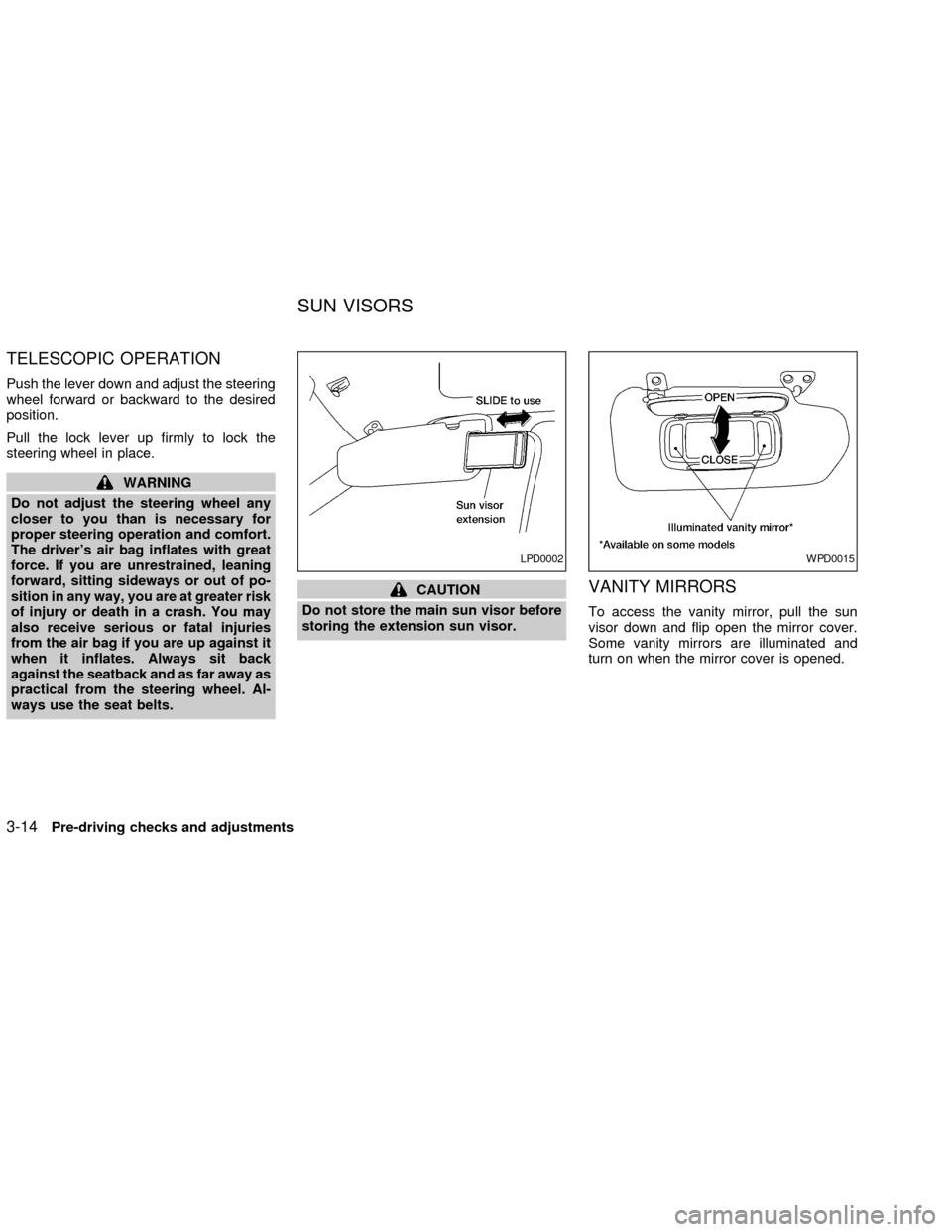
To access the vanity mirror, pull the sun
visor down and flip open the mirror cover.
Some vanity mirrors are illuminated and
turn on when the mirror cover is opened.
LPD0002WPD0015
SUN VISORS
3-14Pre-driving checks and adjustments
ZX
Page 139 of 249
START (4)
This position activates the starter motor,
which starts the engine.
NISSAN VEHICLE IMMOBILIZER
SYSTEM (NVIS)
The Nissan Vehicle Immobilizer System
(NVIS) will not allow the engine to run
without the use of the registered NVIS key.
If the engine fails to run using the registered
NVIS key, it may be due to interference
caused by another NVIS key, an automated
toll road device or automated payment de-
vice on the key ring. Restart the engine
using the following procedures:
1. Leave the ignition switch in the ON posi-
tion for approximately 5 seconds.
2. Turn the ignition switch to the OFF or
LOCK position and wait approximately 5
seconds.
3. Repeat step 1 and 2 again.
4. Restart the engine while holding the de-
vice (which may have caused the inter-
ference) separate from the registered
NVIS key.If this procedure allows the engine to run,
NISSAN recommends placing the regis-
tered NVIS key on a separate key ring to
avoid interference from other devices.cMake sure the area around the vehicle is
clear.
cMaintenance items listed here should be
checked periodically, for example, each
time you check engine oil.
cCheck that all windows and lights are
clean.
cVisually inspect tires for their appearance
and condition. Also check tires for proper
inflation.
cLock all doors.
cPosition seat and adjust head restraints.
cAdjust inside and outside mirrors.
cFasten seat belts and ask all passengers
to do likewise.
cCheck the operation of warning lights
when key is turned to the ON (3) position.
See ``Warning/Indicator lights and au-
dible reminders'' in the ``Instruments and
controls'' section.
BEFORE STARTING THE
ENGINE
5-6Starting and driving
ZX
Page 149 of 249
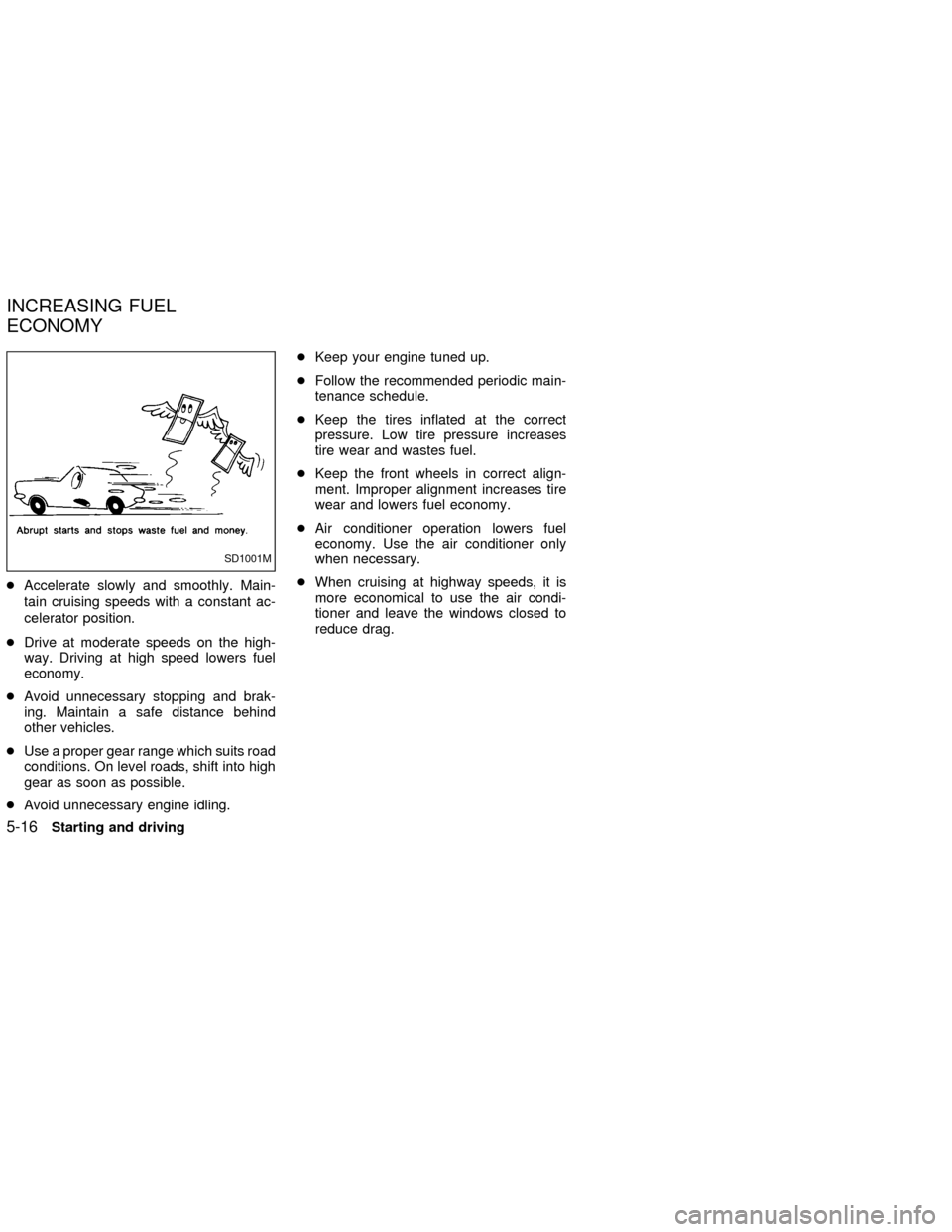
cAccelerate slowly and smoothly. Main-
tain cruising speeds with a constant ac-
celerator position.
cDrive at moderate speeds on the high-
way. Driving at high speed lowers fuel
economy.
cAvoid unnecessary stopping and brak-
ing. Maintain a safe distance behind
other vehicles.
cUse a proper gear range which suits road
conditions. On level roads, shift into high
gear as soon as possible.
cAvoid unnecessary engine idling.cKeep your engine tuned up.
cFollow the recommended periodic main-
tenance schedule.
cKeep the tires inflated at the correct
pressure. Low tire pressure increases
tire wear and wastes fuel.
cKeep the front wheels in correct align-
ment. Improper alignment increases tire
wear and lowers fuel economy.
cAir conditioner operation lowers fuel
economy. Use the air conditioner only
when necessary.
cWhen cruising at highway speeds, it is
more economical to use the air condi-
tioner and leave the windows closed to
reduce drag.
SD1001M
INCREASING FUEL
ECONOMY
5-16Starting and driving
ZX
Page 155 of 249
radiator and on the engine block. Refill
before operating the vehicle. See ``Chang-
ing engine coolant'' in the ``Maintenance
and do-it-yourself'' section.
TIRE EQUIPMENT
1. SUMMER tires have a tread designed to
provide superior performance on dry
pavement. However, the performance of
these tires will be substantially reduced
in snowy and icy conditions. If you oper-
ate your vehicle on snowy or icy roads,
NISSAN recommends the use of MUD &
SNOW or ALL SEASON tires on all four
wheels. Please consult an authorized
NISSAN dealer for the tire type, size,
speed rating and availability information.
2. For additional traction on icy roads, stud-
ded tires may be used. However, some
U.S. States and Canadian Provinces pro-
hibit their use. Check local, state and
provincial laws before installing studded
tires.
Skid and traction capabilities of studded
snow tires, on wet or dry surfaces, may
be poorer than that of non-studded snow
tires.
3. Tire chains may be used. Make sure theyare the proper size for the tires on your
vehicle and are installed according to the
chain manufacturer's suggestions.
Use of tire chains may be prohibited accord-
ing to location. Check the local laws before
installing tire chains. When installing tire
chains, make sure they are of proper size
for the tires on your vehicle and are installed
according to the chain manufacturer's sug-
gestions.Use only SAE Class ``S'' chains.
Other types may damage your vehicle. Use
chain tensioners when recommended by
the tire chain manufacturer to ensure a tight
fit. Loose end links of the tire chain must be
secured or removed to prevent the possibil-
ity of whipping action damage to the fenders
or underbody. If possible, avoid fully loading
your vehicle when using tire chains. In ad-
dition, drive at a reduced speed. Otherwise,
your vehicle may be damaged and/or ve-
hicle handling and performance may be
adversely affected.
Never install tire chains on spare tires. Do
not use tire chains on dry roads.
SPECIAL WINTER EQUIPMENT
It is recommended that the following items
be carried in the vehicle during winter:1. A scraper and stiff-bristled brush to re-
move ice and snow from the windows
and wiper blades.
2. A sturdy, flat board to be placed under
the jack to give it firm support.
3. A shovel to dig the vehicle out of snow-
drifts.
4. Extra window washer fluid to refill the
reservoir tank.
DRIVING ON SNOW OR ICE
WARNING
cWet ice (32ÉF, 0ÉC and freezing rain),
very cold snow or ice can be slick
and very hard to drive on. The ve-
hicle will have much less traction or
``grip'' under these conditions. Try to
avoid driving on wet ice until the
road is salted or sanded.
cWhatever the condition, drive with
caution. Accelerate and slow down
with care. If accelerating or down-
shifting too fast, the drive wheels
will lose even more traction.
5-22Starting and driving
ZX
Page 158 of 249

6 In case of emergency
Flat tire ...................................................................6-2
Changing a flat tire ............................................6-2
Jump starting ..........................................................6-6
Push starting ..........................................................6-8
If your vehicle overheats ........................................6-8Towing your vehicle ...............................................6-9
Towing recommended by Nissan ....................6-10
Vehicle recovery (freeing a stuck
vehicle) ............................................................6-11
ZX