2002 MAZDA 6 wiring
[x] Cancel search: wiringPage 230 of 909

F2–78
CONTROL SYSTEM
BOOST SENSOR INSPECTIONA6E404013214201
Note
•Perform the following test only when directed.
Visual Inspection
1. Inspect the boost sensor for damage and cracks.
•If not as specified, replace the boost sensor.
2. Inspect vacuum hose for improper routing, kinks or leakage.
•If there is any malfunction, repair or replace suspected hose.
Voltage Inspection
1. Turn the engine switch to ON.
2. Monitor the MAP PID using the WDS or equivalent.
•If not as specified, perform the “Circuit Open/Short Inspection”.
MAP PID
2.1—2.5 V
3. Start the engine and warm up the engine completely.
4. Monitor the MAP PID using the WDS or equivalent at idle.
•If not as specified, perform the “Circuit Open/Short Inspection”.
MAP PID
2.1—2.5 V
Circuit Open/Short Inspection
1. Inspect for open/short circuit in the following
wiring harnesses.
•If there is open/short circuit, repair or replace
wiring harnesses.
Open circuit
•Power circuit
—Boost sensor terminal C and PCM terminal 90
•Signal circuit
—Boost sensor terminal B and PCM terminal 36
•GND circuit
—Boost sensor terminal A and PCM terminal 91
Short circuit
•Power circuit
—Boost sensor terminal C and PCM terminal 90 to GND
•Signal circuit
—Boost sensor terminal B and PCM terminal 36 to power circuit
—Boost sensor terminal B and PCM terminal 36 to GND
End Of Sie
BOOST SENSOR
HARNESS SIDE CONNECTOR
A
B C
A6E40702048
Page 231 of 909

CONTROL SYSTEM
F2–79
F2
FUEL PRESSURE SENSOR INSPECTIONA6E404013015201
Note
•Perform the following test only when directed.
Voltage Inspection
1. Start the engine and warm up the engine completely.
2. Measure the voltage between fuel pressure sensor terminals A and B using a voltmeter at idle.
•If not as specified, perform the “Circuit Open/Short Inspection”.
—If there is no open/short circuit, replace the common rail.
Specification
1.4—1.7 V
3. Turn off the engine and wait three minutes.
4. Turn the engine switch to ON.
5. Measure the voltage between fuel pressure
sensor terminals A and B using a voltmeter.
•If not as specified, perform the “Circuit Open/
Short Inspection”.
—If there is no open/short circuit, replace
the common rail.
Specification
0.9—1.1 V
CIrcuit Open/Short Inspection
1. Inspect for open/short circuit in the following
wiring harnesses.
•If there is open/short circuit, repair or replace wiring harnesses.
Open circuit
•Power circuit
—Fuel pressure sensor terminal C and PCM terminal 90
•Signal circuit
—Fuel pressure sensor terminal B and PCM terminal 61
•GND circuit
—Fuel pressure sensor terminal A and PCM terminal 91
Short circuit
•Power circuit
—Fuel pressure sensor terminal C and PCM terminal 90 to GND
•Signal circuit
—Fuel pressure sensor terminal B and PCM terminal 61 to power circuit
—Fuel pressure sensor terminal B and PCM terminal 61 to GND
End Of Sie
FUEL PRESSURE SENSOR
HARNESS SIDE CONNECTOR
A
B C
A6E40702049
Page 232 of 909

F2–80
CONTROL SYSTEM
CAMSHAFT POSITION (CMP) SENSOR REMOVAL/INSTALLATIONA6E404018200201
Caution
•When foreign material, such as iron chips, gets on the CMP sensor, it can cause abnormal output
from the sensor because of flux turbulence and adversely affect engine control. Be sure there is
no foreign material on the CMP sensor when replacing.
•Do not forcefully pull the wiring harness of the CMP sensor. Doing so will break the harness.
1. Disconnect the negative battery cable.
2. Remove the engine cover.
3. Remove in the order indicated in the table.
4. Install in the reverse order of removal.
O-ring Installation Note
1. Apply engine oil to new O-ring thinly and install it
as does not damage.
End Of Sie
CAMSHAFT POSITION (CMP) SENSOR INSPECTIONA6E404018200202
Note
•Perform the following test only when directed.
Caution
•When foreign material, such as iron chips, gets on the CMP sensor, it can cause abnormal output
from the sensor because of flux turbulence and adversely affect engine control. Be sure there is
no foreign material on the CMP sensor when replacing.
•Do not forcefully pull the wiring harness of the CMP sensor. Doing so will break the harness.
Visual Inspection
1. Verify that the CMP sensor and the pulsar are free of any metallic shavings or particles.
•If any are found on the CMP sensor and the pulsar, clean them off.
Air Gap Inspection
1. Disconnect the negative battery cable.
2. Remove the gear cover.
3. Verify that clearance A between the CMP sensor
and the pulsar is within the specification.
•If not as specified, replace the CMP sensor.
Clearance A
0.5—1.5 mm {0.020—0.059 in}
1 CMP sensor installation bolt
2 CMP sensor
3 O-ring
(See F2–80 O-ring Installation Note)
N·m {kgf·cm, in·lbf}
3
127.8—10.8
{80—110, 69.1—95.5}
R
OILOIL
A6E40702050
CMP SENSOR
CLEARANCE A
PULSAR
A6E40702051
Page 233 of 909

CONTROL SYSTEM
F2–81
F2
Resistance Inspection
1. Disconnect the negative battery cable.
2. Remove the engine cover.
3. Disconnect the CMP sensor connector.
4. Inspect the resistance between the terminals
under the following condition.
•If not as specified, replace the CMP sensor.
Specification
Circuit Open/Short Inspection
1. Inspect for open/short circuit in the following
wiring harnesses.
•if there is open/short circuit, repair or replace
wiring harnesses.
Open circuit
•CMP sensor terminal A and PCM terminal 81
•CMP sensor terminal B and PCM terminal 55
Short circuit
•CMP sensor terminal A and PCM terminal 81 to GND
•CMP sensor terminal B and PCM terminal 55 to GND
End Of Sie
CRANKSHAFT POSITION (CKP) SENSOR REMOVAL/INSTALLATIONA6E404018230201
Caution
•When foreign material, such as iron chips, gets on the CKP sensor, it can cause abnormal output
from the sensor because of flux turbulence and adversely affect engine control. Be sure there is
no foreign material on the CKP sensor when replacing.
•Do not forcefully pull the wiring harness of the CKP sensor. Doing so will break the harness.
1. Disconnect the negative battery cable.
2. Remove the crankshaft pulley. (See B2–9 TIMING BELT REMOVAL/INSTALLATION.)
3. Remove the lower timing belt cover. (See B2–9 TIMING BELT REMOVAL/INSTALLATION.)
4. Remove in the order indicated in the table.
5. Install in the reverse order of removal.
End Of Sie
TerminalAtmospheric
temperature (°C {°F})Resistance
(kilohm)
A—B 20 {68} 1.85—2.45
A
B
A6E40702052
1 CKP sensor installation bolt
2 CKP sensor
N·m {kgf·cm, in·lbf} 16—23 {1.6—2.4, 12—17}12
A6E40702053
Page 234 of 909
F2–82
CONTROL SYSTEM
CRANKSHAFT POSITION (CKP) SENSOR INSPECTIONA6E404018230202
Note
•Perform the following test only when directed.
Caution
•When foreign material, such as iron chips, gets on the CKP sensor, it can cause abnormal output
from the sensor because of flux turbulence and adversely affect engine control. Be sure there is
no foreign material on the CKP sensor when replacing.
•Do not forcefully pull the wiring harness of the CKP sensor. Doing so will break the harness.
Visual Inspection
1. Verify that the CKP sensor and the pulsar are free of any metallic shavings or particles.
•If any are found on the CKP sensor and the pulsar, clean them off.
Air Gap Inspection
1. Disconnect the negative battery cable.
2. Remove the crankshaft pulley. (See B2–9 TIMING BELT REMOVAL/INSTALLATION.)
3. Remove the crankshaft pulley. (See B2–9 TIMING BELT REMOVAL/INSTALLATION.)
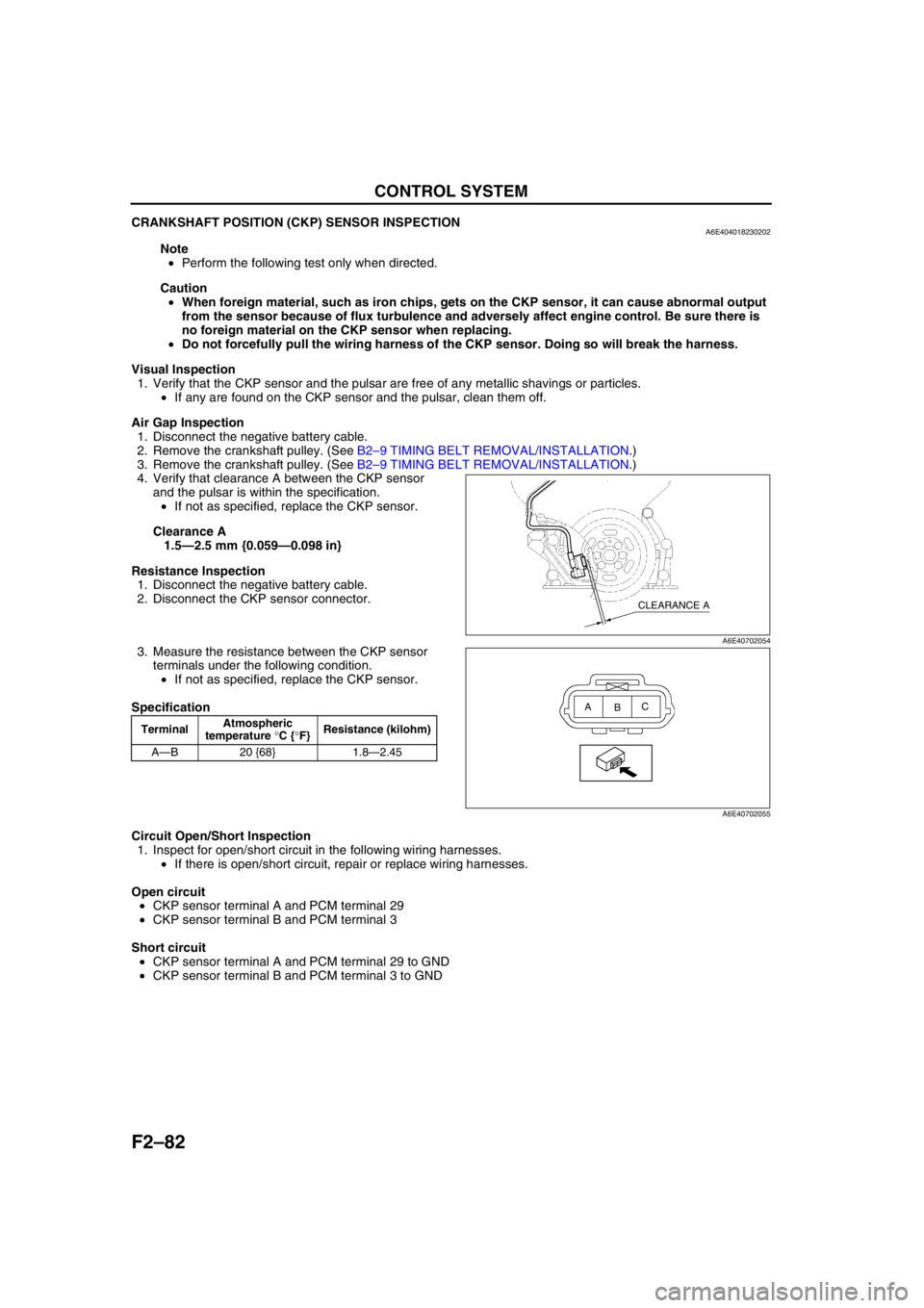
4. Verify that clearance A between the CKP sensor
and the pulsar is within the specification.
•If not as specified, replace the CKP sensor.
Clearance A
1.5—2.5 mm {0.059—0.098 in}
Resistance Inspection
1. Disconnect the negative battery cable.
2. Disconnect the CKP sensor connector.
3. Measure the resistance between the CKP sensor
terminals under the following condition.
•If not as specified, replace the CKP sensor.
Specification
Circuit Open/Short Inspection
1. Inspect for open/short circuit in the following wiring harnesses.
•If there is open/short circuit, repair or replace wiring harnesses.
Open circuit
•CKP sensor terminal A and PCM terminal 29
•CKP sensor terminal B and PCM terminal 3
Short circuit
•CKP sensor terminal A and PCM terminal 29 to GND
•CKP sensor terminal B and PCM terminal 3 to GND
End Of Sie
TerminalAtmospheric
temperature °C {°F}Resistance (kilohm)
A—B 20 {68} 1.8—2.45
CLEARANCE A
A6E40702054
A
BC
A6E40702055
Page 236 of 909

F2–84
CONTROL SYSTEM
CIrcuit Open/Short Inspection
1. Inspect for open/short circuit in the following wiring harnesses.
•If there is open/short circuit, repair or replace wiring harnesses.
Open circuit
•Signal circuit
—Calibration resistor No.1 terminal A and PCM terminal 37
—Calibration resistor No.2 terminal A and PCM terminal 62
—Calibration resistor No.3 terminal A and PCM terminal 89
—Calibration resistor No.4 terminal A and PCM terminal 11
•GND circuit
—Each calibration resistor terminal C and PCM terminal 91
Short circuit
•Signal circuit
—Calibration resistor No.1 terminal A and PCM terminal 37 to power circuit
—Calibration resistor No.1 terminal A and PCM terminal 37 to GND
—Calibration resistor No.2 terminal A and PCM terminal 62 to power circuit
—Calibration resistor No.2 terminal A and PCM terminal 62 to GND
—Calibration resistor No.3 terminal A and PCM terminal 89 to power circuit
—Calibration resistor No.3 terminal A and PCM terminal 89 to GND
—Calibration resistor No.4 terminal A and PCM terminal 11 to power circuit
—Calibration resistor No.4 terminal A and PCM terminal 11 to GND
End Of Sie
INJECTOR DRIVER MODULE (IDM) INSPECTIONA6E404018701201
Warning
•The IDM outputs high voltage and current for fuel injector driving. Do not inspect the IDM terminal
voltage, as it may cause an electric shock.
Note
•Perform the following test only when directed.
1. If any IDM-related failures are suspected, inspect the following:
•DTCs
•IDM-related harnesses
•Fuel injectors
End Of Sie
Page 242 of 909

F2–90
ON-BOARD DIAGNOSTIC
DTC P0091A6E407001082203
Diagnostic procedure
DTC P0091 Suction control valve circuit low input
DETECTION
CONDITION•PCM monitors input voltage from suction control valve while engine is running. If input voltage from suction
control valve does not change from off to on, PCM determines suction control valve circuit low input.
POSSIBLE
CAUSE•Suction control valve malfunction
•Connector or terminal malfunction
•Short to GND in wiring between suction control valve terminal A and PCM terminal 93
•Short to GND in wiring between suction control valve terminal B and PCM terminal 94
•Open circuit in wiring between suction control valve terminal A and PCM terminal 93
•Open circuit in wiring between suction control valve terminal B and PCM terminal 94
•PCM malfunction
STEP INSPECTION ACTION
1VERIFY RELATED REPAIR INFORMATION
AVAILABILITY
•Check for related Service Information
availability.
•Is any related repair information available?Yes Perform repair or diagnosis according to available Service
Information.
•If vehicle is not repaired, go to next step.
No Go to next step.
A
B93
94
BA SUCTION CONTROL VALVE
HARNESS SIDE CONNECTOR
94
93PCM
HARNESS SIDE CONNECTORPCM
SUCTION CONTROL VALVE
5
4
36
2
2
365
Page 244 of 909
F2–92
ON-BOARD DIAGNOSTIC
DTC P0092A6E407001082204
Diagnostic procedure
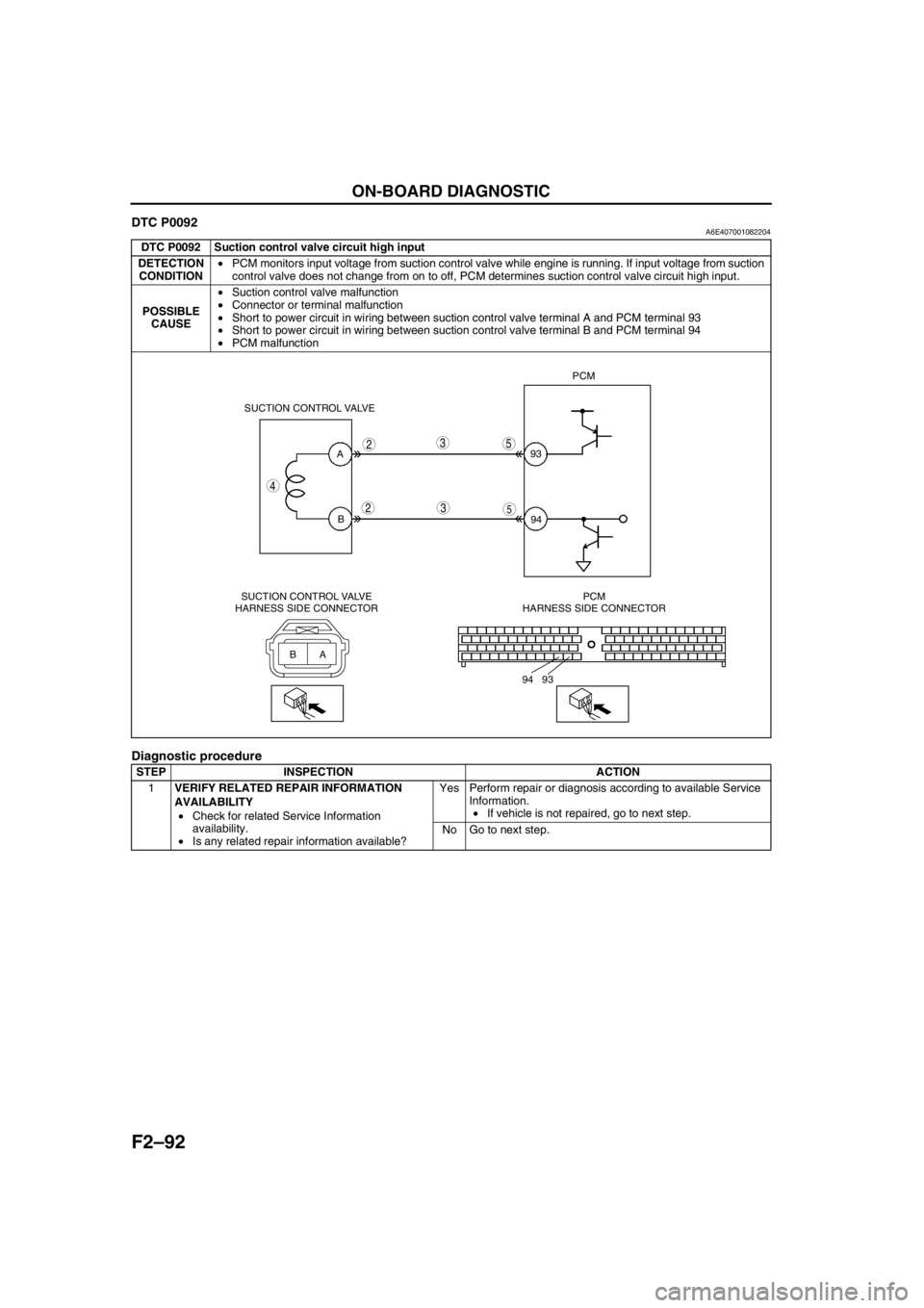
DTC P0092 Suction control valve circuit high input
DETECTION
CONDITION•PCM monitors input voltage from suction control valve while engine is running. If input voltage from suction
control valve does not change from on to off, PCM determines suction control valve circuit high input.
POSSIBLE
CAUSE•Suction control valve malfunction
•Connector or terminal malfunction
•Short to power circuit in wiring between suction control valve terminal A and PCM terminal 93
•Short to power circuit in wiring between suction control valve terminal B and PCM terminal 94
•PCM malfunction
STEP INSPECTION ACTION
1VERIFY RELATED REPAIR INFORMATION
AVAILABILITY
•Check for related Service Information
availability.
•Is any related repair information available?Yes Perform repair or diagnosis according to available Service
Information.
•If vehicle is not repaired, go to next step.
No Go to next step.
2
2
3
3
5
593
94 A
B
4
BA
94 93PCM
SUCTION CONTROL VALVE
SUCTION CONTROL VALVE
HARNESS SIDE CONNECTORPCM
HARNESS SIDE CONNECTOR