2002 LAND ROVER DISCOVERY wheel
[x] Cancel search: wheelPage 544 of 1672

ENGINE MANAGEMENT SYSTEM - V8
REPAIRS 18-2-87
Switch - cruise control (on/off)
$% 19.75.30
Remove
1.Carefully remove switch from instrument cowl.
2.Disconnect multiplug and remove switch.
Refit
1.Position new switch and connect multiplug.
2.Carefully push switch into instrument cowl.
Switch - cruise control (set/resume)
$% 19.75.33
Remove
1.Remove the key from the starter switch.
Disconnect both battery leads, negative lead
first. Wait ten minutes before starting work.
2.Remove driver's airbag module.
+ RESTRAINT SYSTEMS, REPAIRS,
Airbag module - drivers.
3.Release remote control switches multiplug and
leads from steering wheel base.
4.Disconnect remote control switches multiplug
from harness.
5.Remove 2 screws securing remote control
switches to steering wheel base.
6.Release and remove remote control switches
from steering wheel.
Refit
1.Fit remote control switches to steering wheel
and secure with screws.
2.Connect remote control switches multiplug to
harness.
3.Secure leads and multiplug to base of steering
wheel.
4.Fit driver's airbag module.
+ RESTRAINT SYSTEMS, REPAIRS,
Airbag module - drivers.
Page 592 of 1672
COOLING SYSTEM - TD5
DESCRIPTION AND OPERATION 26-1-9
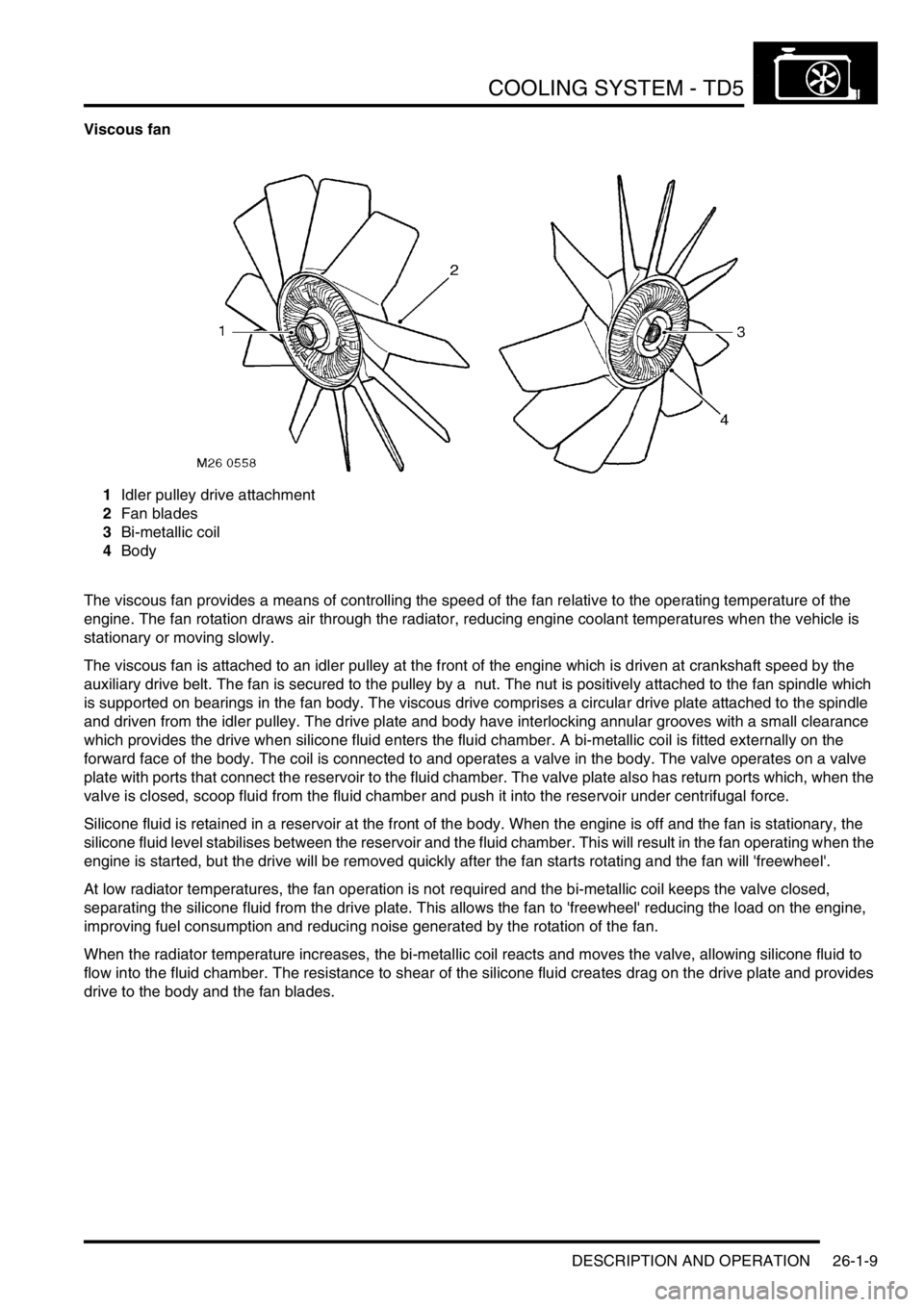
Viscous fan
1Idler pulley drive attachment
2Fan blades
3Bi-metallic coil
4Body
The viscous fan provides a means of controlling the speed of the fan relative to the operating temperature of the
engine. The fan rotation draws air through the radiator, reducing engine coolant temperatures when the vehicle is
stationary or moving slowly.
The viscous fan is attached to an idler pulley at the front of the engine which is driven at crankshaft speed by the
auxiliary drive belt. The fan is secured to the pulley by a nut. The nut is positively attached to the fan spindle which
is supported on bearings in the fan body. The viscous drive comprises a circular drive plate attached to the spindle
and driven from the idler pulley. The drive plate and body have interlocking annular grooves with a small clearance
which provides the drive when silicone fluid enters the fluid chamber. A bi-metallic coil is fitted externally on the
forward face of the body. The coil is connected to and operates a valve in the body. The valve operates on a valve
plate with ports that connect the reservoir to the fluid chamber. The valve plate also has return ports which, when the
valve is closed, scoop fluid from the fluid chamber and push it into the reservoir under centrifugal force.
Silicone fluid is retained in a reservoir at the front of the body. When the engine is off and the fan is stationary, the
silicone fluid level stabilises between the reservoir and the fluid chamber. This will result in the fan operating when the
engine is started, but the drive will be removed quickly after the fan starts rotating and the fan will 'freewheel'.
At low radiator temperatures, the fan operation is not required and the bi-metallic coil keeps the valve closed,
separating the silicone fluid from the drive plate. This allows the fan to 'freewheel' reducing the load on the engine,
improving fuel consumption and reducing noise generated by the rotation of the fan.
When the radiator temperature increases, the bi-metallic coil reacts and moves the valve, allowing silicone fluid to
flow into the fluid chamber. The resistance to shear of the silicone fluid creates drag on the drive plate and provides
drive to the body and the fan blades.
Page 594 of 1672

COOLING SYSTEM - TD5
DESCRIPTION AND OPERATION 26-1-11
Viscous fan operation
A= Cold, B= Hot
1Drive plate
2Fan body
3Clearance
4Valve plate
5Valve
6Bi-metallic coil7Fluid seals
8Ball race
9Fluid chamber
10Reservoir
11Return port
When the engine is off and the fan is not rotating, the silicone fluid stabilises within the fluid chamber and the reservoir.
The fluid levels equalise due to the return port in the valve plate being open between the fluid chamber and the
reservoir. In this condition, when the engine is started, silicone fluid is present in the fluid chamber and causes drag
to occur between the drive plate and the body. This causes the fan to operate initially when the engine is started.
As the fan speed increases, centrifugal force and a scoop formed on the fluid chamber side of the valve plate, pushes
the silicone fluid through the return port in the valve plate into the reservoir. As the fluid chamber empties, the drag
between the drive plate and the body is reduced, causing the drive plate to slip. This reduces the rotational speed of
the fan and allows it to 'freewheel'.
When the coolant temperature is low, the heat emitted from the radiator does not affect the bi-metallic coil. The valve
remains closed, preventing fluid escaping from the reservoir into the fluid chamber. In this condition the fan will
'freewheel' at a slow speed.
Page 610 of 1672

COOLING SYSTEM - V8
DESCRIPTION AND OPERATION 26-2-9
Viscous fan
1Coolant pump pulley drive attachment
2Fan blades
3Bi-metallic coil
4Body
The viscous fan provides a means of controlling the speed of the fan relative to the operating temperature of the
engine. The fan rotation draws air through the radiator, reducing engine coolant temperatures when the vehicle is
stationary or moving slowly.
The viscous fan is attached to the coolant pump drive pulley and secured to the pulley by a nut. The nut is positively
attached to a spindle which is supported on bearings in the fan body. The viscous drive comprises a circular drive
plate attached to the spindle and driven from the coolant pump pulley and the coupling body. The drive plate and the
body have interlocking annular grooves with a small clearance which provides the drive when silicone fluid enters the
fluid chamber. A bi-metallic coil is fitted externally on the forward face of the body. The coil is connected to and
operates a valve in the body. The valve operates on a valve plate with ports that connect the reservoir to the fluid
chamber. The valve plate also has return ports which, when the valve is closed, scoop fluid from the fluid chamber
and push it into the reservoir under centrifugal force.
Silicone fluid is retained in a reservoir at the front of the body. When the engine is off and the fan is stationary, the
silicone fluid level stabilises between the reservoir and the fluid chamber. This will result in the fan operating when the
engine is started, but the drive will be removed quickly after the fan starts rotating and the fan will 'freewheel'.
At low radiator temperatures, the fan operation is not required and the bi-metallic coil keeps the valve closed,
separating the silicone fluid from the drive plate. This allows the fan to 'freewheel' reducing the load on the engine,
improving fuel consumption and reducing noise generated by the rotation of the fan.
When the radiator temperature increases, the bi-metallic coil reacts and moves the valve, allowing the silicone fluid
to flow into the fluid chamber. The resistance to shear of the silicone fluid creates drag on the drive plate and provides
drive to the body and the fan blades.
Page 612 of 1672

COOLING SYSTEM - V8
DESCRIPTION AND OPERATION 26-2-11
Viscous fan operation
A = Cold, B = Hot
1Drive plate
2Fan body
3Clearance
4Valve plate
5Valve
6Bi-metallic coil7Fluid seals
8Ball race
9Fluid chamber
10Reservoir
11Return port
When the engine is off and the fan is not rotating, the silicone fluid stabilises within the fluid chamber and the reservoir.
The fluid levels equalise due to the return port in the valve plate being open between the fluid chamber and the
reservoir. In this condition, when the engine is started, silicone fluid is present in the fluid chamber and causes drag
to occur between the drive plate and the body. This causes the fan to operate initially when the engine is started.
As the fan speed increases, centrifugal force and a scoop formed on the fluid chamber side of the valve plate, pushes
the silicone fluid through the return port in the valve plate into the reservoir. As the fluid chamber empties, the drag
between the drive plate and body is reduced, causing the drive plate to slip. This reduces the rotational speed of the
fan and allows it to 'freewheel'.
When the coolant temperature is low, the heat emitted from the radiator does not affect the bi-metallic coil. The valve
remains closed, preventing fluid escaping from the reservoir into the fluid chamber. In this condition the fan will
'freewheel' at a slow speed.
Page 654 of 1672

CLUTCH - TD5
DESCRIPTION AND OPERATION 33-1-3
1Brake/clutch reservoir
2Connecting hose
3Bolt 2 off
4Master cylinder
5Clutch pedal
6Gearbox housing
7Primary driveshaft
8Bolt 2 off
9Slave cylinder
10Bleed nipple
11Pressure plate
12Drive plate
13Dual mass flywheel
14Metal hydraulic pipe
15Ball spigot
16Clutch release bearing sleeve
17Bolt 2 off
18Pivot washer
19Release lever
20Release bearing
21Retaining clip
22Bolt
23Plastic hydraulic pipe
Page 656 of 1672

CLUTCH - TD5
DESCRIPTION AND OPERATION 33-1-5
1Brake/clutch reservoir
2Fluid supply pipe
3Hydraulic feed pipe
4Damper
5Master cylinder
6Piston
7Clutch pedal
8Primary driveshaft
9Engine crankshaft
10Drive plate
11Dual mass flywheel
12Ring gear
13Leaf spring
14Cover - pressure plate
15Diaphragm
16Release bearing
17Ball spigot
18Release bearing sleeve
19Release lever
20Slave cylinder
21Piston
22Bleed nipple
Page 657 of 1672

CLUTCH - TD5
33-1-6 DESCRIPTION AND OPERATION
Description
General
The clutch system is a diaphragm type clutch operated by a hydraulic cylinder. The drive plate is of the rigid centre
type with no integral damping springs. The flywheel is of the dual mass type with damping springs integral with the
flywheel. The clutch requires no adjustment to compensate for wear.
Hydraulic clutch
The hydraulic clutch comprises a master cylinder, slave cylinder and a hydraulic reservoir. The master and slave
cylinders are connected to each other hydraulically by plastic and metal pipes. The plastic section of the pipe allows
ease of pipe routing and also absorbs engine movements and vibrations.
The master cylinder comprises a body with a central bore. Two ports in the body connect the bore to the hydraulic
feed pipe to the slave cylinder and the fluid reservoir. The bore is also connected to a damper which prevents engine
pulses being transferred hydraulically to the clutch pedal. A piston is fitted in the bore and has an external rod which
is attached to the clutch pedal with a pin. Two coil springs on the clutch pedal reduce the effort required to depress
the pedal.
The master cylinder is mounted on the bulkhead and secured with two bolts. The cylinder is connected to the shared
brake/clutch reservoir on the brake servo by a braided connecting hose.
The slave cylinder is located on the left hand side of the gearbox housing and secured with two bolts. A heat shield
is fitted to protect the underside of the slave cylinder from heat generated from the exhaust system. The slave cylinder
comprises a cylinder with a piston and a rod. A port in the cylinder body provides the attachment for the hydraulic feed
pipe from the master cylinder. A second port is fitted witha bleed nipple used for removing air from the hydraulic
system after servicing. The piston rod locates on a clutch release lever located in the gearbox housing. The rod is
positively retained on the release lever with a clip.
Clutch mechanism
The clutch mechanism comprises a flywheel, drive plate, pressure plate, release lever and a release bearing. The
clutch mechanism is fully enclosed at the rear of the engine by the gearbox housing.
A clutch release bearing sleeve is attached in the gearbox housing with two bolts and located on two dowels. A spigot
with a ball end is formed on the release bearing sleeve and provides amounting and pivot point for the clutch release
lever. A dished pivot washer is located on the ball of the spigot. When the release lever is located on the ball, the pivot
washer seats against the rear face of the release lever. A spring clip is located on the lever and the pivot washer and
secures the lever on the spigot. A small bolt retains the spring clip in position.
The release lever is forked at its inner end and locates on the clutch release bearing carrier. The outer end of the
release lever has a nylon seat which locates the slave cylinder piston rod. A second nylon seat, positioned centrally
on the release lever, locates on the ball spigot of the release bearing sleeve and allows the release lever to pivot freely
around the ball.
The clutch release bearing locates on the clutch release lever and release bearing sleeve. The bearing is retained on
a carrier which has two flats to prevent the carrier rotating on the release lever. A clip retains the release lever on the
carrier. The bearing and carrier are not serviceable individually.