2002 LAND ROVER DISCOVERY oil
[x] Cancel search: oilPage 1529 of 1672

ALARM SYSTEM AND HORN
86-4-20 DESCRIPTION AND OPERATION
Mislock
Mislock alerts the driver that a failed attempt has been made to lock the vehicle because of the doors or the bonnet
not being fully closed.
There are six audible configurations for mislock:
lNo audible warning.
lAlarm sounder.
lVehicle horn.
lAlarm sounder and vehicle horn.
lBBUS.
lAlarm sounder, vehicle horn and BBUS.
When a failed attempt has been made to lock the vehicle, the audible warning device is switched on for 50 ms and
off for 200 ms. The BCU allows the audible warning device to operate 3 times.
Passive immobilisation
Passive immobilisation prevents the vehicle from being started unless the authorised key is used to start the vehicle.
There are only two configurations for passive immobilisation:
lpassive immobilisation not active
lpassive immobilisation active
When the ignition is switched off, the vehicle remains mobilised for up to a maximum of 5 minutes. If however the
driver's door is opened, after 2 minutes 30 seconds, the vehicle remains in a mobilised state for a further 30 seconds.
When the timer in the BCU has expired, the vehicle is immobilised.
Once the ignition is switched on, the BCU transmits a coded signal to the ECM. If the coded signal does not
correspond to the programmed code in the ECM, the ECM is inhibited and the BCU inhibits the starting circuit.
In order for passive immobilisation to occur, the following conditions must be met:
lDriver's door closed.
lFuel cut-off switch not tripped.
lKey not inserted in ignition.
Passive remobilisation
Whenever the vehicle is immobilised, passive remobilisation of the engine occurs when the ignition is switched on,
allowing the vehicle to be started.
There are three configurations for passive remobilisation:
lPassive immobilisation not active.
lPassive immobilisation active.
lEKA with super locking on receiving good passive remobilisation exciter coil signal.
The BCU controls the passive remobilisation exciter coil (located around the ignition barrel) to generate a magnetic
field which causes the handset to transmit a remobilisation signal. The BCU receives the signal and allows the vehicle
to be started. If a valid signal from the handset is not received within one minute of the ignition being switched to
position II, the BCU stops the passive coil from generating the magnetic field.
Page 1530 of 1672

ALARM SYSTEM AND HORN
DESCRIPTION AND OPERATION 86-4-21
Emergency key access
If the handset fails to operate, the engine can be remobilised by using the key to enter a unique four digit Emergency
Key Access (EKA) code.
There are three configurations for emergency key access:
lEKA not active (no immobiliser fitted).
lEKA active.
lEKA with super locking on receiving good passive remobilisation exciter coil signal.
The code is recorded on the security information card and is entered as follows:
1Using the key, turn the driver's door lock to the UNLOCK position and hold in this position for at least 5 seconds.
An audible warning is then emitted to indicate that the body control unit is ready to accept the code. Return the
key to the centre position. It is now possible to use the key to enter the separate numerical values of the four
digits that make up the EKA code.
2Enter the first digit of the code. If the first digit is 4, turn the key to the UNLOCK position 4 times. Ensure the
key is fully returned to the centre position after each turn of the key.
3Enter the second digit of the code. If the second digit is 3, turn the key to the LOCK position 3 times. Ensure
the key is fully returned to the centre position after each turn of the key.
4Enter the third digit of the code. If the third digit is 2, turn the key to the UNLOCK position twice. Ensure the key
is fully returned to the centre position after each turn of the key.
5Enter the fourth digit of the code. If the fourth digit is 1, turn the key to the LOCK position once. Ensure the key
is fully returned to the centre position after each turn of the key.
6Finally, turn the key to the UNLOCK position and back to the centre position, a double bleep will indicate that
the code has been entered correctly. A single bleep indicates that the code has been entered incorrectly.
Then, before opening the door, wait 5 minutes for the alarm and immobiliser to be de-activated. During the 5
minute wait for the alarm and immobiliser to be de-activated, the alarm indicator LED in the instrument pack
continues to flash (one flash every 2 seconds). DO NOT OPEN THE DOOR OR ATTEMPT TO ENTER THE
CAR until the full delay period has elapsed.
When the 5 minute wait has elapsed, the alarm indicator LED stops flashing. Immediately open the door, insert
the key in the ignition switch and turn the switch to position II. If the ignition switch is not turned to position II
within 30 seconds of the end of the 5 minute wait, the engine is automatically immobilised again.
The EKA code will not be recognised if there is an interval of 10 seconds or more between key turns or if the key is
held turned for 5 seconds or more during the procedure.
In some system configurations a successful EKA code entry is indicated by the audible warning device pulsing twice
for a period of 50 ms on, 200 ms off. The theft deterrent LED is switched on for 1 second, all doors unlock, the alarm
disarms and the vehicle is remobilised allowing the engine to start.
If an incorrect code is entered, an audible warning is emitted and the procedure must be repeated. Up to a maximum
of 10 attempts to enter the code is possible. After 10 attempts, the BCU will not allow any further codes to be entered
for a period of 10 minutes.
Single point entry
Single point entry (SPE) allows the driver to unlock the driver's door while leaving all other doors locked.
There are two configurations for single point entry:
lSPE not active.
lSPE active.
To use SPE, press the unlock button on the handset once. Depressing the unlock button a second time in the space
of one minute unlocks the remaining doors. SPE is also possible by turning the key in the driver's door lock to the
unlock position once. Turning the key to the unlock position again within one minute unlocks the remaining doors.
In order for SPE to operate, the following conditions must be met:
lThe ignition is off.
lAll doors are locked.
Page 1538 of 1672
ALARM SYSTEM AND HORN
REPAIR 86-4-29
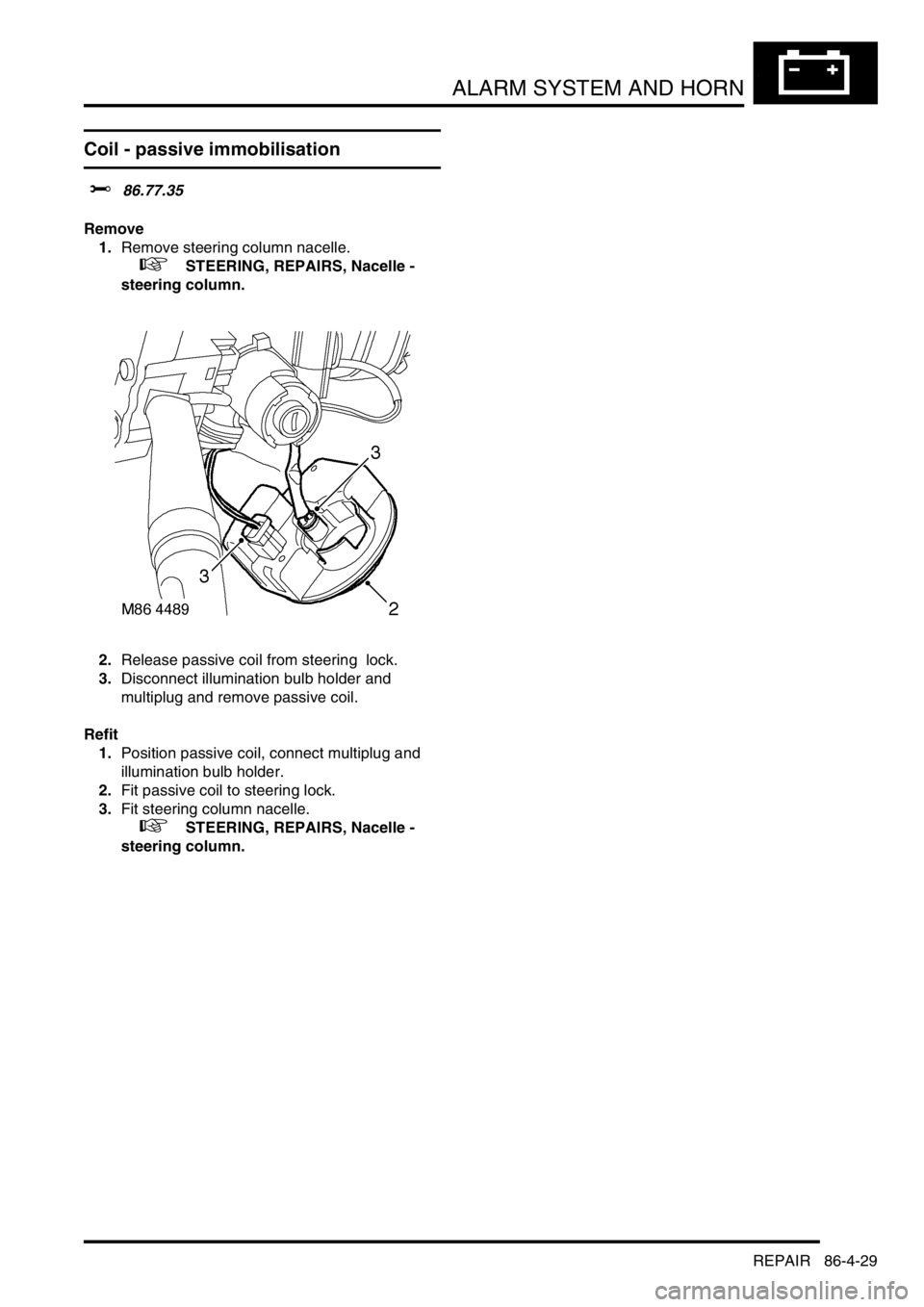
Coil - passive immobilisation
$% 86.77.35
Remove
1.Remove steering column nacelle.
+ STEERING, REPAIRS, Nacelle -
steering column.
2.Release passive coil from steering lock.
3.Disconnect illumination bulb holder and
multiplug and remove passive coil.
Refit
1.Position passive coil, connect multiplug and
illumination bulb holder.
2.Fit passive coil to steering lock.
3.Fit steering column nacelle.
+ STEERING, REPAIRS, Nacelle -
steering column.
Page 1546 of 1672
WINDOWS
DESCRIPTION AND OPERATION 86-5-7
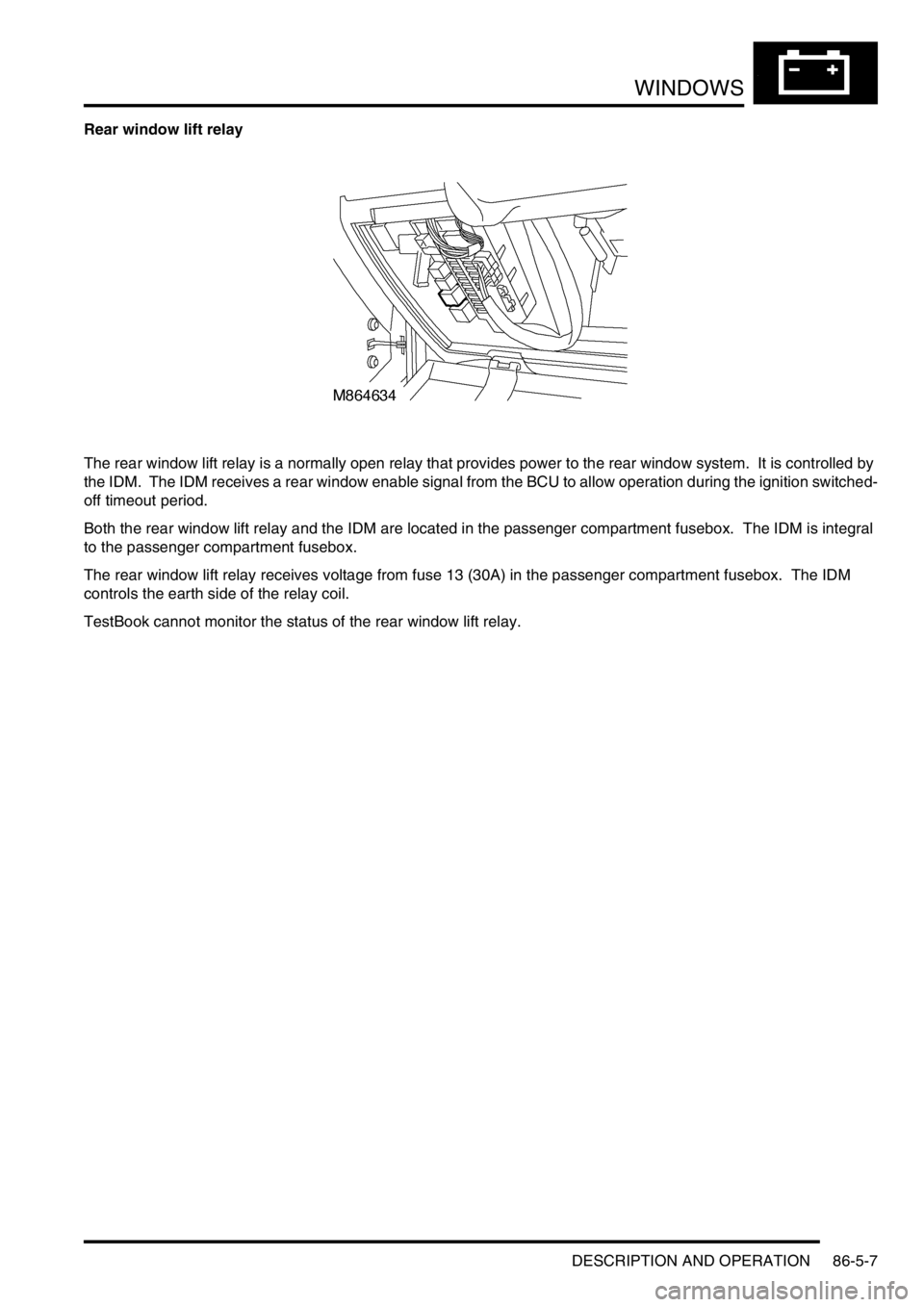
Rear window lift relay
The rear window lift relay is a normally open relay that provides power to the rear window system. It is controlled by
the IDM. The IDM receives a rear window enable signal from the BCU to allow operation during the ignition switched-
off timeout period.
Both the rear window lift relay and the IDM are located in the passenger compartment fusebox. The IDM is integral
to the passenger compartment fusebox.
The rear window lift relay receives voltage from fuse 13 (30A) in the passenger compartment fusebox. The IDM
controls the earth side of the relay coil.
TestBook cannot monitor the status of the rear window lift relay.
Page 1579 of 1672
HARNESSES
86-7-8 REPAIRS
35.Secure harness to LH side of body with cable
tie clips and retainers.
36.Connect and secure multiplugs to lower LH 'A'
post.
37.Feed harness through roof to centre.
38.Secure harness behind bonnet release cable.
39.Connect rear washer pipe at lower 'A' post and
secure with clip.
40.Secure harness to roof with clips.
41.Connect multiplug to interior mirror, ARC
accelerometer.
42.Position sound deadening panels and secure
with clips.
43.Fit headlining.
+ INTERIOR TRIM COMPONENTS,
REPAIRS, Headlining.
44.Fit fascia panel.
+ INTERIOR TRIM COMPONENTS,
REPAIRS, Fascia.
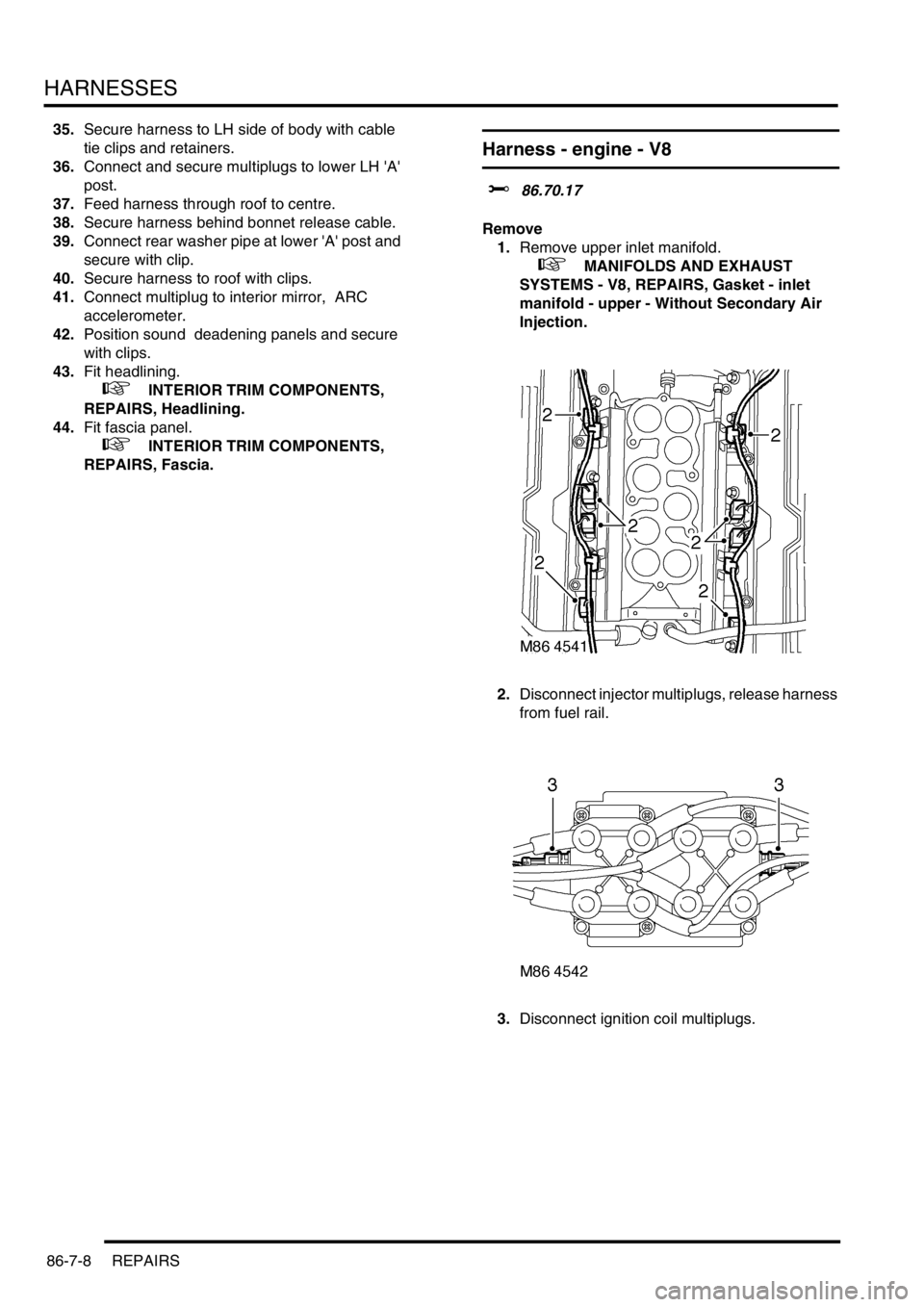
Harness - engine - V8
$% 86.70.17
Remove
1.Remove upper inlet manifold.
+ MANIFOLDS AND EXHAUST
SYSTEMS - V8, REPAIRS, Gasket - inlet
manifold - upper - Without Secondary Air
Injection.
2.Disconnect injector multiplugs, release harness
from fuel rail.
3.Disconnect ignition coil multiplugs.
Page 1583 of 1672
HARNESSES
86-7-12 REPAIRS
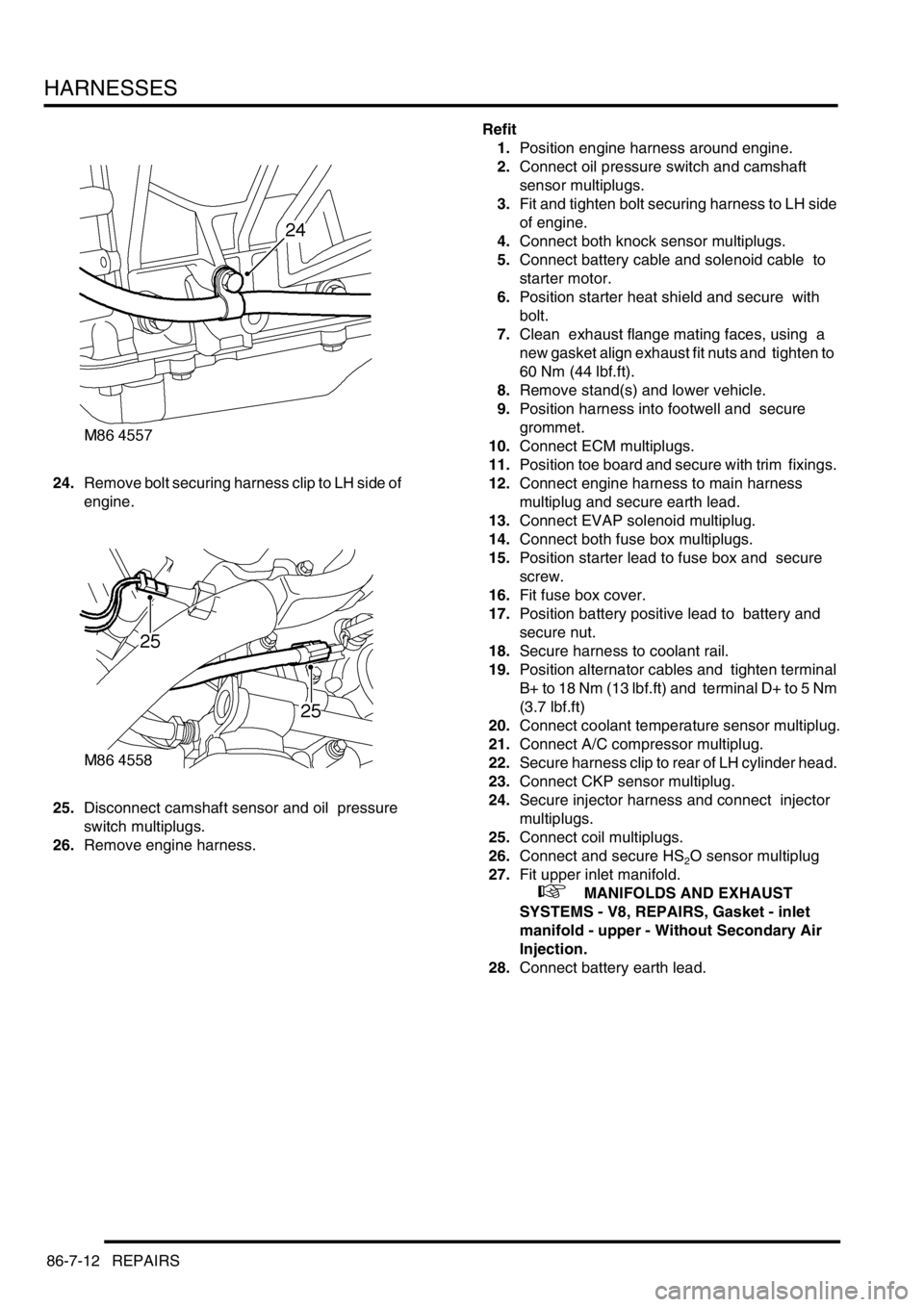
24.Remove bolt securing harness clip to LH side of
engine.
25.Disconnect camshaft sensor and oil pressure
switch multiplugs.
26.Remove engine harness. Refit
1.Position engine harness around engine.
2.Connect oil pressure switch and camshaft
sensor multiplugs.
3.Fit and tighten bolt securing harness to LH side
of engine.
4.Connect both knock sensor multiplugs.
5.Connect battery cable and solenoid cable to
starter motor.
6.Position starter heat shield and secure with
bolt.
7.Clean exhaust flange mating faces, using a
new gasket align exhaust fit nuts and tighten to
60 Nm (44 lbf.ft).
8.Remove stand(s) and lower vehicle.
9.Position harness into footwell and secure
grommet.
10.Connect ECM multiplugs.
11.Position toe board and secure with trim fixings.
12.Connect engine harness to main harness
multiplug and secure earth lead.
13.Connect EVAP solenoid multiplug.
14.Connect both fuse box multiplugs.
15.Position starter lead to fuse box and secure
screw.
16.Fit fuse box cover.
17.Position battery positive lead to battery and
secure nut.
18.Secure harness to coolant rail.
19.Position alternator cables and tighten terminal
B+ to 18 Nm (13 lbf.ft) and terminal D+ to 5 Nm
(3.7 lbf.ft)
20.Connect coolant temperature sensor multiplug.
21.Connect A/C compressor multiplug.
22.Secure harness clip to rear of LH cylinder head.
23.Connect CKP sensor multiplug.
24.Secure injector harness and connect injector
multiplugs.
25.Connect coil multiplugs.
26.Connect and secure HS
2O sensor multiplug
27.Fit upper inlet manifold.
+ MANIFOLDS AND EXHAUST
SYSTEMS - V8, REPAIRS, Gasket - inlet
manifold - upper - Without Secondary Air
Injection.
28.Connect battery earth lead.
Page 1584 of 1672
HARNESSES
REPAIRS 86-7-13
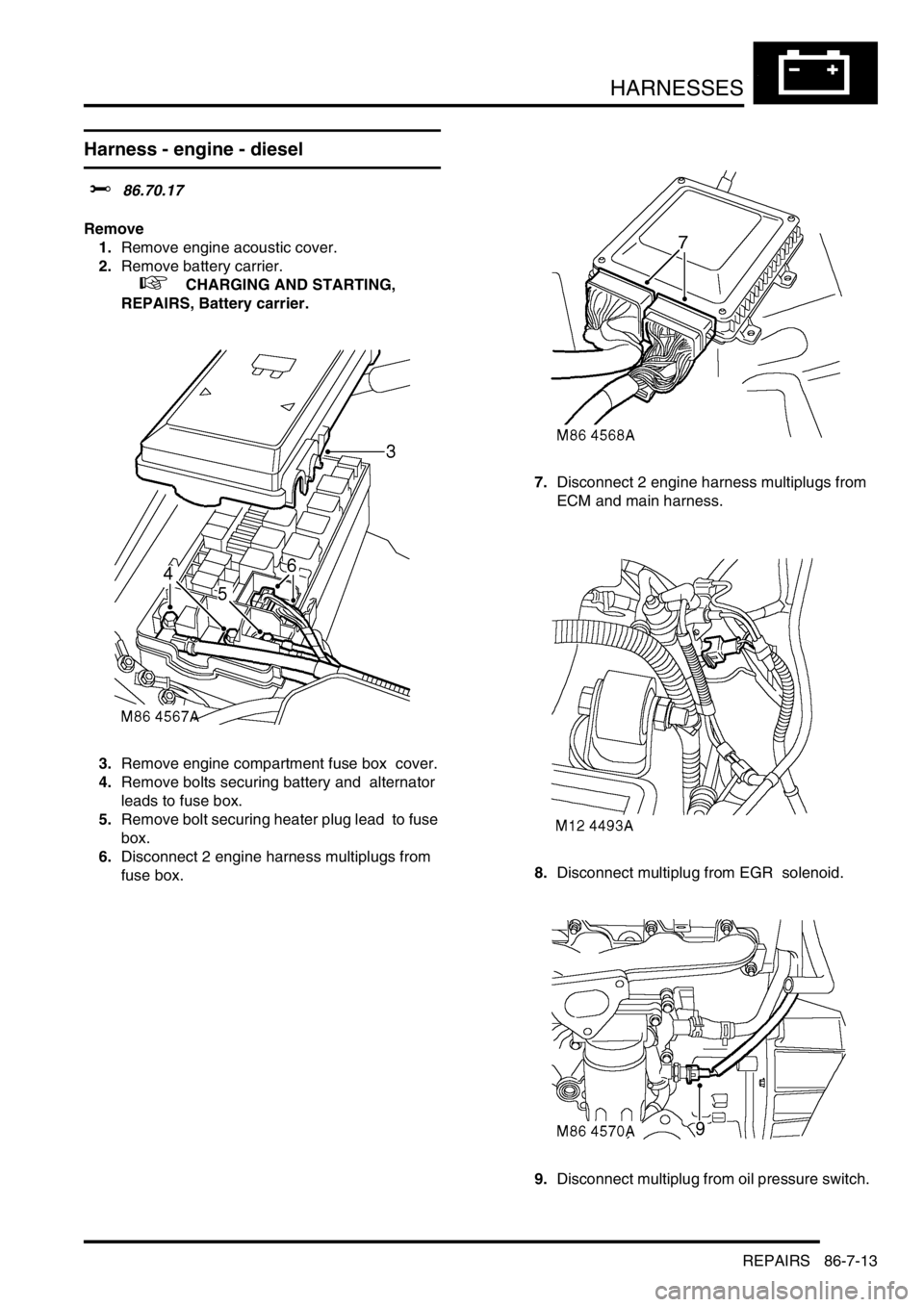
Harness - engine - diesel
$% 86.70.17
Remove
1.Remove engine acoustic cover.
2.Remove battery carrier.
+ CHARGING AND STARTING,
REPAIRS, Battery carrier.
3.Remove engine compartment fuse box cover.
4.Remove bolts securing battery and alternator
leads to fuse box.
5.Remove bolt securing heater plug lead to fuse
box.
6.Disconnect 2 engine harness multiplugs from
fuse box. 7.Disconnect 2 engine harness multiplugs from
ECM and main harness.
8.Disconnect multiplug from EGR solenoid.
9.Disconnect multiplug from oil pressure switch.
Page 1586 of 1672
HARNESSES
REPAIRS 86-7-15
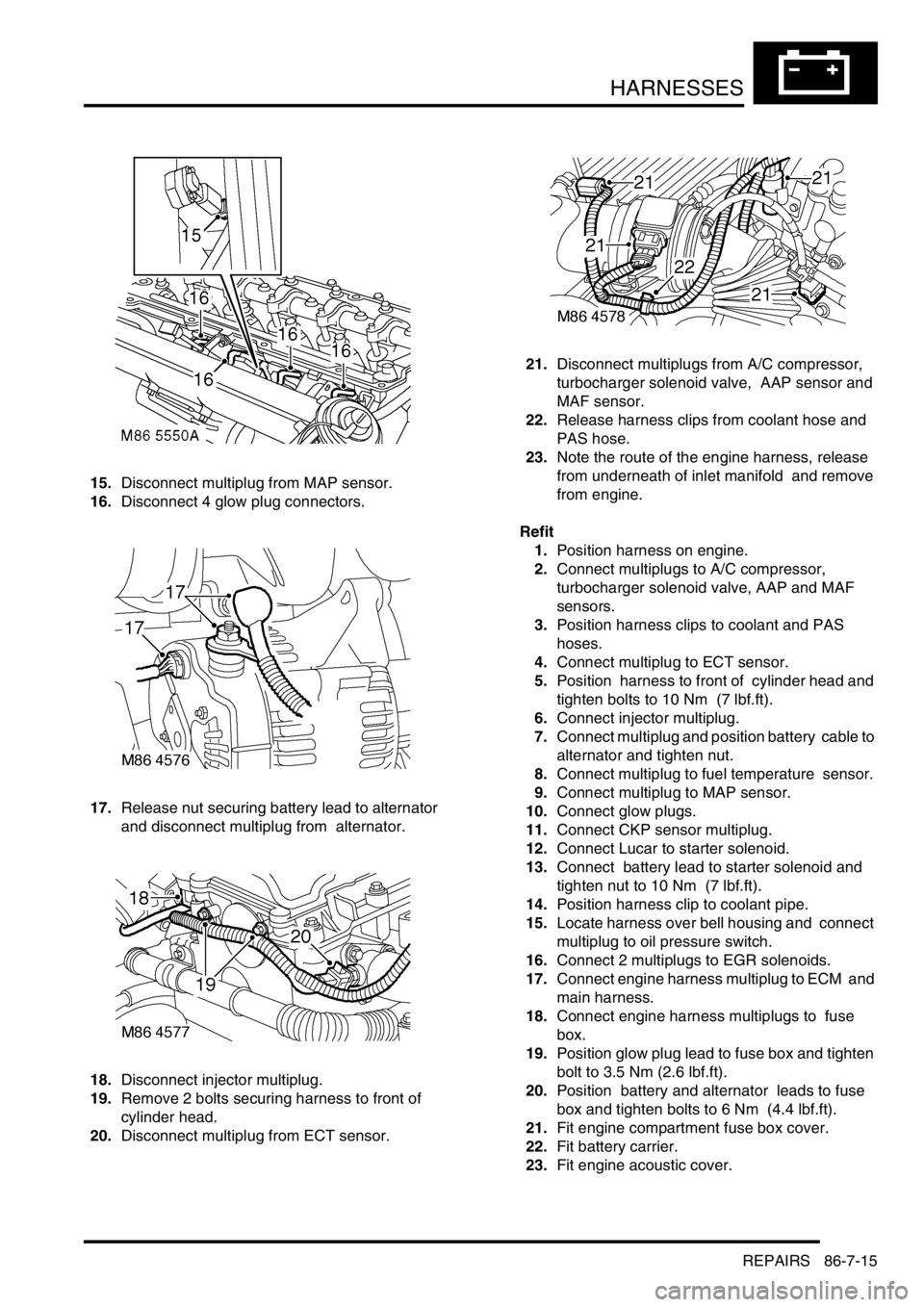
15.Disconnect multiplug from MAP sensor.
16.Disconnect 4 glow plug connectors.
17.Release nut securing battery lead to alternator
and disconnect multiplug from alternator.
18.Disconnect injector multiplug.
19.Remove 2 bolts securing harness to front of
cylinder head.
20.Disconnect multiplug from ECT sensor. 21.Disconnect multiplugs from A/C compressor,
turbocharger solenoid valve, AAP sensor and
MAF sensor.
22.Release harness clips from coolant hose and
PAS hose.
23.Note the route of the engine harness, release
from underneath of inlet manifold and remove
from engine.
Refit
1.Position harness on engine.
2.Connect multiplugs to A/C compressor,
turbocharger solenoid valve, AAP and MAF
sensors.
3.Position harness clips to coolant and PAS
hoses.
4.Connect multiplug to ECT sensor.
5.Position harness to front of cylinder head and
tighten bolts to 10 Nm (7 lbf.ft).
6.Connect injector multiplug.
7.Connect multiplug and position battery cable to
alternator and tighten nut.
8.Connect multiplug to fuel temperature sensor.
9.Connect multiplug to MAP sensor.
10.Connect glow plugs.
11.Connect CKP sensor multiplug.
12.Connect Lucar to starter solenoid.
13.Connect battery lead to starter solenoid and
tighten nut to 10 Nm (7 lbf.ft).
14.Position harness clip to coolant pipe.
15.Locate harness over bell housing and connect
multiplug to oil pressure switch.
16.Connect 2 multiplugs to EGR solenoids.
17.Connect engine harness multiplug to ECM and
main harness.
18.Connect engine harness multiplugs to fuse
box.
19.Position glow plug lead to fuse box and tighten
bolt to 3.5 Nm (2.6 lbf.ft).
20.Position battery and alternator leads to fuse
box and tighten bolts to 6 Nm (4.4 lbf.ft).
21.Fit engine compartment fuse box cover.
22.Fit battery carrier.
23.Fit engine acoustic cover.