2002 LAND ROVER DISCOVERY oil
[x] Cancel search: oilPage 1497 of 1672

BODY CONTROL UNIT
86-3-28 DESCRIPTION AND OPERATION
The BCU can be configured whether or not to provide bulb failure warnings.
When the direction indicators are operating, instrument pack direction indicators flash in sequence with the exterior
direction indicators. If a failure of an indicator bulb occurs, the corresponding instrument pack indication lamp will flash
quickly to warn of the problem.
The IDM monitors the current drawn through the circuit to detect for the occurrence of a lamp failure. If an indicator
lamp fails, the IDM detects the drop in current drawn through the resistor and operates the indicator relay at a faster
speed. The fast flash is demonstrated on the instrument pack direction indicator warning lamps to bring attention to
the driver that a direction indicator bulb failure has occurred. The current sense for the related indicator lamps (RH or
LH) are checked when a direction indicator request has been made that lasts for at least 160 ms. The current level
sensed is relative to the number of working bulbs and determines the request generated by the BCU.
The output is signalled to the instrument pack using the serial communications link. If the hazard warning lamps are
operating, both sets of direction indicators are checked using the current sensing functions to check the number of
bulbs on each side of the vehicle.
If the BCU detects that a direction indicator request has not been made, but one or other of the current sense inputs
indicate that current is flowing, a 'Relay stuck' output is generated.
Hazard lamps
The BCU controls the operation of the hazard warning lamps via the IDM and dedicated relays. The hazard warning
lamps are activated under the following conditions:
lThe vehicle is locked and the security system is set (the hazard warning lamps flash three times if the
superlocking feature is used, once if not).
lThe vehicle is unlocked (the hazard warning lamps flash once for a duration of two seconds).
lThe anti-theft alarm system is triggered (the hazard warning lamps flash in phase with and for the duration of the
audible warning).
lThe hazard warning switch is pressed (the hazard warning lamps flash until the hazard warning switch is pressed
for a second time).
lThe inertia switch is triggered (the hazard warning lamps flash until the inertia switch has been reset).
The hazard warning lamp operation may differ dependent on market and customer configuration options.
The hazard warning lamps are operated from a latching pushbutton switch located on the fascia. When the switch is
pressed, both left and right indicator lamps in the instrument pack flash to show that the hazard warning lamps are
operating and all hazard warning lamps flash simultaneously. If a trailer is fitted, the ICM detects this and a trailer
symbol in the instrument pack also flashes to show correct operation of the trailer direction indicators and hazard
warning lamps.
The BCU supplies a reference voltage to the hazard warning switch. When the hazard warning switch is operated an
earth path is completed which signals the BCU that a request for hazard lamp operation has been made. The BCU
then sends a signal to the IDM via the serial data bus to communicate the request. The IDM supplies an earth path
for both direction indicator relay coils simultaneously so that the hazard warning lamps are turned on concurrently.
The IDM controls the timing of the flash operations by continually removing and restoring the earth path to both
direction indicator relay coils simultaneously.
Number of working bulbs Request generated
3 Trailer detected
2 None (bulbs okay)
1 Bulb failure detected
0 Direction indicator short circuit detected
Page 1498 of 1672

BODY CONTROL UNIT
DESCRIPTION AND OPERATION 86-3-29
Courtesy headlamps
This feature activates the headlamps for 30 seconds when the lock button on the remote transmitter is held down for
longer than 1 second. The headlamps will extinguish if the BCU receives either a lock or an unlock signal from the
remote transmitter.
The BCU checks the status of the following inputs to determine the correct qualifying conditions for requesting
courtesy headlamps:
lIgnition state.
lRemote locking request.
lRemote unlocking request.
lLazy locking request.
If the ignition is off and a lazy locking request is received, the courtesy headlamps are switched on and an internal
timer is turned on in the BCU which operates for 30 seconds. If the 30 second timer expires or a request for remote
locking or remote unlocking is received, the courtesy headlamps will be turned off.
When main beam is selected, the IDM also provides a signal to the instrument pack to switch on the main beam
warning lamp. An additional signal 'main beam indicator disable' is used to prevent the daylight running lamps
illuminating the main beam indicator when the main beam is in the daylight running lamp state and the main beam
indicator disable signal is on.
Lights on alarm
The lights on alarm in the instrument pack operates when the driver's door is open and the side lamps or headlamps
are on. The system uses inputs from the driver's door switch and the lighting switch to determine the logical conditions
that need to occur for switching on the alarm. The BCU carries out the logic operation and communicates with the
instrument pack using the serial data bus; the instrument pack will be requested to sound the alarm if the logic inputs
indicate that the driver's door is open with the lights still on.
Supply voltage is provided through the lighting switch to the IDM which acts as the signal line to indicate that the lights
are on for the logic circuits in the IDM and BCU. When the driver's door is opened, a second feed is supplied to the
BCU through the driver's door switch to indicate the condition. In this logic condition (lights on and driver's door open)
the BCU signals the instrument pack to operate the audible warning. If the lights are switched off or the driver's door
is closed the logic condition will be changed and the audible warning will be switched off.
Daylight running lamps
The BCU operates the daylight running lamps (where fitted) via the IDM. The daylight running lamps option can be
programmed in one of three states dependent on market/ customer requirements, these are:
lOption 1– no daylight running lamps.
lOption 2 – on with main beam off.
lOption 3 – on with main and dipped beam off and gearbox not in Park.
The BCU will ensure the logical conditions are satisfied for the lamps to operate under the set conditions. The BCU
checks the status of the following inputs to determine the logic action for providing an output to the daylight running
lamp relay:
lMain beam state.
lEngine running (link from instrument pack).
lDipped beam.
lGearbox state.
A voltage supply is fed to the coil of the daylight running lamp relay and the IDM. When the preconditions are satisfied
for daylight running lamp operation, the BCU sends a signal for the IDM to complete the circuit to earth to switch on
the daylight running lamps. The logical inputs are checked to ensure that the engine is running before switching the
relay to turn on the daylight running lamps. The engine running signal has to be present for at least 2 seconds before
the daylight running lamp relay can be switched on.
Page 1499 of 1672

BODY CONTROL UNIT
86-3-30 DESCRIPTION AND OPERATION
Fog lamps
The BCU operates the rear fog lamps and the front fog lamps (where fitted) via the IDM. The BCU front fog lamp
operation can be programmed to operate under one of three set conditions. The BCU will ensure the logical conditions
are satisfied for the lamps to operate under the set conditions.
Front fog lamps
Front fog lamp operation is monitored by the BCU, which allows only the front fog lamps to operate when the side
lamps or headlamps are on. When the side lamps, headlamps or ignition switch is turned off, the BCU also switches
off the fog lamps. When the side or headlamps are switched on again, the front fog lamps will remain off unless the
front fog lamp switch is pressed to resume operation. If the rear fog guard lamps are selected on, switching off the
front fog lamps will also switch off the rear fog guard lamps.
When the fog lamp switch is operated, an earth path is completed and the BCU allows the fog lights to be switched
on providing the logical preconditions have been satisfied. The BCU then supplies a voltage supply to the fog lamp
relay, to illuminate the fog lamps.
The front fog lamps option can be programmed in one of three states dependent on market/ customer requirements,
these are:
lOption 1– not fitted.
lOption 2 – main beam no effect.
lOption 3 – off with main beam.
The BCU checks the status of the following inputs to determine the logic action for providing an output to the front fog
lamp relay:
lIgnition state.
lMain beam state.
lSide lamps.
lDipped beam.
lFront fogs selected (press button, not latched).
If the ignition state is crank the state of the front fog relay is memorised and the relay is switched off. Pressing the
front fog switch during cranking will not be recognised. When the ignition state returns to Ignition after cranking, the
memorised front fog relay state is restored. If the ignition is turned off, the front fog relay is turned off.
For option 3 configuration, if the main beam is turned on the state of the front fog relay is memorised and the relay is
switched off. Pressing the front fog switch while main beam is on will not be recognised. When the Main beam state
returns to OFF, the memorised front fog relay state is restored.
In the event of a communications link failure while the front fog relay is on, the front fog relay will be switched off.
Rear fog lamps
The rear fog lamps operation is monitored by the BCU, which only allows the rear fog lamps to operate when the side
lamps or the headlamps are on. When the side lamps, headlamps or ignition is switched off, the rear fog lamps are
also switched off. When the side lamps or headlamps are switched on again, the rear fog lamps will not switch on
again unless reselected by operating the rear fog lamps switch. If front fog lamps are fitted, the rear fog lamps will be
switched off if the front fog lamps are switched off.
A supply voltage to the rear fog lamps relay is provided from a fuse in the passenger compartment fuse box, then
through two electronic switches in the IDM. With the lighting switch in the side lamp or headlamp position, an earth
path from the coil of the rear fog lamps relay completes the circuit through the two switches in the IDM to switch the
rear fog lamps on when the BCU receives a request signal from the rear fog lamps switch to turn the circuit on.
Page 1501 of 1672

BODY CONTROL UNIT
86-3-32 DESCRIPTION AND OPERATION
Odometer update
The BCU can be programmed for one of two options:
lOption 1 – no odometer error warning.
lOption 2 – odometer error warning.
In order to provide an LCD flash request to the instrument pack via the communications link, the following inputs are
checked:
lIgnition state.
lInstrument pack odometer value (via the communications link).
lBCU odometer value.
The function is only active when the ignition state is on. The maximum allowed value is 999,999 miles (1,608,999
km).If the instrument pack odometer value is greater than the maximum allowed value, the maximum value is
assumed. The BCU odometer value is stored in EEPROM. If 16 identical values of the instrument pack odometer
reading is received consecutively, the instrument pack odometer value is compared with the BCU odometer value. If
the consecutive readings from the instrument pack differ, the BCU odometer value is incremented accordingly. If the
BCU odometer value is less than the instrument pack odometer value by up to 10 km, the BCU odometer value is set
equal to the instrument pack odometer value.
If the odometer warning option is enabled, and the contents of the instrument pack odometer value buffer is identical
to, or greater than BCU odometer value
± 10 km, the BCU sends an LED flash request to the instrument pack.
In the event of a communications link failure, this function will be unable to operate.
Gear position indicator illumination
On automatic gearbox models, two variations of illumination for the gear position indicators on the selector lever can
be programmed into the BCU. In option 1, illumination is provided when the ignition is on. In option 2, illumination is
enabled when the ignition is on and the side lamps are off.
Starter relay
The BCU checks the status of the following inputs and internal BCU conditions to determine whether or not to provide
an output to enable the starter relay:
lAutostart inhibit (vehicles with automatic gearbox only).
lSecurity start inhibit (immobilisation check).
lEngine running (link to instrument pack).
lEEPROM locked (internal check).
lIDM and BCU matched.
When the BCU receives a crank signal from the ignition switch, an earth path is completed to the starter relay coil,
provided that the security system has been de-activated. If the ECM has not received a valid unlock/ remobilise signal,
the starter relay will be disengaged and the engine stopped. The BCU also receives an engine running signal from
the instrument pack, so that if the ignition key is turned to the crank position while the engine is running, the starter
motor relay will not be engaged.
If the logic conditions are correct to allow starter operation, the completion of the earth path from the starter relay coil
to the BCU energises the coil and the relay contacts close to supply battery power to the starter motor.
When the ignition switch is released from the crank position, the power supply feed from the ignition switch to the
starter relay coil is interrupted and the relay contacts open to prevent further battery feed to the starter motor.
If a communications link failure is experienced, the BCU will be prevented from detecting the 'engine running'
condition and the BCU will default to assume that the engine is not running.
Page 1503 of 1672

BODY CONTROL UNIT
86-3-34 DESCRIPTION AND OPERATION
The ignition key interlock option can be programmed in one of three states dependent on market/ customer
requirements, these are:
lOption 1– not fitted.
lOption 2 – normal operation.
lOption 3 – inhibit transfer box.
The BCU checks the status of the following inputs to determine the logic action for operating the ignition key interlock
solenoid:
lTransfer box neutral selected.
lGearbox state.
lTransit mode.
When the transit mode is on, the ignition key interlock solenoid is off.
Transfer box interlock (where fitted)
The transfer box interlock is controlled by the IDM to prevent transfer box shifter operation unless certain
preconditions have been satisfied.
The transfer box interlock prevents the transfer box being shifted from High or Low to neutral with the ignition key
removed from the ignition switch. When the BCU senses that the ignition key is removed from the ignition switch, it
signals the IDM via the serial data bus. The IDM then provides an earth path for the coil of the transfer box relay,
energising the relay coil and closing the relay contacts to provide a voltage supply to the transfer box interlock
solenoid.
A diode is included in the supply line to the solenoid to prevent residual current causing the solenoid to stick in the
energised position.
The transfer box solenoid interlock option can be programmed in one of three states dependent on market/ customer
requirements, these are:
lOption 1– not fitted.
lOption 2 – normal operation.
lOption 3 – inhibit transfer box.
The BCU checks the status of the following inputs to determine the logic action for employing the transfer box interlock
solenoid (transfer box solenoid enable):
lIgnition state.
lGearbox state.
In the event of a communications link failure occurring while the transfer box enable is on, the output will be switched
off.
Gear position switch
On automatic gearbox models, the BCU provides an output which supplies power to the automatic gearbox gear
position switch. The BCU checks for the following inputs before it supplies power:
lIgnition on.
lAuxiliary.
When the ignition is on, the feed to the gear position switch is on. When the ignition is off and auxiliary is off for more
than 30 seconds, feed to the gear position switch is off.
+ AUTOMATIC GEARBOX - ZF4HP22 - 24, DESCRIPTION AND OPERATION, Description.
Page 1512 of 1672

ALARM SYSTEM AND HORN
DESCRIPTION AND OPERATION 86-4-3
1Theft deterrent LED
2Receiver
3Volumetric sensors
4Central door locking switch
5Body Control Unit (BCU)
6Bonnet activated alarm switch
7Vehicle horn
8Alarm sounder
9Fuel cut off switch
10Fuel flap release switch
11Door latch switches, drivers door key lock/
unlock switches
12Battery Backed Up Sounder (BBUS)
13Passive remobilisation exciter coil
Page 1520 of 1672
ALARM SYSTEM AND HORN
DESCRIPTION AND OPERATION 86-4-11
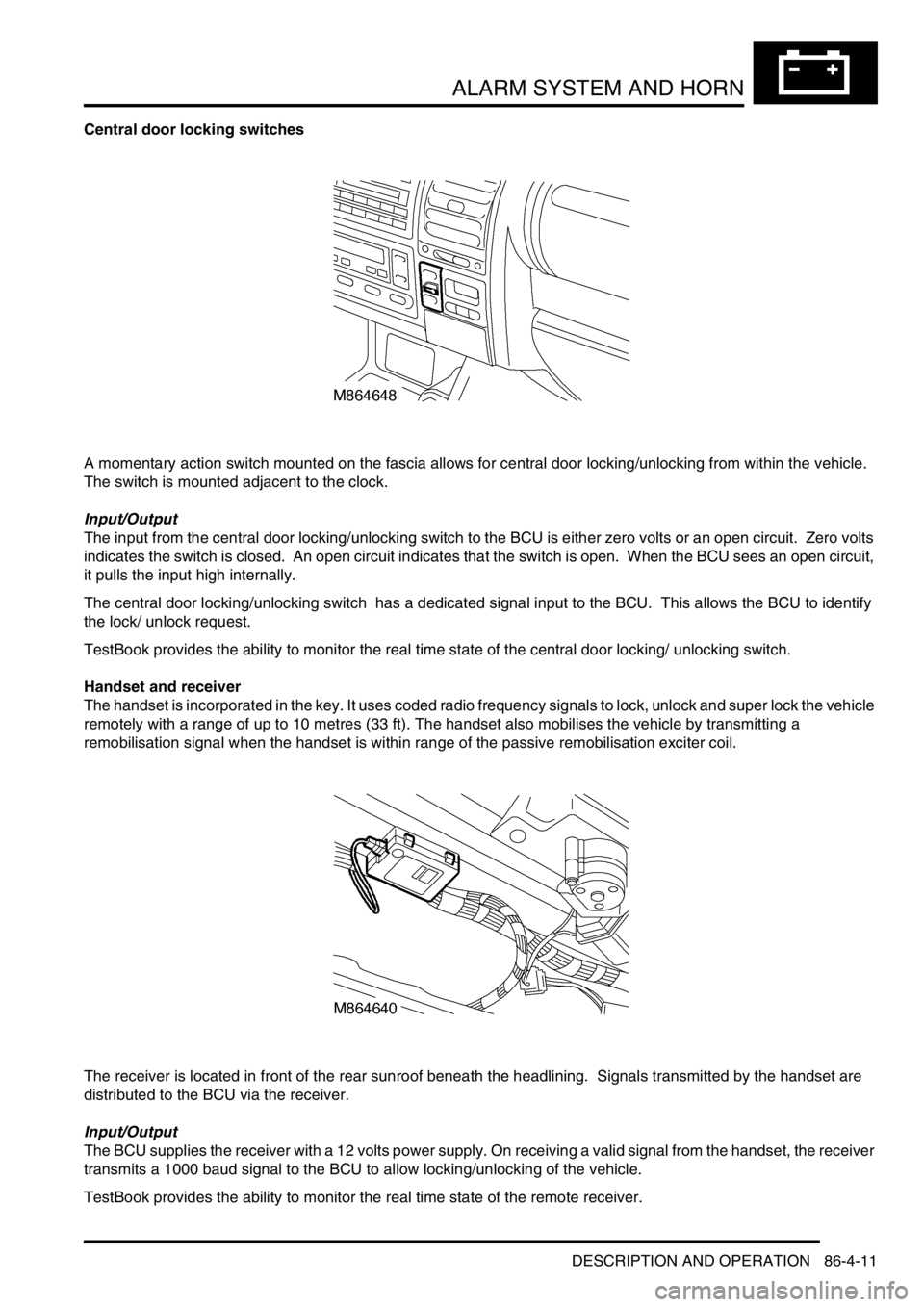
Central door locking switches
A momentary action switch mounted on the fascia allows for central door locking/unlocking from within the vehicle.
The switch is mounted adjacent to the clock.
Input/Output
The input from the central door locking/unlocking switch to the BCU is either zero volts or an open circuit. Zero volts
indicates the switch is closed. An open circuit indicates that the switch is open. When the BCU sees an open circuit,
it pulls the input high internally.
The central door locking/unlocking switch has a dedicated signal input to the BCU. This allows the BCU to identify
the lock/ unlock request.
TestBook provides the ability to monitor the real time state of the central door locking/ unlocking switch.
Handset and receiver
The handset is incorporated in the key. It uses coded radio frequency signals to lock, unlock and super lock the vehicle
remotely with a range of up to 10 metres (33 ft). The handset also mobilises the vehicle by transmitting a
remobilisation signal when the handset is within range of the passive remobilisation exciter coil.
The receiver is located in front of the rear sunroof beneath the headlining. Signals transmitted by the handset are
distributed to the BCU via the receiver.
Input/Output
The BCU supplies the receiver with a 12 volts power supply. On receiving a valid signal from the handset, the receiver
transmits a 1000 baud signal to the BCU to allow locking/unlocking of the vehicle.
TestBook provides the ability to monitor the real time state of the remote receiver.
Page 1521 of 1672
ALARM SYSTEM AND HORN
86-4-12 DESCRIPTION AND OPERATION
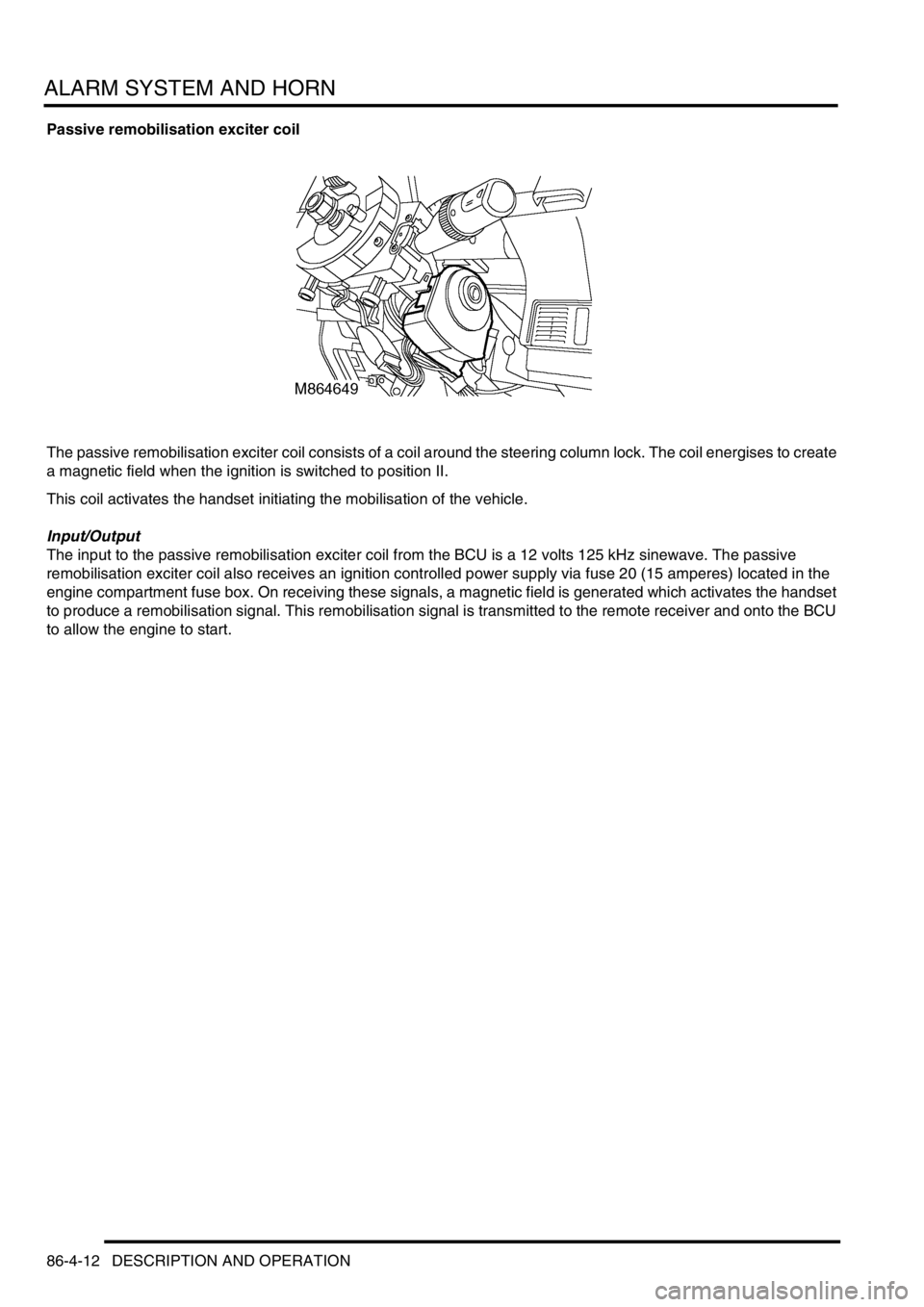
Passive remobilisation exciter coil
The passive remobilisation exciter coil consists of a coil around the steering column lock. The coil energises to create
a magnetic field when the ignition is switched to position II.
This coil activates the handset initiating the mobilisation of the vehicle.
Input/Output
The input to the passive remobilisation exciter coil from the BCU is a 12 volts 125 kHz sinewave. The passive
remobilisation exciter coil also receives an ignition controlled power supply via fuse 20 (15 amperes) located in the
engine compartment fuse box. On receiving these signals, a magnetic field is generated which activates the handset
to produce a remobilisation signal. This remobilisation signal is transmitted to the remote receiver and onto the BCU
to allow the engine to start.