2002 LAND ROVER DISCOVERY heating
[x] Cancel search: heatingPage 608 of 1672

COOLING SYSTEM - V8
DESCRIPTION AND OPERATION 26-2-7
Inlet manifold - Cooling connections
Coolant leaves the cylinder block via an outlet pipe attached to the front of the air intake manifold. The pipe is
connected to the thermostat housing and the radiator by a branch hose off the radiator top hose.
Hot coolant from the engine is also directed from the inlet manifold via pipes and hoses into the heater matrix. Coolant
is circulated through the heater matrix at all times when the engine is running.
A further tapping from the inlet manifold supplies coolant to the throttle housing via a hose. The coolant circulates
through a plate attached to the bottom of the housing and is returned through a plastic bleed pipe to an expansion
tank. The hot coolant heats the air intake of the throttle housing preventing ice from forming.
An Engine Coolant Temperature (ECT) sensor is fitted in the inlet manifold adjacent to the manifold outlet pipe. The
sensor monitors coolant temperature emerging from the engine and sends signals to the ECM for engine
management and temperature gauge operation.
+ ENGINE MANAGEMENT SYSTEM - V8, DESCRIPTION AND OPERATION, Description - engine
management.
Expansion tank
The expansion tank is located in the engine compartment. The tank is made from moulded plastic and attached to
brackets on the right hand inner wing. A maximum coolant when cold level is moulded onto the tank.
Excess coolant created by heat expansion is returned to the expansion tank from the radiator bleed pipe at the top of
the radiator. An outlet pipe is connected into the pump feed hose and replaces the coolant displaced by heat
expansion into the system when the engine is cool.
The expansion tank is fitted with a sealed pressure cap. The cap contains a pressure relief valve which opens to allow
excessive pressure and coolant to vent through the overflow pipe. The relief valve opens at a pressure of 1.4 bar (20
lbf.in
2) and above.
Heater matrix
The heater matrix is fitted in the heater assembly inside the passenger compartment. Two pipes pass through the
bulkhead into the engine compartment and provide coolant flow to and from the matrix. The pipes from the bulkhead
are connected to the matrix, sealed with 'O' rings and clamped with circular rings.
The matrix is constructed from aluminium with two end tanks interconnected with tubes. Aluminium fins are located
between the tubes and conduct heat away from the hot coolant flowing through the tubes. Air from the heater
assembly is warmed as it passes through the matrix fins. The warm air is then distributed into the passenger
compartment as required.
+ HEATING AND VENTILATION, DESCRIPTION AND OPERATION, Description.When the engine is
running, coolant from the engine is constantly circulated through the heater matrix.
Radiator
The 45 row radiator is located at the front of the vehicle. The cross-flow type radiator is manufactured from aluminium
with moulded plastic end tanks interconnected with tubes. Aluminium fins are located between the tubes and conduct
heat from the hot coolant flowing through the tubes, reducing the cooling temperature as it flows through the radiator.
Air intake from the front of the vehicle when moving carries heat away from the fins. When the vehicle is stationary,
the viscous fan draws air through the radiator fins to prevent the engine from overheating.
Two connections at the top of the radiator provide for the attachment of the top hose and bleed pipe. A connection at
the bottom of the radiator allows for the attachment of the bottom hose to the thermostat housing.
Two smaller radiators are located in front of the cooling radiator. The lower radiator provides cooling of the gearbox
oil and the upper radiator provides cooling for the engine oil.
+ MANUAL GEARBOX - R380, DESCRIPTION AND OPERATION, Description.
+ AUTOMATIC GEARBOX - ZF4HP22 - 24, DESCRIPTION AND OPERATION, Description.
+ ENGINE - V8, DESCRIPTION AND OPERATION, Description.
Page 674 of 1672

CLUTCH - V8
DESCRIPTION AND OPERATION 33-2-7
Flywheel
The flywheel is bolted to a flange on the rear of the crankshaft with six bolts. A dowel on the crankshaft flange ensures
that the flywheel is correctly located. A ring gear is fitted on the outside diameter of the flywheel and seats against a
flange. The ring gear is an interference fit on the flywheel and is installed by heating the ring and cooling the flywheel.
The ring gear is a serviceable item and can be replaced if damaged or worn.
The operating face of the flywheel is machined to provide a smooth surface for the drive plate to engage on. Three
dowels and six threaded holes provide for the location and attachment of the pressure plate. The flywheel is balanced
to ensure that it does not produce vibration when rotating. A machined slot, with a series of holes within the slot, is
located on the engine side of the flywheel. The slot accommodates the tip of the crankshaft position sensor which is
used by the Engine Control Module (ECM) for engine management.
+ ENGINE MANAGEMENT SYSTEM - V8, DESCRIPTION AND OPERATION, Description - engine
management.
Pressure plate
1Leaf spring
2Fulcrum ring
3Fulcrum ring
4Drive plate
5Pressure plate6Diaphragm
7Cover
8Rivet
9Retractor clip
The pressure plate assembly comprises a pressure plate, cover and diaphragm and is mounted on and rotates with
the flywheel.
Page 1067 of 1672

BRAKES
70-22 DESCRIPTION AND OPERATION
Minimum target speed
The minimum target speed depends on which gear is engaged. Reduced minimum target speeds are employed for
some gears if rough terrain or sharp bends are encountered while already travelling at the normal minimum target
speed. If loss of traction makes it impossible to maintain the minimum target speed, the SLABS ECU temporarily
increases the minimum target speed to maintain stability, then restores the normal minimum target speed when
traction improves.
HDC minimum target speeds
Fade out
To provide a safe transition from active braking to brakes off, the SLABS ECU invokes a fade out strategy if it detects
any of the following during active braking:
lA system fault.
lThe conditions for HDC are no longer being met.
lPossible brake overheat.
The fade out strategy increases the target speed at a low constant acceleration rate, independent of actual throttle
position. This results in the braking effort being gradually reduced and then discontinued. The SLABS ECU operates
warning indications during fade out that are dependent on the cause.
Fade out warning indications
Clutch disengagement/neutral selection
During active braking, if the SLABS ECU detects the clutch is disengaged or neutral is selected, it flashes the HDC
information warning lamp and sounds the audible warning continuously to indicate that conditions for HDC are no
longer being met. Initially, the SLABS ECU also fixes the target speed to the applicable minimum target speed, but if
the condition continues for approximately 60 seconds the SLABS ECU invokes fade out.
Brake overheat prevention
To prevent the brakes overheating, the SLABS ECU monitors the amount of active braking employed and, from this,
estimates brake temperature. If the SLABS ECU estimates the brake temperature has exceeded a preset limit, it
flashes the HDC fault warning lamp and sounds the audible warning continuously, to indicate that HDC should be
deselected to allow the brakes to cool. If active braking continues and the SLABS ECU estimates that brake
temperature has increased to an unacceptable level, fade out is employed and HDC is disabled. After fade out, the
audible warning is discontinued but the HDC fault warning lamp continues to flash, while HDC is selected, until the
SLABS ECU estimates brake temperature to be at an acceptable level. This calculation continues even if the ignition
is turned off, so turning the ignition off and back on will not reduce the disabled time. When the SLABS ECU estimates
the brake temperature to be acceptable, it extinguishes the HDC fault warning lamp and illuminates the HDC
information warning lamp to indicate that HDC is re-enabled. The disabled time is dependent on vehicle speed; typical
times at constant vehicle speeds are as follows:
Gear Speed, mph (km/h)
Manual gearbox Automatic gearbox
Normal Reduced Normal Reduced
1 4.4 (7.0) 4.4 (7.0) 4.4 (7.0) 4.4 (7.0)
2 5.2 (8.3) 4.4 (7.0) 4.4 (7.0) 4.4 (7.0)
3 6.0 (9.6) 4.4 (7.0) 7.5 (12.0) 6.0 (9.6)
4 7.5 (12.0) 6.0 (9.6) 7.5 (12.0) 6.0 (9.6)
5 8.8 (14.0) 7.0 (11.2) - -
Reverse 3.5 (5.6) 3.5 (5.6) 3.5 (5.6) 3.5 (5.6)
Neutral or clutch
disengaged8.8 (14.0) Last off road speed 4.4 (7.0) 4.4 (7.0)
Cause Warning indication
HDC fault warning lamp HDC information
warning lampAudible warning
Fault detected On Flashes Continuous
HDC conditions not met Off Flashes Continuous
Brake overheat prevention Flashes Off Continuous
Page 1179 of 1672
SCREENS
76-4-2 REPAIRS
Windscreen
$% 76.81.01
Introduction
The following equipment is required:
lCutting wire and handles.
lKent cutting knife.
lGlazing knife.
lWindscreen repair kit.
lSealant applicator gun.
lSuction cups.
lA felt covered table or stand to support glass.
WARNING: Wear protective gloves when
handling glass, solvents and primers.
WARNING: Wear suitable eye protection when
removing and refitting glass.
WARNING: If glass has splintered, protect eyes
and operate demister blower to remove glass
from heater ducts. Use a vacuum cleaner to
remove glass from fascia, carpet and seats.
Remove
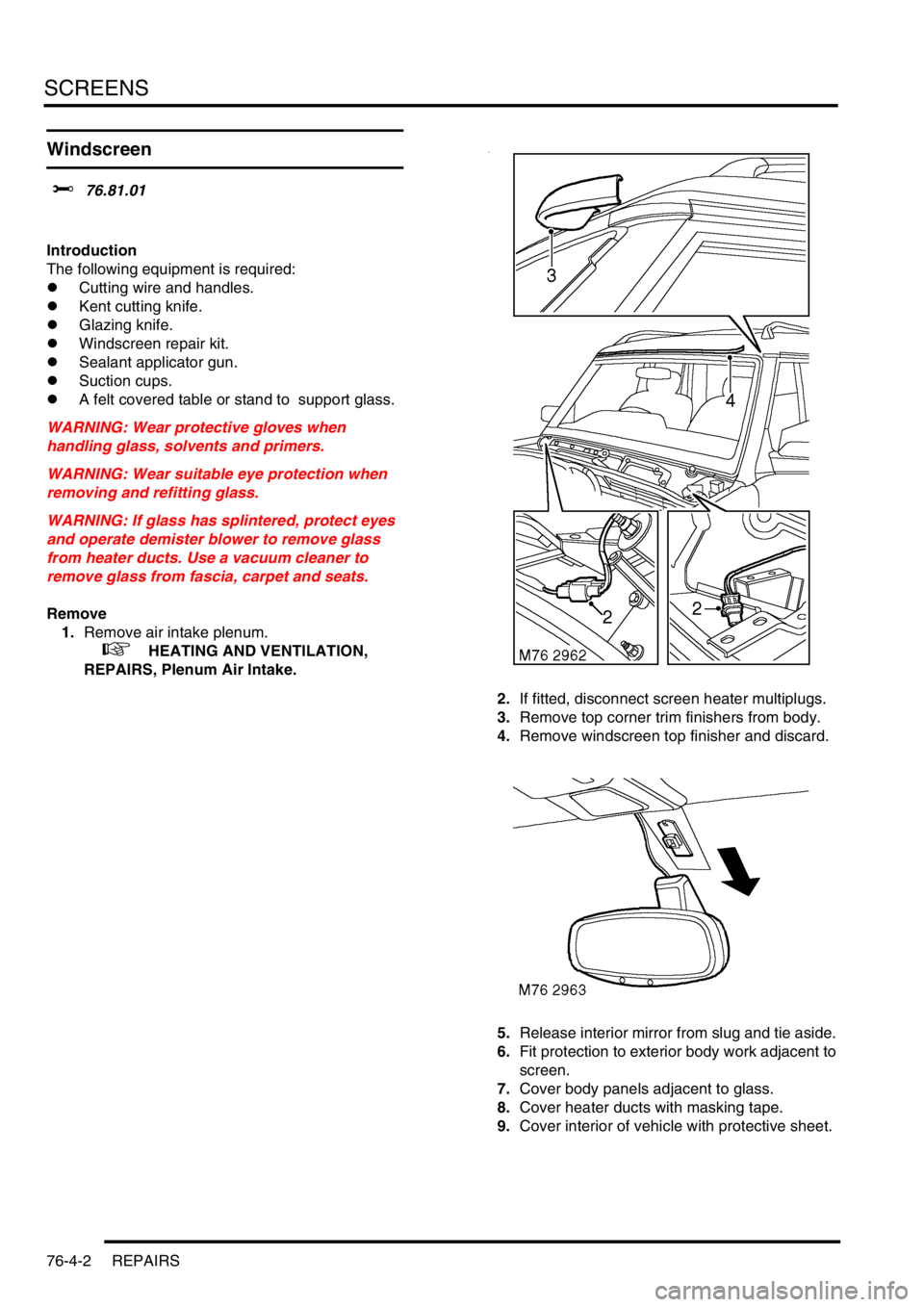
1.Remove air intake plenum.
+ HEATING AND VENTILATION,
REPAIRS, Plenum Air Intake.
2.If fitted, disconnect screen heater multiplugs.
3.Remove top corner trim finishers from body.
4.Remove windscreen top finisher and discard.
5.Release interior mirror from slug and tie aside.
6.Fit protection to exterior body work adjacent to
screen.
7.Cover body panels adjacent to glass.
8.Cover heater ducts with masking tape.
9.Cover interior of vehicle with protective sheet.
Page 1181 of 1672
SCREENS
76-4-4 REPAIRS
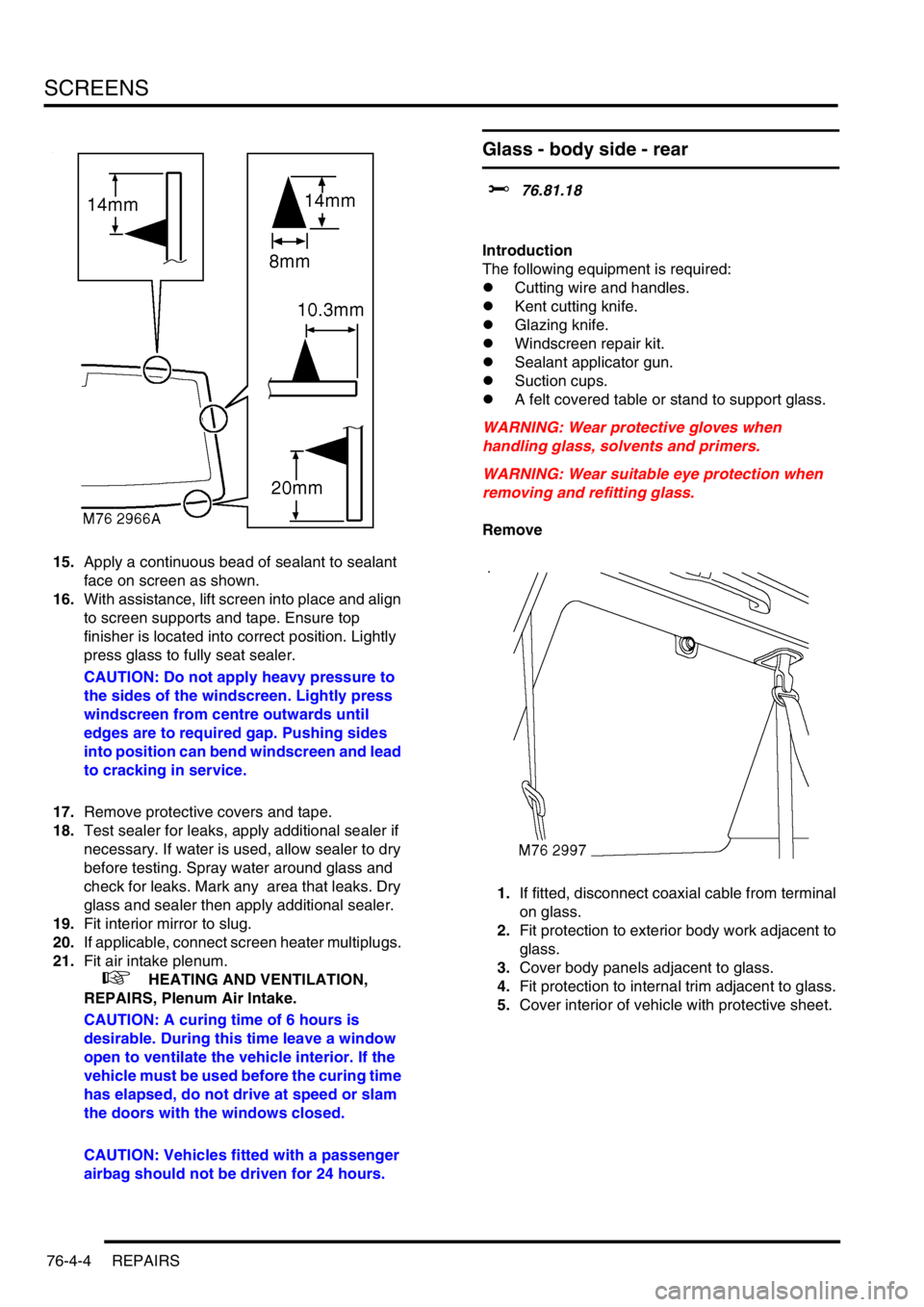
15.Apply a continuous bead of sealant to sealant
face on screen as shown.
16.With assistance, lift screen into place and align
to screen supports and tape. Ensure top
finisher is located into correct position. Lightly
press glass to fully seat sealer.
CAUTION: Do not apply heavy pressure to
the sides of the windscreen. Lightly press
windscreen from centre outwards until
edges are to required gap. Pushing sides
into position can bend windscreen and lead
to cracking in service.
17.Remove protective covers and tape.
18.Test sealer for leaks, apply additional sealer if
necessary. If water is used, allow sealer to dry
before testing. Spray water around glass and
check for leaks. Mark any area that leaks. Dry
glass and sealer then apply additional sealer.
19.Fit interior mirror to slug.
20.If applicable, connect screen heater multiplugs.
21.Fit air intake plenum.
+ HEATING AND VENTILATION,
REPAIRS, Plenum Air Intake.
CAUTION: A curing time of 6 hours is
desirable. During this time leave a window
open to ventilate the vehicle interior. If the
vehicle must be used before the curing time
has elapsed, do not drive at speed or slam
the doors with the windows closed.
CAUTION: Vehicles fitted with a passenger
airbag should not be driven for 24 hours.
Glass - body side - rear
$% 76.81.18
Introduction
The following equipment is required:
lCutting wire and handles.
lKent cutting knife.
lGlazing knife.
lWindscreen repair kit.
lSealant applicator gun.
lSuction cups.
lA felt covered table or stand to support glass.
WARNING: Wear protective gloves when
handling glass, solvents and primers.
WARNING: Wear suitable eye protection when
removing and refitting glass.
Remove
1.If fitted, disconnect coaxial cable from terminal
on glass.
2.Fit protection to exterior body work adjacent to
glass.
3.Cover body panels adjacent to glass.
4.Fit protection to internal trim adjacent to glass.
5.Cover interior of vehicle with protective sheet.
Page 1205 of 1672
SEATS
76-5-20 REPAIRS
Heating element - cushion - front seat
$% 78.30.24
Remove
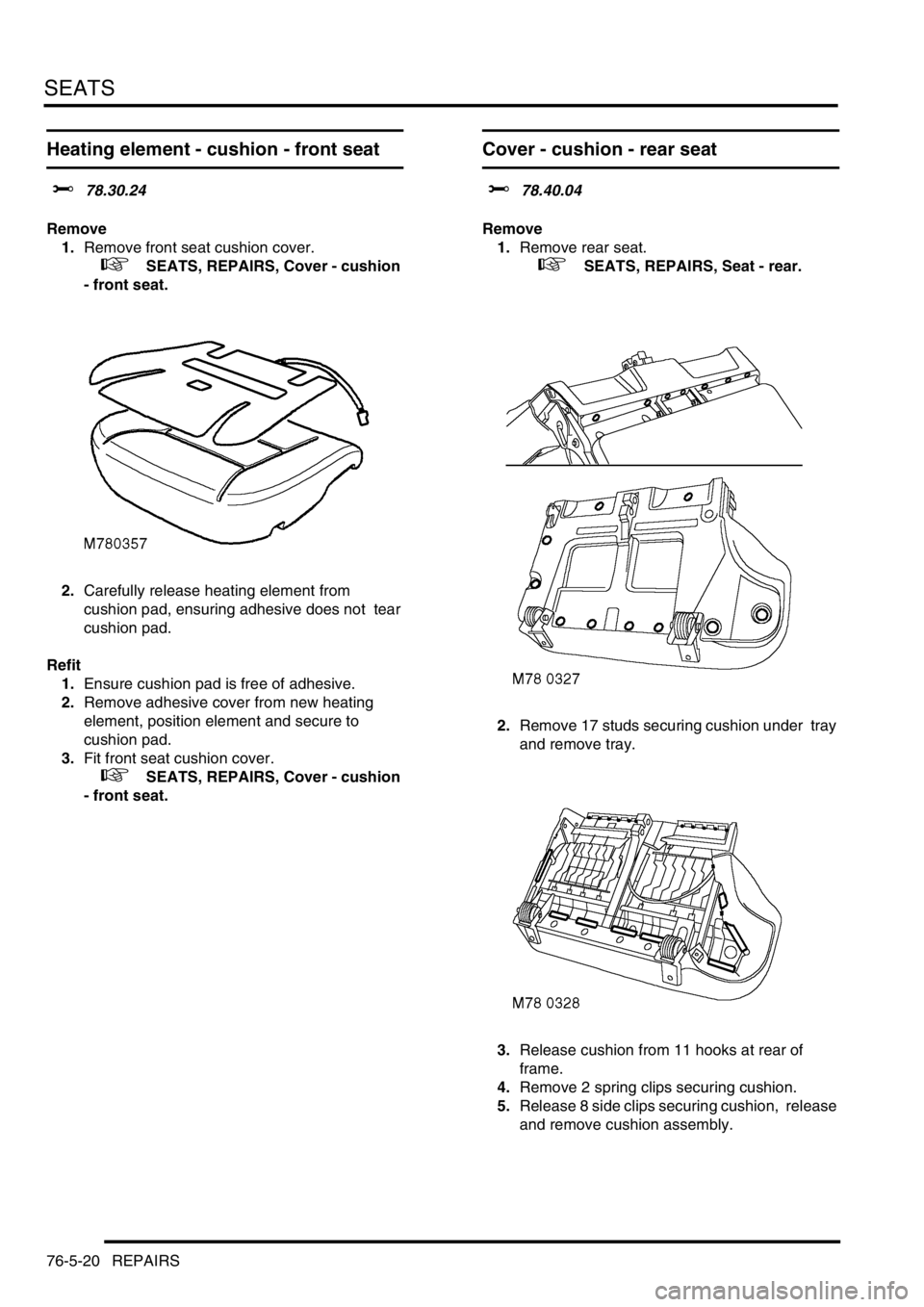
1.Remove front seat cushion cover.
+ SEATS, REPAIRS, Cover - cushion
- front seat.
2.Carefully release heating element from
cushion pad, ensuring adhesive does not tear
cushion pad.
Refit
1.Ensure cushion pad is free of adhesive.
2.Remove adhesive cover from new heating
element, position element and secure to
cushion pad.
3.Fit front seat cushion cover.
+ SEATS, REPAIRS, Cover - cushion
- front seat.
Cover - cushion - rear seat
$% 78.40.04
Remove
1.Remove rear seat.
+ SEATS, REPAIRS, Seat - rear.
2.Remove 17 studs securing cushion under tray
and remove tray.
3.Release cushion from 11 hooks at rear of
frame.
4.Remove 2 spring clips securing cushion.
5.Release 8 side clips securing cushion, release
and remove cushion assembly.
Page 1214 of 1672
SEATS
REPAIRS 76-5-29
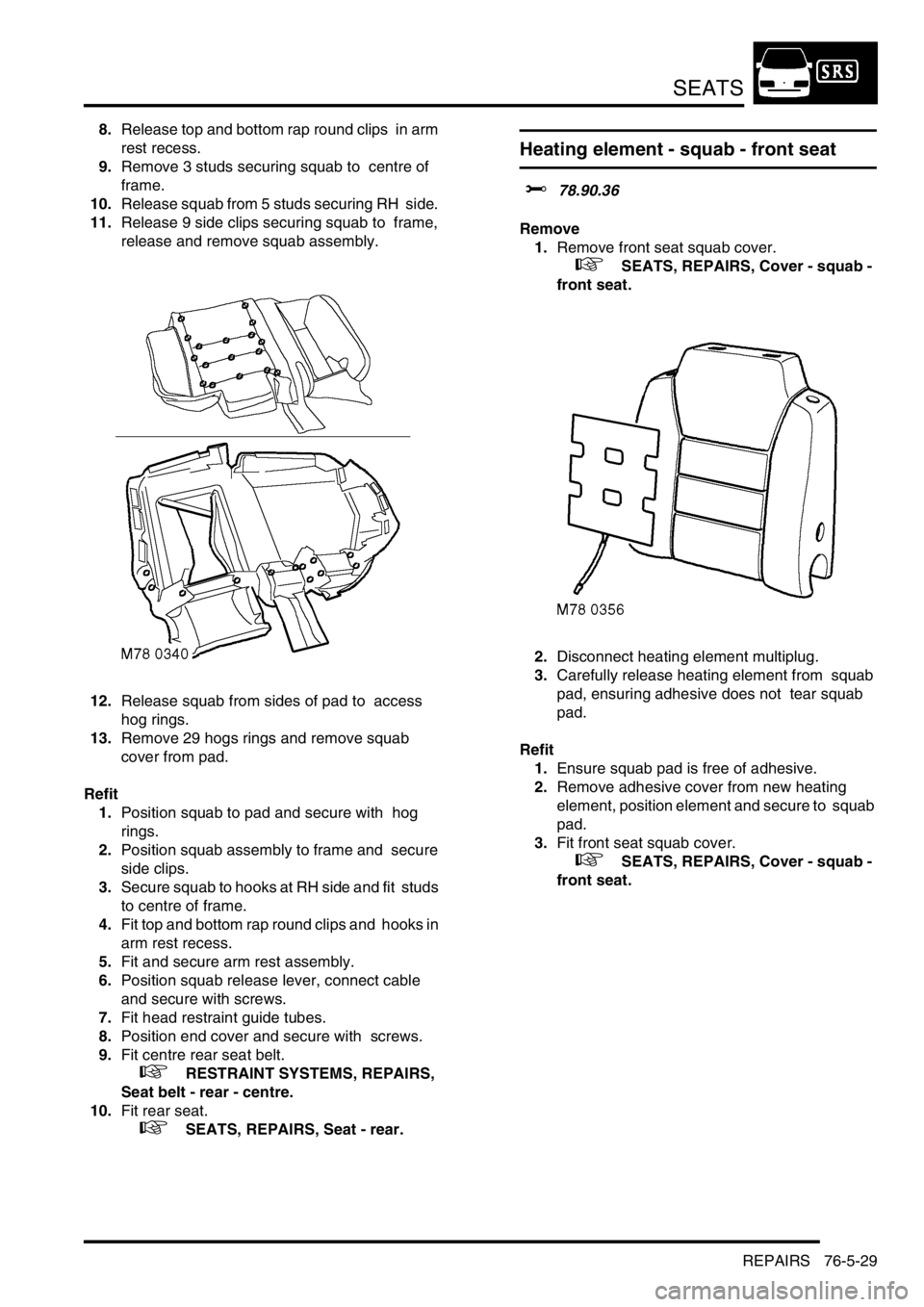
8.Release top and bottom rap round clips in arm
rest recess.
9.Remove 3 studs securing squab to centre of
frame.
10.Release squab from 5 studs securing RH side.
11.Release 9 side clips securing squab to frame,
release and remove squab assembly.
12.Release squab from sides of pad to access
hog rings.
13.Remove 29 hogs rings and remove squab
cover from pad.
Refit
1.Position squab to pad and secure with hog
rings.
2.Position squab assembly to frame and secure
side clips.
3.Secure squab to hooks at RH side and fit studs
to centre of frame.
4.Fit top and bottom rap round clips and hooks in
arm rest recess.
5.Fit and secure arm rest assembly.
6.Position squab release lever, connect cable
and secure with screws.
7.Fit head restraint guide tubes.
8.Position end cover and secure with screws.
9.Fit centre rear seat belt.
+ RESTRAINT SYSTEMS, REPAIRS,
Seat belt - rear - centre.
10.Fit rear seat.
+ SEATS, REPAIRS, Seat - rear.
Heating element - squab - front seat
$% 78.90.36
Remove
1.Remove front seat squab cover.
+ SEATS, REPAIRS, Cover - squab -
front seat.
2.Disconnect heating element multiplug.
3.Carefully release heating element from squab
pad, ensuring adhesive does not tear squab
pad.
Refit
1.Ensure squab pad is free of adhesive.
2.Remove adhesive cover from new heating
element, position element and secure to squab
pad.
3.Fit front seat squab cover.
+ SEATS, REPAIRS, Cover - squab -
front seat.
Page 1342 of 1672
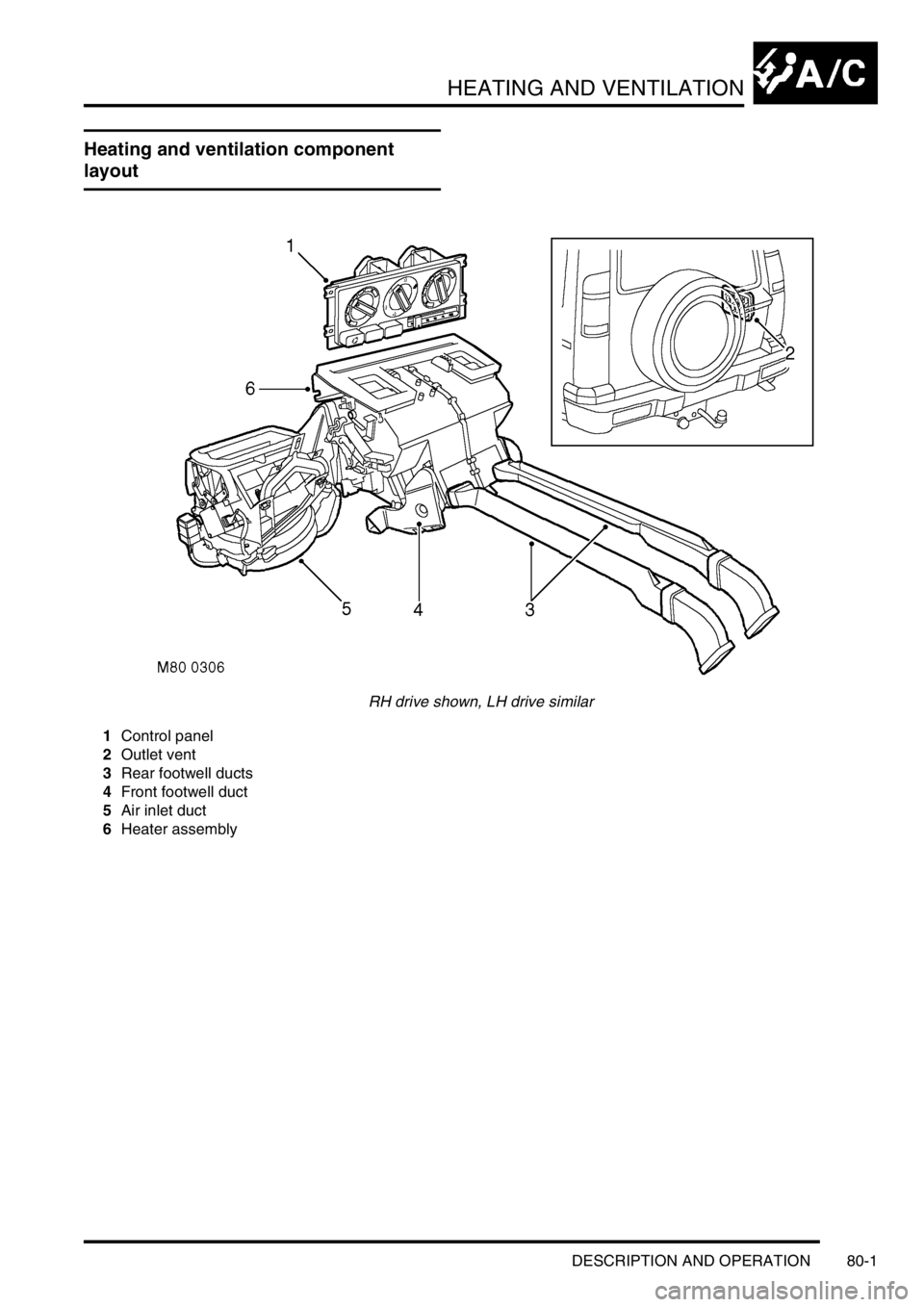
HEATING AND VENTILATION
DESCRIPTION AND OPERATION 80-1
HEATING A ND VENT ILATION DESCRIPTION AND OPERAT ION
Heating and ventilation component
layout
RH drive shown, LH drive similar
1Control panel
2Outlet vent
3Rear footwell ducts
4Front footwell duct
5Air inlet duct
6Heater assembly