2002 LAND ROVER DISCOVERY fuel
[x] Cancel search: fuelPage 598 of 1672

COOLING SYSTEM - TD5
REPAIRS 26-1-15
REPAIRS
Fan - viscous
$% 26.25.19
Remove
1.Release fixings and remove battery cover.
2.Disconnect battery earth lead.
3.Remove 3 bolts and remove engine acoustic
cover.
4.Remove upper fan cowl.
5.Remove viscous fan using tool LRT-12-093
and tool LRT-12-094.
RH thread.
Refit
1.Position viscous fan and tighten using tool
LRT-12-093 and tool LRT-12-094.
2.Fit upper fan cowl.
3. Fit engine acoustic cover and tighten bolts.
4.Connect battery earth lead.
5.Fit battery cover and secure with fixings.
Radiator
$% 26.40.01
Remove
1.Drain cooling system.
+ COOLING SYSTEM - Td5,
ADJUSTMENTS, Drain and refill.
2.Remove intercooler.
+ ENGINE MANAGEMENT SYSTEM -
Td5, REPAIRS, Intercooler.
3.Remove clip and disconnect bleed hose from
radiator.
4.Release clip and disconnect top hose from
radiator.
5.Release clip and disconnect bottom hose from
radiator.
6.Release clip and disconnect engine oil cooler
hose from radiator.
7.Release clip and disconnect fuel cooler hose
from radiator.
Page 599 of 1672

COOLING SYSTEM - TD5
26-1-16 REPAIRS
8.Remove securing screw and release gearbox
oil cooler from radiator.
9.Remove radiator.
10.Remove rubber mountings from base of
radiator.
11.Remove 2 captive nuts from radiator.
12.Remove sealing strip from radiator.
13.Remove cowl retaining clips from radiator. Refit
1.Fit cowl retaining clips to radiator.
2.Fit sealing strip to radiator.
3.Fit nuts and rubber mountings to new radiator.
4.Fit radiator.
5.Fit gearbox oil cooler to radiator and secure
with screw.
6.Connect fuel and engine oil cooler hoses to
radiator and secure with clips.
7.Connect bottom and top hoses to radiator
secure with clips.
8.Connect bleed hose to radiator and fit clip.
9.Fit intercooler.
+ ENGINE MANAGEMENT SYSTEM -
Td5, REPAIRS, Intercooler.
10.Refill cooling system.
+ COOLING SYSTEM - Td5,
ADJUSTMENTS, Drain and refill.
Page 610 of 1672

COOLING SYSTEM - V8
DESCRIPTION AND OPERATION 26-2-9
Viscous fan
1Coolant pump pulley drive attachment
2Fan blades
3Bi-metallic coil
4Body
The viscous fan provides a means of controlling the speed of the fan relative to the operating temperature of the
engine. The fan rotation draws air through the radiator, reducing engine coolant temperatures when the vehicle is
stationary or moving slowly.
The viscous fan is attached to the coolant pump drive pulley and secured to the pulley by a nut. The nut is positively
attached to a spindle which is supported on bearings in the fan body. The viscous drive comprises a circular drive
plate attached to the spindle and driven from the coolant pump pulley and the coupling body. The drive plate and the
body have interlocking annular grooves with a small clearance which provides the drive when silicone fluid enters the
fluid chamber. A bi-metallic coil is fitted externally on the forward face of the body. The coil is connected to and
operates a valve in the body. The valve operates on a valve plate with ports that connect the reservoir to the fluid
chamber. The valve plate also has return ports which, when the valve is closed, scoop fluid from the fluid chamber
and push it into the reservoir under centrifugal force.
Silicone fluid is retained in a reservoir at the front of the body. When the engine is off and the fan is stationary, the
silicone fluid level stabilises between the reservoir and the fluid chamber. This will result in the fan operating when the
engine is started, but the drive will be removed quickly after the fan starts rotating and the fan will 'freewheel'.
At low radiator temperatures, the fan operation is not required and the bi-metallic coil keeps the valve closed,
separating the silicone fluid from the drive plate. This allows the fan to 'freewheel' reducing the load on the engine,
improving fuel consumption and reducing noise generated by the rotation of the fan.
When the radiator temperature increases, the bi-metallic coil reacts and moves the valve, allowing the silicone fluid
to flow into the fluid chamber. The resistance to shear of the silicone fluid creates drag on the drive plate and provides
drive to the body and the fan blades.
Page 624 of 1672

MANIFOLDS AND EXHAUST SYSTEMS - TD5
DESCRIPTION AND OPERATION 30-1-3
Description
General
The diesel engine has the inlet manifold attached to the right hand side of the engine and the exhaust manifold
attached to the left hand side of the engine. The inlet manifold directs cooled compressed air from the turbocharger
and intercooler into the cylinders, where it is mixed with fuel from the injectors. Exhaust gases from the exhaust
manifold can also be directed into the inlet manifold via a pipe from the exhaust manifold and an Exhaust Gas
Recirculation (EGR) valve on the inlet manifold. The exhaust manifold allows combustion gases from the cylinders to
leave the engine where they are directed into the exhaust system and turbocharger.
The exhaust system is attached to the turbocharger and is directed along the underside of the vehicle to emit exhaust
gases from a tail pipe at the rear of the vehicle. A silencer is installed midway along the system and a second tail
silencer is located at the rear of the vehicle.
Inlet manifold
The inlet manifold is a one piece aluminium casting. The manifold is secured to the cylinder head with two studs and
flanged nuts and eight flanged bolts. A one piece laminated gasket seals the manifold to the cylinder head.
Four threaded bosses on the manifold provide for the attachment of the fuel cooler. The fuel cooler is secured to the
manifold with four bolts. A boss with two threaded holes allows for the attachment of the combined intake air
temperature/pressure sensor. The sensor is secured to the manifold with two screws and sealed with a gasket.
At the forward end of the manifold, a machined face and four threaded holes provide for the attachment of the EGR
valve. The valve is sealed to the manifold with a gasket.
+ EMISSION CONTROL - Td5, DESCRIPTION AND OPERATION, Emission Control Systems.
Exhaust manifold
The exhaust manifold is made from cast iron. The manifold has five ports, one from each cylinder, which merge into
one flanged outlet connection positioned centrally on the manifold.
The manifold is attached to the cylinder head with ten studs and flanged nuts. A laminated metal gasket seals the
manifold to the cylinder head. The flanged outlet on the manifold provides the attachment for the turbocharger, which
is attached with three studs and flanged nuts and sealed with a metal laminated gasket.
A second flanged outlet, located at the forward end of the manifold, provides attachment for the EGR pipe. The EGR
pipe is secured to the manifold with two cap screws and connected to the EGR valve mounted on the inlet manifold.
There is no gasket used between the pipe and the exhaust manifold.
+ EMISSION CONTROL - Td5, DESCRIPTION AND OPERATION, Emission Control Systems.
Exhaust system
The exhaust system comprises a front pipe, an intermediate pipe which incorporates a silencer and a tail pipe
assembly which also has a silencer. The exhaust system is constructed mainly of 63 mm (2.48 in) diameter extruded
pipe with a 1.5 mm (0.06 in) wall thickness. All pipes are aluminized to resist corrosion and the silencers are fabricated
from stainless steel sheet.
Page 625 of 1672

MANIFOLDS AND EXHAUST SYSTEMS - TD5
30-1-4 DESCRIPTION AND OPERATION
Front pipe assembly
The front pipe is of welded and fabricated tubular construction. The front pipe is connected to a flange on the
turbocharger and secured with three flanged nuts and sealed with a metal laminated gasket. The front pipe
incorporates a flexible pipe near the connection with the turbocharger and terminates in a flanged connection with the
intermediate pipe.
The flexible pipe is formed into a concertina shape with woven metal strands around its outer diameter. The flexible
pipe allows for ease of exhaust system alignment and also absorbs engine vibration. The woven metal strands also
increase the longevity of the flexible pipe.
The front pipe is attached via a bracket and a mounting rubber to the chassis. The mounting rubber allows ease of
alignment and vibration absorption.
Intermediate pipe and silencer
The intermediate pipe is of welded and fabricated tubular construction. It connects at its forward end to the front pipe
flange. Two captive studs on the intermediate pipe flange allow for attachment to the front pipe with locknuts. The rear
section of intermediate pipe connects to the tail pipe assembly via a flanged joint, sealed with a metal gasket and
secured with locknuts and studs.
The forward and rear sections are joined by a silencer. The silencer is fabricated from stainless steel sheet to form
the body of the silencer. An end plate closes each end of the silencer and is attached to the body with seam joints.
Perforated baffle tubes, inside the silencer, are connected to the inlet and outlet pipes on each end plate. Internal
baffle plates support the baffle tubes and, together with a stainless steel fibre packing, absorb combustion noise as
the exhaust gases pass through the silencer.
The intermediate pipe is attached by two brackets, positioned at each end of the silencer, and two mounting rubbers
to the chassis. The mounting rubber allows for ease of alignment and vibration absorption.
Tail pipe assembly
The tail pipe is of welded and fabricated construction. The tail pipe connects to the intermediate pipe with a flanged
joint secured with locknuts and sealed with a metal gasket. The pipe is shaped to locate above the rear axle allowing
clearance for axle articulation. The pipe is also curved to clear the left hand side of the fuel tank which has a reflective
shield to protect the tank from heat generated from the pipe.
A fabricated silencer is located at the rear of the tail pipe. The silencer is circular in section and is constructed from
stainless steel sheet. A baffle tube is located inside the silencer and the space around the baffle tube is packed with
a stainless steel fibre. The holes in the baffle tube allow the packing to further reduce combustion noise from the
engine. The tail pipe from the silencer is curved downwards at the rear of the vehicle and directs exhaust gases
towards the ground. The curved pipe allows the exhaust gases to be dissipated by the airflow under the vehicle and
prevents the gases from being drawn behind the vehicle.
The tail pipe is attached by a bracket, positioned forward of the silencer, and a mounting rubber to the chassis. The
mounting rubber allows ease of alignment and vibration absorption.
Page 627 of 1672

MANIFOLDS AND EXHAUST SYSTEMS - TD5
30-1-6 REPAIRS
Gasket - inlet manifold
$% 30.15.08
Remove
Note: The following procedure covers engines
fitted with or without an EGR cooler. The EGR
cooler is bolted to the front of the cylinder head.
1.Remove battery cover.
2.Disconnect battery earth lead.
3.Remove 3 bolts and remove engine acoustic
cover.
4.Release retainers and remove upper fan cowl.
5.Disconnect leads from 4 glow plugs and
multiplug from MAP sensor.
6.Remove 4 bolts, release EGR valve from inlet
manifold and discard gasket. 7.Remove 4 bolts securing fuel cooler to inlet
manifold.
8.Remove 2 bolts and remove alternator support
bracket.
9.Remove bolt securing engine dip stick tube to
camshaft carrier.
10.Remove dip stick tube and discard 'O' ring.
Page 628 of 1672
MANIFOLDS AND EXHAUST SYSTEMS - TD5
REPAIRS 30-1-7
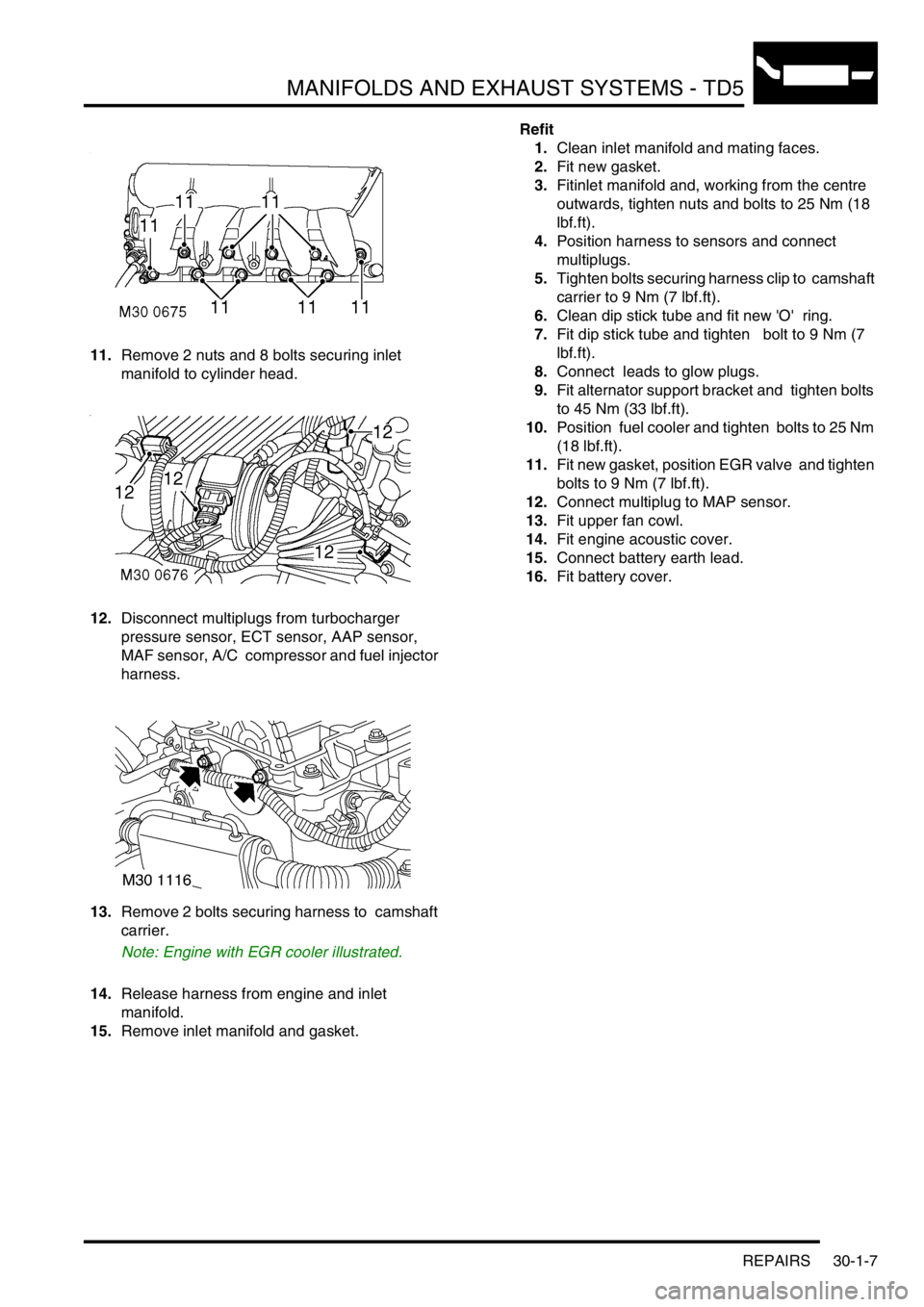
11.Remove 2 nuts and 8 bolts securing inlet
manifold to cylinder head.
12.Disconnect multiplugs from turbocharger
pressure sensor, ECT sensor, AAP sensor,
MAF sensor, A/C compressor and fuel injector
harness.
13.Remove 2 bolts securing harness to camshaft
carrier.
Note: Engine with EGR cooler illustrated.
14.Release harness from engine and inlet
manifold.
15.Remove inlet manifold and gasket. Refit
1.Clean inlet manifold and mating faces.
2.Fit new gasket.
3.Fitinlet manifold and, working from the centre
outwards, tighten nuts and bolts to 25 Nm (18
lbf.ft).
4.Position harness to sensors and connect
multiplugs.
5.Tighten bolts securing harness clip to camshaft
carrier to 9 Nm (7 lbf.ft).
6.Clean dip stick tube and fit new 'O' ring.
7.Fit dip stick tube and tighten bolt to 9 Nm (7
lbf.ft).
8.Connect leads to glow plugs.
9.Fit alternator support bracket and tighten bolts
to 45 Nm (33 lbf.ft).
10.Position fuel cooler and tighten bolts to 25 Nm
(18 lbf.ft).
11.Fit new gasket, position EGR valve and tighten
bolts to 9 Nm (7 lbf.ft).
12.Connect multiplug to MAP sensor.
13.Fit upper fan cowl.
14.Fit engine acoustic cover.
15.Connect battery earth lead.
16.Fit battery cover.
Page 632 of 1672

MANIFOLDS AND EXHAUST SYSTEMS - V8
DESCRIPTION AND OPERATION 30-2-3
1Upper manifold
2Bolt 5 off
3Bolt 1 off
4Gasket
5IAC Valve
6IAC valve hose 2 off
7Bolt 4 off
8Bolt 4 off
9Schraeder valve
10Injector 8 off
11Retaining clip 8 off
12Bolt 12 off
13Bolt 2 off
14Clamp 2 off
15Seal 2 off
16Lower manifold/engine gasket
17Coolant pipe18Bolt 3 off
19Bolt
20Heater return pipe
21Pipe connection
22Lower manifold
23Gasket
24Hose clip 2 off
25Throttle housing coolant hose
26Fuel rail
27Throttle housing
28Gasket
29Bolt 4 off
30Plenum
31Rocker cover breather hose connection
32Brake servo vacuum pipe connection
33Hose clip 4 off