2002 LAND ROVER DISCOVERY earth
[x] Cancel search: earthPage 1423 of 1672
WIPERS AND WASHERS
84-2 DESCRIPTION AND OPERATION
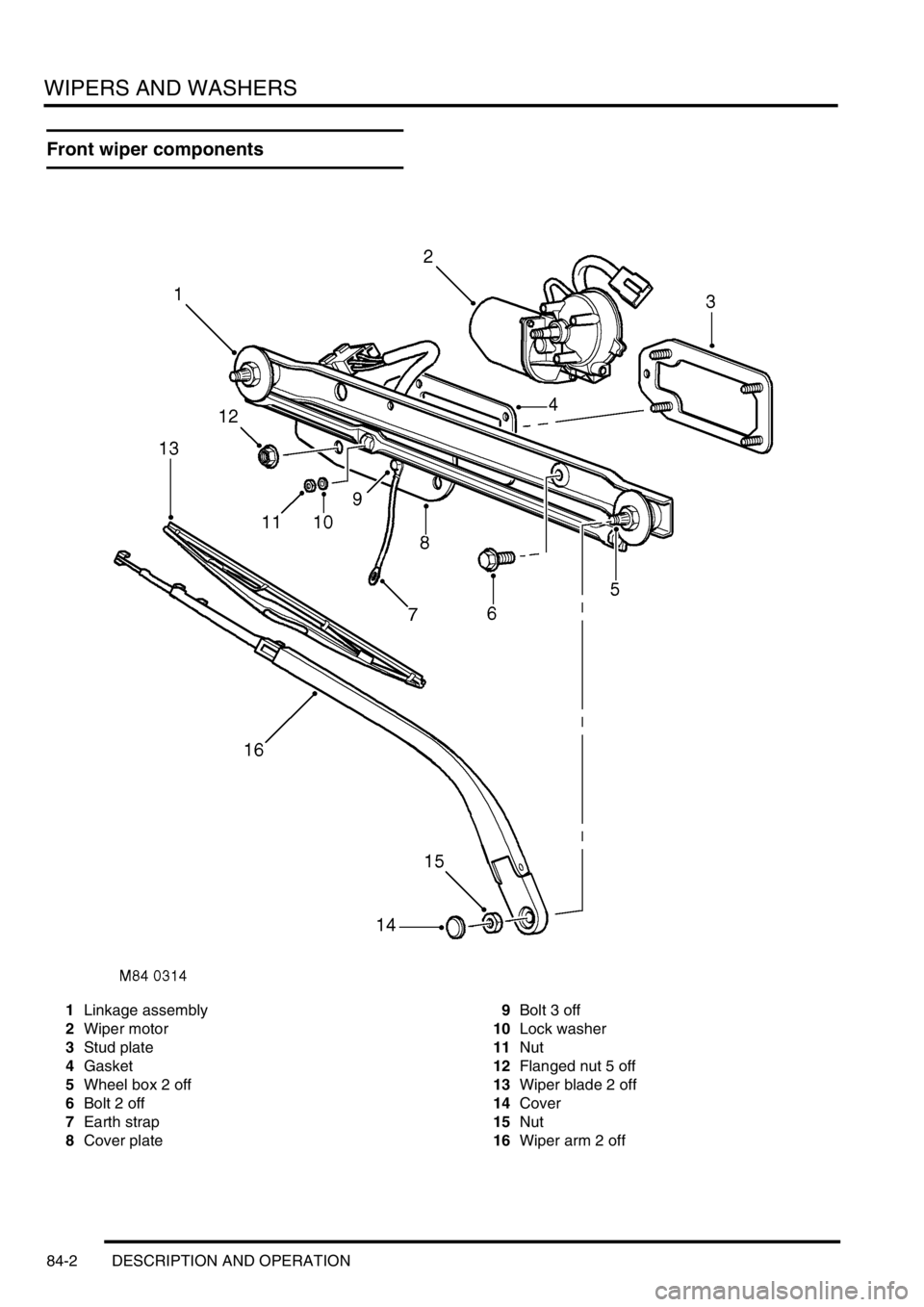
Front wiper components
1Linkage assembly
2Wiper motor
3Stud plate
4Gasket
5Wheel box 2 off
6Bolt 2 off
7Earth strap
8Cover plate9Bolt 3 off
10Lock washer
11Nut
12Flanged nut 5 off
13Wiper blade 2 off
14Cover
15Nut
16Wiper arm 2 off
Page 1432 of 1672
WIPERS AND WASHERS
DESCRIPTION AND OPERATION 84-11
The dc motor contains two permanent magnets, three brushes and a park switch. The smaller third brush is utilised
for high-speed operation. Attached to the brush pack are 3 capacitors, which minimise radio interference during wiper
operation. A thermal trip switch attached to the brush plate prevents thermal overload of the motor.
The motor incorporates a worm drive gear unit to transfer the rotary motion into a linear motion of the wiper linkage
assembly.
The front wiper motor receives battery voltage from fuse 19 of the passenger compartment fuse box. For low-speed
operation, including intermittent variable delay operation, the battery voltage to move the wiper motor from the park
position passes through the front wiper relay. When the park switch moves to the closed when operating position,
fuse 19 of the passenger compartment fuse box provides battery voltage directly to the wiper motor.
For high-speed operation, including flick wipe, fuse 19 in the passenger compartment fuse box provides the battery
voltage to move the wiper motor from the park position through the front wash/ wipe switch to the front wiper motor.
To achieve high-speed wiper operation, power is supplied to a third brush that provides a closer distance between the
motor poles. Because the poles of the motor are closer together, the motor operates faster.
Rear wiper
The rear wiper is driven directly from an electric motor located inside the tail door. The motor is mounted inside the
tail door with two bolts, lock washers and washers. The motor mounting brackets have rubber inserts to prevent motor
operating noise being transferred to the door structure. The motor spindle is fitted with a seal and protrudes through
a hole in the tail door outer skin panel. The motor spindle is secured to the tail door with a washer and nut.
The motor output spindle has a taper splined shaft which allows for the attachment of the wiper arm which is secured
with a nut. The wiper arm attachment to the splined shaft has a pivot to which the remainder of the arm is attached.
The two parts of the arm are connected by a spring which controls the pressure of the blade on the window to a
predetermined amount.
The wiper blade is attached to the wiper arms with a clip which allows the blade to pivot. The wiper blade comprises
of a number of levers and yokes to which the rubber wiper is attached. The levers and yokes ensure that the pressure
applied by the arm spring is evenly distributed along the full length of the blade. The rubber wiper is held in the yokes
by a pair of stainless steel strips which also contribute to the even distribution of spring pressure along the blade.
Rear wiper switch
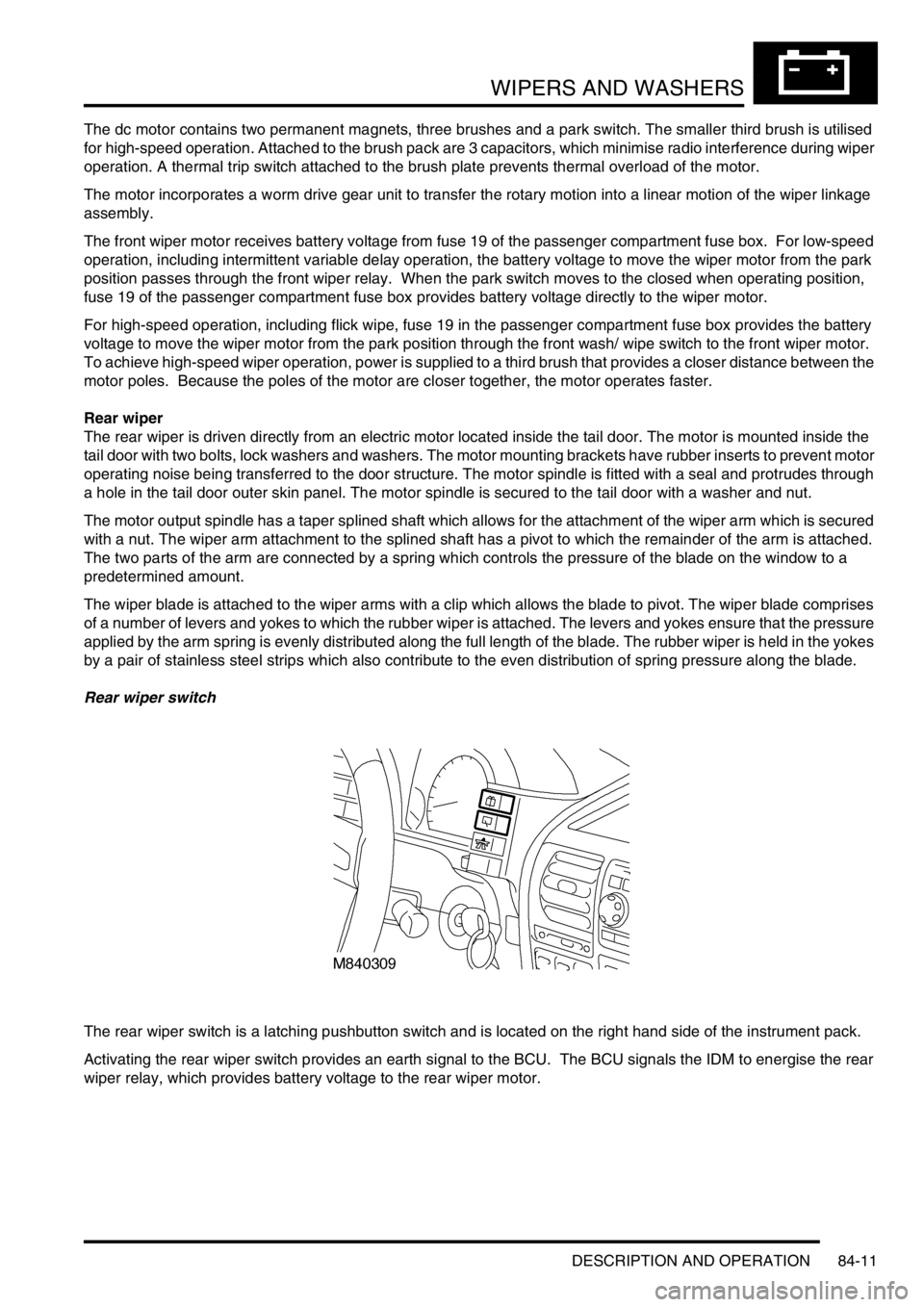
The rear wiper switch is a latching pushbutton switch and is located on the right hand side of the instrument pack.
Activating the rear wiper switch provides an earth signal to the BCU. The BCU signals the IDM to energise the rear
wiper relay, which provides battery voltage to the rear wiper motor.
Page 1433 of 1672
WIPERS AND WASHERS
84-12 DESCRIPTION AND OPERATION
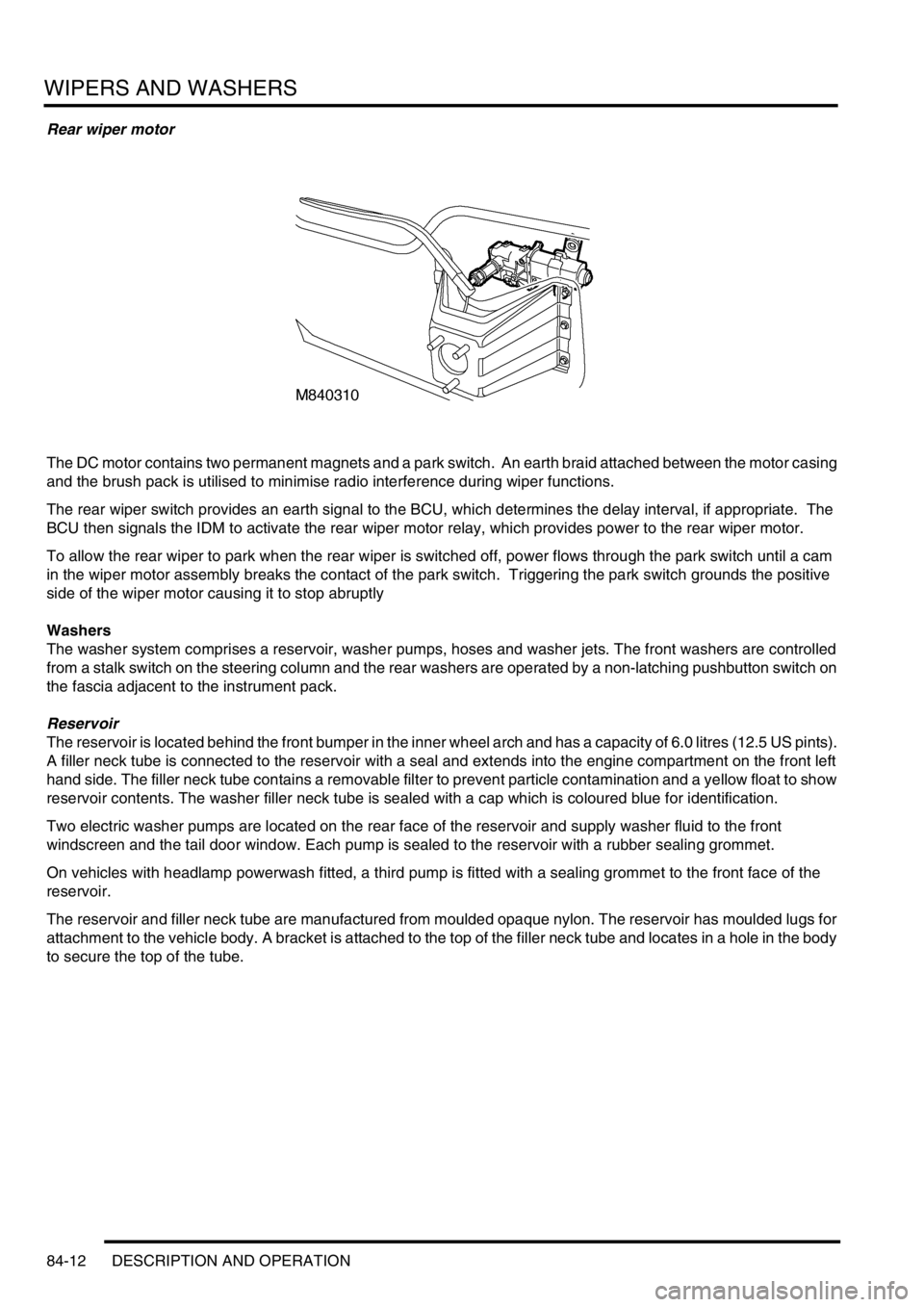
Rear wiper motor
The DC motor contains two permanent magnets and a park switch. An earth braid attached between the motor casing
and the brush pack is utilised to minimise radio interference during wiper functions.
The rear wiper switch provides an earth signal to the BCU, which determines the delay interval, if appropriate. The
BCU then signals the IDM to activate the rear wiper motor relay, which provides power to the rear wiper motor.
To allow the rear wiper to park when the rear wiper is switched off, power flows through the park switch until a cam
in the wiper motor assembly breaks the contact of the park switch. Triggering the park switch grounds the positive
side of the wiper motor causing it to stop abruptly
Washers
The washer system comprises a reservoir, washer pumps, hoses and washer jets. The front washers are controlled
from a stalk switch on the steering column and the rear washers are operated by a non-latching pushbutton switch on
the fascia adjacent to the instrument pack.
Reservoir
The reservoir is located behind the front bumper in the inner wheel arch and has a capacity of 6.0 litres (12.5 US pints).
A filler neck tube is connected to the reservoir with a seal and extends into the engine compartment on the front left
hand side. The filler neck tube contains a removable filter to prevent particle contamination and a yellow float to show
reservoir contents. The washer filler neck tube is sealed with a cap which is coloured blue for identification.
Two electric washer pumps are located on the rear face of the reservoir and supply washer fluid to the front
windscreen and the tail door window. Each pump is sealed to the reservoir with a rubber sealing grommet.
On vehicles with headlamp powerwash fitted, a third pump is fitted with a sealing grommet to the front face of the
reservoir.
The reservoir and filler neck tube are manufactured from moulded opaque nylon. The reservoir has moulded lugs for
attachment to the vehicle body. A bracket is attached to the top of the filler neck tube and locates in a hole in the body
to secure the top of the tube.
Page 1439 of 1672

WIPERS AND WASHERS
84-18 DESCRIPTION AND OPERATION
Rear wipe
Rear wipe operation will only activate when the following conditions are met:
lIgnition switch is in position II.
lRear wipe switch is operated.
Operating the rear wiper switch provides an earth input to the BCU. The BCU tells the IDM to activate the rear wiper
relay, which provides battery voltage to the wiper motor through the normally closed contacts of the park switch.
Rear wash
Rear wash will only operate when the following conditions are met:
lIgnition switch is in position II.
lRear wash switch operated.
Operating the rear washer switch for longer than 0.4 second allows the rear washer pump motor and rear wipers to
run as long as the switch is held. The wipers run for 4 seconds after the rear washer switch is released. Flicking the
rear washer switch energises the rear washer pump motor for 0.4 second.
The rear washer operation has a higher priority than the intermittent wipe operation. If the intermittent wipe is active
when a rear washer operation is initiated, the wash cycle executes and the intermittent wipe is re-instated at the end
of the washer operation.
Wiper park switch
The park switch allows the wipers to come to rest in the park position when the wipe switch is turned off in mid-wipe.
The park switch consists of a positive and a negative contact. These two contacts are described as closed at park
and closed when operating. When the wipers first start, the park switch is in the closed at park position. A relay
controls battery voltage to the motor. Battery voltage passes through this relay contact to move the wiper motor from
the park position.
When the motor moves, the park switch moves to the closed when operating position. Battery voltage to this relay
contact is direct from fuse 19. Battery voltage passes through this contact to keep the wiper motor running. The wiper
motor operates for one complete revolution until the park switch moves to the closed at park position again.
Switching off the wipers removes battery voltage from the closed at park contact. When the wipers reach the closed
at park switch an earth is applied and the motor stops abruptly.
Headlamp power wash
Headlamp power wash activates when the following conditions are met:
lIgnition switch in position II.
lHeadlamps switched on.
lFront wash switch operated.
lBCU counter allows headlamp power wash.
Operating the front washer switch with the headlamps switched on energises the IDM, supplying a voltage to the
headlamp powerwash relay, which operates the headlamp powerwash pump and increments a counter within the
BCU. This counter prevents the headlamp powerwash pump from operating every time the front washer switch is
activated. Headlamp powerwash is only operational every third front wash cycle, providing the headlamps are on.
The counter resets when the ignition switch is turned off.
When the BCU permits headlamp power wash operation, the pump motor operates only for 0.5 second.
Page 1454 of 1672
CHARGING AND STARTING
REPAIRS 86-1-5
Refit
1.Fit jack retaining strap, speed nut and clip.
2.Fit battery carrier, fit bolts and tighten to 28 Nm
(21 lbf.ft).
3. Diesel models: Fit ECM and secure with
screw.
4.Secure coolant hose.
5.Fit and secure jack.
6.Fit battery.
+ CHARGING AND STARTING,
REPAIRS, Battery.
Starter motor - diesel
$% 86.60.01
Remove
1.Release fixings and remove battery cover.
2.Disconnect battery earth lead.
3.Raise front of vehicle.
WARNING: Do not work on or under a
vehicle supported only by a jack. Always
support the vehicle on safety stands.
4.Remove underbelly panel.
+ EXTERIOR FITTINGS, REPAIRS,
Panel - underbelly.
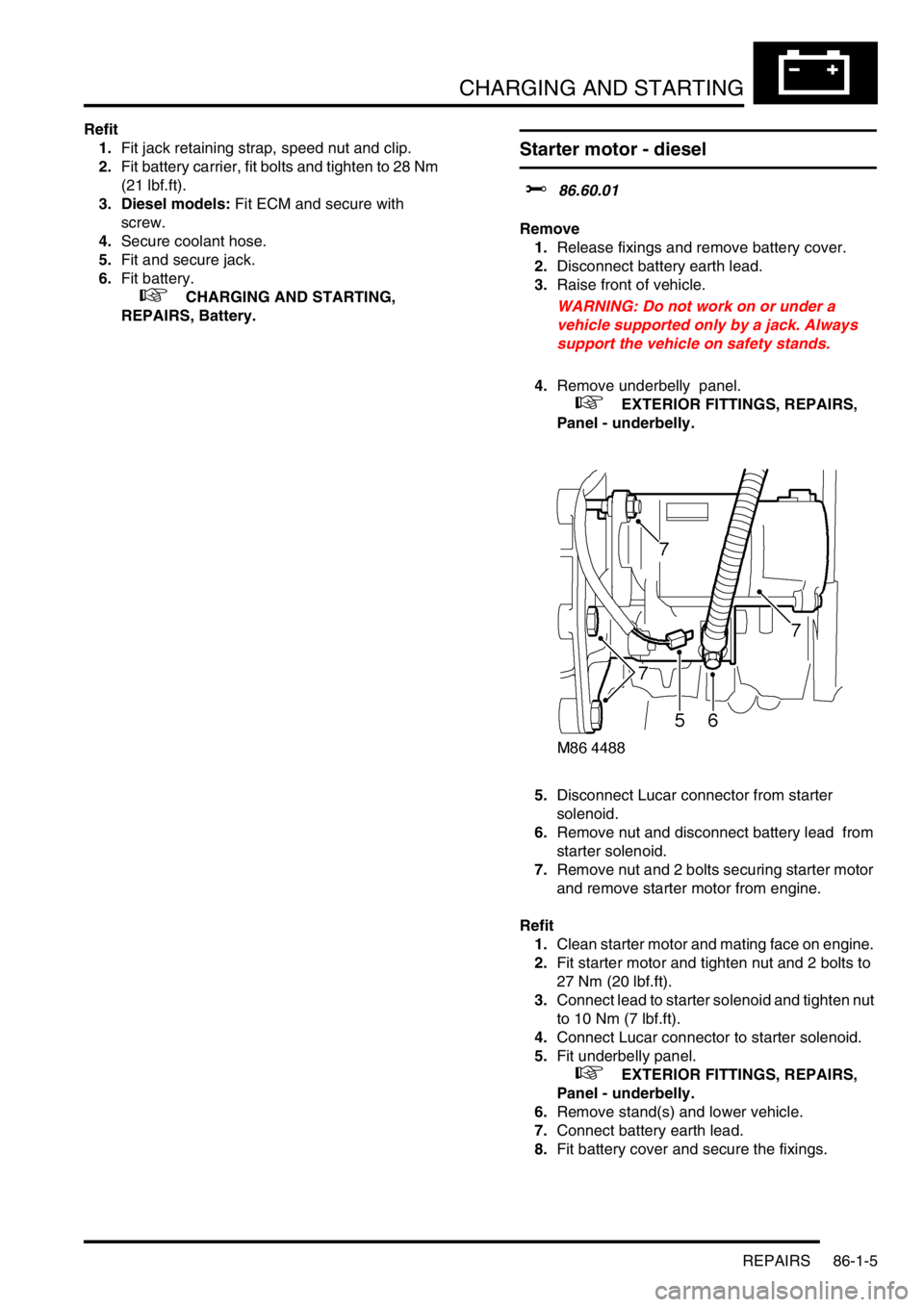
5.Disconnect Lucar connector from starter
solenoid.
6.Remove nut and disconnect battery lead from
starter solenoid.
7.Remove nut and 2 bolts securing starter motor
and remove starter motor from engine.
Refit
1.Clean starter motor and mating face on engine.
2.Fit starter motor and tighten nut and 2 bolts to
27 Nm (20 lbf.ft).
3.Connect lead to starter solenoid and tighten nut
to 10 Nm (7 lbf.ft).
4.Connect Lucar connector to starter solenoid.
5.Fit underbelly panel.
+ EXTERIOR FITTINGS, REPAIRS,
Panel - underbelly.
6.Remove stand(s) and lower vehicle.
7.Connect battery earth lead.
8.Fit battery cover and secure the fixings.
Page 1455 of 1672
CHARGING AND STARTING
86-1-6 REPAIRS
Starter motor - V8
$% 86.60.01
Remove
1.Release fixings and remove battery cover.
2.Disconnect battery earth lead.
3.Raise front of vehicle.
WARNING: Do not work on or under a
vehicle supported only by a jack. Always
support the vehicle on safety stands.
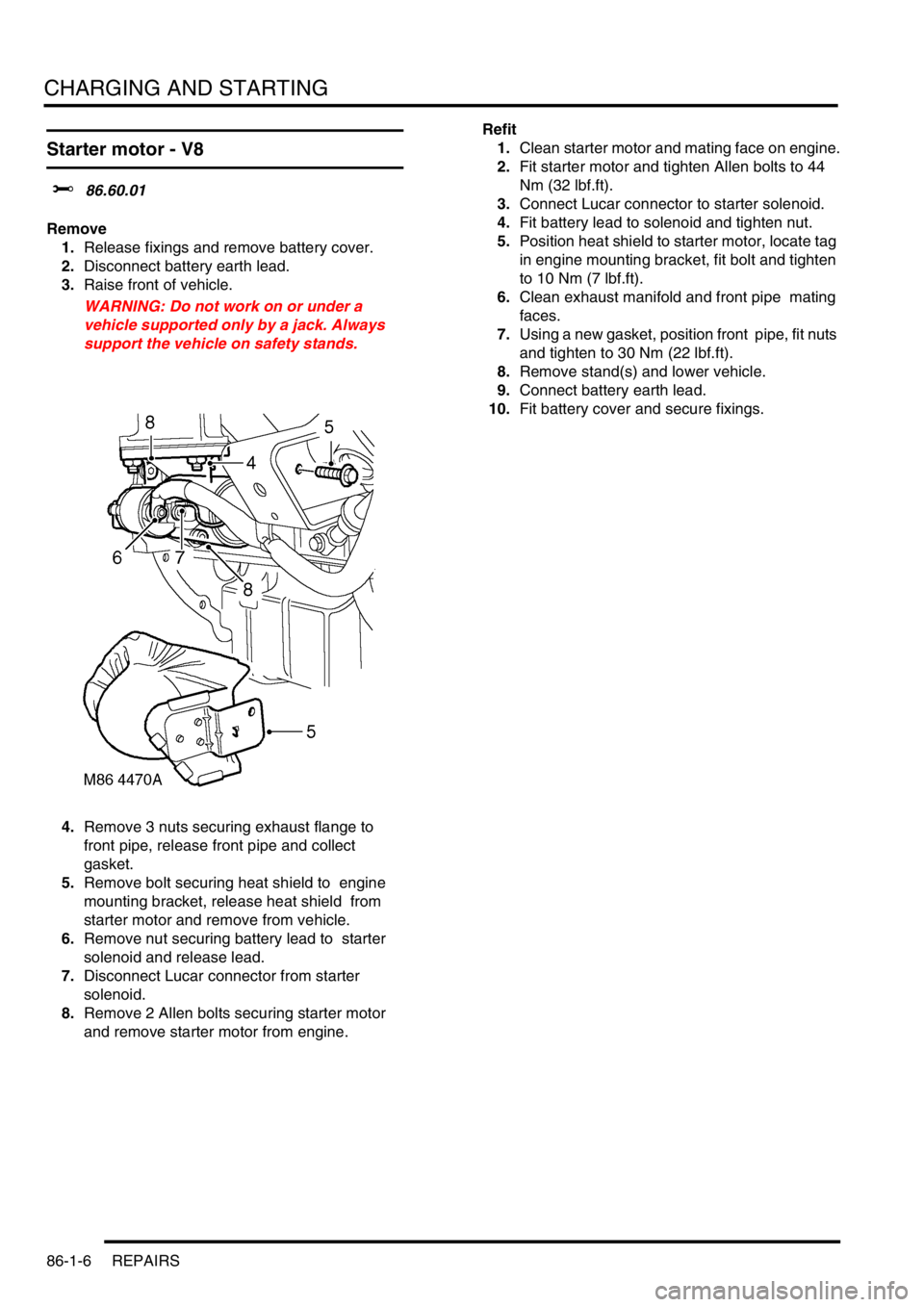
4.Remove 3 nuts securing exhaust flange to
front pipe, release front pipe and collect
gasket.
5.Remove bolt securing heat shield to engine
mounting bracket, release heat shield from
starter motor and remove from vehicle.
6.Remove nut securing battery lead to starter
solenoid and release lead.
7.Disconnect Lucar connector from starter
solenoid.
8.Remove 2 Allen bolts securing starter motor
and remove starter motor from engine. Refit
1.Clean starter motor and mating face on engine.
2.Fit starter motor and tighten Allen bolts to 44
Nm (32 lbf.ft).
3.Connect Lucar connector to starter solenoid.
4.Fit battery lead to solenoid and tighten nut.
5.Position heat shield to starter motor, locate tag
in engine mounting bracket, fit bolt and tighten
to 10 Nm (7 lbf.ft).
6.Clean exhaust manifold and front pipe mating
faces.
7.Using a new gasket, position front pipe, fit nuts
and tighten to 30 Nm (22 lbf.ft).
8.Remove stand(s) and lower vehicle.
9.Connect battery earth lead.
10.Fit battery cover and secure fixings.
Page 1471 of 1672

BODY CONTROL UNIT
86-3-2 DESCRIPTION AND OPERATION
Power supply
Battery supply to the BCU and the IDM is provided through a 10 A fuse located in the engine compartment fuse box.
The BCU unit receives an ignition switched power supply (ignition switch position II) input via a 10 A fuse in the
passenger compartment fuse box.
The BCU receives a signal when the ignition switch is turned to the crank position, it then supplies an earth path to
the starter relay coil, to enable the crank operation by supplying power through the starter relay contacts to the starter
motor.
Battery voltage is monitored and BCU operation will function normally between 8 and 18 volts. Between 5.7 and 8
volts the BCU is in the 'under volts' state. The status of the battery is used to determine which outputs may be driven.
If a voltage supply above 18 volts is experienced, outputs will not normally be driven except for those functions which
are required during cranking (robust immobilisation, antenna coil, crank enable relay and feed to gear position switch
contacts W, X, Y, Z). In the over voltage state the vehicle can be driven, but all other functions are disabled and
outputs are switched off (power windows, heated screen, direction indicators etc.).
All functions are disabled on power up until communications between the BCU and IDM have been established. If
communications cannot be established, operation will commence with degraded functionality.
Battery supply to the IDM is provided through the inertia switch and a 10 A fuse in the engine compartment fuse box.
If the inertia switch contacts are closed battery voltage is available at the IDM; if the inertia switch contacts are open
there is no battery supply to the IDM. The supply condition of the IDM is signalled to the BCU via the serial bus. If the
inertia switch is operated (contacts open) the change in state is detected by the BCU which unlocks the doors if the
ignition switch is in position II and the alarm is not set.
The BCU is earthed through a hard-wire connection.
Inputs and outputs
The BCU and IDM process inputs and provide the necessary outputs for control and operation of the vehicle's 'body'
systems.
BCU inputs
The BCU processes signals received from the following components:
lDoor latch switches.
lDriver's door key lock/ unlock switches.
lBonnet activated security system.
lVolumetric sensors.
lCentral Door Locking (CDL) switches.
lRemote transmitter (via receiver unit).
lInertia fuel cut-off switch.
lIgnition switch.
lFuel flap release switch.
The input voltages (V
in) for BCU digital signals are defined as follows:
lLogic 1 when V
in ≥ 6V.
lLogic 0 when V
in ≤ 2V.
BCU input voltages between 2 and 6 volts are indeterminate and cannot be guaranteed.
Analogue input voltages are measured as a ratio with respect to battery voltage.
Page 1473 of 1672
BODY CONTROL UNIT
86-3-4 DESCRIPTION AND OPERATION
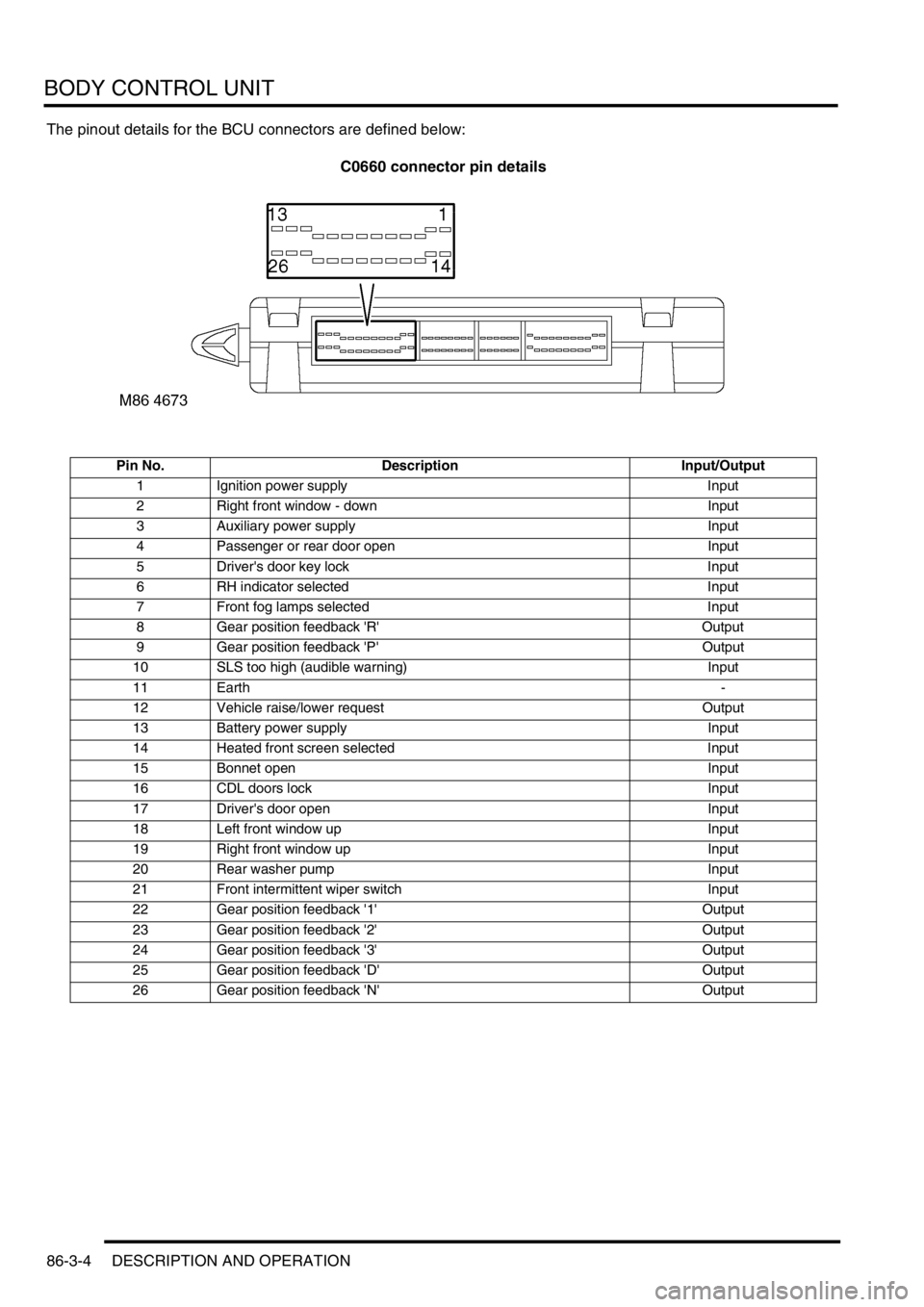
The pinout details for the BCU connectors are defined below:
C0660 connector pin details
Pin No. Description Input/Output
1 Ignition power supply Input
2 Right front window - down Input
3 Auxiliary power supply Input
4 Passenger or rear door open Input
5 Driver's door key lock Input
6 RH indicator selected Input
7 Front fog lamps selected Input
8 Gear position feedback 'R' Output
9 Gear position feedback 'P' Output
10 SLS too high (audible warning) Input
11 Earth-
12 Vehicle raise/lower request Output
13 Battery power supply Input
14 Heated front screen selected Input
15 Bonnet open Input
16 CDL doors lock Input
17 Driver's door open Input
18 Left front window up Input
19 Right front window up Input
20 Rear washer pump Input
21 Front intermittent wiper switch Input
22 Gear position feedback '1' Output
23 Gear position feedback '2' Output
24 Gear position feedback '3' Output
25 Gear position feedback 'D' Output
26 Gear position feedback 'N' Output