2002 LAND ROVER DISCOVERY earth
[x] Cancel search: earthPage 1223 of 1672
SUNROOF
76-6-8 DESCRIPTION AND OPERATION
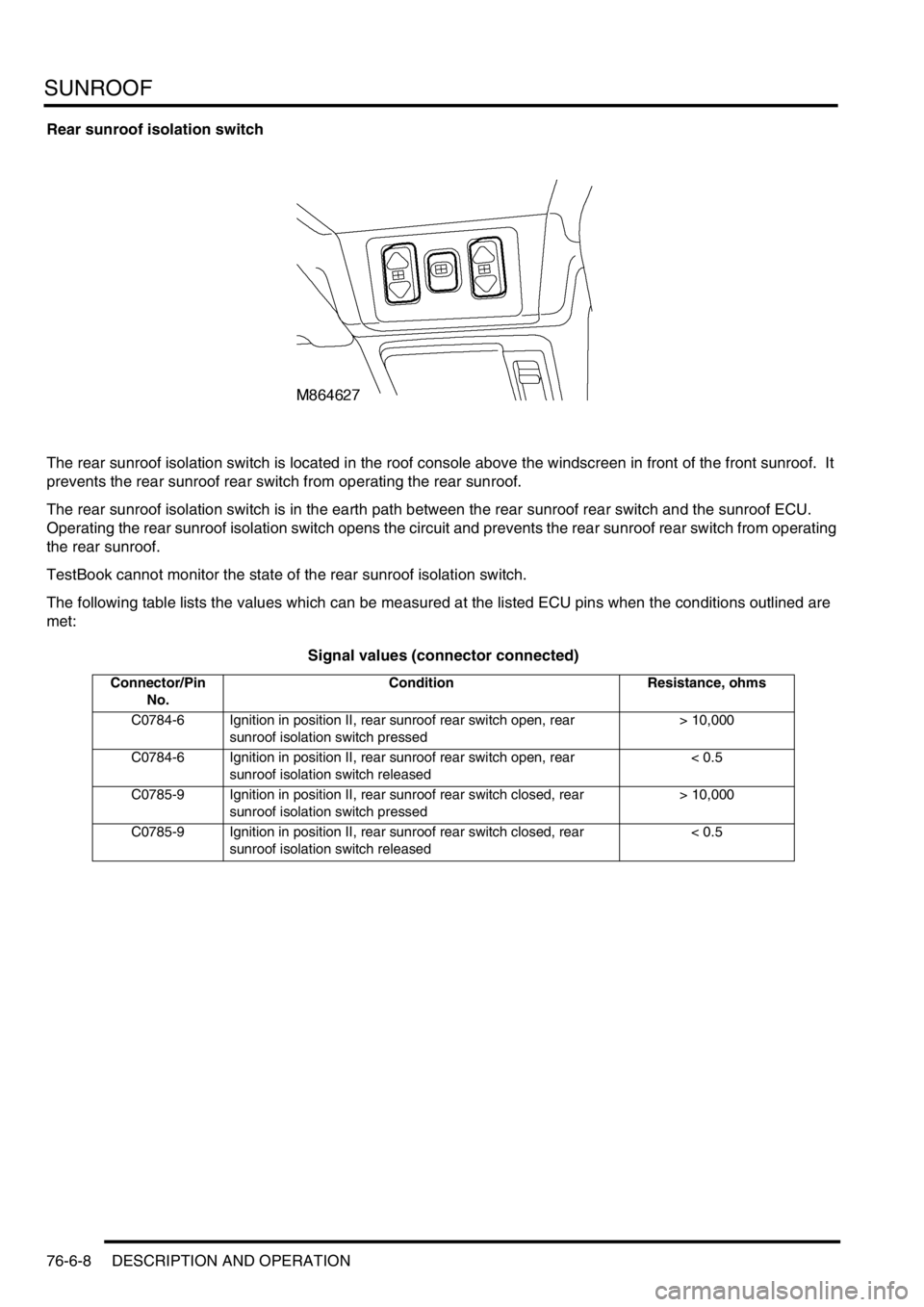
Rear sunroof isolation switch
The rear sunroof isolation switch is located in the roof console above the windscreen in front of the front sunroof. It
prevents the rear sunroof rear switch from operating the rear sunroof.
The rear sunroof isolation switch is in the earth path between the rear sunroof rear switch and the sunroof ECU.
Operating the rear sunroof isolation switch opens the circuit and prevents the rear sunroof rear switch from operating
the rear sunroof.
TestBook cannot monitor the state of the rear sunroof isolation switch.
The following table lists the values which can be measured at the listed ECU pins when the conditions outlined are
met:
Signal values (connector connected)
Connector/Pin
No.Condition Resistance, ohms
C0784-6 Ignition in position II, rear sunroof rear switch open, rear
sunroof isolation switch pressed> 10,000
C0784-6 Ignition in position II, rear sunroof rear switch open, rear
sunroof isolation switch released< 0.5
C0785-9 Ignition in position II, rear sunroof rear switch closed, rear
sunroof isolation switch pressed> 10,000
C0785-9 Ignition in position II, rear sunroof rear switch closed, rear
sunroof isolation switch released< 0.5
Page 1224 of 1672
SUNROOF
DESCRIPTION AND OPERATION 76-6-9
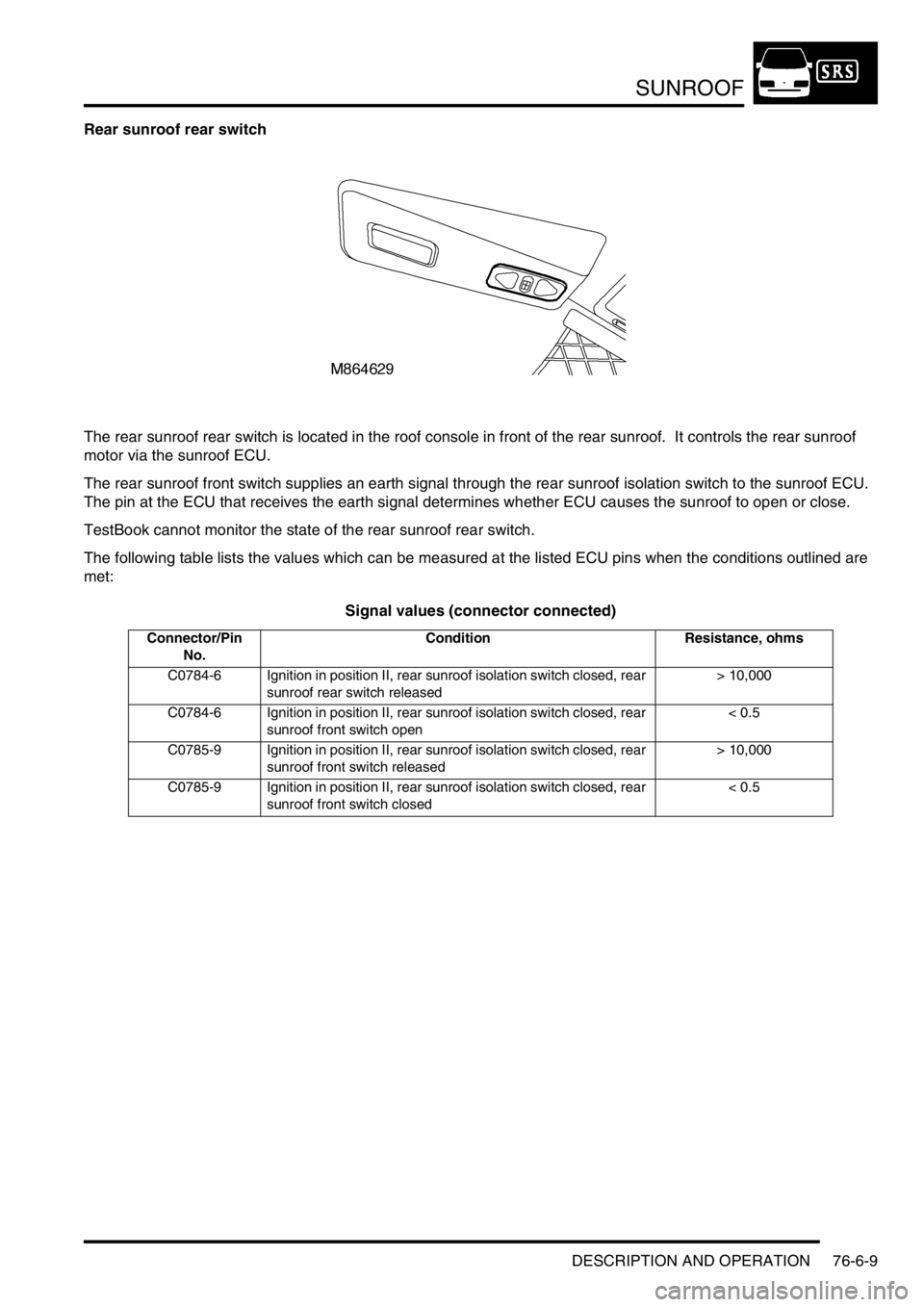
Rear sunroof rear switch
The rear sunroof rear switch is located in the roof console in front of the rear sunroof. It controls the rear sunroof
motor via the sunroof ECU.
The rear sunroof front switch supplies an earth signal through the rear sunroof isolation switch to the sunroof ECU.
The pin at the ECU that receives the earth signal determines whether ECU causes the sunroof to open or close.
TestBook cannot monitor the state of the rear sunroof rear switch.
The following table lists the values which can be measured at the listed ECU pins when the conditions outlined are
met:
Signal values (connector connected)
Connector/Pin
No.Condition Resistance, ohms
C0784-6 Ignition in position II, rear sunroof isolation switch closed, rear
sunroof rear switch released> 10,000
C0784-6 Ignition in position II, rear sunroof isolation switch closed, rear
sunroof front switch open< 0.5
C0785-9 Ignition in position II, rear sunroof isolation switch closed, rear
sunroof front switch released> 10,000
C0785-9 Ignition in position II, rear sunroof isolation switch closed, rear
sunroof front switch closed< 0.5
Page 1225 of 1672
SUNROOF
76-6-10 DESCRIPTION AND OPERATION
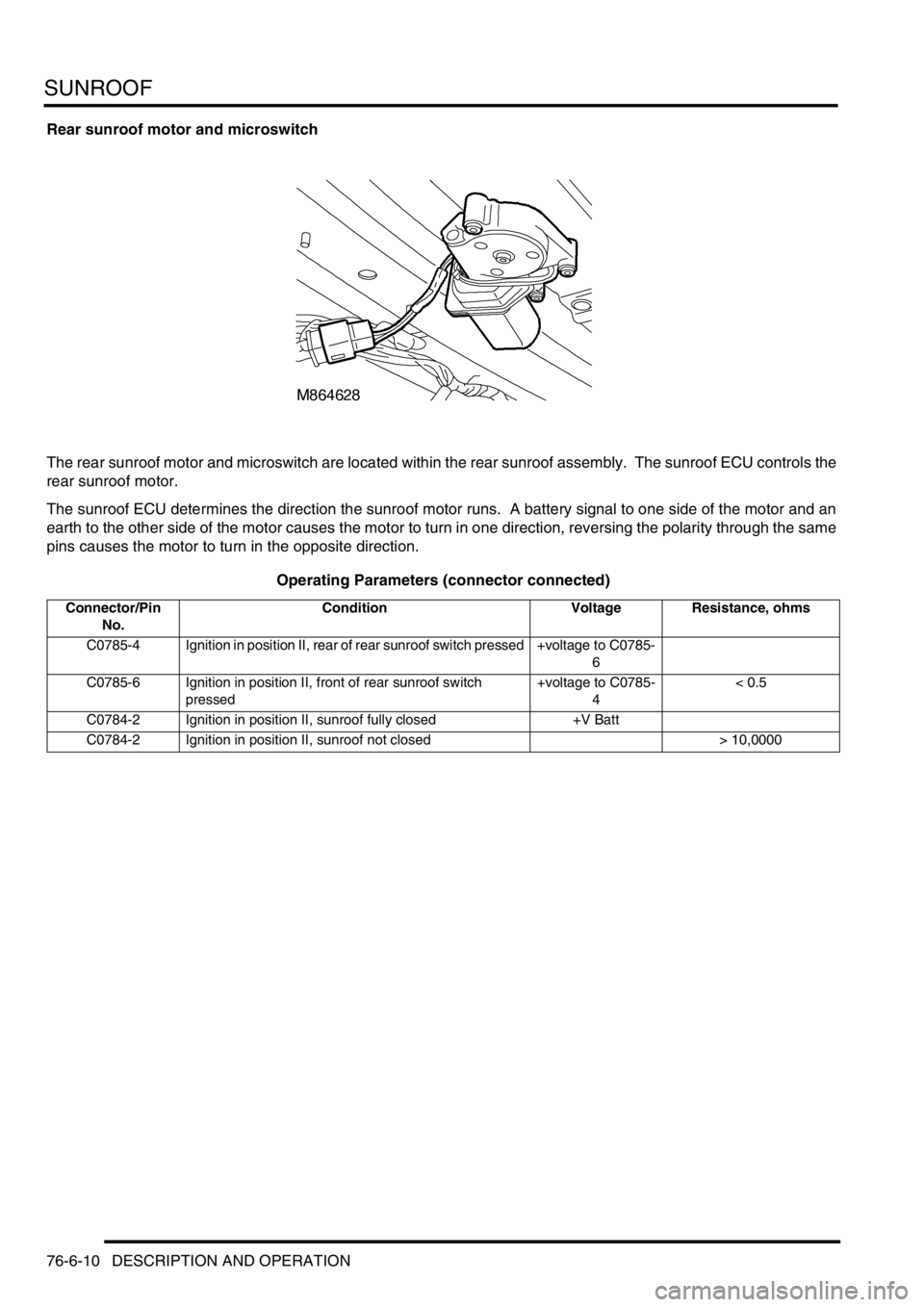
Rear sunroof motor and microswitch
The rear sunroof motor and microswitch are located within the rear sunroof assembly. The sunroof ECU controls the
rear sunroof motor.
The sunroof ECU determines the direction the sunroof motor runs. A battery signal to one side of the motor and an
earth to the other side of the motor causes the motor to turn in one direction, reversing the polarity through the same
pins causes the motor to turn in the opposite direction.
Operating Parameters (connector connected)
Connector/Pin
No.Condition Voltage Resistance, ohms
C0785-4 Ignition in position II, rear of rear sunroof switch pressed +voltage to C0785-
6
C0785-6 Ignition in position II, front of rear sunroof switch
pressed+voltage to C0785-
4< 0.5
C0784-2 Ignition in position II, sunroof fully closed +V Batt
C0784-2 Ignition in position II, sunroof not closed > 10,0000
Page 1226 of 1672
SUNROOF
DESCRIPTION AND OPERATION 76-6-11
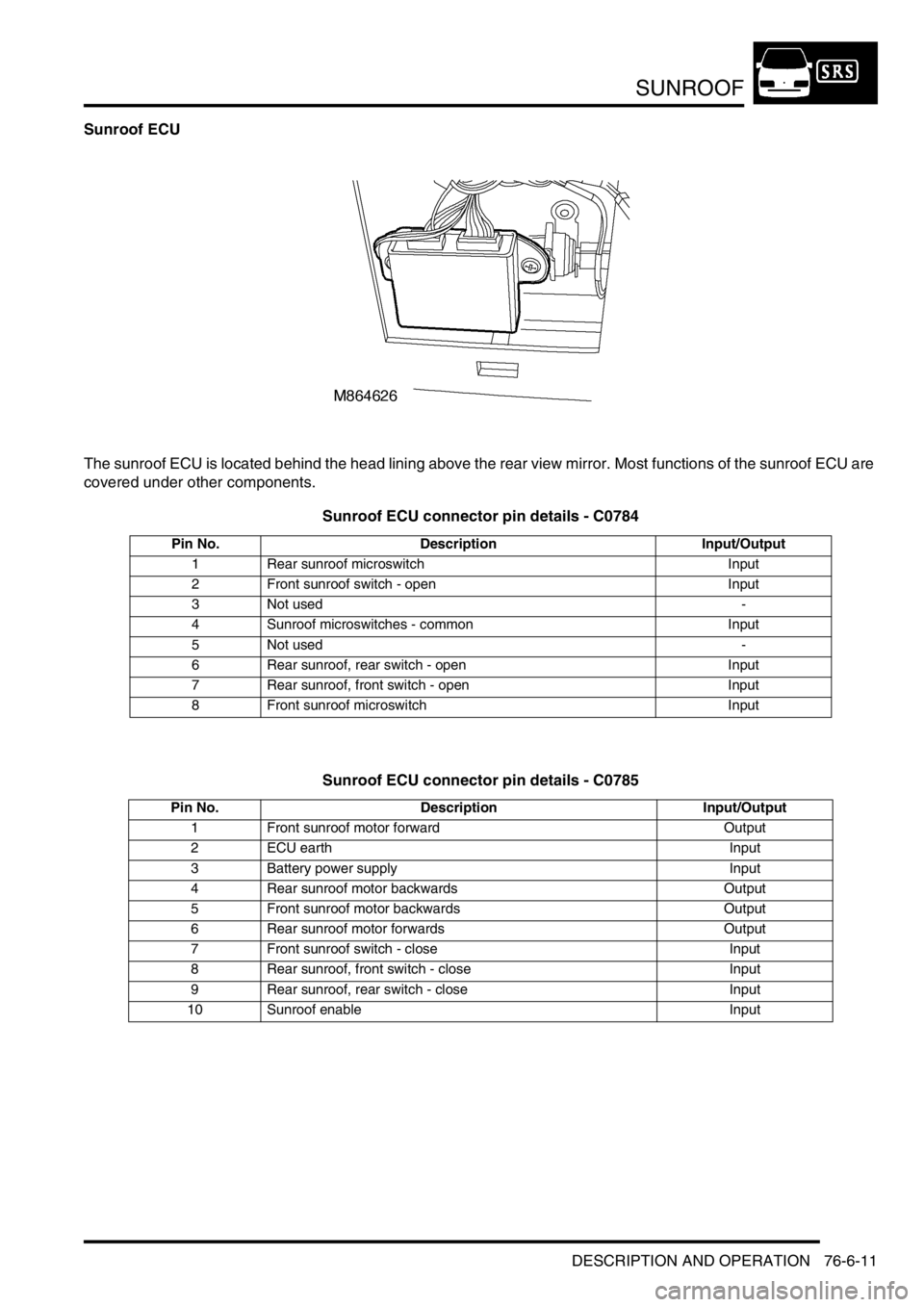
Sunroof ECU
The sunroof ECU is located behind the head lining above the rear view mirror. Most functions of the sunroof ECU are
covered under other components.
Sunroof ECU connector pin details - C0784
Sunroof ECU connector pin details - C0785
Pin No. Description Input/Output
1 Rear sunroof microswitch Input
2 Front sunroof switch - open Input
3 Not used -
4 Sunroof microswitches - common Input
5 Not used -
6 Rear sunroof, rear switch - open Input
7 Rear sunroof, front switch - open Input
8 Front sunroof microswitch Input
Pin No. Description Input/Output
1 Front sunroof motor forward Output
2 ECU earth Input
3 Battery power supply Input
4 Rear sunroof motor backwards Output
5 Front sunroof motor backwards Output
6 Rear sunroof motor forwards Output
7 Front sunroof switch - close Input
8 Rear sunroof, front switch - close Input
9 Rear sunroof, rear switch - close Input
10 Sunroof enable Input
Page 1270 of 1672
PANEL REPAIRS
REPAIRS 77-2-21
REPAIRS
Front bulkhead assembly
Remove
1.Disconnect both battery leads, negative lead
first.
2.Disconnect leads/multiplug from alternator.
3.Remove front wing.
+ EXTERIOR FITTINGS, REPAIRS,
Wing - front - up to 03MY.
4.Remove washer reservoir.
+ WIPERS AND WASHERS, REPAIRS,
Reservoir - washer - up to 03MY.
5. Models with A/C: Remove condensor.
+ AIR CONDITIONING, REPAIRS,
Condenser.
6. Diesel models: Remove gearbox fluid cooler.
7.Remove RH and LH headlamps.
+ LIGHTING, REPAIRS, Headlamp - up
to 03MY.
8.Release headlamp levelling motors and
position aside.
9.Release headlamp wiring and position aside.
10.Remove battery.
+ CHARGING AND STARTING,
REPAIRS, Battery.
11.Remove battery tray.
12.Remove air filter assembly.
+ ENGINE MANAGEMENT SYSTEM -
Td5, REPAIRS, Air filter assembly.
+ ENGINE MANAGEMENT SYSTEM -
V8, REPAIRS, Air cleaner assembly.
13.Remove 2 earth leads from LH of front
bulkhead.
14.Remove RH horn.
+ ALARM SYSTEM AND HORN,
REPAIR, Vehicle horn.
15. Models with A/C: Release and remove A/C
pipes.
16.Remove RH and LH crush cans.
17.Remove bonnet release cable.
18.Support bonnet in open position
19.Remove bonnet locking mechanism.
20.Remove VIN plate.
21.Remove 2 bolts securing front bulkhead
assembly to chassis.
22.Remove centre braces.Repair
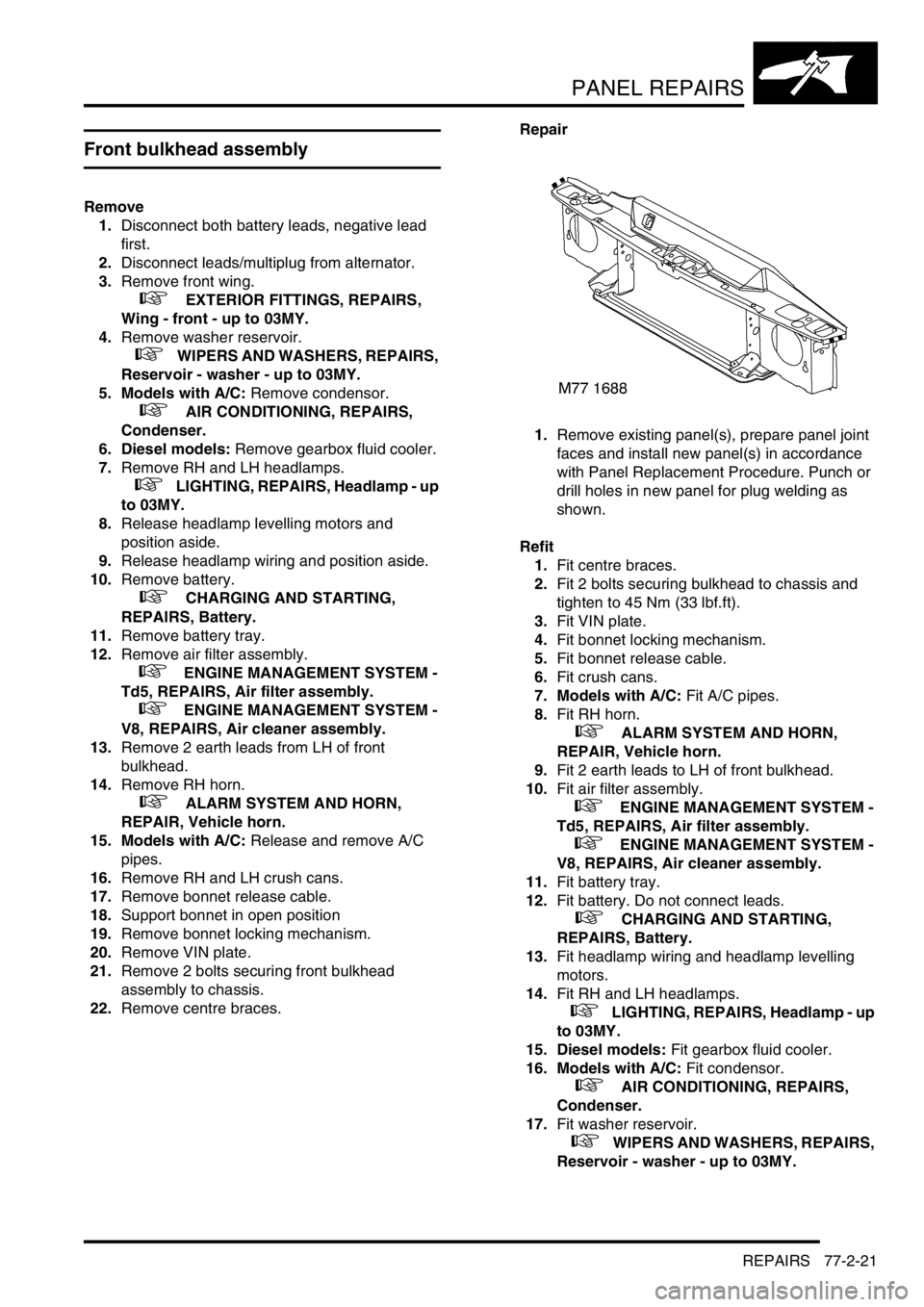
1.Remove existing panel(s), prepare panel joint
faces and install new panel(s) in accordance
with Panel Replacement Procedure. Punch or
drill holes in new panel for plug welding as
shown.
Refit
1.Fit centre braces.
2.Fit 2 bolts securing bulkhead to chassis and
tighten to 45 Nm (33 lbf.ft).
3.Fit VIN plate.
4.Fit bonnet locking mechanism.
5.Fit bonnet release cable.
6.Fit crush cans.
7. Models with A/C: Fit A/C pipes.
8.Fit RH horn.
+ ALARM SYSTEM AND HORN,
REPAIR, Vehicle horn.
9.Fit 2 earth leads to LH of front bulkhead.
10.Fit air filter assembly.
+ ENGINE MANAGEMENT SYSTEM -
Td5, REPAIRS, Air filter assembly.
+ ENGINE MANAGEMENT SYSTEM -
V8, REPAIRS, Air cleaner assembly.
11.Fit battery tray.
12.Fit battery. Do not connect leads.
+ CHARGING AND STARTING,
REPAIRS, Battery.
13.Fit headlamp wiring and headlamp levelling
motors.
14.Fit RH and LH headlamps.
+ LIGHTING, REPAIRS, Headlamp - up
to 03MY.
15. Diesel models: Fit gearbox fluid cooler.
16. Models with A/C: Fit condensor.
+ AIR CONDITIONING, REPAIRS,
Condenser.
17.Fit washer reservoir.
+ WIPERS AND WASHERS, REPAIRS,
Reservoir - washer - up to 03MY.
Page 1275 of 1672
PANEL REPAIRS
77-2-26 REPAIRS
Headlamp mounting panel - LH
Remove
1.Disconnect both battery leads, negative lead
first.
2.Disconnect leads/multiplug from alternator.
3.Remove washer reservoir.
+ WIPERS AND WASHERS, REPAIRS,
Reservoir - washer - up to 03MY.
4. Models with A/C: Remove condensor.
+ AIR CONDITIONING, REPAIRS,
Condenser.
5. Diesel models: Remove gearbox fluid cooler.
6.Remove headlamp.
+ LIGHTING, REPAIRS, Headlamp - up
to 03MY.
7.Remove repeater lamp.
+ LIGHTING, REPAIRS, Lamp - front
repeater.
8.Release headlamp levelling motor and position
aside.
9.Release headlamp wiring and position aside.
10.Remove air filter assembly.
+ ENGINE MANAGEMENT SYSTEM -
Td5, REPAIRS, Air filter assembly.
+ ENGINE MANAGEMENT SYSTEM -
V8, REPAIRS, Air cleaner assembly.
11.Remove 2 earth leads from LH of front
bulkhead.
12.Release and remove A/C pipes.
13.Remove crush can.
14.Remove bonnet release cable.
15.Remove 2 bolts securing front bulkhead
assembly to chassis.
16.Remove centre brace.Repair
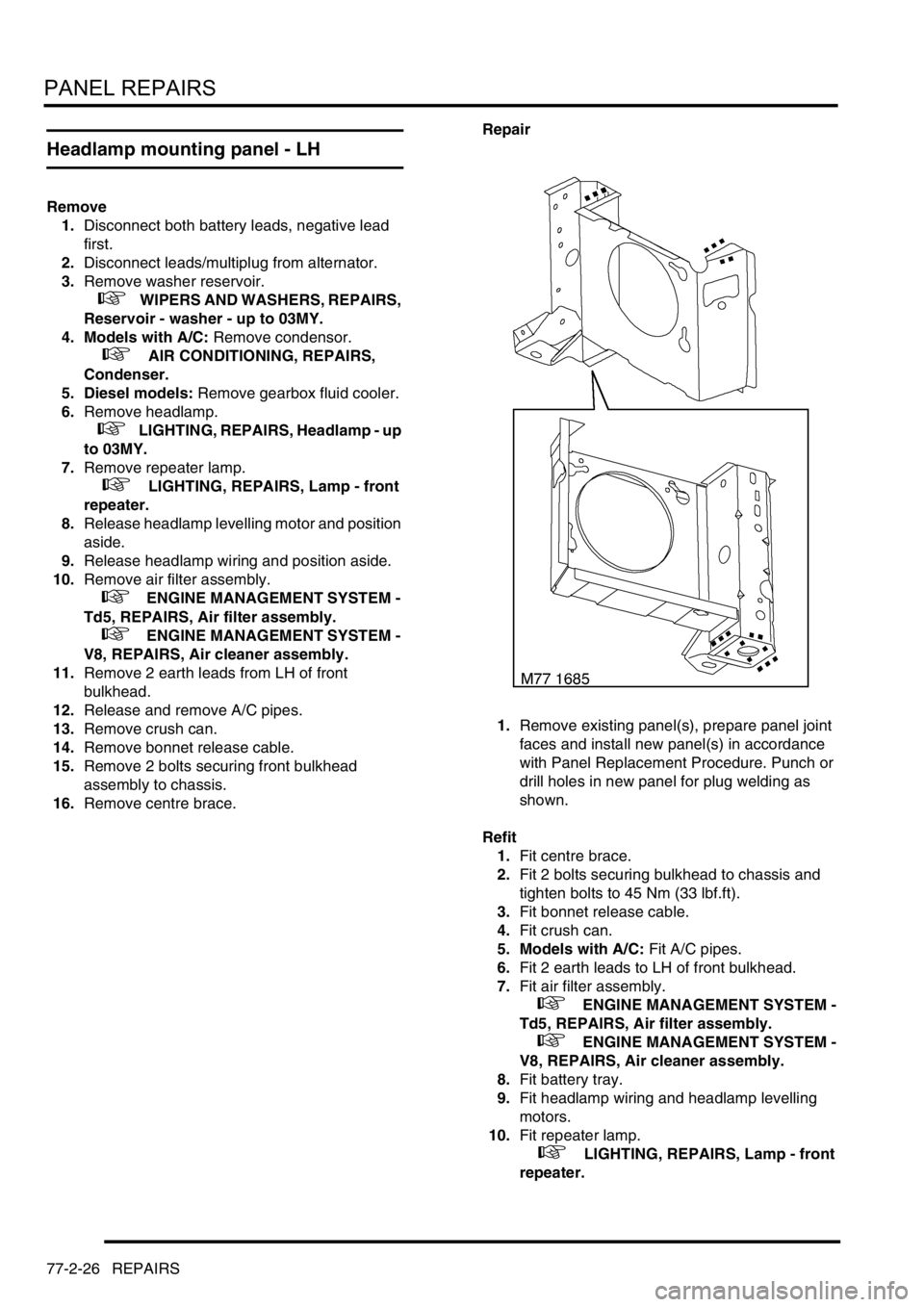
1.Remove existing panel(s), prepare panel joint
faces and install new panel(s) in accordance
with Panel Replacement Procedure. Punch or
drill holes in new panel for plug welding as
shown.
Refit
1.Fit centre brace.
2.Fit 2 bolts securing bulkhead to chassis and
tighten bolts to 45 Nm (33 lbf.ft).
3.Fit bonnet release cable.
4.Fit crush can.
5. Models with A/C: Fit A/C pipes.
6.Fit 2 earth leads to LH of front bulkhead.
7.Fit air filter assembly.
+ ENGINE MANAGEMENT SYSTEM -
Td5, REPAIRS, Air filter assembly.
+ ENGINE MANAGEMENT SYSTEM -
V8, REPAIRS, Air cleaner assembly.
8.Fit battery tray.
9.Fit headlamp wiring and headlamp levelling
motors.
10.Fit repeater lamp.
+ LIGHTING, REPAIRS, Lamp - front
repeater.
Page 1351 of 1672
HEATING AND VENTILATION
80-10DESCRIPTION AND OPERATION
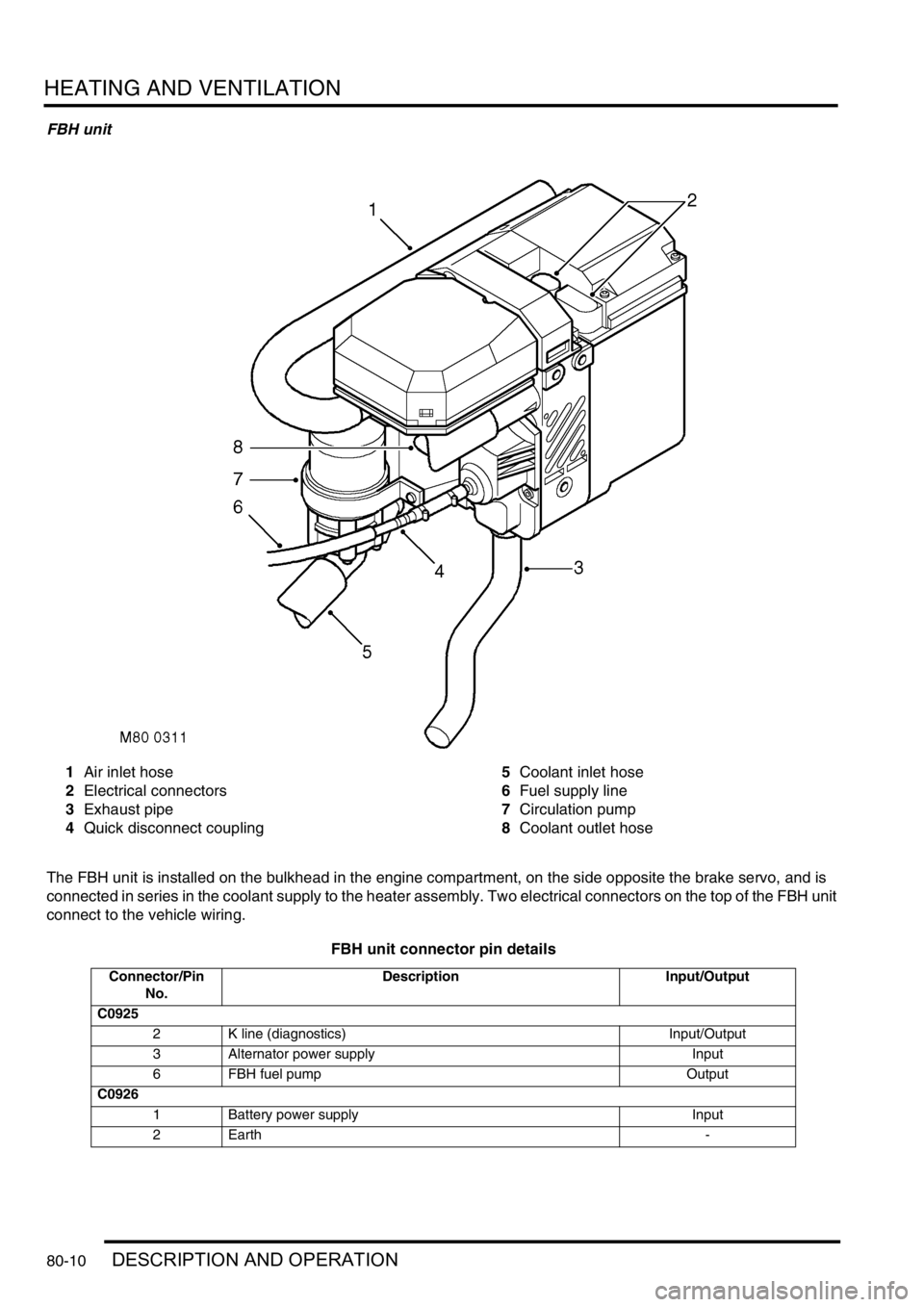
FBH unit
1Air inlet hose
2Electrical connectors
3Exhaust pipe
4Quick disconnect coupling5Coolant inlet hose
6Fuel supply line
7Circulation pump
8Coolant outlet hose
The FBH unit is installed on the bulkhead in the engine compartment, on the side opposite the brake servo, and is
connected in series in the coolant supply to the heater assembly. Two electrical connectors on the top of the FBH unit
connect to the vehicle wiring.
FBH unit connector pin details
Connector/Pin
No.Description Input/Output
C0925
2 K line (diagnostics) Input/Output
3 Alternator power supply Input
6 FBH fuel pump Output
C0926
1 Battery power supply Input
2Earth -
Page 1354 of 1672

HEATING AND VENTILATION
DESCRIPTION AND OPERATION 80-13
Operation
Air distribution
Turning the distribution knob on the control panel turns the control flaps in the heater assembly to direct air to the
corresponding fascia and footwell outlets.
Air temperature
Turning the LH or RH temperature knob on the control panel turns the related blend flaps in the heater assembly. The
blend flaps vary the proportion of air going through the cold air bypass and the heater matrix. The proportion varies,
between full bypass no heat and no bypass full heat, to correspond with the position of the temperature knob.
Blower speed
The blower can be selected off or to run at one of four speeds. While the ignition is on, when the blower switch is set
to positions 1, 2, 3, or 4, ignition power energises the blower relay, which supplies battery power to the blower. At
switch positions 1, 2 and 3, the blower switch also connects the blower to different earth paths through the resistor
pack, to produce corresponding differences of blower operating voltage and speed. At position 4, the blower switch
connects an earth direct to the blower, bypassing the resistor pack, and full battery voltage drives the blower at
maximum speed.
Fresh/Recirculated inlet air
When the recirculated air switch is latched in, the amber indicator LED in the switch illuminates and an earth is
connected to the recirculated air side of the fresh/recirculated air servo motor. The fresh/recirculated air servo motor
then turns the control flaps in the air inlet duct to close the fresh air inlet and open the recirculated air inlets.
When the latch of the recirculated air switch is released, the amber indicator LED in the switch extinguishes and the
earth is switched from the recirculated air side to the fresh air side of the fresh/recirculated air servo motor. The fresh/
recirculated air servo motor then turns the control flaps in the air inlet duct to open the fresh air inlet and close the
recirculated air inlets.
FBH system (where fitted)
The FBH system operates only while the engine is running and the ambient temperature is less than 5
°C (41 °F).
With the engine running and the ambient temperature below 5
°C (41 °F), the air temperature sensor connects the
alternator power supply to the ECU in the FBH unit. On receipt of the alternator power supply, the ECU starts the
circulation pump and, depending on the input from the temperature sensor in the heat exchanger, enters either a
standby or active mode of operation. If the heat exchanger casing temperature is 65
°C (149 °F) or above, the ECU
enters a standby mode of operation. If the heat exchanger casing temperature is below 65
°C (149 °F), the ECU enters
an active mode of operation. In the standby mode, the ECU monitors the heat exchanger casing temperature and
enters the active mode if it drops below 65
°C (149 °F). In the active mode, the ECU initiates a start sequence and
then operates the system at full or part load combustion to provide the required heat input to the coolant.
Start sequence
At the beginning of the start sequence the ECU energises the glow plug function of the glow plug/flame sensor, to
preheat the combustion chamber, and starts the combustion air fan at slow speed. After 30 seconds, the ECU
energises the FBH fuel pump at the starting sequence speed. The fuel delivered by the FBH fuel pump evaporates in
the combustion chamber, mixes with air from the combustion air fan and is ignited by the glow plug/flame sensor. The
ECU then progressively increases the speed of the FBH fuel pump and the combustion air fan to either part or full
load speed, as required by the system. Once full or part load speed is achieved, the ECU switches the glow plug/flame
sensor from the glow plug function to the flame sensing function to monitor combustion. From the beginning of the
start sequence to stable combustion takes approximately 90 seconds for a start to part load combustion and 150
seconds for a start to full load combustion.