2002 LAND ROVER DISCOVERY door lock
[x] Cancel search: door lockPage 118 of 1672

MAINTENANCE
PROCEDURES 10-9
Doors, bonnet and fuel filler flap
Check
1.Check operation of each door, door lock,
bonnet catch and fuel filler flap. Ensure doors
close securely.
Lubricate
1.Lubricate door locks, hinges, check straps,
bonnet catch and fuel filler flap.
+ CAPACITIES, FLUIDS AND
LUBRICANTS, Lubrication.
Air suspension intake filter
Check
1.Check condition of filter and that filter is clean,
replace if necessary.
+ REAR SUSPENSION, REPAIRS,
Filter - intake - SLS.
Anti-freeze
Replace
1.Replace anti-freeze.
+ COOLING SYSTEM - Td5,
ADJUSTMENTS, Drain and refill.
+ COOLING SYSTEM - V8,
ADJUSTMENTS, Drain and refill.
Cooling system
Check
1.Check cooling, intercooler and heating systems
for leaks; hoses and oil pipes for security and
condition.
2.Check accessible hose clips for tightness.
3.Check coolant level, top-up if necessary.
Top-up
1.With engine cold, remove expansion tank filler
cap.
2.Top-up with recommended mixture of coolant
until level reaches mark on expansion tank.
+ CAPACITIES, FLUIDS AND
LUBRICANTS, Anti-Freeze Concentration.
3.Fit expansion tank filler cap.
Page 561 of 1672

FUEL DELIVERY SYSTEM - TD5
19-1-16 REPAIRS
8.Remove 2 trim clips securing RH side trim
casing to body.
9.Remove rear lamp access panel from RH side
trim casing.
10.Remove trim clip securing RH side trim casing
to lower 'E' post.
11. Models with third row seats:Remove bolt
securing lower mounting of RH third row seat
belt to body.
12.Remove RH side trim casing.
13.Pull back loadspace carpet from fuel pump
access panel.
14.Remove 6 screws securing access panel.
15.Remove access panel.
16.Disconnect multiplug and 4 fuel hoses from fuel
pump housing.
CAUTION: Always fit plugs to open
connections to prevent contamination.17.Use LRT-19-009 to remove locking ring from
fuel pump housing.
18.Remove fuel pump housing.
19.Remove and discard sealing ring from fuel
pump housing.
Refit
1.Clean fuel pump housing and mating face on
fuel tank.
2.Fit new seal to mating face on fuel tank.
3.Fit fuel pump housing to fuel tank and use LRT-
19-009 to fit locking ring.
4.Connect multiplug and fuel hoses to fuel pump
housing. Ensure each hose is installed in the
connector with the corresponding colour
code.
5.Fit access panel and secure with screws.
6.Reposition loadspace carpet.
7.Fit RH side trim casing.
8. Models with third row seats:Fit bolt securing
lower mounting of RH third row seat belt to
body and tighten to 50 Nm (37 lbf.ft).
9.Fit trim clip securing RH side trim casing to
lower 'E' post.
10.Fit rear lamp access panel to RH side trim
casing.
11.Fit trim clips securing RH side trim casing to
body.
12.Fit tail door aperture seal.
13. Models with rear ICE controls: Connect
multiplug to remote ICE controls.
14. Models with rear ICE controls: Fit ICE
controls to trim casing and secure with screw.
15.Fit trim clips securing lower edge of 'D' post
trim casing to body.
16. Models with third row seats: Fit RH third row
seat.
+ SEATS, REPAIRS, Seat - third row.
17.Connect battery earth lead.
Page 579 of 1672

FUEL DELIVERY SYSTEM - V8
19-2-14 REPAIRS
8.Remove 2 trim clips securing RH side trim
casing to body.
9.Remove rear lamp access panel from RH side
trim casing.
10.Remove trim clip securing RH side trim casing
to lower 'E' post.
11. Models with third row seats: Remove bolt
securing lower mounting of third row seat belt to
body.
12.Remove RH side trim casing.
13.Pull back loadspace carpet from fuel pump
access panel.
14.Remove 6 screws securing access panel.
15.Remove access panel.
16.Disconnect multiplug and fuel hose from fuel
pump housing.
CAUTION: Always fit plugs to open
connections to prevent contamination.
17. NAS models: Disconnect pressure sensor
pipe from fuel pump housing.
CAUTION: Always fit plugs to open
connections to prevent contamination.18.Use LRT-19-009 to remove locking ring from
fuel pump housing.
19.Remove fuel pump housing.
20.Remove and discard sealing ring from fuel
pump housing.
Refit
1.Clean fuel pump housing and mating face on
fuel tank.
2.Fit new seal to mating face on fuel tank.
3.Fit fuel pump housing to fuel tank and use LRT-
19-009 to fit locking ring.
4.Connect multiplug and fuel hose to fuel pump
housing.
5. NAS models: Connect pressure sensor pipe to
fuel pump housing.
6.Fit access panel and secure with screws.
7.Reposition loadspace carpet.
8.Fit RH side trim casing.
9. Models with third row seats: Fit bolt securing
lower mounting of third row seat belt to body
and tighten to 50 Nm (37 lbf.ft).
10.Fit trim clip securing RH side trim casing to
lower 'E' post.
11.Fit rear lamp access panel to RH side trim
casing.
12.Fit trim clips securing RH side trim casing to
body.
13.Fit tail door aperture seal.
14. Models with rear ICE controls: Connect
multiplug to remote ICE controls.
15. Models with rear ICE controls: Fit ICE
controls to RH side trim casing and secure with
screw.
16.Fit trim clips securing lower edge of RH 'D' post
trim casing to body.
17. Models with third row seats: Fit RH third row
seat.
+ SEATS, REPAIRS, Seat - third row.
18.Connect battery earth lead.
19.Fit battery cover and secure with fixings.
Page 1023 of 1672
REAR SUSPENSION
64-18 DESCRIPTION AND OPERATION
The ECU supplies a 5 V current to each of the height sensors. Each height sensor uses the current to supply an
analogue input to the ECU. The ECU can calculate from the input received from each height sensor the height of the
vehicle and can then power the air supply unit as necessary to raise or lower one or both air springs to level the
vehicle.
When SLS compressor operation is required, the ECU provides a battery supply to energise the SLS relay located in
the engine compartment fusebox. When the relay contacts close, a 12 V supply passes through fusible link 9 in the
engine compartment fusebox, through the relay contacts and operates the air supply unit compressor. The ECU will
then supply power to operate one or both air control valve solenoids and/or the exhaust valve solenoid to inflate or
deflate the air springs as required. The compressor does not need to be powered to deflate the air springs.
The ECU also controls the operation of the SLS audible warning, the SLS warning lamp and the ORM warning lamp.
When the ignition is switched to position II, the ECU performs a three second bulb check and illuminates the SLS and
ORM warning lamps in the instrument pack to check for operation. When the system is operating or a fault is sensed
by the ECU, the ECU will operate the appropriate warning lamp and audible warning as required. The audible warning
is operated by the Body Control Unit (BCU) when it receives a signal from the SLABS ECU. The audible warning is
emitted from a speaker at the rear of the instrument pack.
Depressing the ORM switch for a minimum of 0.5 seconds, completes an earth which the ECU uses as a signal to
initiate the ORM if conditions allow. When the ECU starts ORM, the same earth that was completed by the ORM
switch is pulled to earth by the ECU to activate the ORM warning lamp. The ECU checks for a further operation of the
ORM switch by continuously and very quickly removing the earth for the ORM warning lamp. If the ORM switch is
operated for more than 0.5 seconds, the ECU will detect this and de-activate the ORM.
The SLS part of the SLABS ECU also uses the road speed data generated within the SLABS ECU by the ABS system.
Operation of ORM and extended mode are road speed sensitive and use the ABS signal to monitor the vehicle speed.
When the accessory remote handset is used for the SLS lower and raise functions, the handset transmits RF signals
which are received by the same RF receiver used for the alarm/remote door locking system. The RF receiver passes
this data as a 25 Hz PWM signal to the BCU. The BCU then transmits this data to the SLABS ECU as raise or lower
data. TestBook is required to program the BCU for remote handset operation.
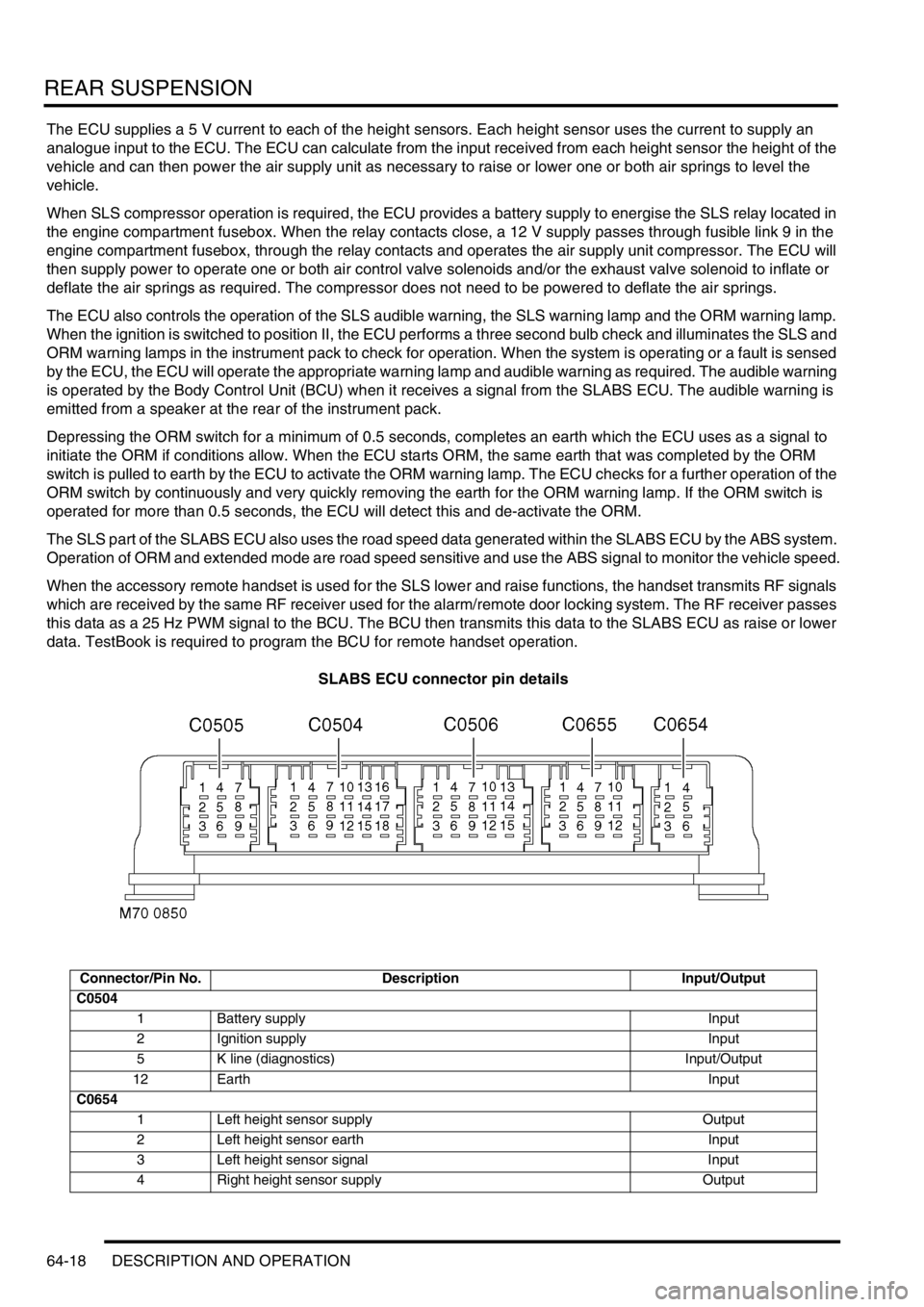
SLABS ECU connector pin details
Connector/Pin No. Description Input/Output
C0504
1 Battery supply Input
2 Ignition supply Input
5 K line (diagnostics) Input/Output
12 EarthInput
C0654
1 Left height sensor supply Output
2 Left height sensor earth Input
3 Left height sensor signal Input
4 Right height sensor supply Output
Page 1026 of 1672

REAR SUSPENSION
DESCRIPTION AND OPERATION 64-21
Normal ride height
When the vehicle is stationary, a door is open and the ignition is off, the SLS system will allow the rear of the vehicle
to lower to within 20 mm of the normal ride height as load is removed from the vehicle. The SLS system will only
operate the compressor to raise the rear of the vehicle when the engine is running, unless requested using the remote
handset.
Off-road mode (ORM)
ORM is used to raise the rear of the vehicle from normal ride height to the ORM ride height of 100 mm between the
tip of the bump stop and the axle.
ORM is activated by depressing the ORM switch located on the fascia for not less than 0.5 seconds. With the engine
running, all doors closed and the vehicle speed below 18 mph (30 km/h), the audible warning will sound once and the
ORM warning lamp in the instrument pack will start to flash when the switch is released. The compressor will be
started and the air control valves will be energised by the ECU to inflate the air springs and raise the rear of the vehicle.
When the full ORM height is reached, the ECU will terminate compressor operation and close the air valves. The ORM
warning lamp will stop flashing and remain continuously illuminated to inform the driver that the SLS system is in ORM.
When ORM is no longer required, depressing the ORM switch for not less than 0.5 seconds with all doors closed will
lower the SLS to normal ride height. The audible warning will sound once and the ORM warning lamp will flash as the
suspension lowers. The ECU energises the air control valves and the exhaust valve to release air pressure from the
air springs. When standard ride height is reached the ORM warning lamp will extinguish and the ECU will de-energise
the air control valves and the exhaust valve solenoids.
If the SLS is in ORM and the vehicle speed exceeds 18 mph (30 km/h), the ECU will lower the SLS to standard ride
height. The driver will be informed of this by an audible warning and the ORM warning lamp flashing as the suspension
lowers. When normal ride height is achieved, the ORM warning lamp will extinguish.
At sea level, the time to change the SLS from normal ride height to ORM or visa versa will take between 15 and 20
seconds.
If the ECU determines that conditions are not correct for SLS operation, i.e.; axle articulation or system fault, the
audible warning will sound three times to inform the driver that the ORM request has not been granted.
Extended mode
The extended mode is automatically operated by the ECU and requires no input from the driver. Extended mode
operates when the chassis is grounded causing the rear wheels to spin. This information is generated by the ABS
function of the SLABS ECU.
When the ECU senses that the chassis is grounded and the vehicle speed is less than 6 mph (10 km/h), the ECU will
operate the compressor and energise the air control valves for 25 seconds to raise the rear of the vehicle. This
operates irrespective of the mode that the SLS system is in at that time. To inform the driver, the ORM warning lamp
will flash continuously at all times that the system is in extended mode.
The driver can exit the extended mode by depressing the ORM switch for not less than 0.5 seconds or by exceeding
8 mph (13 km/h).
Remote handset SLS control
The remote handset is an accessory item which allows the SLS to be operated between normal ride height and bump
stop height to allow easier connection and disconnection of trailers. The remote handset is similar in appearance to
that of the remote door locking handset but does not have an integral key. A circular button with an arrow is used to
raise the SLS and an oval button with the 'Land Rover' logo is used to lower the SLS.
The remote handset control requires all doors to be closed and the ignition to be in position II, but the engine does
not need to be running.
Page 1124 of 1672
DOORS
REPAIRS 76-1-1
DOORS REPAIRS
Door - front
$% 76.28.01.99
Remove
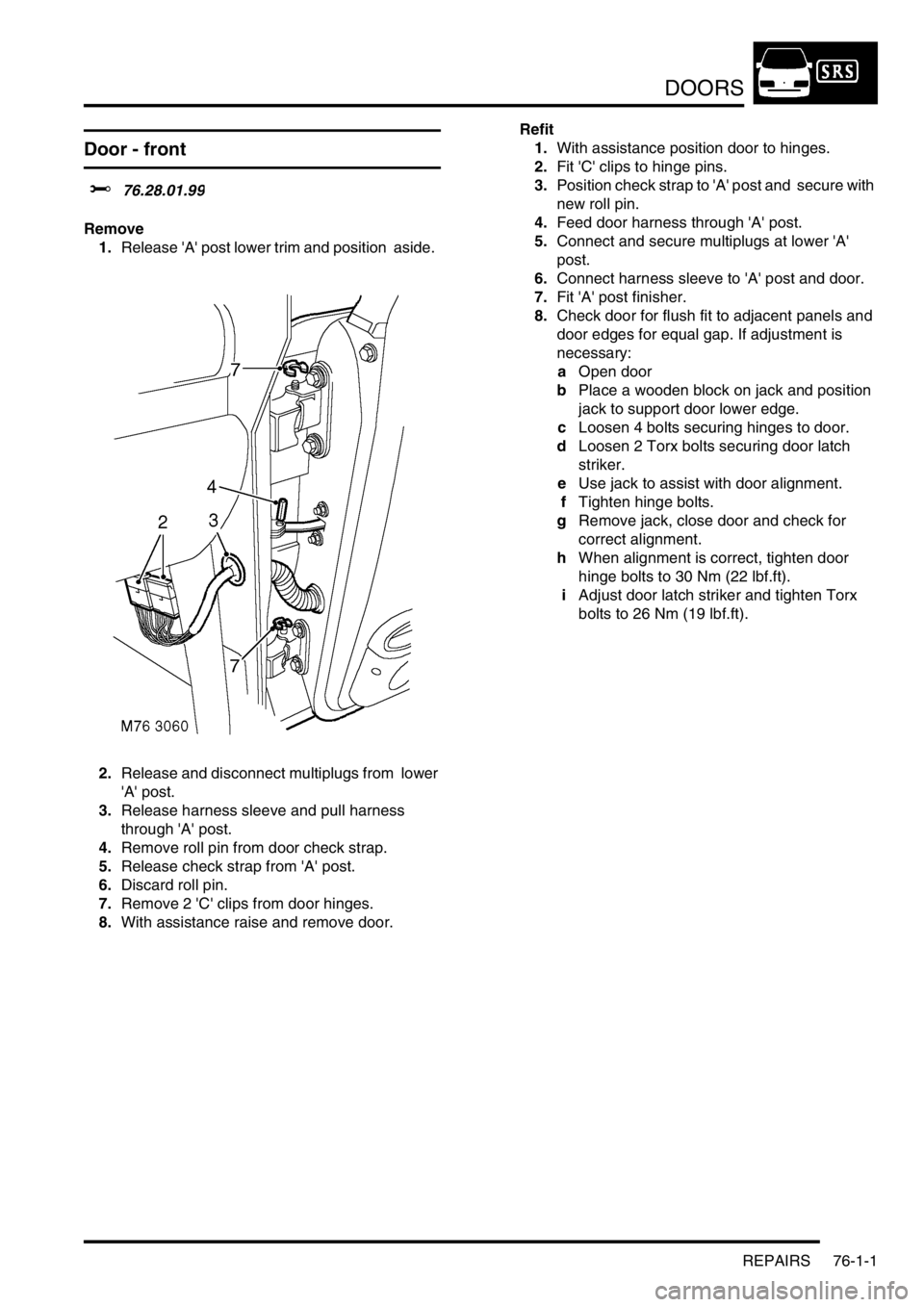
1.Release 'A' post lower trim and position aside.
2.Release and disconnect multiplugs from lower
'A' post.
3.Release harness sleeve and pull harness
through 'A' post.
4.Remove roll pin from door check strap.
5.Release check strap from 'A' post.
6.Discard roll pin.
7.Remove 2 'C' clips from door hinges.
8.With assistance raise and remove door. Refit
1.With assistance position door to hinges.
2.Fit 'C' clips to hinge pins.
3.Position check strap to 'A' post and secure with
new roll pin.
4.Feed door harness through 'A' post.
5.Connect and secure multiplugs at lower 'A'
post.
6.Connect harness sleeve to 'A' post and door.
7.Fit 'A' post finisher.
8.Check door for flush fit to adjacent panels and
door edges for equal gap. If adjustment is
necessary:
aOpen door
bPlace a wooden block on jack and position
jack to support door lower edge.
cLoosen 4 bolts securing hinges to door.
dLoosen 2 Torx bolts securing door latch
striker.
eUse jack to assist with door alignment.
fTighten hinge bolts.
gRemove jack, close door and check for
correct alignment.
hWhen alignment is correct, tighten door
hinge bolts to 30 Nm (22 lbf.ft).
iAdjust door latch striker and tighten Torx
bolts to 26 Nm (19 lbf.ft).
Page 1125 of 1672
DOORS
76-1-2 REPAIRS
Door - rear
$% 76.28.02.99
Remove
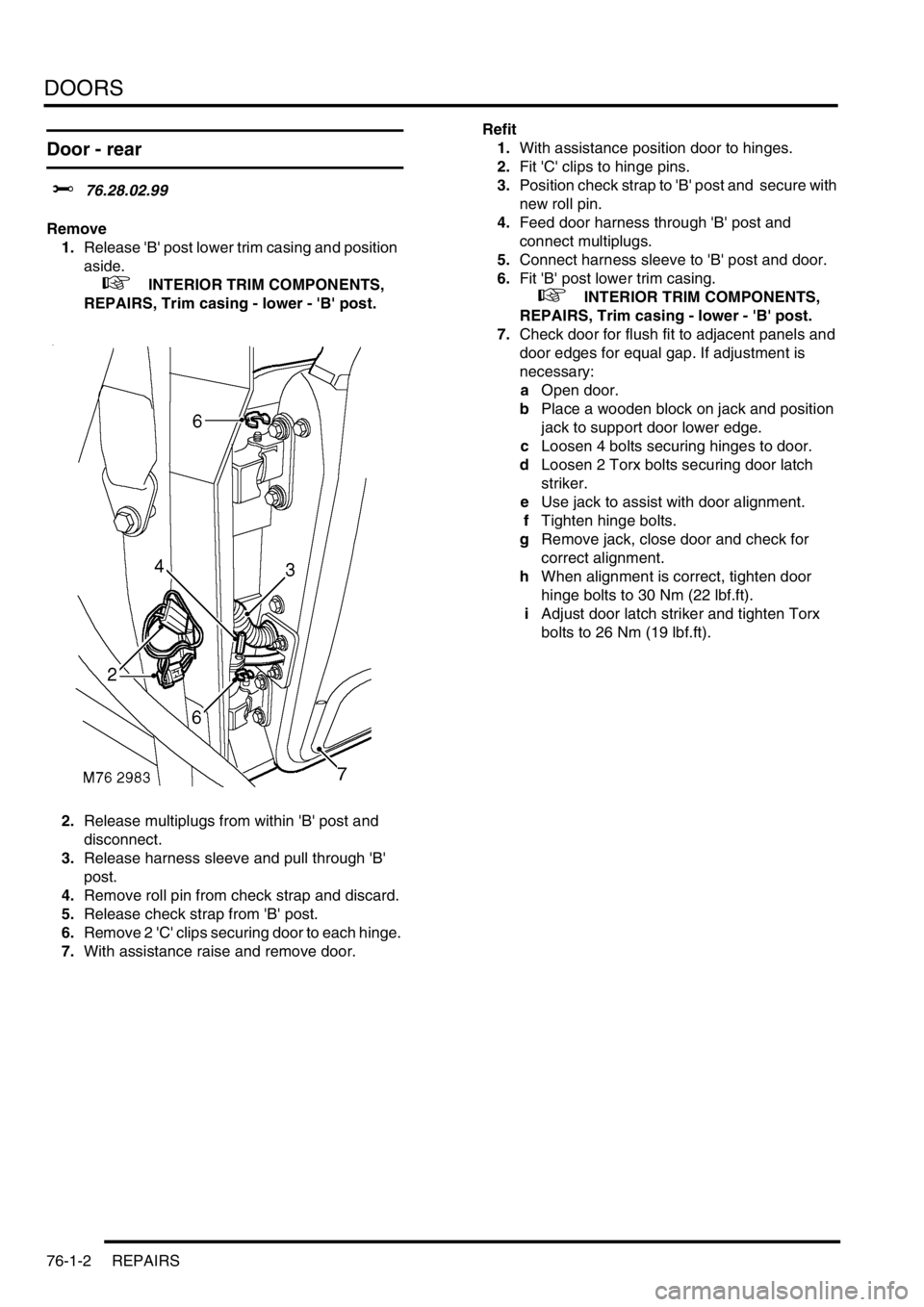
1.Release 'B' post lower trim casing and position
aside.
+ INTERIOR TRIM COMPONENTS,
REPAIRS, Trim casing - lower - 'B' post.
2.Release multiplugs from within 'B' post and
disconnect.
3.Release harness sleeve and pull through 'B'
post.
4.Remove roll pin from check strap and discard.
5.Release check strap from 'B' post.
6.Remove 2 'C' clips securing door to each hinge.
7.With assistance raise and remove door. Refit
1.With assistance position door to hinges.
2.Fit 'C' clips to hinge pins.
3.Position check strap to 'B' post and secure with
new roll pin.
4.Feed door harness through 'B' post and
connect multiplugs.
5.Connect harness sleeve to 'B' post and door.
6.Fit 'B' post lower trim casing.
+ INTERIOR TRIM COMPONENTS,
REPAIRS, Trim casing - lower - 'B' post.
7.Check door for flush fit to adjacent panels and
door edges for equal gap. If adjustment is
necessary:
aOpen door.
bPlace a wooden block on jack and position
jack to support door lower edge.
cLoosen 4 bolts securing hinges to door.
dLoosen 2 Torx bolts securing door latch
striker.
eUse jack to assist with door alignment.
fTighten hinge bolts.
gRemove jack, close door and check for
correct alignment.
hWhen alignment is correct, tighten door
hinge bolts to 30 Nm (22 lbf.ft).
iAdjust door latch striker and tighten Torx
bolts to 26 Nm (19 lbf.ft).
Page 1126 of 1672
DOORS
REPAIRS 76-1-3
Door - tail
$% 76.28.19.99
Remove
1.Remove spare wheel from tail door.
2.Remove tail door trim casing.
+ DOORS, REPAIRS, Trim casing - tail
door.
3.Carefully release water shedder from tail door.
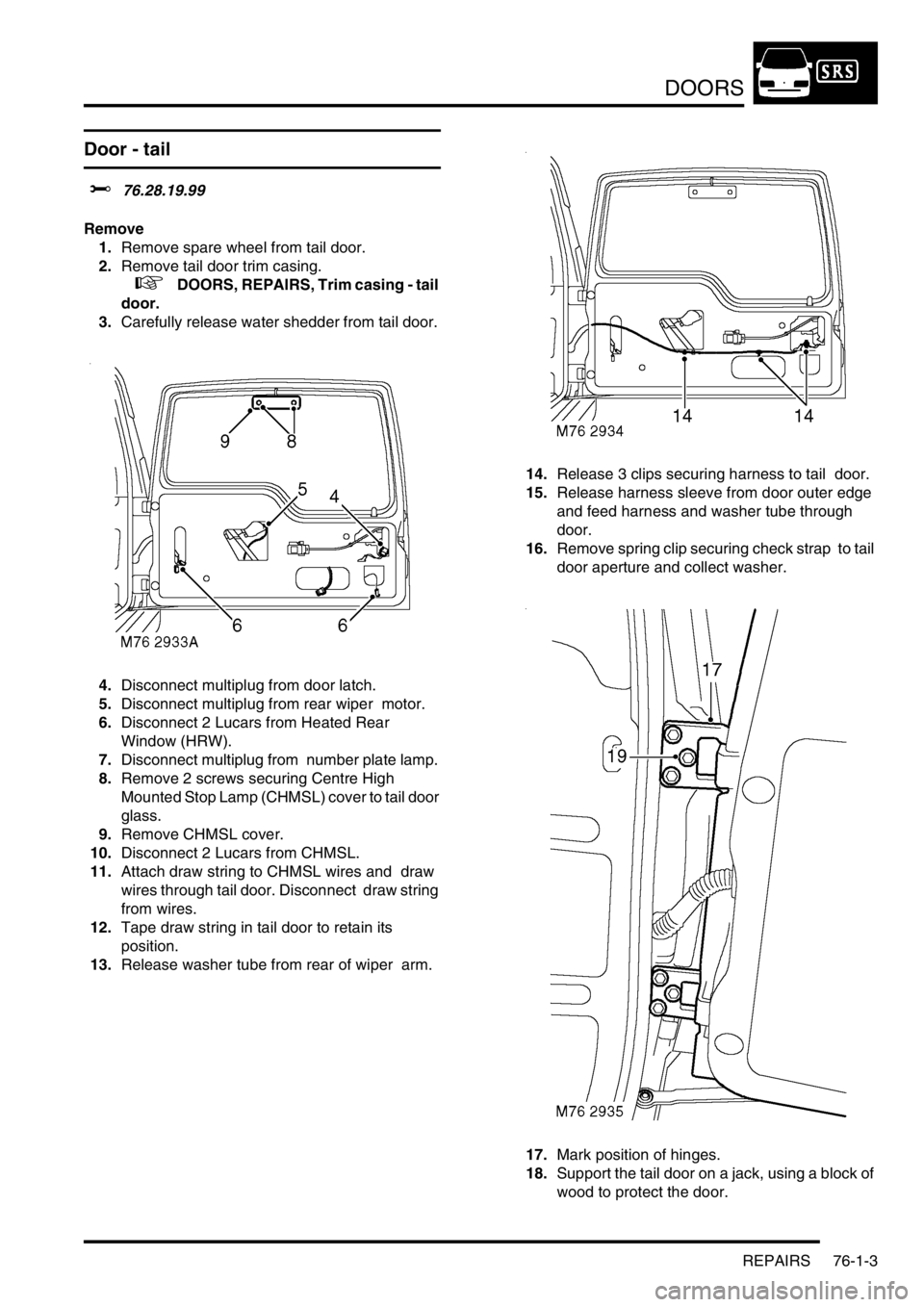
4.Disconnect multiplug from door latch.
5.Disconnect multiplug from rear wiper motor.
6.Disconnect 2 Lucars from Heated Rear
Window (HRW).
7.Disconnect multiplug from number plate lamp.
8.Remove 2 screws securing Centre High
Mounted Stop Lamp (CHMSL) cover to tail door
glass.
9.Remove CHMSL cover.
10.Disconnect 2 Lucars from CHMSL.
11.Attach draw string to CHMSL wires and draw
wires through tail door. Disconnect draw string
from wires.
12.Tape draw string in tail door to retain its
position.
13.Release washer tube from rear of wiper arm. 14.Release 3 clips securing harness to tail door.
15.Release harness sleeve from door outer edge
and feed harness and washer tube through
door.
16.Remove spring clip securing check strap to tail
door aperture and collect washer.
17.Mark position of hinges.
18.Support the tail door on a jack, using a block of
wood to protect the door.