2002 JEEP LIBERTY removal
[x] Cancel search: removalPage 35 of 1803

REMOVAL - LEFT SIDE
(1) Raise and support the vehicle.
(2) Remove the left side tire and wheel assembly.
(3) Remove the upper ball joint nut.
(4) Separate the upper ball joint from the steering
knuckle using tool C-4150A.
(5) Lower the vehicle.
(6) Remove the battery (Refer to 8 - ELECTRI-
CAL/BATTERY SYSTEM/BATTERY - REMOVAL).
(7) Unclip the power center and move it to the side
out of the way.
(8) Remove the battery tray (Refer to 8 - ELEC-
TRICAL/BATTERY SYSTEM/TRAY - REMOVAL).
(9) Disconnect the battery temperature sensor
from the battery tray.
(10) Remove the upper control arm rear bolt by
using a ratchet and extension under the steering
shaft and positioned by the power steering reservoir.
(Fig. 10)
(11) Remove the upper control arm front bolt.
(12) Remove the upper control arm from the vehi-
cle.
INSTALLATION
INSTALLATION - RIGHT SIDE
(1) Install the upper control arm to the vehicle.
(2) Install the upper control arm front bolt.
Tighten the bolt to 122 N´m (90 ft.lbs.).
(3) Install the upper control arm rear bolt. Tighten
the bolt to 122 N´m (90 ft.lbs.).
(4) Install the cruise control servo mounting nuts.(5) Install the air box (Refer to 9 - ENGINE/AIR
INTAKE SYSTEM/AIR CLEANER ELEMENT -
INSTALLATION).
(6) Install the upper ball joint nut. Tighten the nut
to 81 N´m (60 ft.lbs.).
(7) Install the right side tire and wheel assembly.
(Refer to 22 - TIRES/WHEELS/WHEELS - STAN-
DARD PROCEDURE).
(8) Lower the vehicle.
(9) Set the toe and center the steering wheel
(Refer to 2 - SUSPENSION/WHEEL ALIGNMENT -
STANDARD PROCEDURE).
INSTALLATION - LEFT SIDE
(1) Install the upper control arm to the vehicle.
(2) Install the upper control arm front bolt (Fig.
11). Tighten the bolt to 122 N´m (90 ft.lbs.).
(3) Install the upper control arm rear bolt (Fig.
11). Tighten the bolt to 122 N´m (90 ft.lbs.).
(4) Reconnect the battery temperature sensor to
the battery tray.
(5) Install the battery tray (Refer to 8 - ELECTRI-
CAL/BATTERY SYSTEM/TRAY - INSTALLATION).
(6) Install the battery (Refer to 8 - ELECTRICAL/
BATTERY SYSTEM/BATTERY - INSTALLATION).
(7) Reclip and mount the power center.
(8) Install the upper ball joint nut (Fig. 11).
Tighten the nut to 81 N´m (60 ft.lbs.).
(9) Install the left side tire and wheel assembly.
(Refer to 22 - TIRES/WHEELS/WHEELS - STAN-
DARD PROCEDURE).
(10) Lower the vehicle.
(11) Set the toe and center the steering wheel
(Refer to 2 - SUSPENSION/WHEEL ALIGNMENT -
STANDARD PROCEDURE).
Fig. 10 REAR BOLT
1 - STEERING SHAFT
2 - REAR BOLT
3 - RATCHET WITH AN EXTENSION
Fig. 11 UPPER CONTROL ARM
KJFRONT 2 - 15
UPPER CONTROL ARM (Continued)
Page 36 of 1803

REAR
TABLE OF CONTENTS
page page
REAR
DESCRIPTION.........................16
WARNING.............................16
DIAGNOSIS AND TESTING - REAR
SUSPENSION........................17
SPECIFICATIONS
TORQUE CHART......................17
SHOCK
REMOVAL.............................18
INSTALLATION.........................18
SPRING
REMOVAL.............................18
INSTALLATION.........................18
JOUNCE BUMPER
REMOVAL.............................19
INSTALLATION.........................19
STABILIZER BAR
REMOVAL.............................19INSTALLATION.........................19
UPPER BALL JOINT
REMOVAL.............................20
INSTALLATION.........................20
UPPER CONTROL ARM
DESCRIPTION - UPPER SUSPENSION ARM,
BUSHINGS, AND BALL JOINT............20
OPERATION - UPPER SUSPENSION ARM,
BUSHINGS, AND BALL JOINT............20
REMOVAL.............................20
INSTALLATION.........................21
LOWER CONTROL ARM
DESCRIPTION.........................21
OPERATION...........................21
REMOVAL.............................21
INSTALLATION.........................21
REAR
DESCRIPTION
The rear suspension (Fig. 1) is comprised of :
²Drive axle
²Shock absorbers
²Coil springs
²Lower suspension arms
²Upper suspension arm
²Stabilizer bar
CAUTION: Suspension components with rubber/ure-
thane bushings should be tightened with the vehi-
cle at normal ride height. It is important to have the
springs supporting the weight of the vehicle when
the fasteners are torqued. This will maintain vehicle
ride comfort and prevent premature bushing wear.
WARNING
WARNING:: Suspension components with rubber
bushings must be tightened with the vehicle at nor-
mal ride height. It is important to have the springs
supporting the weight of the vehicle when the fas-
teners are torqued. If springs are not at their normal
ride position, vehicle ride comfort will be affected
and cause premature bushing wear.
Fig. 1 REAR SUSPENSION
1 - COIL SPRING
2 - UPPER SUSPENSION ARM
3 - STABILIZER BAR
4 - LOWER SUSPENSION ARM
5 - SHOCK
2 - 16 REARKJ
Page 38 of 1803

SHOCK
REMOVAL
(1) Raise and support the vehicle. Position a
hydraulic jack under the axle to support the axle.
CAUTION: Do not allow the axle to hang from the
upper suspension arm ball joint.
(2) Remove the upper nut and bolt from the frame
bracket (Fig. 2).
(3) Remove the lower nut and bolt from the axle
bracket. Remove the shock absorber.
INSTALLATION
(1) Install the shock absorber in the frame bracket
and install the bolt and nut (Fig. 2).
(2) Install the shock absorber in the axle bracket
and install the bolt and nut (Fig. 2).
(3) Remove the supports and lower the vehicle.
(4) Tighten the upper mounting nuts to 108 N´m
(80 ft. lbs.). Tighten the lower mounting nuts to 115
N´m (85 ft. lbs.).
SPRING
REMOVAL
(1) Raise and support the vehicle. Position a
hydraulic jack under the axle to support the axle.
(2) Remove the shock absorber lower bolt from the
axle bracket.
(3) Lower the hydraulic jack and tilt the axle and
remove the coil spring (Fig. 3).
(4) Remove and inspect the upper and lower
spring isolators (Fig. 3).
INSTALLATION
(1) Install the upper isolator (Fig. 3).
(2) Install the lower isolator (Fig. 3).
(3) Pull down on the axle and position the coil
spring in the lower isolator.
CAUTION: Ensure the spring is positioned on the
lower isolator.
(4) Raise the axle with the hydraulic jack.
(5) Install the shock absorber to the axle bracket
and tighten to 115 N´m (85 ft. lbs.).
(6) Remove the supports and lower the vehicle.
(7) Tighten the stabilizer bar links to 99 N´m (73
ft. lbs.).
Fig. 2 SHOCK ABSORBER
1 - UPPER MOUNTING BOLT
2 - LOWER MOUNTING BOLT
Fig. 3 COIL SPRING
1 - UPPER INSULATOR
2 - JOUNCE BUMPER
3 - COIL SPRING
2 - 18 REARKJ
Page 39 of 1803

JOUNCE BUMPER
REMOVAL
(1) Remove the shock (Refer to 2 - SUSPENSION/
REAR/SHOCK - REMOVAL).
(2) Remove the coil spring (Refer to 2 - SUSPEN-
SION/REAR/SPRING - REMOVAL).
(3) Pull the jounce bumper downwards to remove.
(Fig. 4)
INSTALLATION
(1) Install the jounce bumper into the mount by
twisting the bumper into place (Fig. 4).
(2) Install the coil spring (Refer to 2 - SUSPEN-
SION/REAR/SPRING - INSTALLATION).
(3) Install the shock (Refer to 2 - SUSPENSION/
REAR/SHOCK - INSTALLATION).
STABILIZER BAR
REMOVAL
(1) Raise and support the vehicle.
(2) Remove the stabilizer bar bolts from the lower
suspension arm. (Fig. 5).
(3) Remove the stabilizer bar.
INSTALLATION
(1) Position the stabilizer bar over the axle and
install the bolts to the lower suspension arm (Fig. 6).
Ensure the bar is centered with equal spacing on
both sides. Tighten the bolts to 99 N´m (73 ft. lbs.).
(2) Remove support and lower the vehicle.
Fig. 4 JOUNCE BUMPER
Fig. 5 REAR STABILIZER BAR
1 - MOUNTING HOLES
2 - STABILIZER BAR
Fig. 6 STABILIZER BAR MOUNTS
1 - STABILIZER BAR MOUNTING BOLTS
2 - LOWER SUSPENSION ARM
KJREAR 2 - 19
Page 40 of 1803

UPPER BALL JOINT
REMOVAL
(1) Raise and support the vehicle.
(2) Support the rear axle with a hydraulic jack.
(3) Remove the ball joint pinch bolt from the top of
the axle. (Fig. 7)
(4) Seperate the ball joint arm assembly from the
differential housing by prying upwards.
INSTALLATION
(1)Raise the rear axle with a hydraulic jack to align
the ball joint with the differential housing bracket.
(2) Insert the ball joint into the differential hous-
ing bracket.
(3) Install the ball joint pinch bolt and tighten to
95 N´m (70 ft. lbs.). (Fig. 7).
(4) Remove the supports and lower the vehicle.
UPPER CONTROL ARM
DESCRIPTION - UPPER SUSPENSION ARM,
BUSHINGS, AND BALL JOINT
The suspension arm uses vertical spool bushings to
isolate road noise. The suspension arm is bolted
through bushings to cage nuts in the body and a ball
joint to the top of the differential housing.
OPERATION - UPPER SUSPENSION ARM,
BUSHINGS, AND BALL JOINT
The upper suspension arm provides fore/aft and
lateral location of the rear axle. The suspension arm
travel is limited through the use of jounce bumpers
in compression and shock absorbers in rebound.
REMOVAL
(1) Raise and support the vehicle.
(2) Support the rear axle with a hydraulic jack.
(3) Remove the ball joint pinch bolt from the top of
the differential housing bracket (Fig. 7).
(4) Remove partial nuts from the heat shield in
order to lower the shield down enough to get the
proper clearence to remove the right side bolt from
the body.
(5) Remove the upper suspension arm mounting
bolts from the body and remove the arm (Fig. 8).
(6) Remove the support bracket mounting bolts if
needed. (Fig. 9)
Fig. 7 BALL JOINT PINCH BOLT
1 - UPPER BALL JOINT
2 - PINCH BOLTFig. 8 UPPER CONTROL ARM
1 - BODY MOUNTS
2 - UPPER BALL JOINT
3 - STABILIZER BAR
4 - UPPER CONTROL ARM
5 - LOWER CONTROL ARM
Fig. 9 BALL JOINT BRACKET
1 - UPPER BALL JOINT
2 - SUPPORT BRACKET BOLTS
2 - 20 REARKJ
Page 41 of 1803

INSTALLATION
(1) Position the upper suspension arm in the
frame rail brackets (Fig. 8).
(2) Install the mounting bolts and tighten to 100
N´m (74 ft. lbs.).
(3) Retighten the heat shield back into place.
(4) Pull the arm down on the differential housing
bracket and install the pinch bolt and nut. Tighten
the nut to 95 N´m (70 ft. lbs.) (Fig. 7).
(5) Remove the supports and lower the vehicle.
LOWER CONTROL ARM
DESCRIPTION
The lower suspension arms are stamped steel and
welded and use voided round bushings at the axle
end and solid rubber at the body end of the arm.
OPERATION
The bushings provide isolation from the axle. The
arms mount to the unibody frame rail bracket and
the axle brackets. The arm and bushings provide
location and react to loads.
REMOVAL
(1) Raise the vehicle and support the rear axle.
(2) Remove the stabilizer bar retaining bolts from
the suspension arm.
(3) Remove the lower suspension arm nut and bolt
from the axle bracket (Fig. 10).
NOTE: When removing the right side suspension
arm from the frame rail it will be necessary to pry
the exhaust over slightly to allow enough clearance
to remove the bolt.
(4) Remove the nut and bolt (Fig. 10) from the
frame rail and remove the lower suspension arm.
INSTALLATION
(1) Position the lower suspension arm in the axle
bracket and frame rail bracket.NOTE: The end of the arm with the voided round
bushing attaches to the axle bracket.
(2) Install the axle bracket bolt and nut finger
tight (Fig. 10).
NOTE: When installing the right side suspension
arm to the frame rail it will be necessary to pry the
exhaust over slightly to allow enough clearance to
install the bolt.
(3) Install the frame rail bracket bolt and nut fin-
ger tight.
(4) Install the stabilizer bar retaining bolts to the
suspension arm.
(5) Remove the supports and lower the vehicle.
(6) With the vehicle on the ground tighten the nut
at the frame to 163 N´m (120 ft. lbs.). Tighten the
nut at the axle bracket to 163 N´m (120 ft. lbs.).
Fig. 10 LOWER SUSPENSION ARM
1 - AXLE BRACKET BOLT
2 - LOWER CONTROL ARM
3 - BODY BRACKET BOLT
KJREAR 2 - 21
UPPER CONTROL ARM (Continued)
Page 42 of 1803

SUSPENSION
TABLE OF CONTENTS
page page
FRONT
SPECIAL TOOLS
FRONT SUSPENSION...................1
BUSHINGS
REMOVAL
REMOVAL - LOWER CONTROL ARM
BUSHING............................2
REMOVAL - CLEVIS BRACKET BUSHING....2
REMOVAL - UPPER CONTROL ARM
BUSHINGS...........................3
INSTALLATION
INSTALLATION - LOWER CONTROL ARM
BUSHING............................3
INSTALLATION - CLEVIS BRACKET
BUSHING............................4
INSTALLATION - UPPER CONTROL ARM
BUSHINGS...........................4
LOWER BALL JOINT
REMOVAL.............................5INSTALLATION..........................5
REAR
SPECIAL TOOLS
REAR SUSPENSION....................6
UPPER BALL JOINT
REMOVAL.............................6
INSTALLATION..........................6
BUSHINGS
REMOVAL
REMOVAL - LOWER SUSPENSION ARM
BUSHING............................7
REMOVAL - UPPER SUSPENSION ARM
BUSHING............................7
INSTALLATION
INSTALLATION - LOWER SUSPENSION
ARM BUSHING........................8
INSTALLATION - UPPER SUSPENSION ARM
BUSHING............................8
FRONT
SPECIAL TOOLS
FRONT SUSPENSION
BALL JOINT PRESS - C-4212F
Remover C-4150A
REMOVER / INSTALLER FRONT LOWER BALL
JOINT - 8859
KJSUSPENSION 2s - 1
Page 43 of 1803
BUSHINGS
REMOVAL
REMOVAL - LOWER CONTROL ARM BUSHING
(1) Remove the lower control arm (Refer to 2 -
SUSPENSION/FRONT/LOWER CONTROL ARM -
REMOVAL).
(2) Secure the control arm in a vise.
NOTE: Extreme pressure lubrication must be used
on the threaded portions of the tool. This will
increase the longevity of the tool and insure proper
operation during the removal and installation pro-
cess.
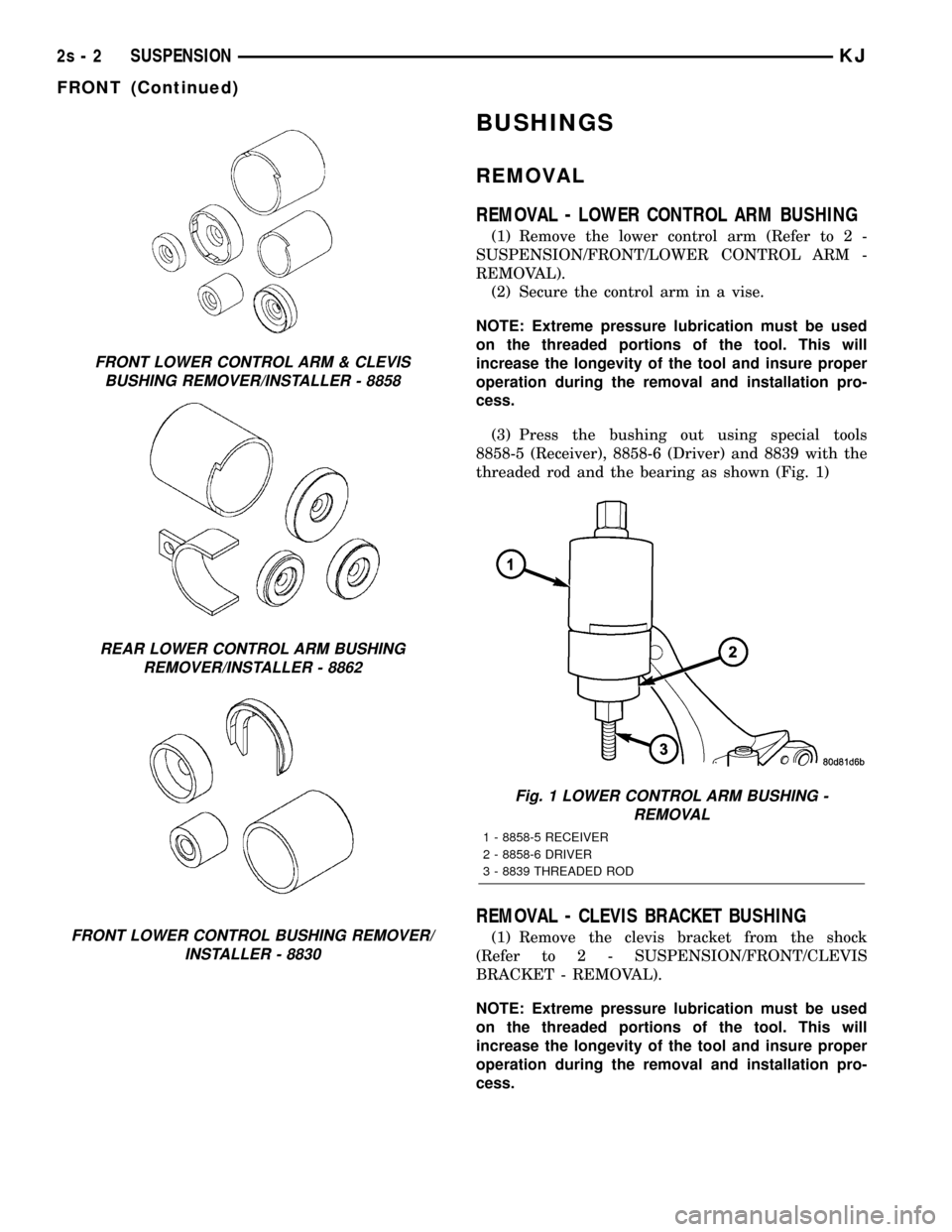
(3) Press the bushing out using special tools
8858-5 (Receiver), 8858-6 (Driver) and 8839 with the
threaded rod and the bearing as shown (Fig. 1)
REMOVAL - CLEVIS BRACKET BUSHING
(1) Remove the clevis bracket from the shock
(Refer to 2 - SUSPENSION/FRONT/CLEVIS
BRACKET - REMOVAL).
NOTE: Extreme pressure lubrication must be used
on the threaded portions of the tool. This will
increase the longevity of the tool and insure proper
operation during the removal and installation pro-
cess.
FRONT LOWER CONTROL ARM & CLEVIS
BUSHING REMOVER/INSTALLER - 8858
REAR LOWER CONTROL ARM BUSHING
REMOVER/INSTALLER - 8862
FRONT LOWER CONTROL BUSHING REMOVER/
INSTALLER - 8830
Fig. 1 LOWER CONTROL ARM BUSHING -
REMOVAL
1 - 8858-5 RECEIVER
2 - 8858-6 DRIVER
3 - 8839 THREADED ROD
2s - 2 SUSPENSIONKJ
FRONT (Continued)