2002 JEEP LIBERTY pan torque
[x] Cancel search: pan torquePage 117 of 1803
PINION SEAL
REMOVAL
(1) Raise and support the vehicle.
(2) Remove wheel and tire assemblies.
(3) Remove rear brake rotors drums.
(4) Mark propeller shaft and pinion yoke for
installation reference.
(5) Remove the propeller shaft from the yoke.
(6) Rotate pinion gear three or four times and ver-
ify that pinion rotates smoothly.
(7) Measure and record torque to rotate the pinion
gear with an inch pound dial-type torque wrench.
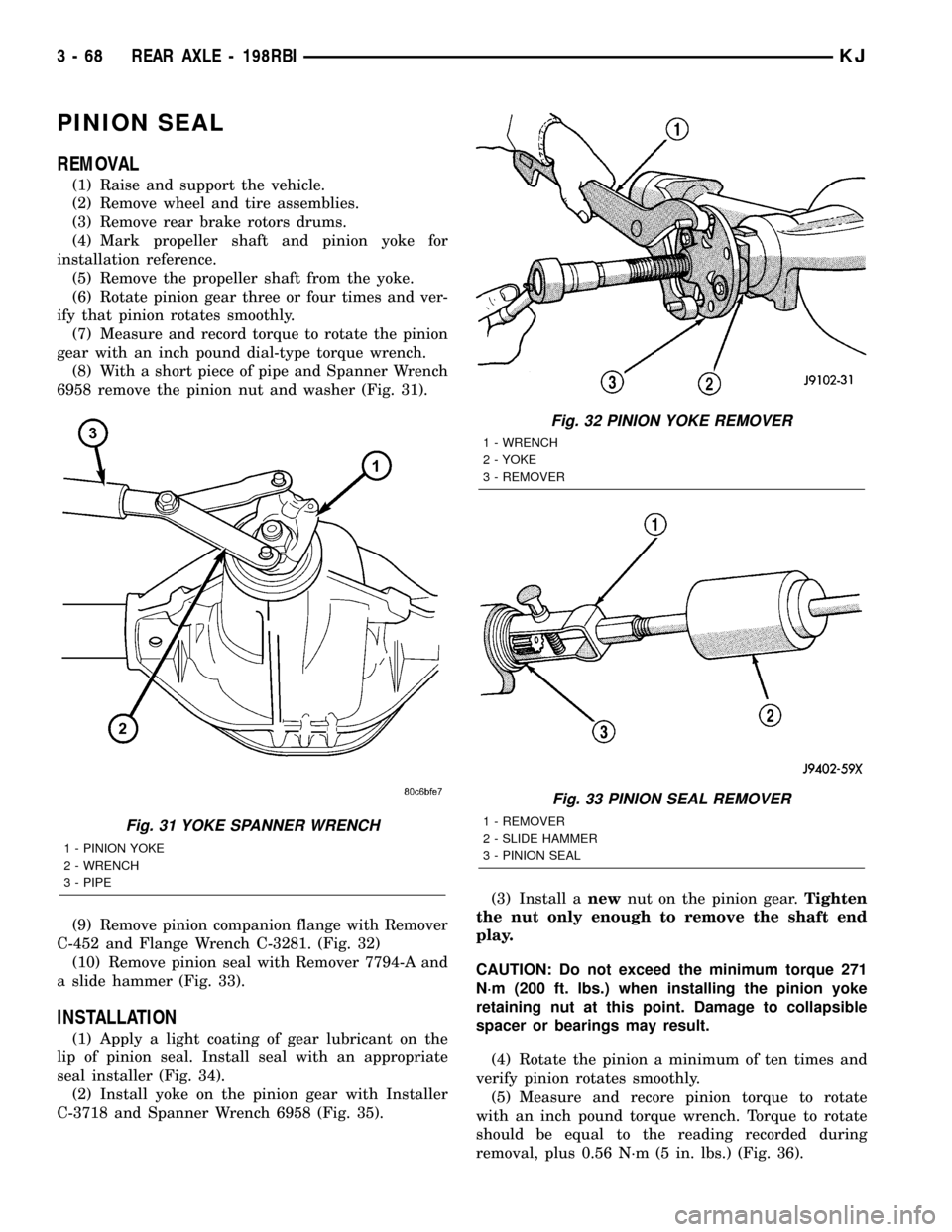
(8) With a short piece of pipe and Spanner Wrench
6958 remove the pinion nut and washer (Fig. 31).
(9) Remove pinion companion flange with Remover
C-452 and Flange Wrench C-3281. (Fig. 32)
(10) Remove pinion seal with Remover 7794-A and
a slide hammer (Fig. 33).
INSTALLATION
(1) Apply a light coating of gear lubricant on the
lip of pinion seal. Install seal with an appropriate
seal installer (Fig. 34).
(2) Install yoke on the pinion gear with Installer
C-3718 and Spanner Wrench 6958 (Fig. 35).(3) Install anewnut on the pinion gear.Tighten
the nut only enough to remove the shaft end
play.
CAUTION: Do not exceed the minimum torque 271
N´m (200 ft. lbs.) when installing the pinion yoke
retaining nut at this point. Damage to collapsible
spacer or bearings may result.
(4) Rotate the pinion a minimum of ten times and
verify pinion rotates smoothly.
(5) Measure and recore pinion torque to rotate
with an inch pound torque wrench. Torque to rotate
should be equal to the reading recorded during
removal, plus 0.56 N´m (5 in. lbs.) (Fig. 36).
Fig. 31 YOKE SPANNER WRENCH
1 - PINION YOKE
2 - WRENCH
3 - PIPE
Fig. 32 PINION YOKE REMOVER
1 - WRENCH
2 - YOKE
3 - REMOVER
Fig. 33 PINION SEAL REMOVER
1 - REMOVER
2 - SLIDE HAMMER
3 - PINION SEAL
3 - 68 REAR AXLE - 198RBIKJ
Page 118 of 1803

(6) If rotating torque is low, hold pinion yoke with
Wrench 6958 (Fig. 37) and tighten pinion shaft nut
in 6.8 N´m (5 ft. lbs.) increments until rotating
torque is achieved.
CAUTION: If maximum tightening torque is reached
prior to reaching the required rotating torque, the
collapsible spacer may have been damaged.
Replace the collapsible spacer.
(7) Align the installation reference marks on the
propeller shaft and pinion yoke and install the pro-
peller shaft.
Fig. 34 PINION SEAL INSTALLATION
1 - HANDLE
2 - INSTALLER
Fig. 35 PINION YOKE INSTALLER
1 - INSTALLER
2 - PINION YOKE
3 - WRENCH
Fig. 36 PINION GEAR ROTATING TORQUE
1 - TORQUE WRENCH
2 - PINION YOKE
Fig. 37 YOKE SPANNER WRENCH
1 - PINION YOKE
2 - WRENCH
3 - PIPE
KJREAR AXLE - 198RBI 3 - 69
PINION SEAL (Continued)
Page 119 of 1803

(8) Fill differential with gear lubricant.
(9) Install the brake drums
(10) Install wheel and tire assemblies.
(11) Lower the vehicle.
COLLAPSIBLE SPACER
REMOVAL
(1) Raise and support the vehicle.
(2) Remove wheel and tire assemblies.
(3) Remove rear brake drums.
(4) Mark the propeller shaft and pinion yoke for
installation reference.
(5) Remove the propeller shaft from the yoke.
(6) Rotate the pinion gear three or four times.
(7) Measure and record torque to rotate the pinion
gear with an inch pound dial-type torque wrench.
(8) Hold pinion yoke with Spanner Wrench 6958
and remove pinion nut and washer.
(9) Remove the pinion yoke with Remover C-452
and Flange Wrench C-3281 (Fig. 38).
(10) Remove pinion shaft seal with a pry tool or a
slide hammer mounted screw.
(11) Remove front pinion bearing using a pair of
pick tools. Pull the bearing straight off the pinion
gear shaft. If the bearing becomes bound on the pin-
ion shaft, lightly tap the end of the pinion gear with
a rawhide/rubber hammer.
(12) Remove the collapsible spacer.
INSTALLATION
(1) Install anewcollapsible preload spacer on pin-
ion shaft.
(2) Install pinion front bearing.(3) Apply a light coating of gear lubricant on the
lip of pinion seal and install anewseal with an
appropriate installer (Fig. 39).
(4) Install yoke with Screw 8112, Cup 8109 and
Spanner Wrench 6958 (Fig. 40).
(5) Install yoke washer andnewnut on the pinion
gear. Tighten the nut to 271 N´m (200 ft. lbs.).
CAUTION: Never loosen pinion gear nut to decrease
pinion gear bearing rotating torque and never
exceed specified preload torque. If preload torque
or rotating torque is exceeded a new collapsible
spacer must be installed.
Fig. 38 PINION YOKE
1 - FLANGE WRENCH
2 - YOKE
3 - REMOVER
Fig. 39 PINION SEAL
1 - HANDLE
2 - INSTALLER
Fig. 40 PINION YOKE INSTALLER
1 - INSTALLER
2 - PINION YOKE
3 - WRENCH
3 - 70 REAR AXLE - 198RBIKJ
PINION SEAL (Continued)
Page 120 of 1803

(6) Using yoke with Spanner Wrench 6958 and a
torque wrench set at 474 N´m (350 ft. lbs.), (Fig. 41)
slowly tighten the nut in 6.8 N´m (5 ft. lbs.) incre-
ments until the rotating torque is achieved. Measure
the rotating torque frequently to avoid over crushing
the collapsible spacer (Fig. 42).
NOTE: If more than 474 N´m (350 ft. lbs.) torque is
required to crush the collapsible spacer, the spacer
is defective and must be replaced.
(7) Check rotating torque with an inch pound
torque wrench (Fig. 42). The rotating torque of the
pinion gear should be, the reading recorded during
removal plus an additional 0.56 N´m (5 in. lbs.).
(8) Install propeller shaft with reference marks
aligned.
(9) Install rear brake drums.
(10) Add gear lubricant, if necessary.
(11) Install wheel and tire assemblies.
(12) Remove supports and lower vehicle.
DIFFERENTIAL
REMOVAL
(1) Raise and support vehicle.
(2) Remove differential cover and drain fluid.
(3) Clean the housing cavity with flushing oil, light
engine oil or lint free cloth.NOTE: Do not use water, steam, kerosene or gaso-
line for cleaning.
(4) Remove axle shafts.
(5)
Note the reference letters stamped on the bearing
caps and housing machined sealing surface (Fig. 43).
Fig. 41 YOKE SPANNER WRENCH
1 - PINION YOKE
2 - WRENCH
3 - PIPE
Fig. 42 PINION ROTATING TORQUE
1 - TORQUE WRENCH
2 - PINION YOKE
Fig. 43 BEARING CAP IDENTIFICATION
1 - REFERENCE LETTERS
2 - REFERENCE LETTERS
KJREAR AXLE - 198RBI 3 - 71
COLLAPSIBLE SPACER (Continued)
Page 133 of 1803

(11) Install the yoke washer and a new nut on the
pinion gear and tighten the pinion nut until there is
zero bearing end-play.
(12) Tighten the nut to 271 N´m (200 ft. lbs.).
CAUTION: Never loosen pinion gear nut to decrease
pinion gear bearing rotating torque and never
exceed specified preload torque. If preload torque
or rotating torque is exceeded a new collapsible
spacer must be installed.
(13) Using Spanner Wrench 6958 and a torque
wrench set at 474 N´m (350 ft. lbs.), (Fig. 81) slowly
tighten the nut in 6.8 N´m (5 ft. lbs.) increments
until the rotating torque is achieved.
CAUTION: Measure torque to rotate frequently to
avoid over crushing the collapsible spacer.
NOTE: If more than 474 N´m (350 ft. lbs.) torque is
required to crush the collapsible spacer, the spacer
is defective and must be replaced.(14) Check pinion torque to rotate with a inch
pound torque wrench (Fig. 82). The pinion torque to
rotate should be:
²Original Bearings: 1 to 2.25 N´m (10 to 20 in.
lbs.).
²New Bearings: 1.69 to 2.82 N´m (15 to 25 in.
lbs.).
Fig. 81 YOKE SPANNER WRENCH
1 - PINION YOKE
2 - WRENCH
3 - PIPE
Fig. 82 PINION GEAR ROTATING TORQUE
1 - TORQUE WRENCH
2 - PINION YOKE
3 - 84 REAR AXLE - 198RBIKJ
PINION GEAR/RING GEAR/TONE RING (Continued)
Page 205 of 1803

CLUTCH
TABLE OF CONTENTS
page page
CLUTCH
DESCRIPTION..........................1
OPERATION............................1
WARNING.............................2
DIAGNOSIS AND TESTING - CLUTCH........2
SPECIFICATIONS - CLUTCH...............5
CLUTCH DISC
REMOVAL.............................6
INSTALLATION..........................6
CLUTCH RELEASE BEARING
REMOVAL.............................6
INSTALLATION..........................6
FLYWHEEL
DESCRIPTION..........................7
OPERATION............................7
DIAGNOSIS AND TESTING - FLYWHEEL......8
PILOT BEARING
REMOVAL.............................8
INSTALLATION..........................8LINKAGE
REMOVAL.............................8
INSTALLATION..........................9
MASTER CYLINDER
INSPECTION...........................9
CLUTCH PEDAL
REMOVAL.............................10
INSTALLATION.........................10
CLUTCH SWITCH OVERRIDE RELAY
DESCRIPTION.........................10
OPERATION...........................10
REMOVAL.............................10
INSTALLATION.........................10
CLUTCH PEDAL POSITION SWITCH
DESCRIPTION.........................11
OPERATION...........................11
DIAGNOSIS AND TESTING - CLUTCH PEDAL
POSITION SWITCH....................11
CLUTCH
DESCRIPTION
The clutch mechanism consists of a flywheel, dry-
type disc, diaphragm style pressure plate and
hydraulic linkage. The flywheel is bolted to the rear
flange of the crankshaft. The clutch pressure plate is
bolted to the flywheel with the clutch disc between
these two components. The clutch system provides
the mechanical, link between the engine and the
transmission. The system is designed to transfer the
torque output of the engine, to the transmission
while isolating the transmission from the engine fir-
ing pulses to minimize concerns such as gear rattle.
OPERATION
The clutch operates with leverage, clamping force
and friction. The disc serves as the friction element,
the diaphragm spring and pressure plate provide the
clamping force. The clutch pedal, hydraulic linkage,
release lever and bearing provide the leverage.
The clutch master cylinder push rod is connected
to the clutch pedal. When the clutch pedal is
depressed, the slave cylinder is operated by the
clutch master cylinder mounted on the dash panel.
The release fork is actuated by the hydraulic slave
cylinder mounted on the transmission housing. The
release bearing is operated by a release fork pivoting
on a ball stud mounted in the transmission housing.
The release bearing then depresses the pressure
plate spring fingers, thereby releasing pressure on
the clutch disc and allowing the engine crankshaft to
spin independently of the transmission input shaft.
KJCLUTCH 6 - 1
Page 214 of 1803

CLUTCH PEDAL
REMOVAL
(1) Remove steering column lower cover and knee
blocker for access.
(2) Disconnect clutch pedal position switch wires.
(3) Disengage captured bushing lock tabs attach-
ing clutch master cylinder actuator to pedal pivot.
(4) Remove nuts attaching pedal and bracket to
dash panel and upper cowl support (Fig. 8).
(5) Separate pedal assemble from vehicle.
INSTALLATION
(1) Place clutch pedal and bracket over studs on
dash panel and cowl support.
(2) Install nuts to attach pedal and bracket to
dash panel and upper cowl support. Tighten nuts to
39 N´m (29 ft. lbs.) torque
(3) Engage captured bushing and actuator on
brake pedal pivot.
(4) Connect clutch pedal position switch wires.
CLUTCH SWITCH OVERRIDE
RELAY
DESCRIPTION
The clutch pedal position switch override relay is
located in the Power Distribution Center (PDC).
Refer to PDC cover label for location within PDC.
OPERATION
Refer to Clutch Pedal Position Switch Operation
for information.
REMOVAL
The Clutch Switch Override Relay is located in the
Power Distribution Center (PDC) (Fig. 9). Refer to
label on PDC cover for relay location.
(1) Remove PDC cover.
(2) Remove relay from PDC.
(3) Check condition of relay terminals and PDC
connector terminals for damage or corrosion. Repair
if necessary before installing relay.
(4) Check for pin height (pin height should be the
same for all terminals within the PDC connector).
Repair if necessary before installing relay.
INSTALLATION
The Clutch Switch Override Relay is located in the
Power Distribution Center (PDC). Refer to label on
PDC cover for relay location.
(1) Install relay to PDC.
(2) Install cover to PDC.
Fig. 8 CLUTCH PEDAL
1 - CYLINDER
2 - ACTUATOR SHAFT
3 - ACTUATOR EYE
4 - PEDAL PIN
5 - CONNECTOR
Fig. 9 POWER DISTRIBUTION CENTER (PDC)
1 - BATTERY
2 - PDC
3 - PDC COVER
6 - 10 CLUTCHKJ
Page 236 of 1803

INSTALLATION
(1) Apply thread sealant to sensor threads.
(2) Install sensor to engine.
(3) Tighten sensor to 11 N´m (8 ft. lbs.) torque.
(4) Replace any lost engine coolant.
ENGINE COOLANT
THERMOSTAT
DESCRIPTION - 3.7L ENGINE
CAUTION: Do not operate an engine without a ther-
mostat, except for servicing or testing.
A pellet-type thermostat controls the operating
temperature of the engine by controlling the amount
of coolant flow to the radiator. On all engines the
thermostat is closed below 195ÉF (90ÉC). Above this
temperature, coolant is allowed to flow to the radia-
tor. This provides quick engine warm up and overall
temperature control. On the 3.7L engine the thermo-
stat is designed to block the flow of the coolant
bypass journal by 50% instead of completely blocking
the flow. This design controls coolant temperature
more accurately (Fig. 3).
The same thermostat is used for winter and sum-
mer seasons. An engine should not be operated with-
out a thermostat, except for servicing or testing.
Operating without a thermostat causes other prob-
lems. These are: longer engine warmup time, unreli-
able warmup performance, increased exhaust
emissions and crankcase condensation. This conden-
sation can result in sludge formation.
OPERATION
The wax pellet is located in a sealed container at
the spring end of the thermostat. When heated, the
pellet expands, overcoming closing spring tension
and water pump pressure to force the valve to open.
DIAGNOSIS AND TESTING - THERMOSTAT
ON-BOARD DIAGNOSTICS
All models are equipped with On-Board Diagnos-
tics for certain cooling system components.If the pow-
ertrain control module (PCM) detects low engine
coolant temperature, it will record a Diagnostic Trou-
ble Code (DTC). For other DTC numbers, (Refer to 25
- EMISSIONS CONTROL - DESCRIPTION).
The DTC can also be accessed through the DRB
scan tool.
REMOVAL - 3.7L ENGINE
WARNING: DO NOT LOOSEN RADIATOR DRAIN-
COCK WITH SYSTEM HOT AND PRESSURIZED.
SERIOUS BURNS FROM COOLANT CAN OCCUR.
Do not waste reusable coolant. If solution is clean,
drain coolant into a clean container for reuse.
If thermostat is being replaced, be sure that
replacement is specified thermostat for vehicle model
and engine type.
(1) Disconnect negative battery cable at battery.
(2) Drain cooling system (Refer to 7 - COOLING -
STANDARD PROCEDURE).
(3) Raise vehicle on hoist.
(4) Remove splash shield.
(5) Remove lower radiator hose clamp and lower
radiator hose at thermostat housing.
(6) Remove thermostat housing mounting bolts,
thermostat housing and thermostat (Fig. 4).
Fig. 3 Thermostat
1 - FROM HEATER
2 - FROM RADIATOR
3 - TO WATER PUMP
4 - ENGINE BYPASS
5 - THERMOSTAT
KJENGINE 7 - 21
ENGINE COOLANT TEMPERATURE SENSOR (Continued)